Yoga Exercises for Women: 15 Poses to Strengthen and Tone
Yoga exercises are mind-body practices combining physical poses, breathing techniques, and meditation to build strength, flexibility, and balance. The most effective poses for women include Downward Dog, Warrior II, Plank, and Bridge Pose, targeting core stability, lean muscle development, and functional strength for sustainable fitness results.
You've probably heard that yoga exercises can transform your body, but you might wonder if flowing through poses can actually build the strength and muscle tone you're working toward. The answer is a resounding yes. Yoga isn't just about flexibility and relaxation—it's a powerful strength-building practice that challenges your muscles through bodyweight resistance, improves functional movement patterns, and develops the mind-muscle connection essential for any fitness goal.
Whether you're new to fitness or looking to complement your strength training routine, yoga offers a unique approach to building lean muscle, improving posture, and developing core stability. Unlike traditional weightlifting, yoga exercises engage multiple muscle groups simultaneously while emphasizing proper alignment and controlled movement. This comprehensive approach makes yoga an excellent addition to any women's fitness program, especially when you understand which poses deliver the most significant strength and toning benefits.
In this guide, we'll explore 15 yoga exercises specifically chosen for their ability to strengthen and tone your entire body. You'll learn proper form, discover modifications for different fitness levels, and understand how to incorporate these poses into your existing routine for maximum results.
Key Takeaways
- Yoga builds functional strength through bodyweight resistance and isometric holds that engage multiple muscle groups simultaneously
- The 15 poses covered target your entire body—from core and glutes to arms and legs—for balanced muscle development
- Proper form and breathing technique are essential for maximizing strength gains and preventing injury
- Beginners can modify poses with props while advanced practitioners can increase intensity through longer holds and variations
- Consistent practice 3-4 times weekly produces visible toning results within 4-6 weeks when combined with proper nutrition
Understanding How Yoga Exercises Build Strength
Many women underestimate yoga's capacity to build genuine strength because they associate it primarily with stretching and relaxation. Yoga exercises create muscle tension through isometric contractions and eccentric loading, which are proven methods for developing lean muscle mass and improving muscular endurance. When you hold a Plank pose for 60 seconds, your core muscles work just as hard as they would during weighted exercises—the resistance comes from supporting your own bodyweight against gravity.
The Science Behind Bodyweight Resistance Training
Bodyweight exercises like yoga poses trigger muscle protein synthesis, the biological process that repairs and builds muscle tissue. When you flow through a Vinyasa sequence or hold a challenging balance pose, you create microscopic tears in muscle fibers. Your body responds by repairing these fibers stronger and more resilient than before, leading to increased muscle tone and definition over time.
Research on bodyweight training demonstrates that exercises requiring you to stabilize and control your body position activate more muscle fibers than isolated movements. This full-body engagement is why yoga practitioners often develop balanced, functional strength that translates to everyday activities and other fitness pursuits.
Progressive Overload in Yoga Practice
The principle of progressive overload—gradually increasing the challenge to your muscles—applies to yoga just as it does to weight training. You can progress in yoga by:
- Holding poses for longer durations to increase time under tension
- Moving into more advanced variations that require greater strength and balance
- Reducing rest periods between poses to maintain continuous muscle engagement
- Adding dynamic movements like Chaturanga push-ups to static holds
- Practicing more challenging sequences that combine multiple strength-building poses
This progressive approach ensures your muscles continue adapting and growing stronger rather than plateauing after initial gains.
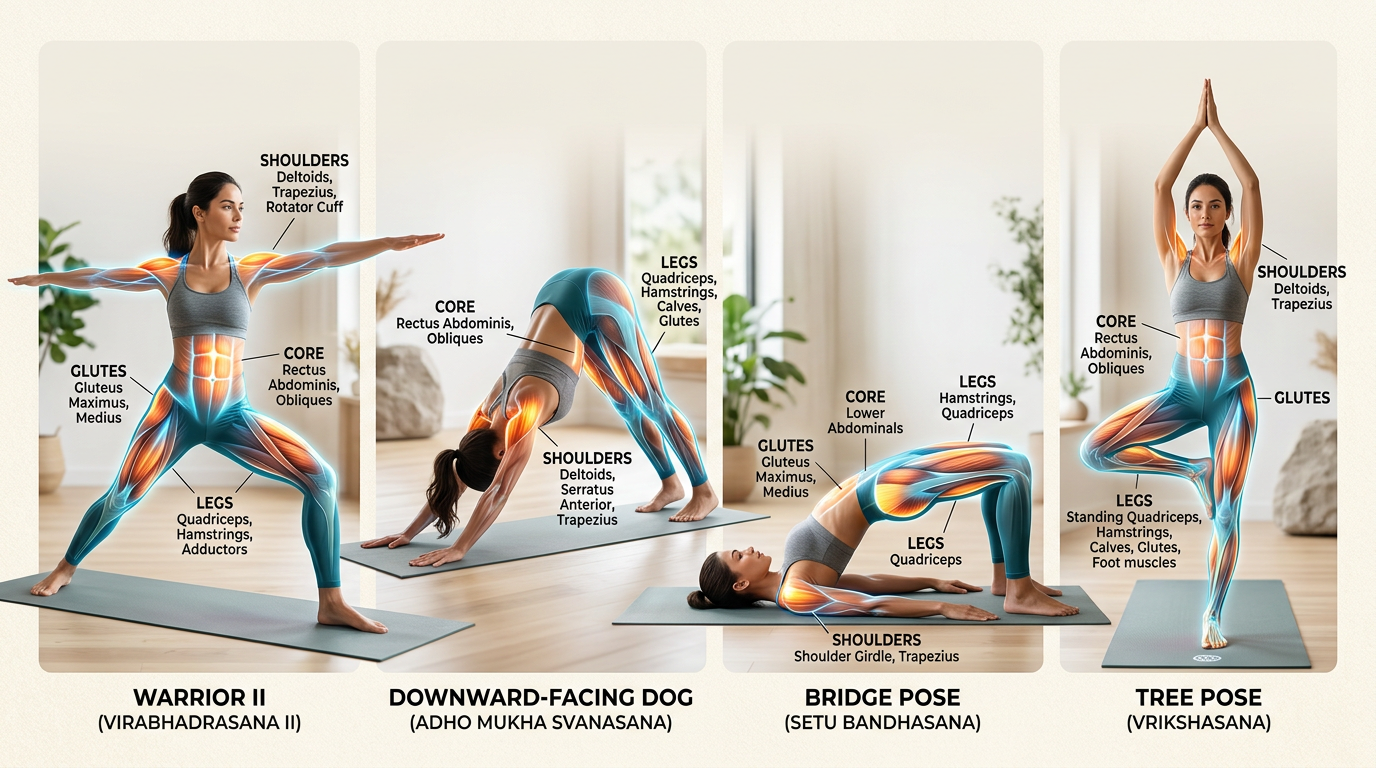
Infographic showing muscle groups activated during common yoga poses with anatomical overlay highlighting core, glutes, shoulders, and legs
Essential Yoga Exercises for Core Strength
Your core encompasses far more than just your abdominal muscles—it includes your entire torso, from your pelvic floor to your diaphragm, including deep stabilizers that support your spine. Building core strength through yoga improves posture, reduces lower back pain, and creates the foundation for all other strength-building movements. These poses target your core from multiple angles for comprehensive development.
1. Plank Pose (Phalakasana)
The Plank is one of the best yoga exercises for developing total-body strength with special emphasis on core stability. This foundational pose teaches you to maintain a neutral spine while resisting gravity, engaging your transverse abdominis (your deepest core muscle), rectus abdominis, obliques, and back extensors simultaneously.
To perform Plank correctly, start on your hands and knees, then step your feet back until your body forms a straight line from head to heels. Your hands should be directly under your shoulders, fingers spread wide. Engage your core by drawing your navel toward your spine, squeeze your glutes, and press your heels back. Keep your neck neutral by looking at the floor about six inches in front of your hands.
Begin with 20-30 second holds and gradually work up to 60-90 seconds. For a modification, drop to your forearms or knees while maintaining that straight-line body position.
2. Boat Pose (Navasana)
Boat Pose specifically targets your rectus abdominis and hip flexors while challenging your balance and building mental focus. This V-shaped pose requires you to balance on your sit bones while holding your legs and torso off the ground, creating intense engagement through your entire core.
Sit on the floor with your knees bent and feet flat. Lean back slightly while lifting your feet off the ground, shins parallel to the floor. Extend your arms forward, parallel to the ground. Once stable, work toward straightening your legs to form a V-shape with your body. Keep your chest lifted and shoulders back—avoid rounding your spine.
Hold for 15-30 seconds, rest, and repeat for 3-5 rounds. If the full expression is too challenging, keep your knees bent or lightly hold the backs of your thighs for support.
3. Side Plank (Vasisthasana)
Side Plank works your obliques, lateral hip stabilizers, and shoulders while improving balance. This unilateral exercise helps correct muscle imbalances and builds the lateral core strength essential for rotational movements and spinal stability.
From Plank position, shift your weight onto your right hand and the outer edge of your right foot, stacking your left foot on top. Lift your hips high and extend your left arm toward the ceiling. Your body should form a straight line from head to feet. Engage your core and press firmly through your bottom hand and foot.
Hold for 20-45 seconds per side. Modify by dropping your bottom knee to the floor or placing your top foot on the floor in front of the bottom foot for added stability.
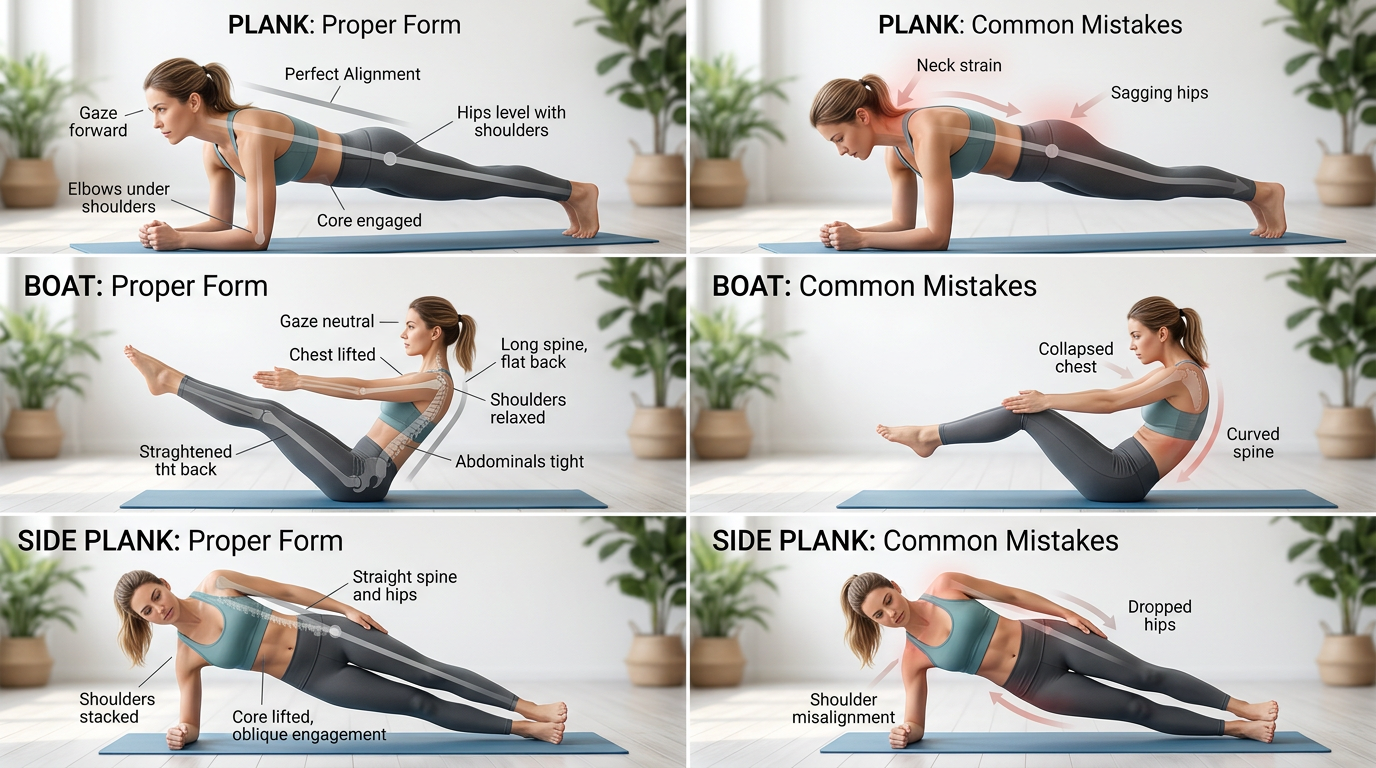
Step-by-step demonstration of proper Plank, Boat, and Side Plank form showing alignment cues and common mistakes to avoid
Best Yoga Exercises for Lower Body Strength
Your legs and glutes contain the largest muscle groups in your body, and strengthening them through yoga exercises improves metabolism, athletic performance, and daily function. These standing poses build lower body strength while improving balance, joint stability, and muscular endurance. The constant engagement required to maintain these positions creates significant time under tension for muscle development.
4. Warrior II (Virabhadrasana II)
Warrior II is among the most effective yoga exercises for building quadriceps, glute, and hip strength while opening the hips and chest. The sustained hold in this pose challenges your legs intensely while teaching proper knee alignment and hip stability.
Stand with feet about 3-4 feet apart. Turn your right foot out 90 degrees and your left foot slightly inward. Bend your right knee until it's directly over your ankle, creating a 90-degree angle. Keep your left leg straight and strong. Extend your arms out to the sides at shoulder height, gaze over your right fingertips. Your hips should face the long edge of your mat, not turning toward your front leg.
Hold for 30-60 seconds per side, focusing on keeping your front knee tracking over your ankle and your back leg actively engaged. Feel the burn in your front thigh—that's your muscles working hard.
5. Chair Pose (Utkatasana)
Chair Pose mimics a squat position, making it one of the best yoga exercises for strengthening your glutes, quadriceps, and calves. This pose also engages your core and back muscles as you maintain an upright torso position.
Stand with feet hip-width apart. Bend your knees and shift your hips back as if sitting in a chair, keeping your weight in your heels. Raise your arms overhead alongside your ears. Your thighs should be as parallel to the floor as possible while maintaining a neutral spine. Draw your lower belly in and keep your chest lifted.
Hold for 20-45 seconds, rest, and repeat 3-4 times. To increase intensity, hold the position longer or pulse up and down slightly to add dynamic movement.
6. Warrior III (Virabhadrasana III)
This challenging balance pose builds single-leg strength, particularly in your glutes and hamstrings, while developing core stability and focus. Warrior III requires full-body engagement and improves proprioception (body awareness in space).
From standing, shift your weight onto your right foot. Hinge forward at your hips while lifting your left leg behind you. Your torso and left leg should form a straight line parallel to the floor. Extend your arms forward or alongside your body. Keep your hips level and your standing leg slightly bent to protect your knee.
Hold for 15-30 seconds per side. Modify by keeping your hands on your hips, using a wall for balance, or not lifting your back leg as high initially.
7. Goddess Pose (Utkata Konasana)
Goddess Pose targets your inner thighs, glutes, and quadriceps while opening your hips. The wide-legged squat position builds lower body strength and endurance while improving hip mobility.
Stand with feet wide apart, toes turned out at 45-degree angles. Bend your knees and lower your hips until your thighs are parallel to the floor, knees tracking over your toes. Bring your arms into a goalpost position (elbows bent at 90 degrees, upper arms parallel to the floor). Keep your torso upright and core engaged.
Hold for 30-60 seconds, feeling the intense work in your inner thighs and glutes. To increase challenge, pulse up and down or rise onto your toes.
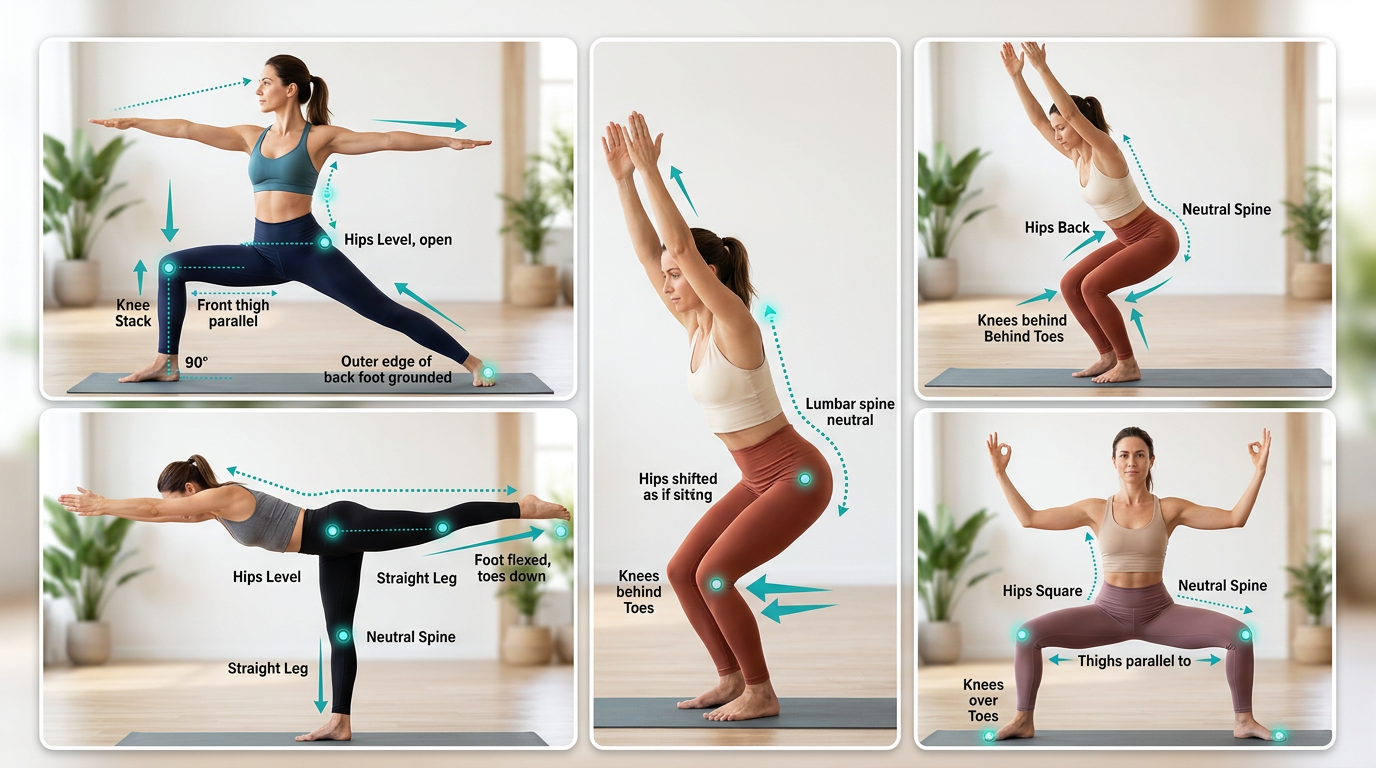
Collage showing proper alignment in Warrior II, Chair Pose, Warrior III, and Goddess Pose with alignment markers highlighting knee position, hip placement, and spine neutrality
Upper Body and Arm-Strengthening Yoga Exercises
While yoga is often associated with lower body and core work, specific poses effectively build upper body strength, particularly in your shoulders, arms, and back. These yoga exercises develop functional upper body strength through pushing and pulling movements that engage multiple muscle groups simultaneously. Building upper body strength improves posture, makes daily tasks easier, and creates balanced muscle development.
8. Chaturanga Dandasana (Four-Limbed Staff Pose)
Chaturanga is essentially a yoga push-up that builds tremendous strength in your chest, shoulders, triceps, and core. This pose appears frequently in Vinyasa flows, making it one of the most practical yoga exercises to master for building upper body endurance.
From Plank position, shift forward onto your toes slightly, then bend your elbows straight back (not out to the sides), lowering until your upper arms are parallel to the floor. Your elbows should stay close to your ribs. Keep your body in one straight line, core engaged, and gaze slightly forward.
This is an advanced pose. Beginners should modify by lowering knees to the floor or practicing the lowering phase slowly from Plank to the floor, building strength before attempting to hold the position.
9. Dolphin Pose
Dolphin Pose strengthens your shoulders, arms, and upper back while building the foundation for more advanced inversions. This pose is particularly effective for developing shoulder stability and upper body endurance.
Start on your hands and knees, then lower to your forearms with elbows shoulder-width apart. Tuck your toes and lift your hips high, similar to Downward Dog but on your forearms. Press firmly through your forearms and hands, lifting your shoulders away from the floor. Walk your feet closer to your elbows to increase shoulder engagement.
Hold for 30-60 seconds, rest, and repeat. Focus on actively pressing through your arms rather than sinking into your shoulders.
10. Upward Plank (Purvottanasana)
This reverse plank position targets the often-neglected posterior chain—your back, glutes, and hamstrings—while also working your triceps and shoulders. Upward Plank helps counterbalance forward-focused exercises and improves posture.
Sit with legs extended in front of you, hands placed behind your hips with fingers pointing toward your feet. Press into your hands and feet, lifting your hips toward the ceiling until your body forms a straight line from head to heels. Let your head drop back gently or keep your neck neutral if that's more comfortable.
Hold for 15-30 seconds. Modify by bending your knees and placing your feet flat on the floor (Tabletop position), which reduces the intensity while still building strength.
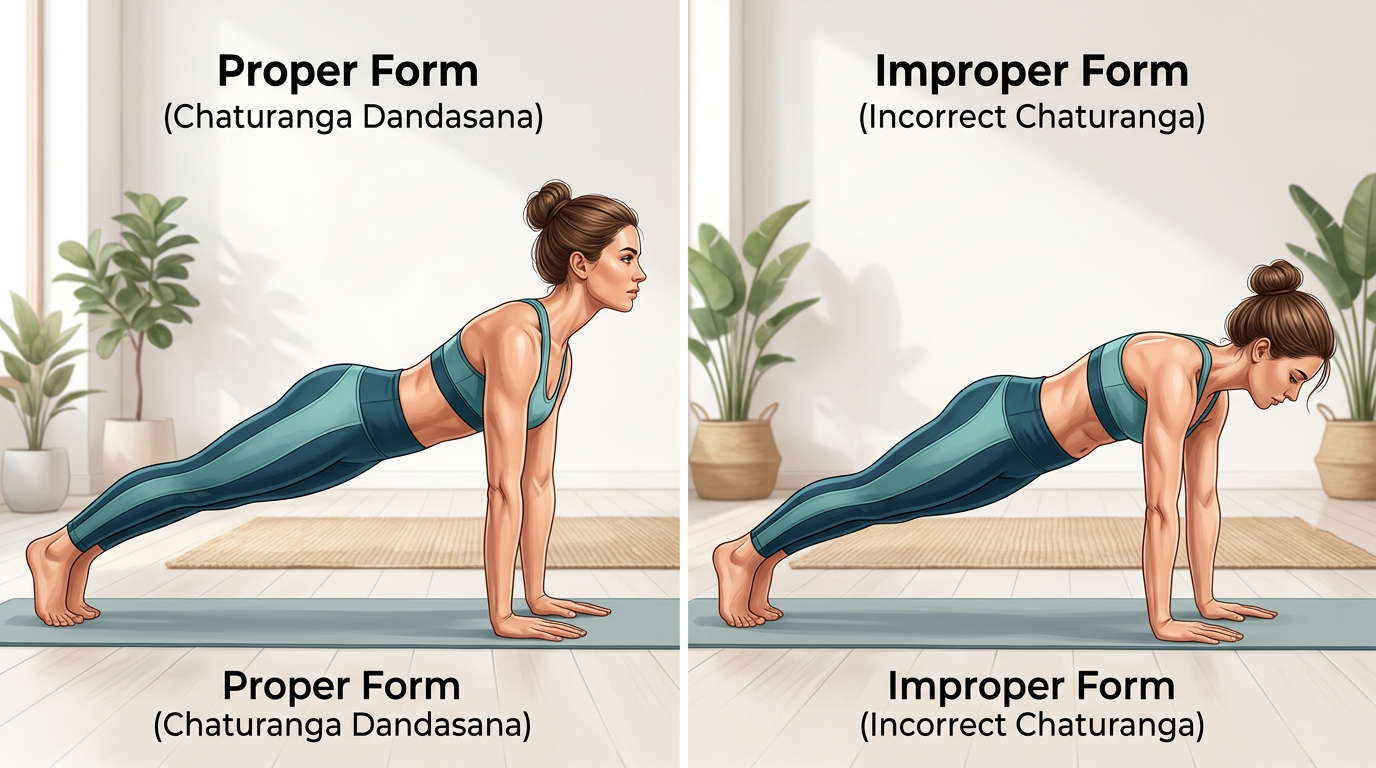
Side-by-side comparison showing proper vs improper form in Chaturanga with emphasis on elbow position and body alignment
Full-Body Yoga Exercises for Total Toning
Some yoga exercises engage virtually every muscle group simultaneously, providing efficient full-body workouts that build functional strength and improve coordination. These compound movements maximize your training efficiency by working multiple muscle groups at once while elevating your heart rate for added cardiovascular benefits.
11. Downward Facing Dog (Adho Mukha Svanasana)
Downward Dog is one of the most fundamental and versatile yoga exercises, appearing in nearly every practice. This inverted V-position strengthens your shoulders, arms, and core while stretching your hamstrings and calves. It's both an active strengthening pose and a resting position, depending on where you are in your practice.
From hands and knees, tuck your toes and lift your hips toward the ceiling, straightening your legs as much as comfortable. Your hands should be shoulder-width apart, fingers spread wide, and feet hip-width apart. Press firmly through your hands, especially your thumb and index finger, while drawing your shoulder blades down your back. Your body should form an inverted V-shape.
Hold for 30-90 seconds, focusing on lengthening your spine and pressing your chest toward your thighs. Don't worry if your heels don't touch the floor—keeping a slight bend in your knees is perfectly acceptable and often better for maintaining proper spinal alignment.
12. Sun Salutation Sequence (Surya Namaskar)
While technically a sequence rather than a single pose, Sun Salutations deserve mention as one of the most effective full-body yoga exercises. This flowing series links breath with movement through multiple poses, building cardiovascular endurance alongside muscular strength.
A basic Sun Salutation includes: Mountain Pose, Forward Fold, Halfway Lift, Plank, Chaturanga, Upward Dog (or Cobra), Downward Dog, Halfway Lift, Forward Fold, and return to Mountain Pose. Each complete cycle takes about 30-60 seconds depending on your pace.
Practice 5-10 rounds as a warm-up or standalone workout. The continuous movement builds heat in your body, improves circulation, and challenges your muscles through varied positions and ranges of motion.
13. Bridge Pose (Setu Bandhasana)
Bridge Pose is excellent for strengthening your glutes, hamstrings, and lower back while opening your chest and hip flexors. This backbend also engages your core and can help counteract the effects of prolonged sitting.
Lie on your back with knees bent and feet hip-width apart, heels close to your glutes. Press into your feet and lift your hips toward the ceiling, creating a straight line from your knees to your shoulders. Keep your thighs parallel and knees over ankles. Clasp your hands under your back and press your arms into the floor for added lift.
Hold for 30-60 seconds, lower slowly, rest briefly, and repeat 3-4 times. To increase glute activation, place a yoga block between your thighs and squeeze it throughout the hold.
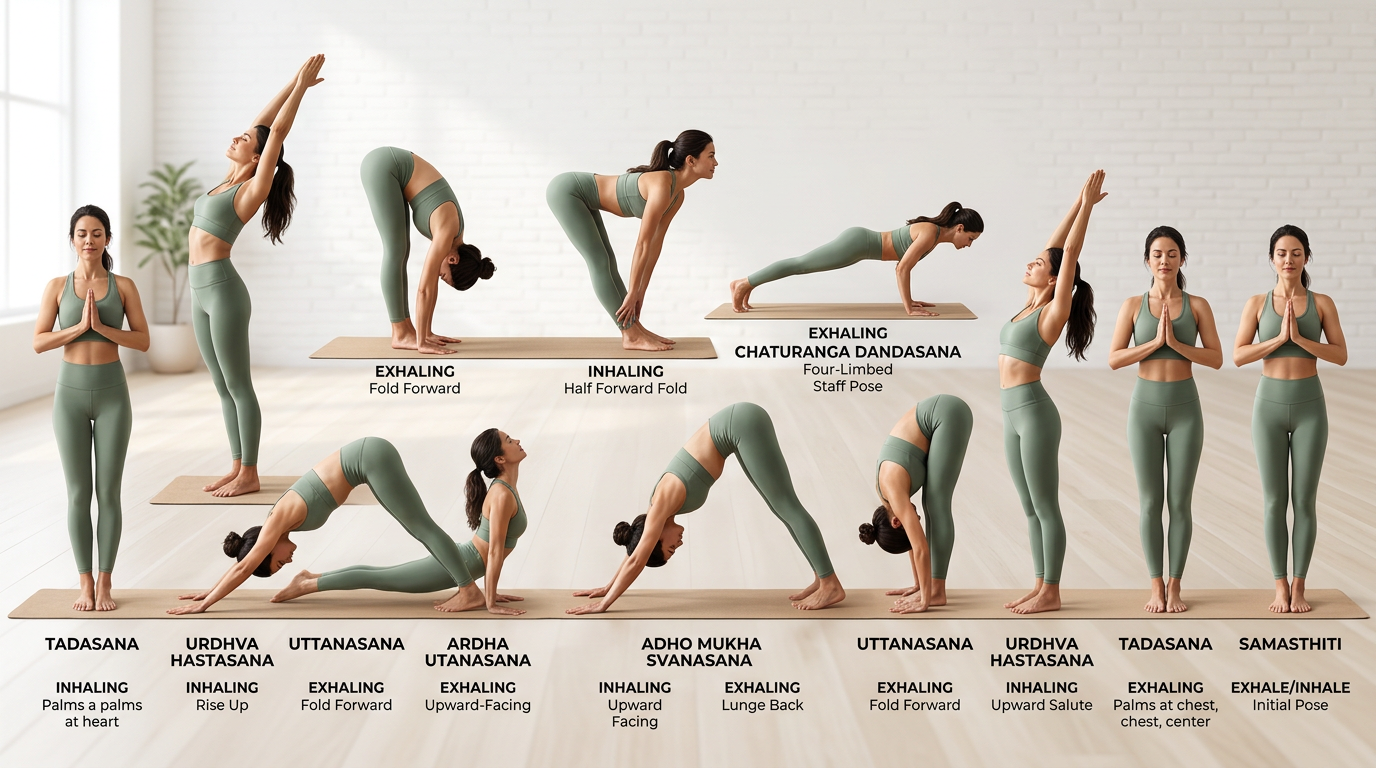
Sequence illustration showing the complete Sun Salutation flow with breath cues for each transition
Balance-Focused Yoga Exercises for Stability and Control
Balance poses require intense muscle engagement to maintain stability, making them highly effective for building strength, particularly in your core and stabilizer muscles. These yoga exercises improve proprioception, develop mind-muscle connection, and build the functional strength necessary for injury prevention and athletic performance.
14. Tree Pose (Vrksasana)
Tree Pose builds single-leg strength and stability while improving focus and concentration. This foundational balance pose works your standing leg intensely while engaging your core and hip stabilizers.
Stand on your left foot and place your right foot on your inner left thigh, calf, or ankle (never directly on the knee joint). Press your foot and leg together firmly. Bring your hands to prayer position at your heart or extend them overhead. Find a focal point (drishti) to help maintain balance. Keep your standing leg strong but not locked, with your knee slightly bent.
Hold for 30-60 seconds per side. The wobbling is normal and actually beneficial—it means your stabilizer muscles are working hard to keep you balanced.
15. Half Moon Pose (Ardha Chandrasana)
Half Moon is an advanced balance pose that strengthens your standing leg, particularly your glutes and outer hip, while challenging your core stability and coordination. This pose builds functional strength that translates to improved balance in daily activities.
From Warrior II, place your front hand on the floor about 12 inches in front of your front foot (or on a block). Shift your weight onto your front foot and lift your back leg parallel to the floor. Stack your hips and shoulders, opening your chest toward the side. Extend your top arm toward the ceiling. Your body should form a T-shape when viewed from the front.
Hold for 15-30 seconds per side. Modify by keeping your bottom hand on a block for support or practicing against a wall until you build sufficient strength and balance.
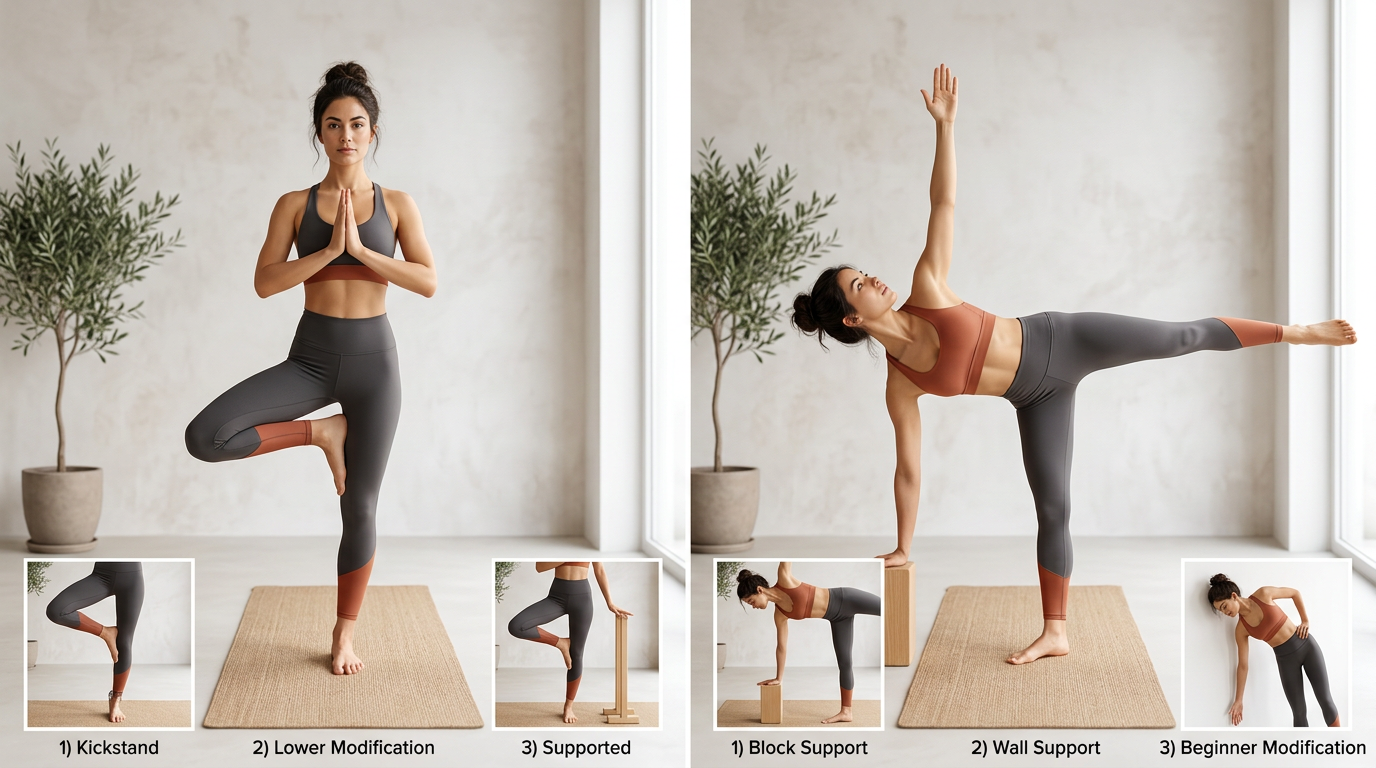
Side-by-side photos showing Tree Pose and Half Moon Pose with proper alignment and common modifications
Creating Your Yoga Exercises Routine for Maximum Results
Understanding individual poses is just the beginning—the real transformation comes from combining these yoga exercises into a structured routine that progressively challenges your body. A well-designed yoga practice balances strength-building poses with recovery, incorporates progressive overload, and aligns with your overall fitness goals.
Structuring Your Weekly Practice
For optimal strength and toning results, aim to practice yoga 3-4 times per week, allowing rest days between sessions for muscle recovery. Each session should last 30-60 minutes depending on your fitness level and schedule.
A balanced weekly structure might look like:
- Monday: Full-body strength flow focusing on standing poses and arm balances (45 minutes)
- Tuesday: Rest or gentle stretching (20 minutes)
- Wednesday: Core-focused practice with planks, boat pose, and balance work (30 minutes)
- Thursday: Rest or low-intensity activity like walking
- Friday: Lower body emphasis with warrior poses, chair pose, and goddess pose (40 minutes)
- Saturday: Vinyasa flow combining all elements with sun salutations (50 minutes)
- Sunday: Restorative practice or complete rest
This schedule provides adequate training stimulus while allowing sufficient recovery time for muscle adaptation and growth.
Progressive Overload Strategies in Yoga
To continue seeing results beyond the initial adaptation phase, you need to progressively increase the challenge to your muscles. Apply these strategies every 2-4 weeks:
- Increase hold times by 10-15 seconds for static poses
- Add more repetitions of flowing sequences like Sun Salutations
- Transition to more advanced variations of familiar poses
- Reduce rest periods between poses to increase metabolic demand
- Combine poses into more challenging sequences without breaks
- Practice more difficult balance poses that require greater stability
Combining Yoga with Other Training Modalities
Yoga exercises complement traditional strength training beautifully. Many women find that adding yoga to their fitness routine improves their performance in other activities while reducing injury risk and muscle soreness.
If you're already doing resistance training, use yoga on your rest days or after lifting sessions to promote recovery and maintain mobility. The active stretching and blood flow from yoga can help reduce delayed onset muscle soreness (DOMS) and improve flexibility that might be limited by heavy lifting.
For cardio enthusiasts, yoga provides the strength component that running or cycling alone doesn't offer, creating a more balanced fitness approach that addresses all components of physical fitness.
Common Mistakes to Avoid in Your Yoga Exercises Practice
Even experienced practitioners can develop habits that limit their progress or increase injury risk. Avoiding these common mistakes ensures you get maximum strength-building benefits from your yoga exercises while maintaining safe, sustainable practice.
Sacrificing Form for Depth
The deepest expression of a pose isn't always the most effective for building strength. Pushing into positions your body isn't ready for often means compensating with improper alignment, which reduces muscle engagement and increases injury risk.
Focus on maintaining proper alignment and muscle engagement rather than achieving an aesthetic shape. In Warrior II, for example, it's better to keep your front knee at 90 degrees with proper tracking over your ankle than to sink deeper with your knee collapsing inward. The correct form activates the right muscles and builds functional strength.
Holding Your Breath
Many people unconsciously hold their breath during challenging poses, which limits oxygen delivery to working muscles and increases tension. Proper breathing actually enhances strength by stabilizing your core and maintaining steady energy delivery.
Practice steady, rhythmic breathing throughout your practice. Generally, inhale during expansive movements and exhale during contracting or twisting movements. In static holds, maintain smooth, even breaths—if you can't breathe steadily, you might be pushing too hard.
Skipping the Warm-Up
Jumping directly into challenging yoga exercises without warming up increases injury risk and reduces the quality of your practice. Cold muscles are less pliable and more prone to strain.
Begin every session with 5-10 minutes of gentle movement: Cat-Cow stretches, gentle twists, or a few slow Sun Salutations. This preparation increases blood flow, lubricates joints, and mentally prepares you for the work ahead.
Ignoring Recovery and Rest
More practice doesn't always equal better results. Your muscles need recovery time to repair and grow stronger. Overtraining leads to fatigue, decreased performance, and increased injury risk.
Schedule at least 2-3 rest days per week, and listen to your body's signals. Persistent soreness, decreased performance, or loss of enthusiasm often indicate you need additional recovery time.
Nutrition Considerations for Yoga-Based Strength Building
While yoga exercises provide the stimulus for muscle development, your nutrition supplies the building blocks your body needs for recovery and growth. Proper nutrition amplifies your results from yoga practice, supporting muscle protein synthesis, energy levels, and overall performance.
Protein Requirements for Muscle Development
Protein provides the amino acids necessary for repairing and building muscle tissue. Women practicing yoga for strength should aim for adequate protein intake distributed throughout the day.
Focus on including protein sources at each meal: lean meats, fish, eggs, dairy products, legumes, tofu, tempeh, and protein-rich grains like quinoa. Timing matters less than total daily intake, but having protein within a few hours of your practice supports optimal recovery.
Carbohydrates for Energy and Performance
Carbohydrates fuel your yoga practice and replenish glycogen stores in your muscles. Don't fear carbs—they're essential for sustained energy during longer sessions and support recovery afterward.
Choose complex carbohydrates like whole grains, sweet potatoes, fruits, and vegetables that provide steady energy rather than quick spikes and crashes. Time your larger carbohydrate servings around your practice for optimal energy availability.
Hydration for Performance and Recovery
Proper hydration affects everything from muscle function to mental focus. Even mild dehydration impairs physical performance and recovery.
Drink water consistently throughout the day rather than chugging large amounts right before practice. Aim for pale yellow urine as an indicator of adequate hydration. During intense or hot yoga sessions, you may need to replace electrolytes along with fluids.
Frequently Asked Questions
What is the best yoga exercise?
The best yoga exercise depends on your goals, but Downward Facing Dog offers exceptional full-body benefits, strengthening shoulders, arms, and core while stretching hamstrings and calves. For lower body toning, Warrior II builds quadriceps and glute strength effectively. Plank pose delivers superior core strengthening and total-body stability. Most comprehensive results come from combining multiple poses rather than relying on one.
What are the 5 basic yoga poses?
The five basic yoga poses for beginners are Mountain Pose (Tadasana) for posture and alignment, Downward Facing Dog for full-body strength, Warrior I for lower body power, Child's Pose for rest and recovery, and Corpse Pose (Savasana) for relaxation. These foundational poses teach proper alignment, build basic strength, and introduce fundamental movement patterns that prepare you for more advanced practice.
Can I lose belly fat by doing yoga?
Yoga can contribute to belly fat loss when combined with proper nutrition and a caloric deficit. While you cannot spot-reduce fat from specific areas, yoga builds lean muscle mass that increases your metabolic rate, burns calories during practice, and reduces stress hormones that promote abdominal fat storage. Core-strengthening poses like Plank and Boat tone underlying muscles. Consistent practice alongside healthy eating produces the best results.
What are the 7 basic yoga poses?
The seven basic yoga poses are Mountain Pose (Tadasana), Downward Facing Dog (Adho Mukha Svanasana), Warrior I (Virabhadrasana I), Triangle Pose (Trikonasana), Tree Pose (Vrksasana), Bridge Pose (Setu Bandhasana), and Child's Pose (Balasana). These foundational poses cover all essential movement categories including standing poses, forward folds, backbends, balance poses, and resting positions, providing a complete foundation for yoga practice.
How long should I hold yoga poses to build strength?
Hold yoga poses for 30-60 seconds to effectively build strength and muscular endurance. Beginners should start with 15-30 second holds and gradually increase duration as strength improves. For maximum strength gains, aim for the point where your muscles feel fatigued but you can maintain proper form. Progressive overload by adding 10-15 seconds every few weeks ensures continued adaptation and strength development.
How many times per week should I practice yoga to see results?
Practice yoga 3-4 times per week for optimal strength and toning results. This frequency provides sufficient training stimulus while allowing adequate recovery time for muscle adaptation. Beginners might start with 2-3 sessions weekly, while advanced practitioners can practice 4-5 times. Consistency matters more than frequency—regular practice over months produces better results than intense but sporadic sessions.
Can yoga replace weight training for building muscle?
Yoga builds lean muscle and functional strength but typically produces less muscle mass than progressive weight training with heavy loads. Yoga excels at developing muscular endurance, core stability, and balanced strength through bodyweight resistance. For maximum muscle development, combine yoga with traditional strength training. Yoga alone can maintain and moderately build muscle, especially for beginners, while providing flexibility and mind-body benefits that weights don't offer.
Conclusion
These 15 yoga exercises provide a comprehensive approach to building strength, toning muscles, and developing functional fitness through bodyweight resistance. From core-strengthening planks to lower-body-focused warrior poses and full-body movements like Downward Dog, each pose offers unique benefits that contribute to balanced physical development. The key to success lies in consistent practice, proper form, progressive overload, and patience as your body adapts and grows stronger.
Remember that yoga exercises work best when integrated into a holistic approach that includes proper nutrition, adequate recovery, and attention to your body's signals. Whether you're new to fitness or adding yoga to complement your existing strength training routine, these poses deliver real results when practiced with intention and regularity. Start with the modifications that match your current fitness level, focus on maintaining proper alignment, and gradually progress to more challenging variations as your strength improves. The Strong Curves app offers guided yoga workouts designed specifically for women's strength and toning goals.