Reformer Pilates at Home: Tested & Ranked
Reformer pilates at home involves using a specialized sliding carriage machine with springs for resistance to build strength, flexibility, and core stability. The best home reformers include the FOLD Reformer for versatility, AeroPilates 287 for beginners, and Align Pilates F3 for studio-quality workouts, offering low-impact full-body conditioning without expensive studio memberships.
Introduction
Studio reformer classes can cost $30-50 per session, adding up to thousands annually. If you're ready to bring reformer pilates at home, you're making a smart investment in your fitness journey. Home reformers have evolved from clunky, expensive equipment to accessible, space-saving machines that deliver studio-quality workouts in your living room.
This comprehensive guide breaks down everything you need to know about practicing reformer pilates at home. We've tested and ranked the top machines, analyzed their features, and created a practical roadmap for building your home Pilates practice. Whether you're a complete beginner or transitioning from studio classes, you'll discover how to choose the right reformer, set up your space, and maximize your results.
The beauty of reformer Pilates lies in its adaptability. The spring-based resistance system challenges your muscles through their full range of motion while protecting your joints. For women focused on building functional strength, improving posture, and developing that coveted mind-body connection, reformer work offers unmatched benefits. Let's explore how to bring this transformative practice into your home.
Key Takeaways
- Home reformers range from $300-$3,000, with quality options available at every price point for different space and budget needs
- Reformer Pilates builds strength, flexibility, and core stability through controlled, low-impact movements that protect joints while challenging muscles
- Beginners should start with 2-3 sessions weekly, focusing on foundational movements before progressing to advanced exercises
- Space-saving foldable reformers make home practice accessible even in small apartments without sacrificing workout quality
- Proper form matters more than resistance level—master the basics before increasing spring tension
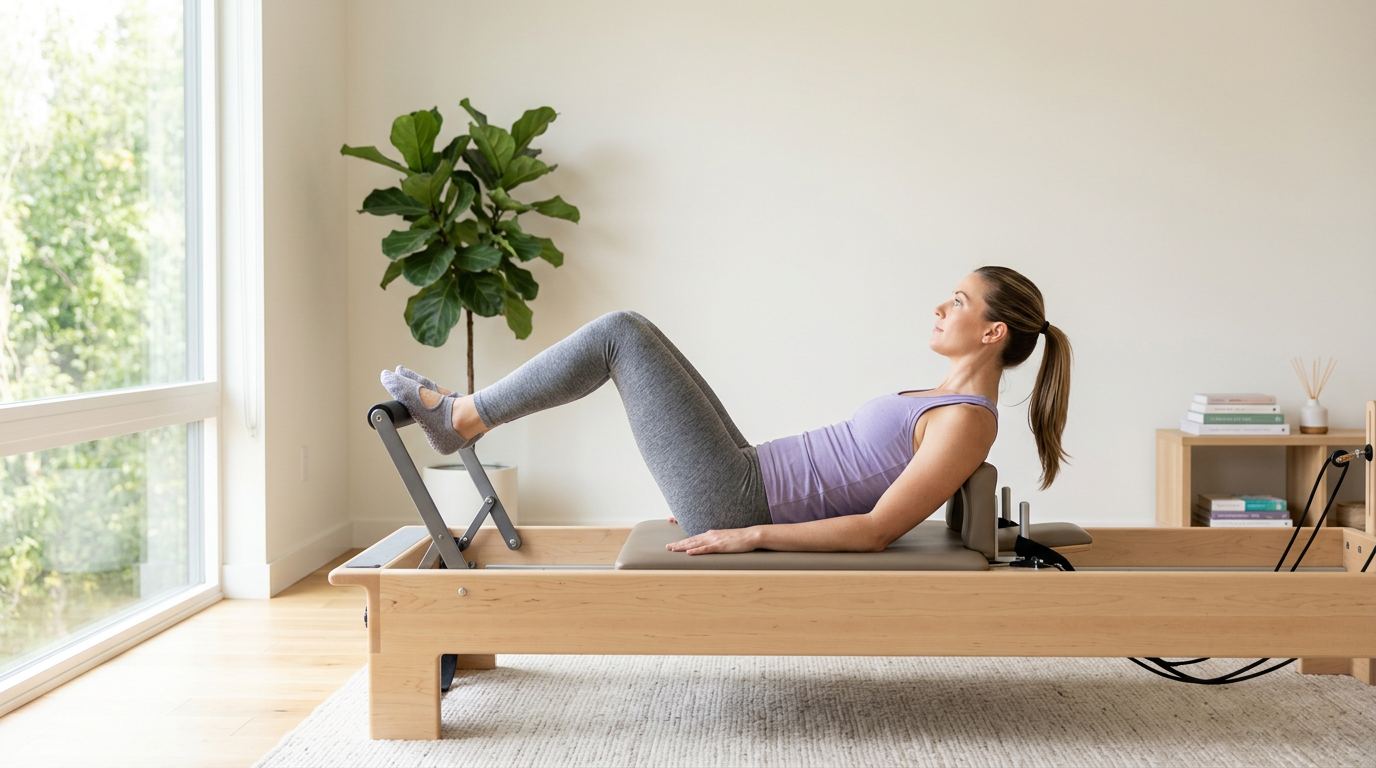
Woman performing footwork exercise on a home reformer in a bright, minimalist living room with proper form and alignment
What Is Reformer Pilates at Home and Why It Works
Reformer pilates at home uses a specialized piece of equipment featuring a sliding carriage, adjustable springs, ropes, and a footbar. Unlike mat Pilates, the reformer provides variable resistance that can make exercises easier or more challenging depending on spring configuration.
The Science Behind Reformer Training
The reformer's spring-based resistance creates eccentric and concentric muscle contractions throughout each movement, building strength while improving flexibility. This dual benefit makes reformer work exceptionally effective for women seeking functional fitness that translates to daily activities.
The unstable surface of the moving carriage engages your core stabilizers constantly. Every exercise becomes a full-body integration challenge, even when targeting specific muscle groups. This explains why reformer devotees develop that characteristic lean, strong physique with improved posture and body awareness.
Key Benefits for Women's Fitness Goals
Reformer Pilates addresses multiple fitness objectives simultaneously. The low-impact nature protects joints while building bone density through resistance training. This makes it particularly valuable for women managing hormonal changes, recovering from pregnancy, or dealing with joint concerns.
- Core strength: Every exercise requires spinal stabilization, building deep abdominal and back muscles that improve posture and reduce back pain
- Lean muscle development: The resistance challenges muscles without bulk, creating definition and functional strength
- Flexibility gains: The reformer facilitates stretching under resistance, improving range of motion more effectively than static stretching
- Mind-body connection: The precise, controlled movements demand focus, reducing stress while building body awareness
- Joint health: The supported positions and smooth resistance protect joints while strengthening surrounding muscles
- Postural alignment: Regular practice corrects imbalances and promotes proper spinal positioning throughout daily activities
How Home Practice Compares to Studio Classes
Studio classes offer expert instruction and community motivation, but home practice provides flexibility and long-term cost savings. The key difference lies in accountability and form feedback. Studios provide immediate corrections, while home practitioners must develop self-awareness and potentially supplement with online instruction.
The financial comparison is compelling. A quality home reformer costs $800-$2,000 on average, equivalent to 4-8 months of studio classes. After the initial investment, your per-session cost drops to zero. For women committed to consistent practice, home equipment pays for itself quickly while offering unlimited access.
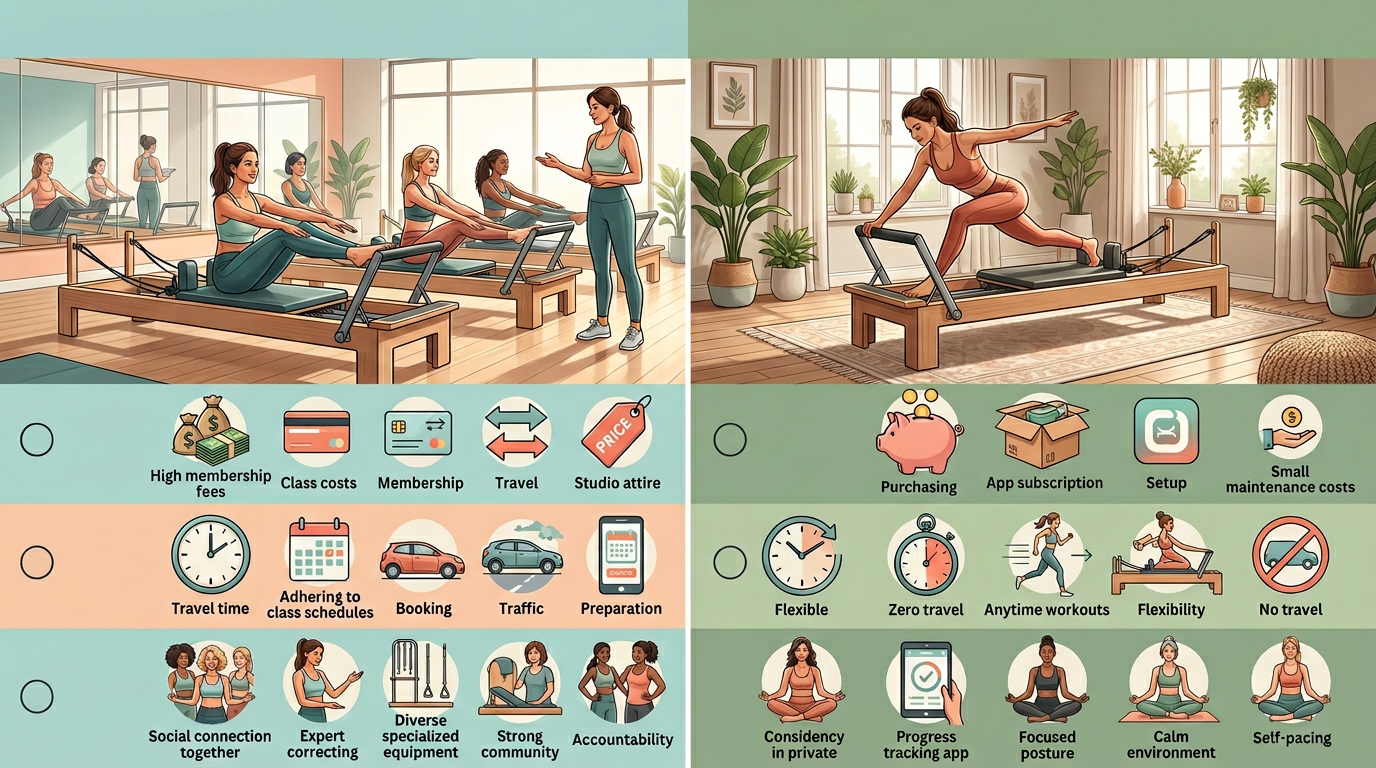
Side-by-side comparison infographic showing studio vs home reformer practice costs, time investment, and benefits over 12 months
Best Reformer Pilates Machines for Home Use: Tested & Ranked
We evaluated home reformers based on build quality, exercise variety, space efficiency, price point, and user experience. Here's our comprehensive ranking to help you make an informed decision.
Premium Category: Studio-Quality Performance
1. FOLD Reformer - Best Overall ($1,795)
The FOLD Reformer delivers studio-quality construction in a space-saving design. Its innovative folding mechanism reduces storage footprint by 70% without compromising stability during workouts. The four spring system offers precise resistance adjustments, and the included jump board expands exercise possibilities significantly.
Key features include commercial-grade upholstery, smooth carriage glide, and a weight capacity of 350 pounds. The shoulder blocks adjust to three positions, accommodating different body heights. Setup takes under 10 minutes, and folding requires minimal effort—a crucial consideration for apartment dwellers.
2. Align Pilates F3 Max - Best Studio Replication ($2,499)
If budget allows, the Align F3 Max replicates professional studio equipment with exceptional precision. Five spring options provide nuanced resistance variations, and the extended carriage accommodates taller users comfortably. The rope system includes both short and long configurations for maximum exercise variety.
Mid-Range Category: Best Value Options
3. Balanced Body Allegro 2 - Best for Serious Practitioners ($2,295)
Balanced Body's reputation for quality shines in the Allegro 2. This reformer features the same spring system used in professional studios, offering consistent resistance and durability. The footbar adjusts to five positions, and the included standing platform enables advanced exercises.
4. Merrithew SPX Max Plus - Best for Tall Users ($2,395)
With an extended carriage length of 108 inches, the SPX Max Plus accommodates users up to 6'4" comfortably. The patented rope system prevents tangling, and the cardio-tramp rebounder attachment adds cardiovascular training options. Build quality exceeds most home reformers, justifying the premium price.
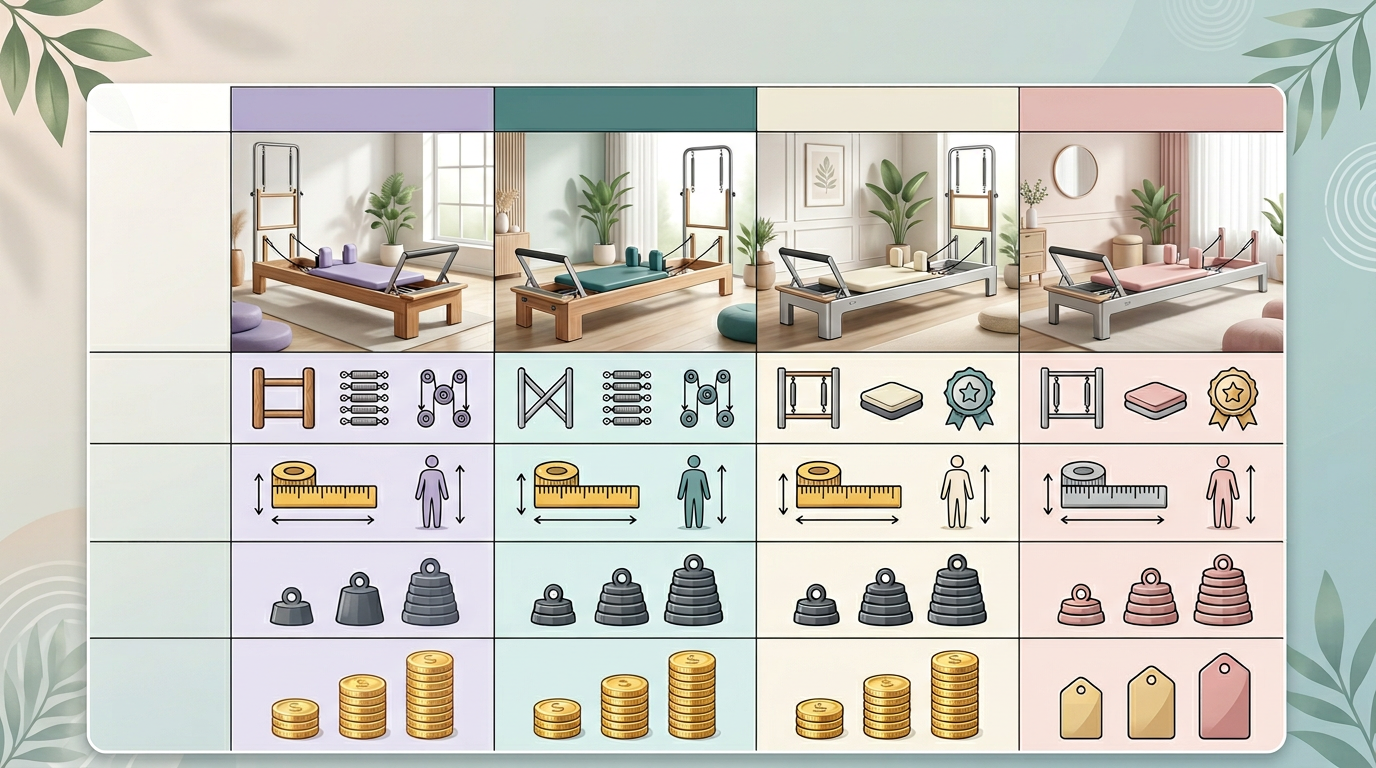
Detailed comparison chart showing the top 4 premium reformers with key specs, dimensions, weight capacity, and price points
Budget-Friendly Category: Best Affordable Options
5. AeroPilates Reformer 287 - Best for Beginners ($449)
The AeroPilates 287 makes reformer practice accessible at a fraction of studio reformer costs. While the cord-and-pulley system differs from traditional spring resistance, it provides effective workouts for beginners and intermediate practitioners. The included workout videos guide you through proper form and exercise progressions.
This reformer folds for storage and weighs just 70 pounds, making it manageable for solo setup. The three resistance cords allow basic adjustments, though the resistance curve feels different from spring-based systems. For women exploring reformer work before committing to premium equipment, this represents excellent value.
6. Stamina AeroPilates Pro XP 556 - Best Budget Full-Size ($599)
The Pro XP 556 upgrades the basic AeroPilates with four resistance cords, a wider carriage, and enhanced padding. The cardio rebounder transforms the reformer into a low-impact cardio machine, adding workout variety. At 130 pounds, it's substantially sturdier than budget competitors.
Compact Category: Best Space-Saving Solutions
7. Bala Reformer - Most Portable ($349)
The Bala Reformer reimagines home Pilates with an ultra-compact design measuring just 63 inches long. The resistance bands replace traditional springs, creating a different feel but enabling effective workouts. This option suits women with severe space constraints or those wanting reformer-style training while traveling.
Setup takes seconds, and the entire unit weighs 25 pounds. The trade-off comes in exercise variety—advanced movements requiring heavy spring resistance aren't possible. However, for fundamental reformer exercises and supplementary training, the Bala delivers impressive functionality in a tiny package.
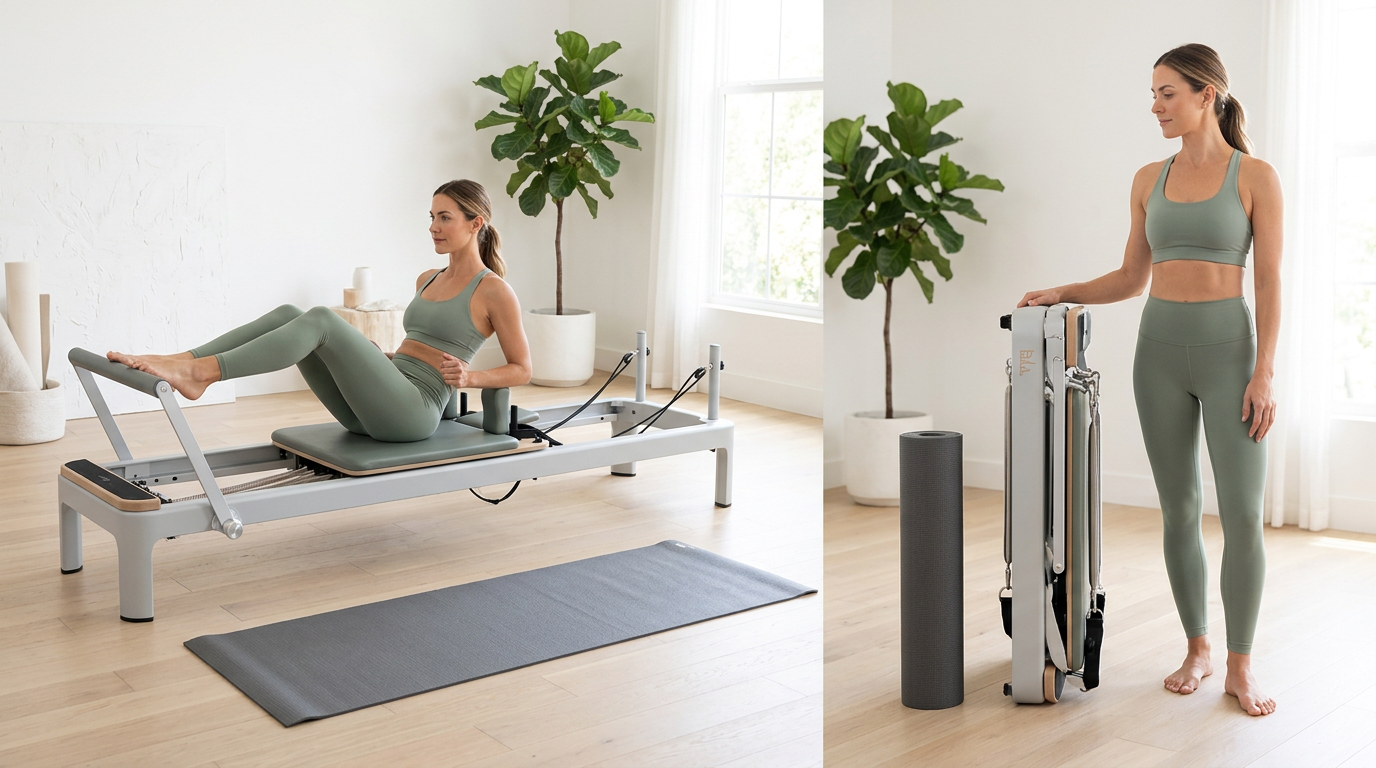
Woman demonstrating the compact Bala Reformer folded and unfolded, showing size comparison to a standard yoga mat
How to Choose the Right Home Reformer for Your Needs
Selecting a reformer requires balancing budget, space, fitness level, and long-term goals. Use this framework to identify your ideal machine.
Space Assessment and Storage Solutions
Measure your available space before falling in love with a reformer model. Standard reformers require approximately 8 feet long by 2.5 feet wide, plus clearance for safe movement. Ceiling height matters for exercises involving raised arms—aim for at least 7.5 feet.
Foldable models reduce storage footprint significantly but require dedicated setup time before each workout. Consider whether you'll leave the reformer assembled or need to store it between sessions. Women with limited space should prioritize compact or foldable designs over full-size studio replicas.
Budget Planning and Long-Term Value
Calculate your reformer investment against studio class costs to understand payback period. If you currently attend three classes weekly at $35 each, a $1,500 reformer pays for itself in approximately 11 months. Factor in the convenience value of home practice—no commute time or schedule restrictions.
Budget considerations by price range:
- Under $500: Expect cord-based resistance, lighter construction, and limited longevity—ideal for beginners testing their commitment
- $500-$1,000: Entry-level spring systems with adequate stability for regular practice, suitable for intermediate users
- $1,000-$2,000: Quality construction, smooth operation, and features supporting long-term progression
- $2,000+: Studio-grade equipment with commercial durability, extensive exercise options, and investment-quality build
Experience Level and Feature Requirements
Beginners benefit from reformers with clear resistance indicators and included instructional content. Look for models offering online workout libraries or DVD programs that teach proper form and exercise sequences. The learning curve for reformer work is steeper than mat Pilates—quality instruction prevents injury and accelerates progress.
Intermediate and advanced practitioners should prioritize spring variety, footbar adjustability, and accessory compatibility. Advanced exercises require specific resistance configurations and equipment features. If you've been practicing in studios, replicate the reformer features you use most frequently.
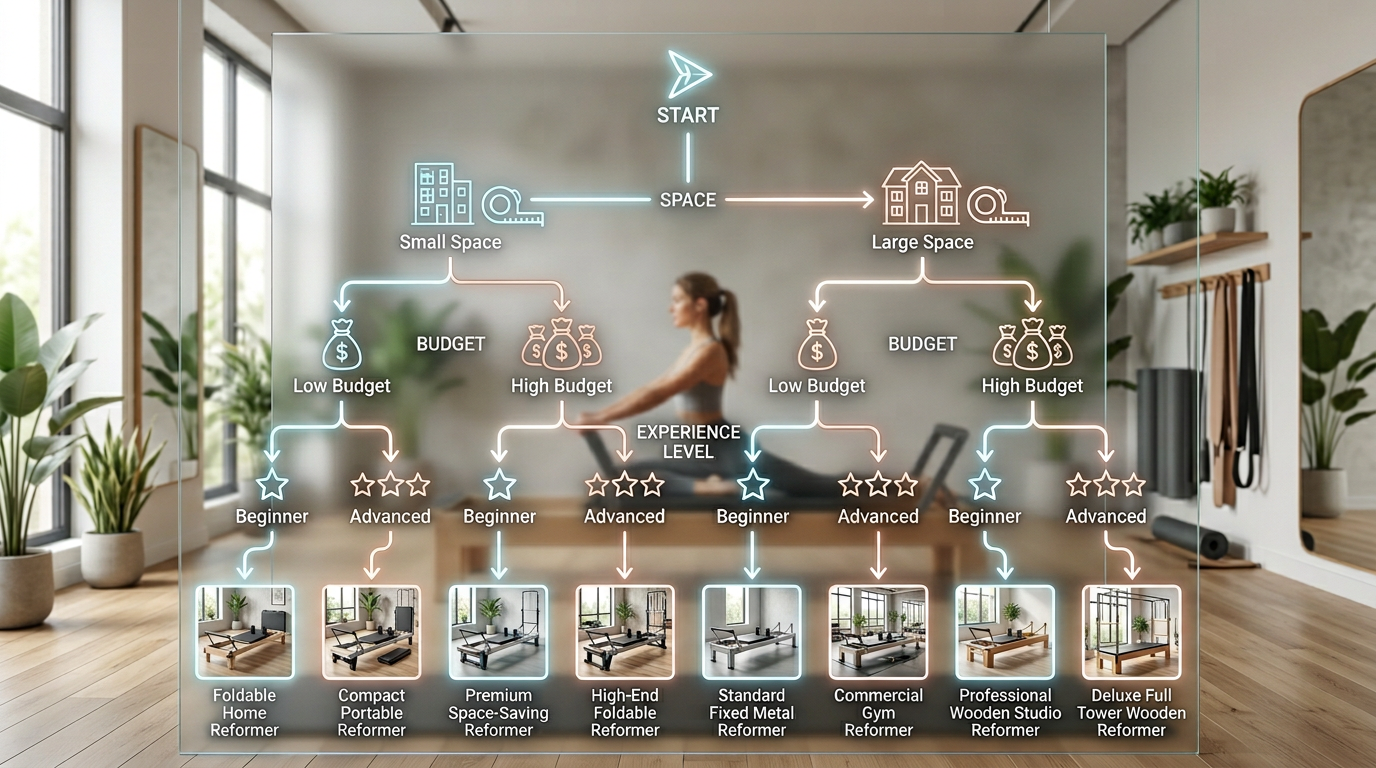
Decision tree flowchart helping readers choose between reformer types based on space, budget, and experience level
Setting Up Your Home Reformer Practice Space
Creating an effective practice environment enhances consistency and workout quality. Your setup doesn't require a dedicated room, but thoughtful arrangement makes significant difference.
Essential Space Requirements
Allocate a clear zone extending 12 inches beyond the reformer on all sides for safe movement and exercise transitions. Position the reformer perpendicular to a mirror if possible—visual feedback helps maintain proper alignment and form awareness.
Flooring considerations matter for stability and noise reduction. Hardwood or tile floors work well with a reformer mat underneath to prevent sliding and protect surfaces. Carpet provides cushioning but can interfere with reformer stability—place a solid board under the reformer feet if practicing on carpet.
Lighting and Ambiance Optimization
Natural light energizes morning workouts, while adjustable lighting creates ambiance for evening sessions. Position your reformer to avoid screen glare if following video workouts. Many women find that creating a dedicated practice atmosphere—even in a multipurpose space—improves focus and consistency.
Consider these ambiance elements:
- Adjustable lighting to match workout intensity and time of day
- Bluetooth speaker for curated playlists or guided instruction audio
- Small storage solution for props like resistance bands, Pilates balls, and towels
- Temperature control—reformer work generates heat, so ensure adequate ventilation
- Minimal visual distractions to maintain mind-body focus
Technology Integration for Guided Workouts
A tablet or phone mount positioned at eye level enables following along with online classes while maintaining proper form. Many home practitioners subscribe to reformer-specific platforms offering structured programs and progressive training plans. Check out our pilates workout at home guide for complementary mat exercises that enhance your reformer practice.
Streaming platforms worth exploring include Pilates Anytime, Balanced Body Education, and Align Pilates Online. These services provide reformer-specific instruction at various difficulty levels, typically costing $15-30 monthly—still a fraction of studio class prices.
Getting Started: Your First Month of Home Reformer Practice
Beginning a home reformer practice requires structured progression to build competence safely. Follow this framework for your first four weeks.
Week 1-2: Foundational Movement Patterns
Master the five fundamental reformer exercises before advancing to complex variations: footwork, hundred, leg circles, short box series, and front splits. These movements establish proper carriage control, breathing patterns, and core engagement that underpin all reformer work.
Start with light spring resistance—typically one red spring or equivalent. Focus entirely on form quality rather than resistance level or repetition count. Each session should last 20-30 minutes, allowing time for setup, exercise execution, and mindful cool-down.
Recommended weekly schedule for beginners:
- Session 1: Footwork variations and basic leg work (20 minutes)
- Session 2: Upper body pulling exercises and core work (25 minutes)
- Session 3: Full-body integration practice combining learned movements (30 minutes)
Week 3-4: Building Exercise Repertoire
Introduce intermediate exercises as foundational patterns become comfortable. Add arm work with straps, kneeling exercises, and standing footwork variations. Increase spring resistance gradually—when you can complete 10 repetitions with perfect form, consider adding resistance.
This phase builds endurance and movement vocabulary. You'll notice improved body awareness and stronger mind-muscle connection. Many women report better posture and reduced back discomfort within the first month of consistent practice.
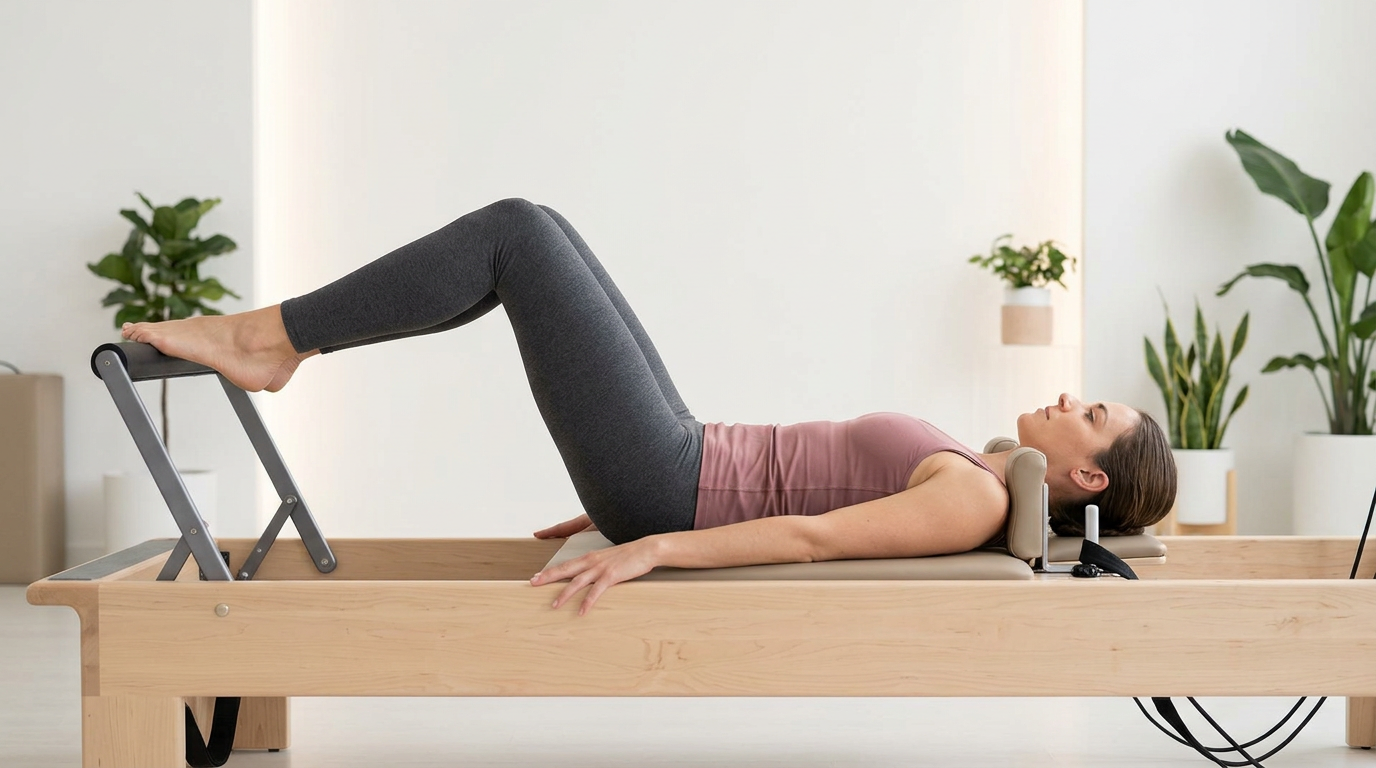
Step-by-step photo sequence showing proper form for the five foundational reformer exercises with alignment cues
Form Cues and Common Mistakes to Avoid
Proper reformer technique requires attention to alignment, breathing, and controlled movement. Common beginner mistakes include gripping the straps too tightly, holding breath during exertion, and using momentum rather than muscle control to move the carriage.
Key form principles for safe, effective practice:
- Maintain neutral spine: Avoid excessive arching or flattening of the lower back unless the exercise specifically requires spinal flexion
- Engage before moving: Activate core stabilizers before initiating carriage movement to protect the spine and maximize effectiveness
- Control the return: The eccentric (returning) phase of each exercise builds strength—resist the spring pull rather than allowing it to snap back
- Breathe intentionally: Exhale during exertion, inhale during recovery, maintaining steady rhythm throughout
- Check shoulder position: Keep shoulders down and back, away from ears, especially during upper body exercises
- Stabilize the pelvis: Prevent rocking or shifting during leg exercises by maintaining core engagement
Addressing Special Considerations and Health Conditions
Reformer Pilates accommodates various health situations with appropriate modifications. Understanding how to adapt practice for specific conditions ensures safe, beneficial workouts.
Reformer Pilates for Hormonal Health
Reformer practice supports hormonal balance through moderate-intensity resistance training and stress reduction. The controlled, mindful nature of reformer work activates the parasympathetic nervous system, countering chronic stress responses that elevate cortisol.
For women managing high cortisol levels, reformer Pilates offers significant advantages over high-intensity training. The low-impact resistance builds strength without triggering additional stress responses. Focus on breath work and controlled movement rather than pushing to exhaustion—this approach supports cortisol regulation while building functional fitness.
Practicing with Hypermobility and Joint Conditions
Women with hypermobility conditions like Ehlers-Danlos Syndrome can benefit from reformer work with proper precautions. The supported positions and controlled resistance help strengthen muscles around hypermobile joints without forcing them into extreme ranges of motion.
The key for hypermobile practitioners is avoiding end-range positions and focusing on muscular control rather than flexibility. Use lighter spring resistance to prevent overstretching, and prioritize stability exercises that build joint support. Working with a Pilates instructor experienced in hypermobility ensures appropriate exercise selection and modification.
Cardiovascular and Circulatory Benefits
The rhythmic, flowing nature of reformer sequences promotes healthy circulation without the impact stress of running or jumping. For women managing venous insufficiency, reformer exercises in supine and elevated positions facilitate blood return from the legs while strengthening the muscle pump that supports venous function.
The combination of resistance training and controlled breathing improves cardiovascular efficiency over time. While reformer work isn't traditional cardio, the continuous movement and muscle engagement elevate heart rate moderately, supporting cardiovascular health without excessive stress.
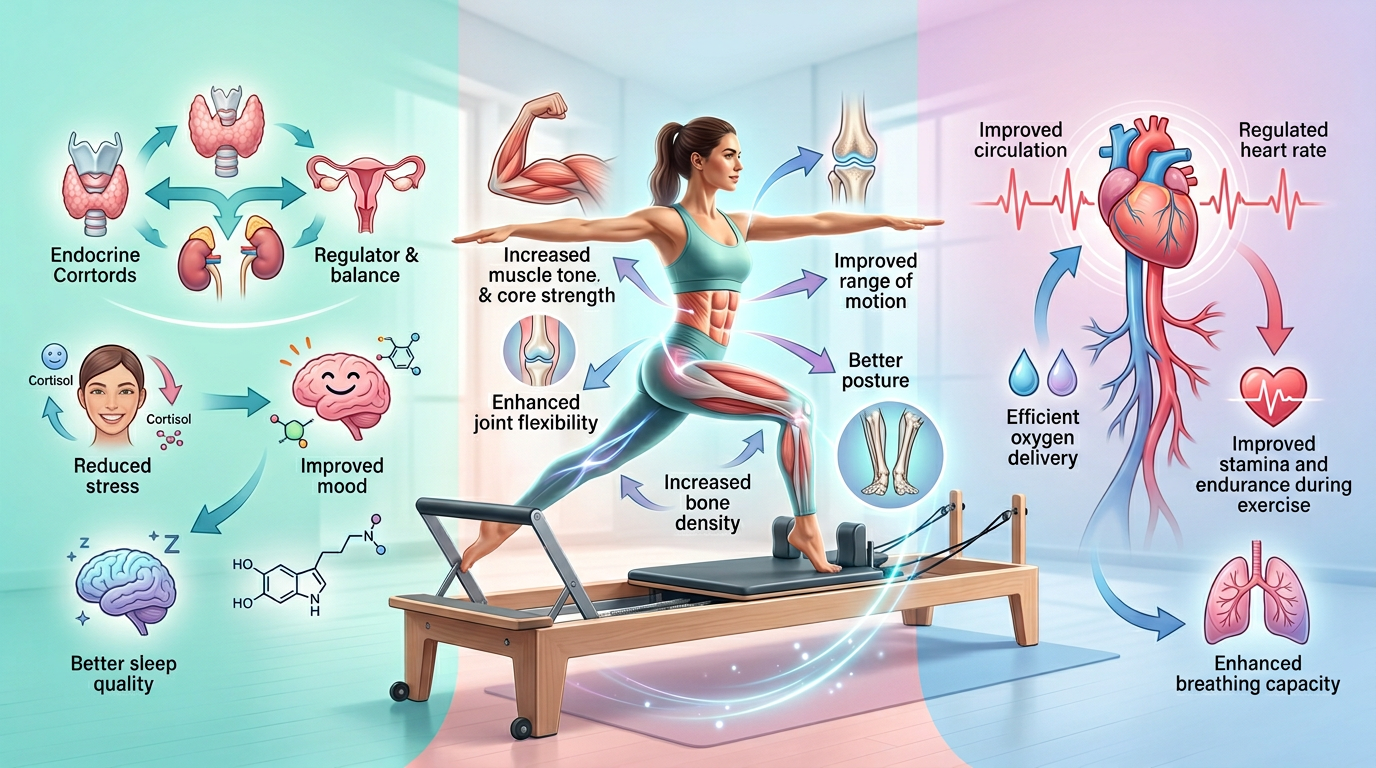
Infographic showing how reformer Pilates benefits different body systems including hormonal, musculoskeletal, and cardiovascular health
Maximizing Results: Progressive Training Strategies
Consistent progress requires systematic advancement in exercise difficulty, resistance, and workout complexity. Apply these principles to continue challenging your body.
Progressive Overload on the Reformer
Progressive overload in reformer Pilates occurs through increasing spring resistance, adding repetitions, slowing tempo, or advancing to more complex exercise variations. Unlike traditional strength training, reformer progression isn't always about adding weight—sometimes decreasing spring assistance makes exercises harder.
Track your workouts to identify when exercises become comfortable. When you can complete 12-15 repetitions with excellent form, progress using one of these methods:
- Add one spring level of resistance
- Increase repetitions by 3-5
- Slow the movement tempo, especially the eccentric phase
- Progress to a more challenging exercise variation
- Reduce rest periods between exercises
Balancing Reformer Work with Other Training
Reformer Pilates complements strength training, cardiovascular exercise, and flexibility work beautifully. Many women find that 2-3 reformer sessions weekly combined with 2-3 strength training sessions creates optimal results for body composition and functional fitness.
The reformer excels at core stabilization, postural muscles, and movement quality—areas that support performance in other activities. Use reformer sessions as active recovery between heavy strength days, or as primary training if your goals center on functional movement and mind-body connection.
Tracking Progress and Setting Milestones
Document your reformer journey through workout logs, progress photos, or performance milestones. Unlike traditional strength training with clear weight progression, reformer advancement shows through improved movement quality, exercise complexity, and how your body feels in daily activities.
Meaningful progress indicators include:
- Mastering new exercise variations with proper form
- Improved posture and body awareness throughout the day
- Reduced back pain or joint discomfort
- Enhanced performance in other physical activities
- Visible muscle definition and improved body composition
- Increased spring resistance on familiar exercises
Maintaining Your Reformer and Ensuring Longevity
Proper maintenance protects your investment and ensures safe, smooth operation. Follow these care protocols to maximize reformer lifespan.
Regular Cleaning and Upkeep
Wipe down the carriage, ropes, and frame after each use to remove sweat and body oils. Use mild soap and water rather than harsh chemicals that can degrade upholstery and finishes. Clean the rails monthly with a slightly damp cloth to prevent dust buildup that interferes with carriage glide.
Inspect springs quarterly for signs of wear or deformation. Springs maintain their resistance for years with normal use, but eventual replacement ensures consistent performance. Most manufacturers sell replacement spring sets for $50-100.
Troubleshooting Common Issues
Sticky carriage movement usually indicates dirty rails or wheels. Clean both thoroughly, then apply a small amount of silicone lubricant to the rails if needed. Squeaking sounds often come from spring attachments—a drop of lubricant at connection points typically resolves the issue.
If straps feel uneven or jerky, check for fraying or tangling. Replace worn straps immediately to prevent breakage during use. Most reformer manufacturers offer replacement parts, ensuring your machine remains functional for decades with proper care.
Frequently Asked Questions
Are home reformer pilates any good?
Home reformers deliver excellent results when chosen appropriately for your experience level and goals. Quality models replicate studio equipment functionality at a fraction of long-term cost. The key is selecting a reformer with adequate spring resistance, stable construction, and supplementing with online instruction for proper form guidance.
Is Pilates good for high cortisol?
Pilates supports cortisol regulation through moderate-intensity movement and breath work that activates the parasympathetic nervous system. Unlike high-intensity training that can elevate stress hormones, the controlled nature of reformer practice builds strength while promoting relaxation. Focus on mindful movement rather than exhaustion for optimal hormonal benefits.
Can people with Ehlers Danlos do Pilates?
People with Ehlers-Danlos Syndrome can practice reformer Pilates with appropriate modifications focusing on joint stability rather than flexibility. Use lighter spring resistance, avoid end-range positions, and prioritize exercises that strengthen muscles supporting hypermobile joints. Working with an instructor experienced in hypermobility ensures safe, beneficial practice.
Is Pilates good for venous insufficiency?
Pilates benefits venous insufficiency through exercises in supine and elevated positions that facilitate blood return from the legs. The rhythmic muscle contractions strengthen the muscle pump supporting venous function, while the low-impact nature avoids excessive pressure on compromised veins. Reformer work provides these benefits without the stress of standing exercises.
How much space do I need for a home reformer?
Standard reformers require approximately 8 feet long by 3 feet wide, plus 12 inches clearance on all sides for safe movement. Ceiling height should be at least 7.5 feet for exercises with raised arms. Foldable models reduce storage footprint by up to 70% but require setup before each session.
How often should I practice reformer Pilates at home?
Practice reformer Pilates 2-4 times weekly for optimal results, allowing rest days between sessions for muscle recovery. Beginners should start with 2-3 sessions of 20-30 minutes, gradually increasing duration and frequency as strength and competence develop. Consistency matters more than session length for building sustainable practice.
Can I lose weight with home reformer Pilates?
Reformer Pilates supports weight loss through muscle building that increases metabolic rate and moderate calorie burn during sessions. Combined with appropriate nutrition, regular practice creates the caloric deficit needed for fat loss while preserving lean muscle. Results appear as improved body composition and muscle definition rather than dramatic scale changes.
Conclusion
Bringing reformer pilates at home transforms your fitness routine with accessible, effective full-body training that builds strength, flexibility, and body awareness. Whether you invest in a premium studio-quality machine or start with a budget-friendly option, consistent practice delivers remarkable results for women seeking functional fitness and mind-body connection.
The key to success lies in choosing equipment that matches your space, budget, and experience level, then committing to regular practice with proper form. Start with foundational movements, progress systematically, and listen to your body's feedback. The reformer's versatility accommodates various fitness goals and health considerations, making it an exceptional long-term investment in your wellness journey.
Your home reformer practice awaits—begin with the fundamentals, stay consistent, and watch your strength and confidence grow with every session.