Ab weight exercises are core movements that incorporate dumbbells, weight plates, or other resistance to intensify abdominal training. The most effective include weighted Russian twists, dumbbell side bends, weighted planks, and cable crunches, which progressively overload the rectus abdominis, obliques, and transverse abdominis for enhanced strength and definition.
You've mastered bodyweight planks and crunches, but your abs still don't have the definition or strength you're working toward. The missing piece? Progressive resistance. Just like your glutes and legs need weights to grow stronger and more sculpted, your core muscles respond powerfully to ab weight exercises that challenge them beyond basic bodyweight movements.
Adding weights to your ab training isn't about spot-reducing belly fat—it's about building a stronger, more functional core that supports every lift, every movement, and every daily activity. Whether you're deadlifting, carrying groceries, or playing with your kids, a resilient core makes everything easier and safer.
This comprehensive guide reveals the best ab weight exercises for women, how to perform them correctly, and how to structure your weighted core training for maximum results. You'll discover which movements target each section of your abs, how much weight to use, and how to progress safely while avoiding common mistakes that limit results.
Key Takeaways
- Weighted ab exercises build core strength and definition more effectively than bodyweight movements alone through progressive overload
- The most effective weighted core movements include Russian twists, cable crunches, weighted planks, and side bends that target all abdominal regions
- Start with 5-10 pounds and focus on perfect form before increasing resistance to prevent injury and maximize muscle engagement
- Train abs with weights 2-3 times weekly, allowing 48 hours recovery between sessions for optimal strength gains
- Combine weighted ab training with proper nutrition and full-body strength work for visible core definition
Why Add Weights to Your Ab Training
Your abs are muscles just like your biceps, quads, and glutes. They respond to the same training principles, particularly progressive overload—gradually increasing resistance over time to stimulate growth and strength adaptations.
The Science Behind Weighted Core Work
Progressive resistance challenges your core muscles to adapt by building more muscle fibers and neural connections, creating both functional strength and visible definition. When you perform endless bodyweight crunches, your muscles eventually adapt to that specific stimulus and stop progressing.
Adding external resistance forces your rectus abdominis, obliques, and transverse abdominis to recruit more muscle fibers during each contraction. This increased muscle activation leads to greater strength gains and metabolic benefits that support your overall fitness goals.
Benefits Beyond Aesthetics
Weighted ab exercises deliver functional benefits that extend far beyond appearance:
- Enhanced lifting performance: A stronger core stabilizes your spine during squats, deadlifts, and overhead presses, allowing you to lift heavier safely
- Improved posture: Weighted core training strengthens the muscles that support proper spinal alignment throughout your day
- Injury prevention: A resilient core protects your lower back during both exercise and daily activities like lifting, bending, and twisting
- Better balance and stability: Weighted anti-rotation and anti-extension exercises train your core to resist unwanted movement
- Increased metabolic demand: Building muscle tissue through resistance training elevates your resting metabolism
When Bodyweight Isn't Enough
You're ready to incorporate ab weight exercises when you can perform 20+ repetitions of bodyweight movements with perfect form. At this point, adding resistance becomes more time-efficient than performing higher repetitions, and it provides the progressive overload necessary for continued adaptation.
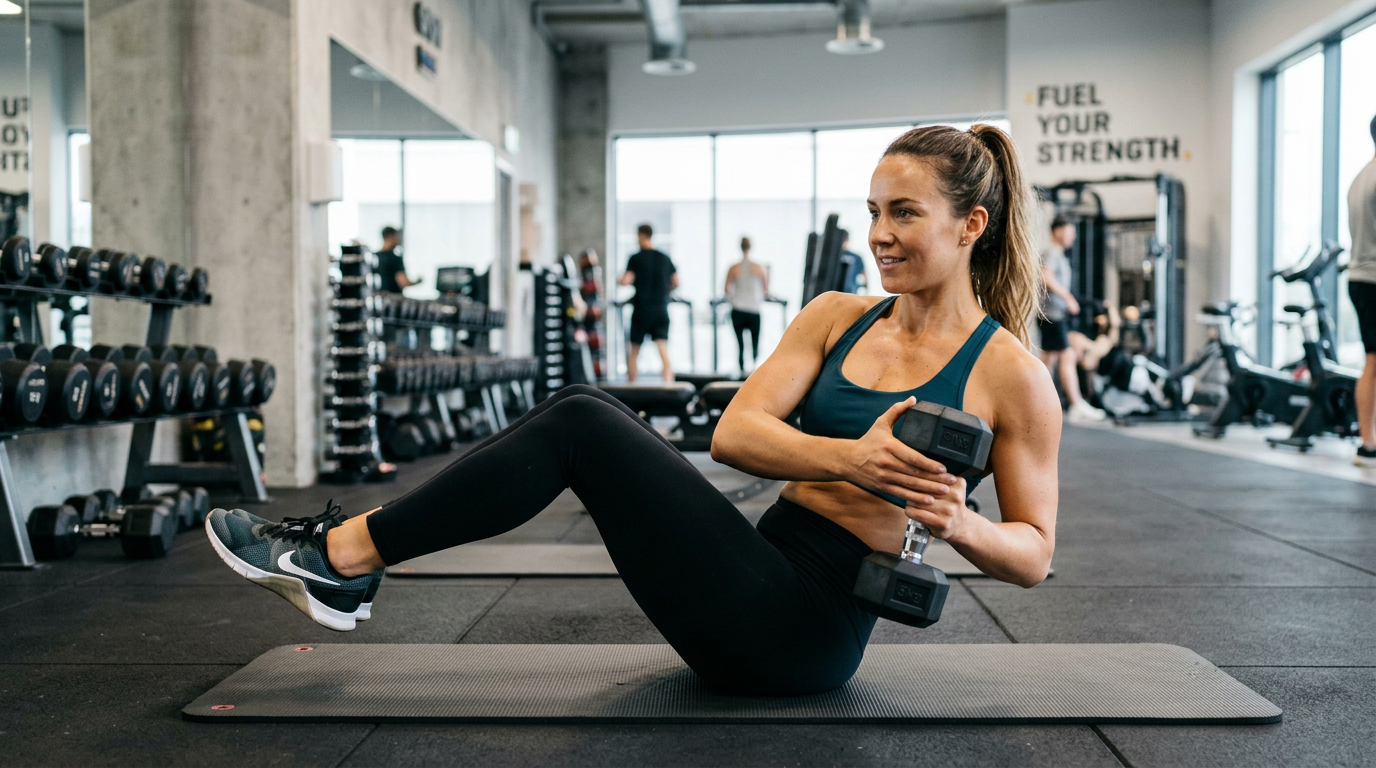
Woman performing weighted Russian twist with dumbbell in gym, demonstrating proper form with neutral spine and controlled rotation
The Best Ab Weight Exercises for Women
These movements represent the most effective weighted exercises for building comprehensive core strength and definition. Each targets different regions and functions of your abdominal muscles.
Weighted Russian Twists
Russian twists with a dumbbell or weight plate specifically target your obliques while challenging rotational core strength. This exercise builds the muscles along the sides of your waist that create that defined, athletic look.
How to perform weighted Russian twists:
- Sit on the floor with knees bent and feet elevated slightly off the ground
- Hold a dumbbell or weight plate with both hands at chest level
- Lean back slightly to engage your core, maintaining a straight spine
- Rotate your torso to the right, bringing the weight toward the floor beside your hip
- Return to center, then rotate to the left side
- Continue alternating sides for 10-15 repetitions per side
Start with 5-10 pounds and focus on controlled rotation rather than momentum. Keep your chest lifted and avoid rounding your spine forward.
Cable Crunches
Cable crunches allow for smooth, adjustable resistance that targets your rectus abdominis—the "six-pack" muscles. The cable provides constant tension throughout the movement, maximizing muscle engagement.
How to perform cable crunches:
- Attach a rope handle to a high cable pulley
- Kneel facing away from the machine, holding the rope beside your head
- Engage your core and crunch downward, bringing your elbows toward your knees
- Focus on flexing your abs rather than pulling with your arms
- Pause briefly at the bottom, then return to the starting position with control
- Complete 12-15 repetitions for 3-4 sets
The key is moving from your abs, not your hips. Your hips should remain stationary while your ribcage moves toward your pelvis.
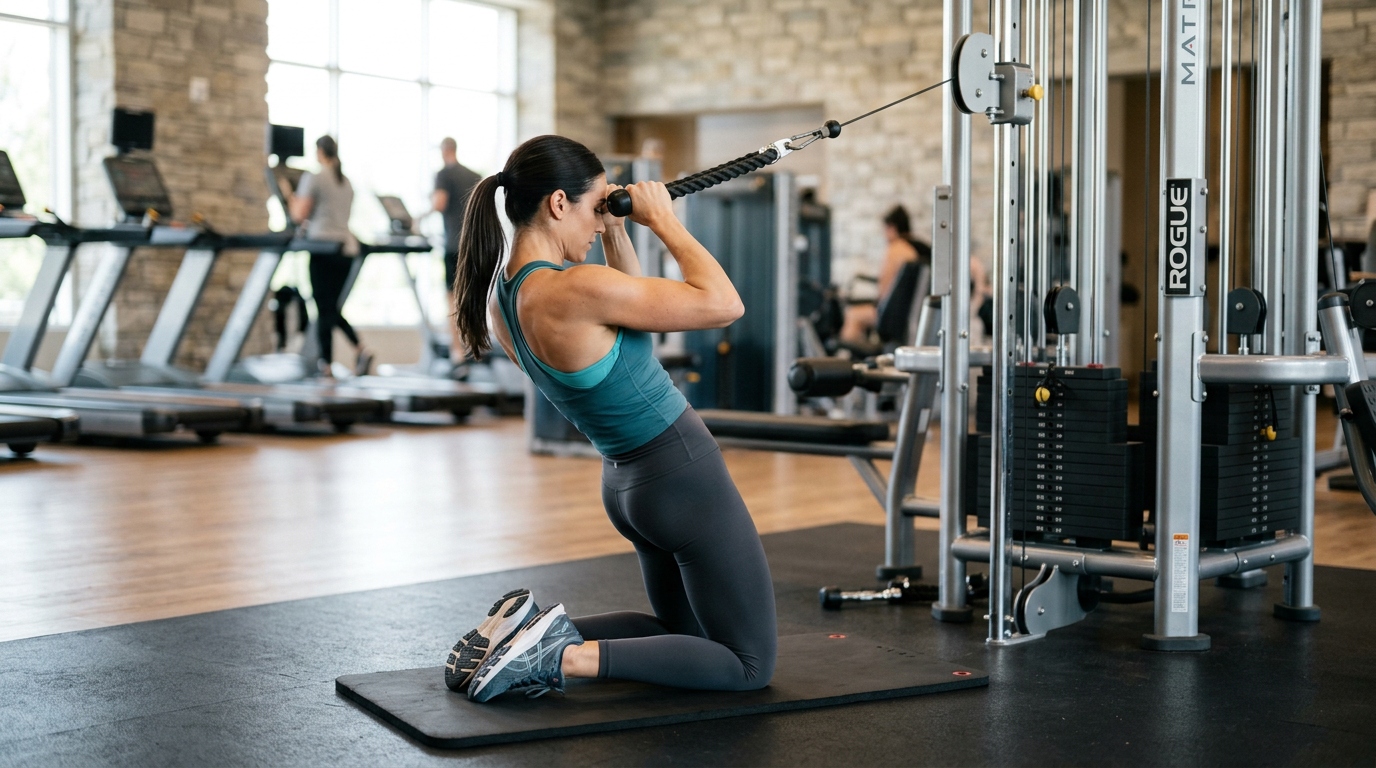
Woman demonstrating cable crunch exercise at cable machine with proper kneeling form and core engagement
Weighted Planks
Adding a weight plate to your back transforms the traditional plank into a powerful anti-extension exercise that builds serious core endurance and stability. Weighted planks train your entire core to resist spinal extension under load, which directly translates to better performance in compound lifts.
How to perform weighted planks:
- Set up in a forearm plank position with proper alignment
- Have a training partner place a weight plate on your mid-back
- Maintain a neutral spine without sagging or piking your hips
- Brace your core as if preparing for a punch to your stomach
- Hold for 30-60 seconds, maintaining perfect form throughout
- Rest and repeat for 3-4 sets
Start with 10-25 pounds and progress gradually. Quality always trumps duration—stop when your form breaks down.
Dumbbell Side Bends
This exercise specifically targets your obliques through lateral flexion, building strength and definition along the sides of your torso. Side bends also improve your ability to resist lateral movement during other exercises.
How to perform dumbbell side bends:
- Stand with feet hip-width apart, holding a dumbbell in your right hand
- Place your left hand behind your head or on your hip
- Keeping your torso facing forward, bend laterally to the right
- Use your left obliques to pull yourself back to the starting position
- Complete 12-15 reps, then switch sides
- Perform 3 sets per side
Avoid leaning forward or backward—move purely in the lateral plane. The weight side provides resistance while the opposite side does the work of returning you upright.
Weighted Dead Bugs
Dead bugs with ankle weights or a light dumbbell challenge your core stability while training coordination and control. This exercise is exceptional for building anti-extension strength in a safe, controlled position.
How to perform weighted dead bugs:
- Lie on your back with arms extended toward the ceiling, holding a light dumbbell (3-8 pounds)
- Lift your legs to tabletop position with knees bent at 90 degrees
- Press your lower back into the floor and maintain this connection throughout
- Slowly extend your right leg while lowering your left arm overhead
- Return to the starting position, then alternate sides
- Complete 8-10 repetitions per side for 3 sets
The moment your lower back arches off the floor, you've gone too far—this exercise is about control, not range of motion.
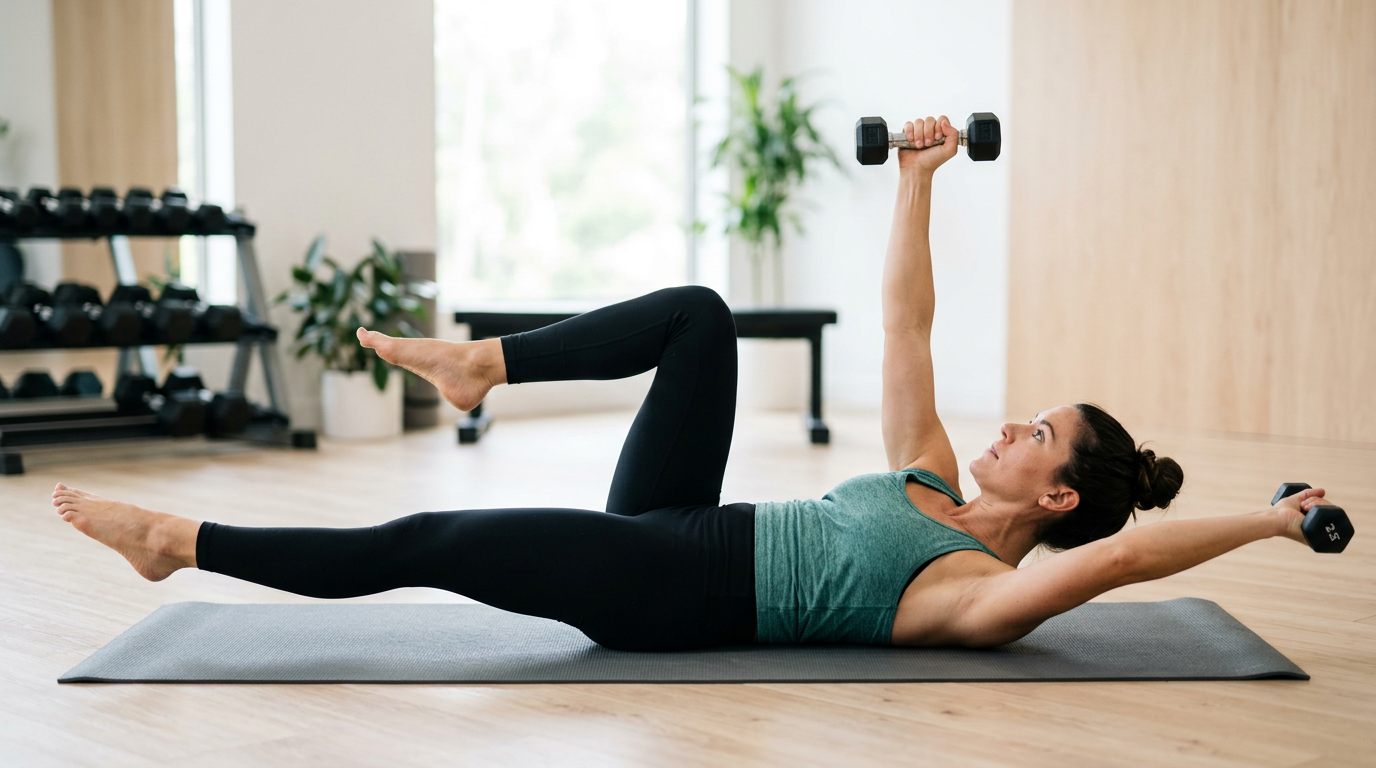
Woman performing weighted dead bug exercise on mat, demonstrating proper lower back position and opposite arm-leg extension
Pallof Press
The Pallof press is an anti-rotation exercise that builds incredible core stability and strength. Using a cable or resistance band, you resist rotational forces that try to pull your torso out of alignment.
How to perform the Pallof press:
- Set a cable at chest height and stand perpendicular to the machine
- Hold the handle with both hands at your chest, feet shoulder-width apart
- Step away from the machine to create tension in the cable
- Press the handle straight out from your chest, resisting the cable's pull
- Hold for 2-3 seconds, then return to your chest
- Complete 10-12 reps, then switch sides
Your hips and shoulders should remain square throughout the movement. Start with moderate resistance and focus on preventing any rotation or side-bending.
Overhead Weighted Crunches
Holding a weight plate or dumbbell overhead during crunches increases the resistance your abs must overcome, making each repetition significantly more challenging than bodyweight versions.
How to perform overhead weighted crunches:
- Lie on your back with knees bent and feet flat on the floor
- Hold a weight plate with both hands, arms extended toward the ceiling
- Engage your core and lift your shoulder blades off the floor
- Focus on bringing your ribcage toward your pelvis, not just lifting your arms
- Lower with control and repeat for 12-15 repetitions
- Complete 3-4 sets with appropriate rest between
Start with 5-10 pounds and prioritize the mind-muscle connection. You should feel your abs working intensely, not your neck or hip flexors.
How to Structure Your Weighted Ab Training
Strategic programming ensures you build strength progressively while allowing adequate recovery. Your abs are muscles that need both stimulus and rest to grow stronger.
Training Frequency and Volume
Train your abs with weights 2-3 times per week, allowing at least 48 hours between sessions for optimal recovery and adaptation. Unlike the outdated advice to train abs daily, weighted core work requires recovery time just like any other muscle group.
Effective weekly volume guidelines:
- Beginners: 6-9 total sets per week across 2 sessions
- Intermediate: 10-15 total sets per week across 2-3 sessions
- Advanced: 15-20 total sets per week across 3 sessions
Each set should include 8-15 repetitions for most exercises, or 30-60 second holds for static movements like weighted planks. Rest 60-90 seconds between sets to allow partial recovery while maintaining workout efficiency.
Exercise Selection Strategy
Your core has multiple functions: flexion, extension, lateral flexion, rotation, and anti-movement (stability). A comprehensive program includes exercises that address each function.
Sample workout structure for balanced core development:
- Flexion exercise: Cable crunches or overhead weighted crunches (3 sets)
- Anti-extension exercise: Weighted planks or weighted dead bugs (3 sets)
- Rotation or anti-rotation: Russian twists or Pallof press (3 sets)
- Lateral flexion: Dumbbell side bends (2-3 sets per side)
Rotate exercises every 4-6 weeks to prevent adaptation and maintain progress. Your muscles respond best to variety combined with progressive overload.
Progressive Overload for Abs
Apply the same progression principles to ab training that you use for other muscle groups. Progressive overload can be achieved through multiple variables:
- Increased weight: Add 2.5-5 pounds when you can complete the upper end of your rep range with good form
- Additional repetitions: Progress from 8 to 15 reps before increasing weight
- Longer time under tension: Slow down the eccentric (lowering) phase or add pauses
- Reduced rest periods: Decrease rest from 90 to 60 seconds between sets
- Increased training frequency: Add one additional session per week when recovery allows
Track your workouts in a journal or app to ensure you're progressing consistently. Small, incremental improvements compound into significant strength gains over months.
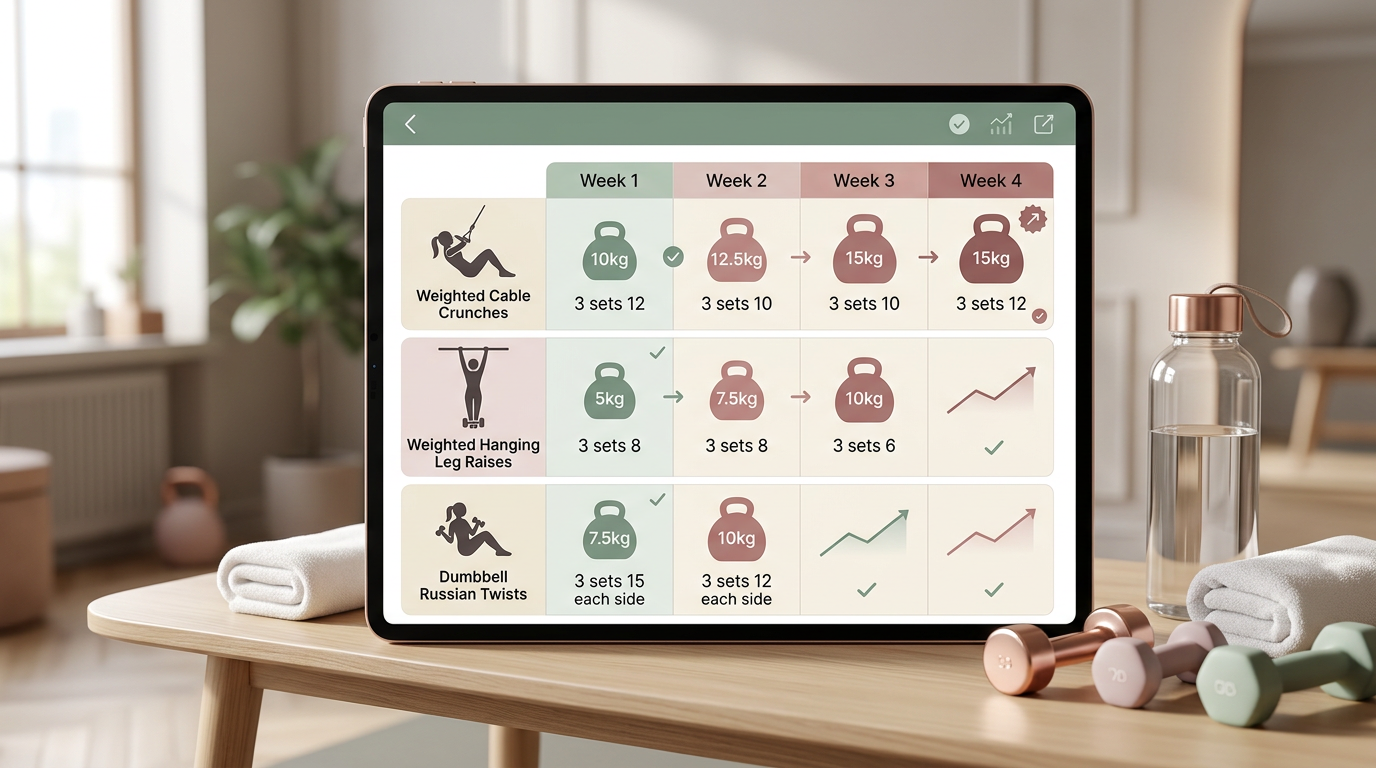
Fitness journal or app screenshot showing progressive overload tracking for weighted ab exercises with increasing weights and reps
Common Mistakes to Avoid
Even experienced lifters make errors when adding weights to ab training. Avoiding these mistakes accelerates your progress and prevents injury.
Using Too Much Weight Too Soon
Starting with excessive weight compromises form, shifts tension away from your abs, and increases injury risk, particularly to your lower back and hip flexors. Your ego might want to load up the weight, but your core needs time to adapt to new movement patterns.
Begin conservatively with 5-10 pounds for most exercises. Master the movement pattern and mind-muscle connection before progressing. You should feel your abs working intensely, not your neck, back, or other compensating muscles.
Neglecting the Eccentric Phase
Many people focus only on the lifting or crunching portion of exercises, rushing through the lowering phase. The eccentric (lengthening) phase builds significant strength and muscle when performed with control.
Take 2-3 seconds to lower the weight or return to the starting position. This controlled tempo maximizes time under tension and muscle fiber recruitment while improving your mind-muscle connection.
Training Abs in Isolation
Your core doesn't function in isolation—it stabilizes your entire body during compound movements. While dedicated ab weight exercises build targeted strength, they should complement, not replace, full-body training.
Compound exercises that heavily engage your core:
- Squats and front squats
- Deadlifts and Romanian deadlifts
- Overhead presses
- Single-leg exercises like lunges and Bulgarian split squats
- Farmer's carries and loaded carries
- Pull-ups and chin-ups
These movements require intense core stabilization under load, building functional strength that transfers to daily activities and sports performance.
Ignoring Nutrition
Ab weight exercises build stronger, more defined muscles, but visible abs require reducing body fat through proper nutrition. You cannot out-train a poor diet, and spot reduction is physiologically impossible.
Focus on a balanced approach that includes adequate protein (0.7-1 gram per pound of body weight), sufficient calories to support training, and nutrient-dense whole foods. Sustainable fat loss occurs through a modest caloric deficit combined with consistent strength training.
Forgetting to Breathe
Proper breathing enhances core engagement and prevents dangerous spikes in blood pressure during weighted exercises. Many people hold their breath during ab exercises, which reduces performance and can cause dizziness.
Exhale during the concentric (working) phase of each exercise and inhale during the eccentric (lowering) phase. For isometric holds like weighted planks, maintain steady breathing rather than holding your breath.
Equipment Options for Home and Gym
You don't need an elaborate setup to perform effective ab weight exercises. Both home and gym environments offer excellent options for progressive core training.
Essential Equipment for Home Training
Building a home ab training setup requires minimal investment:
- Adjustable dumbbells: The most versatile option, allowing weight progression from 5-50+ pounds
- Weight plates: Affordable and space-efficient for exercises like Russian twists and weighted planks
- Resistance bands: Portable and effective for Pallof presses and other anti-rotation movements
- Ankle weights: Perfect for weighted leg raises and dead bug variations
- Medicine ball: Excellent for rotational exercises and overhead movements
- Exercise mat: Provides cushioning for floor-based exercises
Start with a pair of 5-15 pound dumbbells and a set of resistance bands. This minimal setup enables dozens of effective weighted core exercises.
Gym Equipment Advantages
Training at a gym provides access to specialized equipment that enhances certain movements:
- Cable machines: Offer adjustable, constant tension for crunches, woodchops, and Pallof presses
- Weight plate trees: Easy access to various weights for quick progression
- Decline benches: Increase difficulty for weighted crunches and sit-ups
- Landmine attachments: Enable unique rotational exercises and anti-rotation movements
- Ab wheels with weight vests: Advanced option for experienced lifters
The best equipment is whatever you'll use consistently—don't let limited equipment become an excuse for skipping core training.
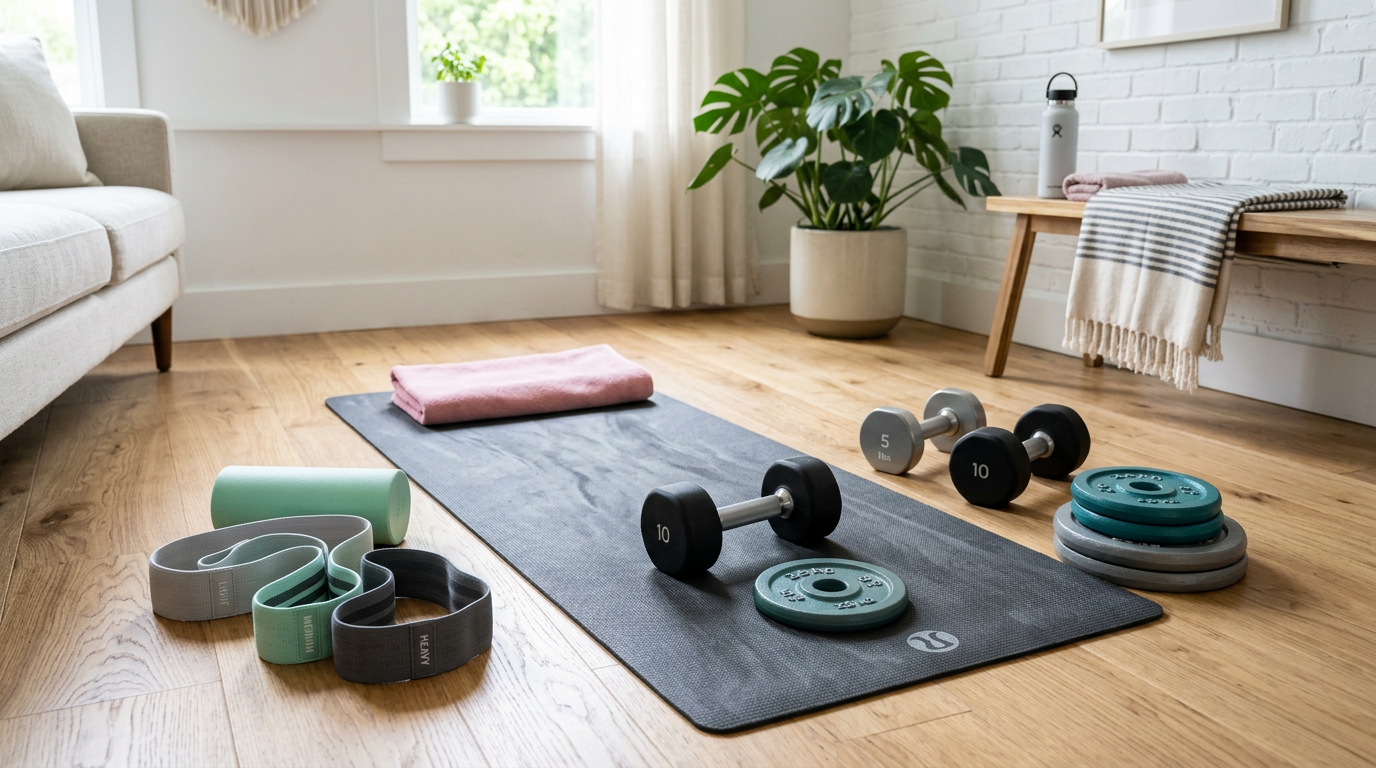
Home workout setup showing dumbbells, weight plates, resistance bands, and exercise mat arranged for weighted ab training
Modifications for Different Fitness Levels
Ab weight exercises can be scaled to match your current strength level, ensuring safe progression regardless of where you're starting.
Beginner Modifications
If you're new to weighted core training, these modifications build foundational strength:
- Start with bodyweight mastery: Ensure you can perform 15-20 quality bodyweight reps before adding resistance
- Use light weights: Begin with 3-5 pound dumbbells or a 5-pound plate
- Reduce range of motion: Perform partial movements with perfect form rather than full range with compensation
- Add stability: Keep feet on the ground during Russian twists until you build sufficient strength
- Use resistance bands: Bands provide variable resistance that's lighter at weak points in the movement
Progress gradually over weeks and months. Building a strong foundation prevents injury and accelerates long-term results.
Advanced Progressions
Experienced lifters can intensify ab weight exercises through advanced techniques:
- Tempo training: Use a 4-2-1 tempo (4 seconds eccentric, 2 second pause, 1 second concentric)
- Paused reps: Hold the peak contraction for 3-5 seconds on each repetition
- Drop sets: Perform a set to near-failure, reduce weight by 20-30%, and continue immediately
- Supersets: Pair complementary exercises like cable crunches with Pallof presses
- Unstable surfaces: Perform weighted exercises on a stability ball or BOSU for increased challenge
- Weighted carries: Add farmer's carries, waiter walks, and suitcase carries for dynamic core work
These advanced techniques should be implemented strategically, not in every workout. Periodize your training to include phases of higher intensity followed by deload weeks for recovery.
Pregnancy and Postpartum Considerations
Pregnant and postpartum women need modified approaches to core training. During pregnancy, avoid exercises that create excessive intra-abdominal pressure or require lying flat on your back after the first trimester.
Safe alternatives include standing cable exercises, modified side planks, and breathing-focused core work. Postpartum, work with a pelvic floor physical therapist to address any diastasis recti before progressing to weighted ab exercises.
Integrating Ab Work Into Your Training Split
Strategic placement of ab weight exercises within your overall program maximizes results without interfering with other training goals.
Training Day Placement
Perform dedicated ab work at the end of your workout rather than at the beginning, since a fatigued core compromises your ability to stabilize during compound lifts. Save weighted core exercises for after your main lifts when spinal stability is no longer critical.
Ideal training day pairings:
- Lower body days: Add anti-rotation exercises like Pallof presses that don't further fatigue your already-worked core
- Upper body days: Include flexion and rotation exercises like cable crunches and Russian twists
- Dedicated core days: If training 5-6 days per week, dedicate one session entirely to comprehensive core work
Sample Weekly Schedule
Here's how to integrate ab weight exercises into a balanced training program:
Monday - Lower Body + Core:
- Squats, lunges, hip thrusts (main workout)
- Pallof press: 3 sets of 12 per side
- Weighted planks: 3 sets of 45 seconds
Wednesday - Upper Body + Core:
- Overhead press, rows, bench press (main workout)
- Cable crunches: 4 sets of 12-15
- Russian twists: 3 sets of 20 total reps
Friday - Full Body + Core:
- Deadlifts, pull-ups, Bulgarian split squats (main workout)
- Dumbbell side bends: 3 sets of 12 per side
- Weighted dead bugs: 3 sets of 10 per side
This structure provides adequate core stimulus while allowing recovery between sessions. Adjust frequency based on your recovery capacity and training experience.
Frequently Asked Questions
What is the best AB exercise with weights?
Cable crunches are the best weighted ab exercise because they provide constant tension throughout the movement and allow precise resistance adjustments. They directly target the rectus abdominis while minimizing hip flexor involvement. For comprehensive core development, combine cable crunches with anti-rotation movements like Pallof presses.
What weight exercises work abs?
Compound exercises like squats, deadlifts, overhead presses, and front squats heavily engage your abs as stabilizers. Isolation exercises include cable crunches, weighted Russian twists, dumbbell side bends, Pallof presses, and weighted planks. Both categories build core strength when performed with proper form and progressive resistance.
What are the big 3 ab exercises?
The big 3 ab exercises are cable crunches for flexion, weighted planks for anti-extension, and Pallof presses for anti-rotation. These three movements target all primary core functions and build comprehensive strength. Perform them 2-3 times weekly with progressive resistance for optimal results.
What are 5 good ab exercises?
Five excellent ab exercises are cable crunches, weighted Russian twists, Pallof presses, weighted planks, and dumbbell side bends. This combination targets flexion, rotation, anti-rotation, anti-extension, and lateral flexion. Perform 3-4 sets of 8-15 reps or 30-60 second holds for each exercise twice weekly.
How much weight should I use for ab exercises?
Start with 5-10 pounds for most weighted ab exercises and focus on perfect form. Progress to heavier weights when you can complete 15 repetitions with control. Your abs should fatigue within 8-15 reps at the appropriate weight. Prioritize form and muscle engagement over lifting heavy.
How often should I train abs with weights?
Train abs with weights 2-3 times per week, allowing 48 hours between sessions for recovery. Your core muscles need rest to adapt and grow stronger, just like other muscle groups. Beginners should start with 2 sessions weekly, while advanced lifters can handle 3 sessions with higher volume.
Can weighted ab exercises reduce belly fat?
Weighted ab exercises build muscle and strength but don't directly reduce belly fat through spot reduction. Visible abs require reducing overall body fat through a caloric deficit, proper nutrition, and consistent strength training. Weighted core work builds the muscle that becomes visible as you lose fat.
Conclusion
Adding resistance to your core training transforms basic ab work into a powerful strength-building practice. The best ab weight exercises—cable crunches, weighted Russian twists, Pallof presses, weighted planks, and dumbbell side bends—target all functions of your core while applying progressive overload principles that drive continuous adaptation.
Start conservatively with 5-10 pounds, master proper form, and progress gradually over weeks and months. Train your weighted core 2-3 times weekly, allowing adequate recovery between sessions. Combine dedicated ab work with compound lifts and proper nutrition for comprehensive core development that enhances both performance and aesthetics.
Your core is the foundation of all movement—build it with the same intentionality and progressive approach you apply to the rest of your training. Track your workouts, celebrate small improvements, and trust the process of consistent, intelligent training.