Strength Training for Women Over 50: Build Muscle, Stay Strong
Strength training for women over 50 is resistance exercise that builds muscle mass, increases bone density, and improves metabolic health. The most effective programs include compound movements like squats, deadlifts, and presses performed 2-3 times weekly with progressive overload for optimal strength and longevity.
After 50, your body changes in ways that can feel discouraging. You might notice your clothes fitting differently, everyday tasks becoming harder, or energy levels dropping. But here's the empowering truth: strength training for women over 50 can reverse many age-related changes, helping you build muscle, strengthen bones, and reclaim the vitality you deserve.
The narrative that women should slow down after 50 is outdated and harmful. Research consistently shows that women who strength train in their 50s, 60s, and beyond experience remarkable improvements in muscle mass, bone density, balance, and overall quality of life. You're not too old to start, and it's never too late to get stronger.
This comprehensive guide will walk you through everything you need to know about strength training after 50, from understanding the unique benefits for your age group to creating an effective workout routine that fits your lifestyle. You'll discover how to exercise safely, what equipment you need, and how to progress at a pace that builds confidence alongside muscle.
Key Takeaways
- Women over 50 should strength train 2-3 times per week to build muscle and bone density effectively
- Progressive overload and compound movements deliver the best results for strength and functional fitness
- Proper form and recovery are more important than heavy weights, especially when starting
- Strength training combats age-related muscle loss, improves metabolism, and enhances independence
- Most women can safely lift weights with conditions like osteoporosis when following proper guidelines
Why Strength Training for Women Over 50 Is Essential
The years after 50 bring significant physiological changes that make strength training more important than ever. Understanding these changes empowers you to take targeted action.
Combat Age-Related Muscle Loss
Muscle loss accelerates after 30, with women losing approximately 3-5% of muscle mass per decade. This process, called sarcopenia, speeds up significantly after menopause. Strength training is the only proven method to rebuild lost muscle tissue and prevent further decline.
Without intervention, this muscle loss leads to decreased strength, slower metabolism, and reduced functional capacity. Simple activities like carrying groceries, climbing stairs, or playing with grandchildren become increasingly difficult. Resistance training reverses this trajectory, allowing you to maintain and even increase muscle mass well into your later years.
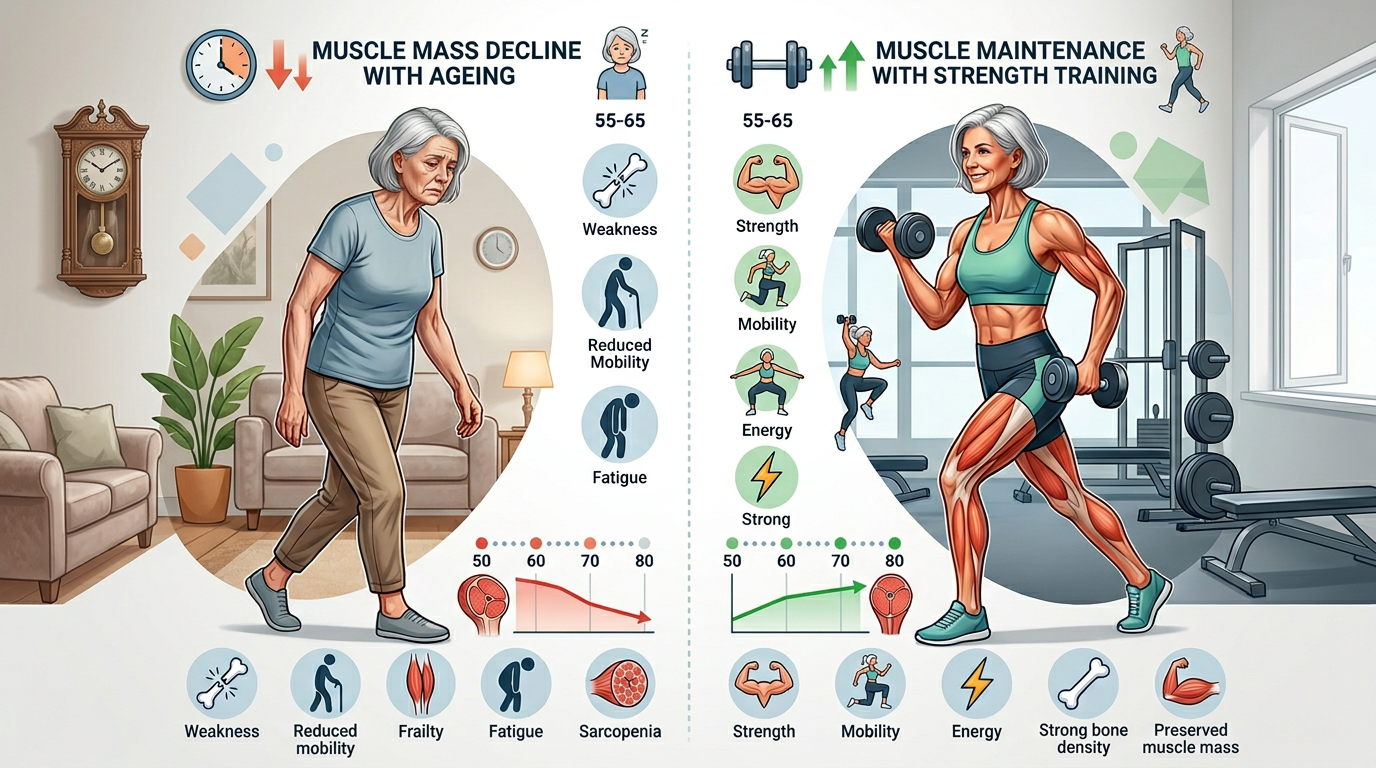
Comparison infographic showing muscle mass decline with age versus muscle maintenance with strength training for women over 50
Protect Your Bone Health
Bone density decreases rapidly after menopause due to declining estrogen levels. This puts women at significantly higher risk for osteoporosis and fractures. Weight-bearing exercises create mechanical stress on bones, stimulating them to become denser and stronger.
Strength training is one of the most effective interventions for building and maintaining bone density. The progressive loading of resistance exercises signals your body to reinforce bone structure, particularly in high-risk areas like the hips, spine, and wrists.
Boost Your Metabolism and Body Composition
Muscle tissue burns more calories at rest than fat tissue. As you lose muscle with age, your metabolic rate decreases, making weight management increasingly challenging. Building muscle through strength training elevates your resting metabolic rate, helping you maintain a healthy body composition.
This metabolic boost extends beyond the workout itself. Your body continues burning additional calories for hours after strength training as it repairs and builds muscle tissue. This "afterburn effect" contributes to better weight management and improved energy levels throughout the day.
Enhance Balance and Prevent Falls
Falls become a serious health concern as we age, often leading to fractures, hospitalizations, and loss of independence. Strength training improves balance, coordination, and proprioception—your body's awareness of its position in space.
Exercises that challenge stability, like single-leg movements and functional patterns, train your body to react quickly and maintain balance in everyday situations. This translates directly to fall prevention and greater confidence in your movements.
How to Start Strength Training After 50
Beginning a strength training program requires thoughtful planning and patience. The goal is sustainable progress, not overnight transformation.
Get Medical Clearance First
Before starting any new exercise program, consult with your healthcare provider, especially if you have existing health conditions like osteoporosis, arthritis, heart disease, or high blood pressure. Most women receive clearance to strength train with appropriate modifications.
Your doctor can identify any specific precautions you should take and may recommend working with a physical therapist or certified trainer initially. This proactive approach ensures you exercise safely and effectively from day one.
Master Bodyweight Movements First
You don't need equipment to start building strength. Bodyweight exercises teach proper movement patterns and build foundational strength before adding external resistance. Focus on these fundamental movements:
- Squats: Develop leg strength and practice the hip hinge pattern essential for daily activities
- Push-ups: Build upper body and core strength (start with wall or elevated versions)
- Planks: Strengthen your entire core and improve posture
- Glute bridges: Activate and strengthen glutes while protecting your lower back
- Step-ups: Improve single-leg strength and balance
- Bird dogs: Enhance core stability and coordination
Spend 2-4 weeks mastering these movements before progressing to weighted exercises. This foundation prevents injury and accelerates your progress when you add resistance.
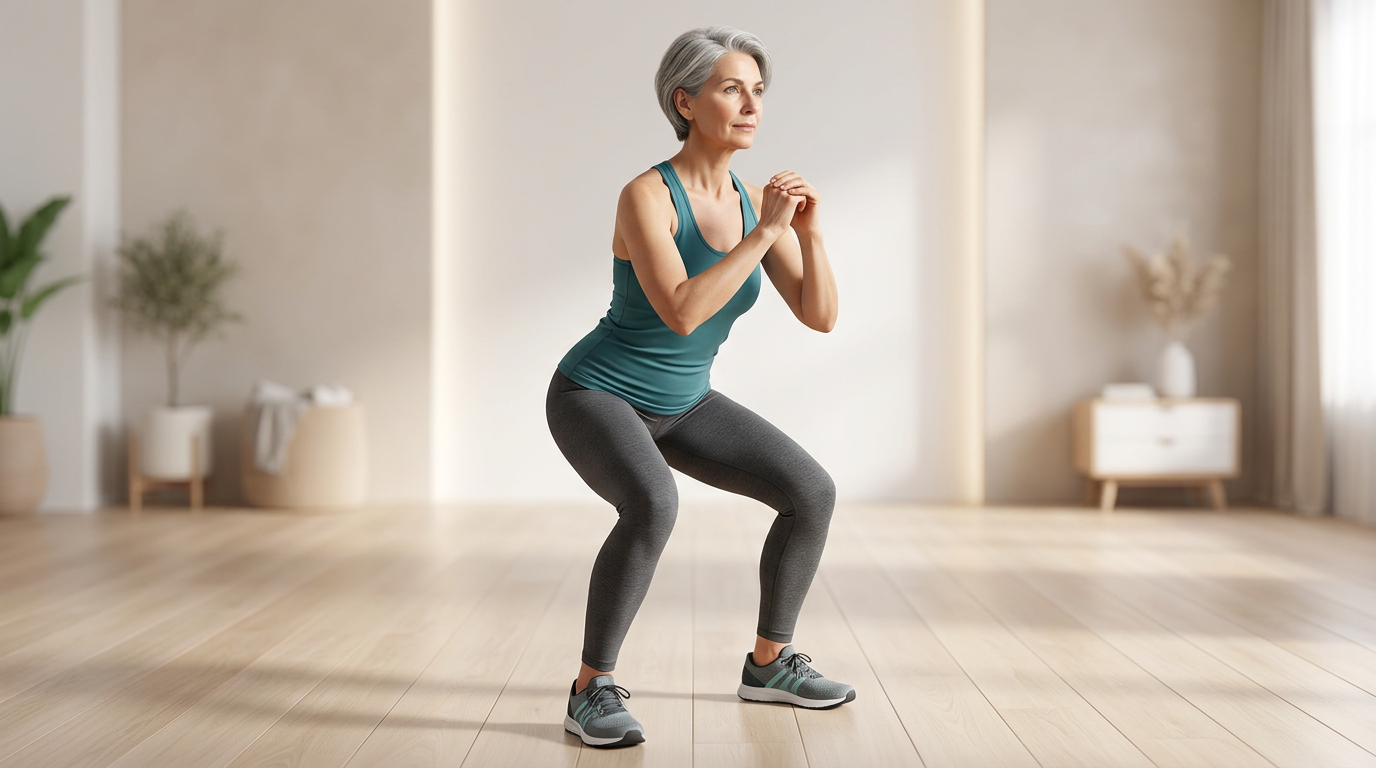
Step-by-step demonstration of proper bodyweight squat form for women over 50 with common mistakes highlighted
Choose the Right Equipment
You can build significant strength with minimal equipment. Start with these versatile, budget-friendly options:
- Resistance bands: Provide variable resistance and are joint-friendly for beginners
- Dumbbells: A set of 5-20 pound dumbbells covers most exercises initially
- Kettlebells: Excellent for functional movements and building total-body strength
- Exercise mat: Provides cushioning for floor exercises
- Stability ball: Adds variety and challenges balance
As you progress, you might add a weight bench, barbell, or heavier dumbbells. However, many women achieve excellent results training at home with just bands and a set of dumbbells.
Learn Proper Form and Technique
Quality of movement always trumps quantity of weight. Poor form leads to injury and limits your results. Consider these options for learning proper technique:
- Work with a certified personal trainer for 3-5 sessions to learn foundational movements
- Use fitness apps with video demonstrations and form cues
- Record yourself performing exercises to identify form issues
- Start with lighter weights than you think you need to perfect technique
- Focus on controlled movements rather than speed or momentum
Investing time in proper form pays dividends throughout your fitness journey. You'll progress faster, avoid setbacks from injury, and build functional strength that transfers to daily life.
Creating Your Strength Training Routine
An effective strength training program balances frequency, intensity, exercise selection, and recovery. Here's how to structure your routine for optimal results.
Optimal Training Frequency
Research shows that women over 50 achieve excellent results training 2-3 times per week. This frequency provides sufficient stimulus for muscle growth while allowing adequate recovery between sessions. Your muscles grow during rest, not during workouts, making recovery as important as training itself.
For beginners, start with 2 full-body sessions per week, spacing them 2-3 days apart. As you adapt, you can add a third session or split your routine into upper body and lower body days. Most women find that 3 well-designed sessions per week deliver the best balance of results and sustainability.
Essential Exercise Categories
A complete strength training program includes movements from each of these categories:
- Lower body push (squats, lunges): Build leg strength and functional movement patterns
- Lower body pull (deadlifts, hip thrusts): Strengthen posterior chain muscles critical for posture
- Upper body push (push-ups, chest press, overhead press): Develop pushing strength for daily activities
- Upper body pull (rows, lat pulldowns): Counterbalance pushing movements and improve posture
- Core stability (planks, dead bugs, pallof press): Protect your spine and improve balance
Select 1-2 exercises from each category per workout. This ensures balanced development and prevents muscle imbalances that lead to injury.
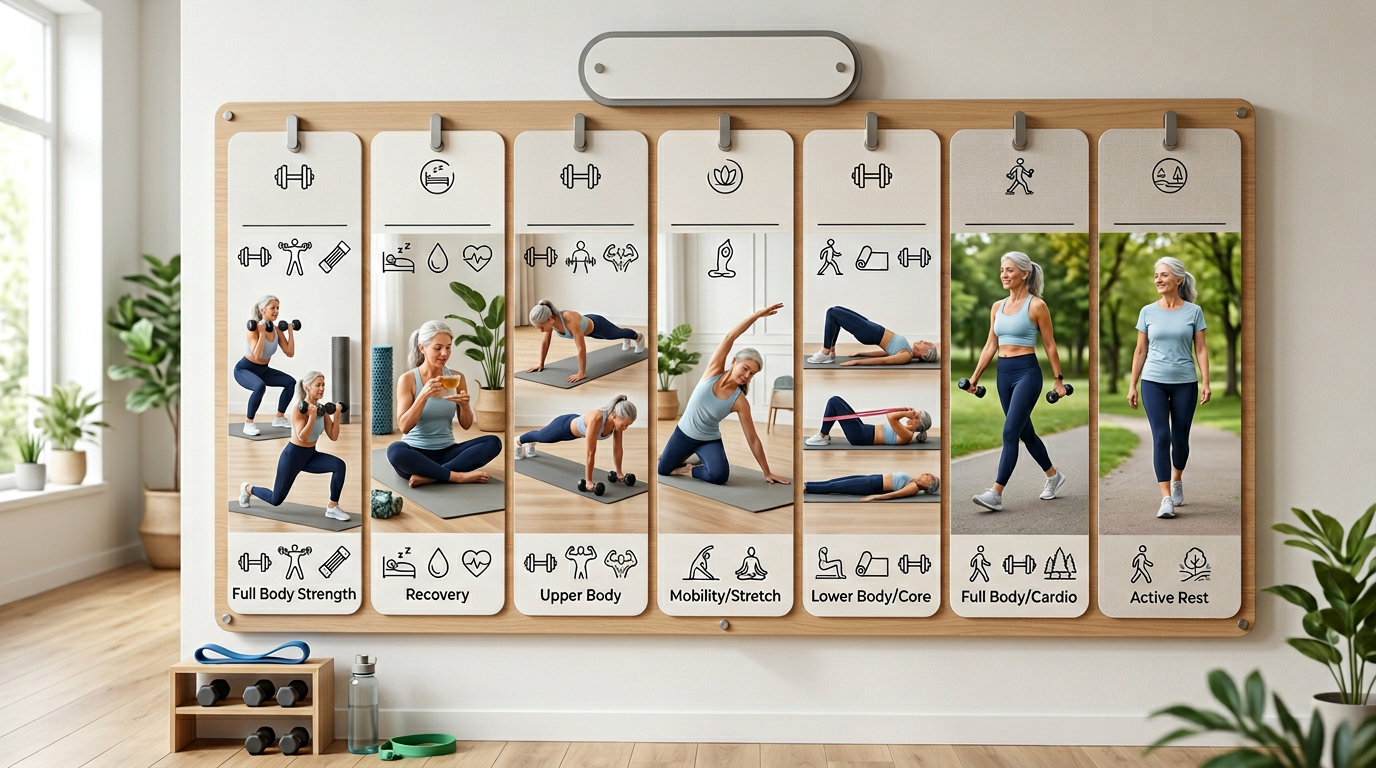
Weekly strength training schedule template for women over 50 showing workout days, rest days, and exercise categories
Sets, Reps, and Progressive Overload
For building strength and muscle after 50, aim for 2-4 sets of 8-12 repetitions per exercise. This rep range effectively stimulates muscle growth while remaining joint-friendly. Progressive overload—gradually increasing the challenge over time—is the key to continued improvement.
You can apply progressive overload through several methods:
- Increase weight by 2-5 pounds when you can complete all sets with good form
- Add one more repetition per set each week
- Perform an additional set of each exercise
- Slow down the tempo, spending 3-4 seconds lowering the weight
- Decrease rest time between sets from 90 to 60 seconds
Progress gradually and celebrate small wins. Adding just 2-3 pounds every few weeks compounds into significant strength gains over months and years.
Sample Full-Body Workout
Here's a beginner-friendly full-body routine to perform 2-3 times per week:
- Goblet Squat: 3 sets of 10-12 reps (hold a dumbbell at chest height)
- Dumbbell Chest Press: 3 sets of 10-12 reps (lying on bench or floor)
- Romanian Deadlift: 3 sets of 10-12 reps (with dumbbells or kettlebell)
- Seated Row: 3 sets of 10-12 reps (with resistance band or cable)
- Overhead Press: 2 sets of 10-12 reps (standing or seated with dumbbells)
- Glute Bridge: 3 sets of 12-15 reps (add weight across hips as you progress)
- Plank Hold: 2-3 sets of 20-45 seconds
Rest 60-90 seconds between sets. The entire workout takes 35-45 minutes including warm-up and cool-down.
Special Considerations for Women Over 50
Your age and life stage require specific attention to certain aspects of training that younger exercisers might overlook.
Menopause and Hormonal Changes
Declining estrogen levels affect muscle recovery, joint health, and body composition. You might notice that you need more recovery time between workouts or that you're more prone to joint discomfort. Listen to your body and adjust your training accordingly rather than pushing through pain.
Focus on exercises that feel good in your body. If certain movements cause joint pain, modify them or choose alternatives that provide similar benefits without discomfort. For example, if traditional squats bother your knees, try goblet squats with a narrower stance or box squats.
Joint Health and Arthritis
Many women over 50 manage arthritis or joint concerns. Contrary to popular belief, strength training typically improves joint health when performed correctly. The key is choosing appropriate exercises and avoiding positions that exacerbate pain.
Prioritize controlled movements through comfortable ranges of motion. Avoid exercises that cause sharp pain, but understand that mild discomfort during movement is normal and often improves as joints warm up. Water-based resistance training or pool exercises provide excellent alternatives for those with significant joint issues.
Training With Osteoporosis
If you have osteoporosis or osteopenia, strength training becomes even more critical for bone health. However, certain precautions are necessary. Weight-bearing and resistance exercises strengthen bones, but you should avoid exercises involving spinal flexion (forward bending) or twisting under load.
Safe exercises for osteoporosis include:
- Standing exercises with weights (squats, lunges, overhead press)
- Resistance band exercises in neutral spine positions
- Wall push-ups and modified planks
- Step-ups and stair climbing
- Rowing movements that strengthen back muscles
Avoid or modify these movements:
- Crunches and sit-ups (spinal flexion)
- Loaded spinal rotation exercises
- Exercises involving jumping or impact (until cleared by your doctor)
- Heavy overhead lifting without proper progression
Always work with a healthcare provider or physical therapist to create a safe, effective program tailored to your bone density status.
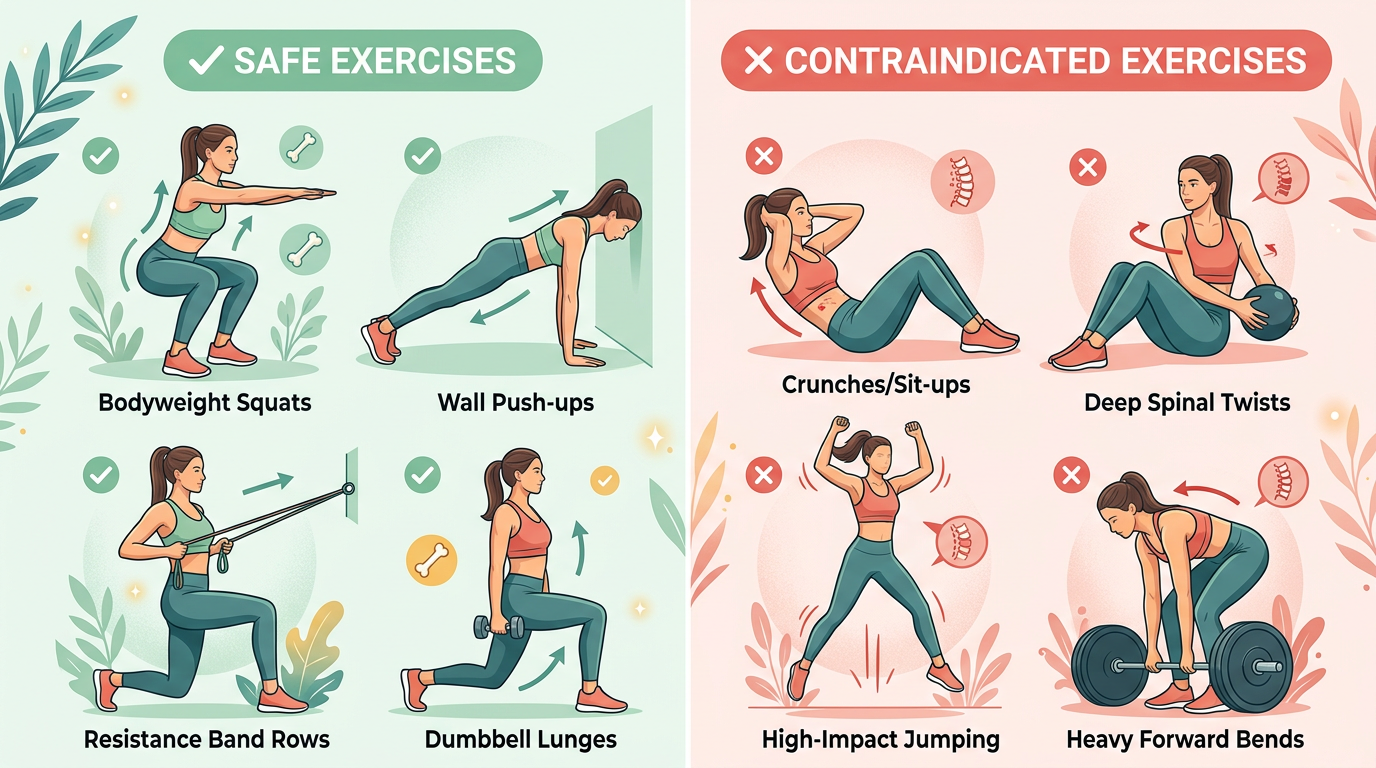
Infographic showing safe versus contraindicated exercises for women with osteoporosis during strength training
Nutrition to Support Your Strength Training
Exercise is only half the equation. Proper nutrition fuels your workouts and supports muscle recovery and growth.
Prioritize Protein Intake
Protein provides the building blocks for muscle tissue. Women over 50 have higher protein needs than younger women due to decreased muscle protein synthesis efficiency. Aim for 1.2-1.6 grams of protein per kilogram of body weight daily, distributed across 3-4 meals.
Excellent protein sources include:
- Lean meats (chicken, turkey, lean beef)
- Fish and seafood (salmon, tuna, shrimp)
- Eggs and egg whites
- Greek yogurt and cottage cheese
- Legumes (beans, lentils, chickpeas)
- Protein powder (whey, casein, or plant-based options)
Consuming 25-30 grams of protein per meal optimizes muscle protein synthesis. Include a protein source within 1-2 hours after strength training to support recovery.
Don't Fear Carbohydrates
Carbohydrates fuel your workouts and replenish muscle glycogen. While you don't need excessive carbs, adequate intake supports energy levels and workout performance. Focus on nutrient-dense sources like fruits, vegetables, whole grains, and legumes.
Time some of your carbohydrate intake around your workouts for optimal energy and recovery. A balanced meal containing protein and carbs 2-3 hours before training provides sustained energy.
Stay Hydrated
Dehydration impairs strength, endurance, and recovery. Many women over 50 experience decreased thirst sensation, making conscious hydration efforts important. Aim for at least 8 glasses of water daily, increasing intake on training days and in hot weather.
Overcoming Common Challenges and Concerns
Starting strength training after 50 comes with unique challenges. Here's how to address the most common concerns.
"I'm Too Old to Start"
This limiting belief stops countless women from experiencing the benefits of strength training. Research consistently demonstrates that women in their 50s, 60s, 70s, and beyond can build significant muscle and strength. Your body retains the ability to adapt and grow stronger at any age.
Start where you are, not where you think you should be. Every woman who strength trains successfully started as a beginner. Your only competition is the person you were yesterday.
Fear of Getting "Bulky"
This concern is based on misconceptions about women's physiology. Women have significantly lower testosterone levels than men, making it extremely difficult to build large, bulky muscles. After 50, hormonal changes make this even less likely.
What you will develop is lean, toned muscle that creates a strong, capable physique. You'll notice improved muscle definition, better posture, and a more confident presence—not excessive bulk.
Dealing With Muscle Soreness
Delayed onset muscle soreness (DOMS) is normal, especially when starting a new program. This soreness typically peaks 24-48 hours after exercise and gradually decreases as your body adapts. Soreness indicates your muscles are adapting, but it shouldn't be debilitating.
Manage soreness through:
- Gentle movement and light activity on rest days
- Adequate protein intake to support recovery
- Proper hydration throughout the day
- Foam rolling and gentle stretching
- Gradual progression rather than doing too much too soon
If soreness persists beyond 3-4 days or is severe, you may have overdone it. Scale back your intensity and volume, then build up more gradually.
Time Constraints and Consistency
Finding time for exercise becomes challenging with busy schedules, family obligations, and other responsibilities. Remember that 2-3 sessions of 30-45 minutes per week delivers significant benefits. That's less than 2% of your week dedicated to an activity that dramatically improves your quality of life.
Schedule workouts like important appointments. Early morning sessions often work best because fewer conflicts arise. Home workouts eliminate travel time and make consistency easier to maintain.
Tracking Progress Beyond the Scale
The number on the scale tells an incomplete story. As you build muscle and lose fat, your body composition changes dramatically even if your weight remains similar.
Better Ways to Measure Success
Focus on performance-based goals and how you feel rather than purely aesthetic outcomes. Track these meaningful indicators of progress:
- Weights lifted: Are you progressively handling heavier loads?
- Repetitions completed: Can you do more reps with the same weight?
- Energy levels: Do you feel more energetic throughout the day?
- Daily activities: Are household tasks and errands easier?
- Sleep quality: Are you sleeping more soundly?
- Clothing fit: How do your clothes feel, regardless of the scale?
- Confidence: Do you feel stronger and more capable?
Take progress photos every 4-6 weeks and measurements of your waist, hips, arms, and thighs. These objective measures reveal changes that daily mirror checks miss.
Celebrate Non-Scale Victories
The most meaningful benefits of strength training often have nothing to do with appearance. Celebrate when you carry all the groceries in one trip, play actively with grandchildren without fatigue, or complete a challenging hike you couldn't have done months earlier.
These functional improvements represent the true value of strength training: maintaining independence, vitality, and quality of life as you age.
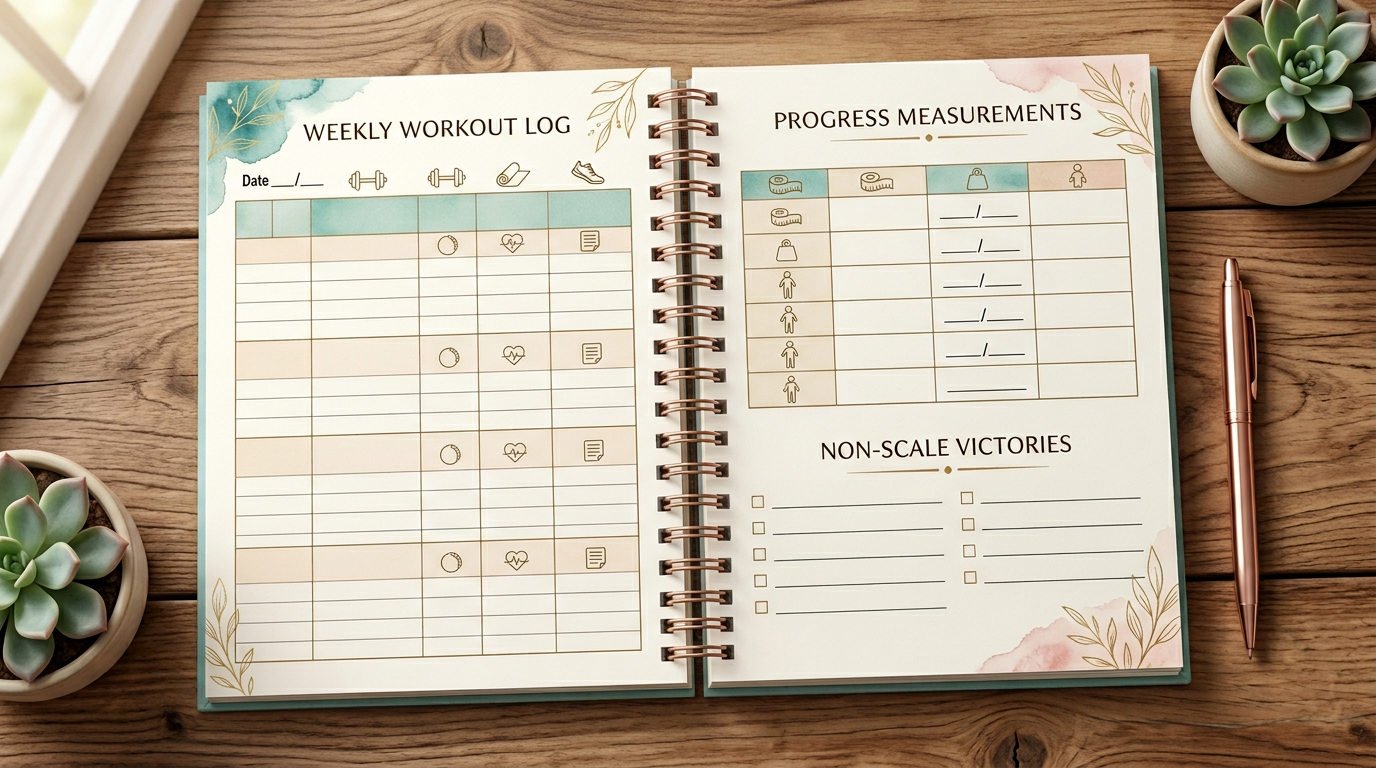
Progress tracking journal template for women over 50 showing workout logs, measurements, and non-scale victory checkboxes
Building a Sustainable Long-Term Practice
Short-term motivation fades. Building a sustainable strength training practice requires systems and mindset shifts that support consistency over years and decades.
Make It Enjoyable
You're far more likely to stick with exercise you genuinely enjoy. Experiment with different training styles, equipment, and environments until you find what resonates with you. Some women love the social aspect of group classes, while others prefer solo home workouts with their favorite music or podcasts.
Variety prevents boredom and keeps your body adapting. Change exercises every 6-8 weeks, try new equipment, or explore different training methods while maintaining the core principles of progressive overload and consistency.
Build a Support System
Women who train with partners or groups show significantly higher adherence rates than those who exercise alone. Find a workout buddy, join a fitness community, or participate in online groups focused on strength training for women over 50.
Share your goals with supportive friends and family. Their encouragement during challenging times helps you maintain consistency when motivation wanes.
Embrace the Long Game
Strength training is a lifelong practice, not a 12-week transformation program. Progress happens gradually through consistent effort over months and years. Some weeks you'll feel strong and motivated; others will be challenging. Both are normal parts of the journey.
Focus on showing up consistently rather than perfection. Two imperfect workouts per week deliver far better results than waiting for the perfect circumstances that never arrive.
Frequently Asked Questions
How many days a week should a woman over 50 do strength training?
Women over 50 should strength train 2-3 times per week for optimal muscle building and bone health. This frequency provides sufficient stimulus for adaptation while allowing adequate recovery between sessions. Beginners should start with 2 sessions weekly, progressing to 3 as they adapt.
What is the 3 3 3 rule for exercise?
The 3 3 3 rule suggests exercising 3 times per week, for 30 minutes per session, at moderate intensity. While this provides a simple framework for beginners, effective strength training for women over 50 typically requires 35-45 minute sessions with progressive resistance rather than just moderate intensity.
Can you lift weights with osteoporosis?
Yes, weight lifting is highly beneficial for osteoporosis when performed correctly. Resistance training builds bone density and strengthens muscles that support your skeleton. Avoid exercises involving spinal flexion or twisting under load, and focus on standing exercises, resistance bands, and controlled movements. Always consult your doctor first.
Can flabby arms be toned after 50?
Absolutely. Strength training builds arm muscle and reduces body fat, creating more defined, toned arms at any age. Focus on exercises like tricep dips, overhead presses, bicep curls, and push-ups combined with adequate protein intake. Results typically appear within 8-12 weeks of consistent training.
Should I do cardio or strength training first?
Perform strength training before cardio when doing both in one session. Strength training requires maximum focus and energy for proper form and progressive overload. Doing cardio first depletes energy stores and compromises strength performance. Alternatively, separate cardio and strength sessions by several hours or different days entirely.
How long does it take to see results from strength training after 50?
Most women notice strength improvements within 2-3 weeks and visible muscle definition within 6-8 weeks of consistent training. Significant body composition changes typically appear after 12-16 weeks. Neural adaptations happen first, allowing you to lift heavier weights before visible muscle growth occurs. Patience and consistency deliver results.
Do I need supplements for strength training over 50?
Most women can build strength effectively through whole foods alone. However, protein powder offers convenient supplementation if you struggle to meet daily protein targets through food. Creatine monohydrate may benefit muscle strength and cognition. Vitamin D and calcium support bone health. Consult your doctor before starting any supplements.
Conclusion
Strength training for women over 50 isn't about turning back the clock—it's about writing a powerful new chapter. You have the opportunity to build strength, confidence, and vitality that enhances every aspect of your life. The physical benefits of increased muscle mass, stronger bones, and improved metabolism are matched by the mental and emotional gains of feeling capable and strong in your body.
Start where you are with the resources you have. Focus on consistency over perfection, progress over comparison, and the long-term journey over quick fixes. Every rep you complete, every workout you show up for, and every small progression you make compounds into remarkable transformation over time. Your future self will thank you for the investment you make today in your strength, health, and independence.