Weighted Squats for Women: Build Strength and Tone
Weighted squats are compound exercises where you perform squats while holding external resistance like dumbbells, barbells, or kettlebells. They build lower body strength, increase bone density, boost metabolism, and sculpt glutes, quads, and hamstrings more effectively than bodyweight variations alone.
If you've been doing bodyweight squats for a while and feel ready to level up, weighted squats are your next powerful step toward building real strength. Adding resistance transforms this foundational movement into a muscle-building, metabolism-boosting powerhouse that delivers visible results.
Whether you're training at home with a pair of dumbbells or at the gym with a loaded barbell, weighted squats help you break through plateaus and achieve the strong, sculpted lower body you're working toward. This comprehensive guide will show you exactly how to incorporate weighted squats into your routine safely and effectively.
You'll learn proper form, discover the best variations for your goals, understand how to progress strategically, and get answers to common questions about this essential strength-building exercise. Let's dive into everything you need to know about weighted squats and how they can transform your training.
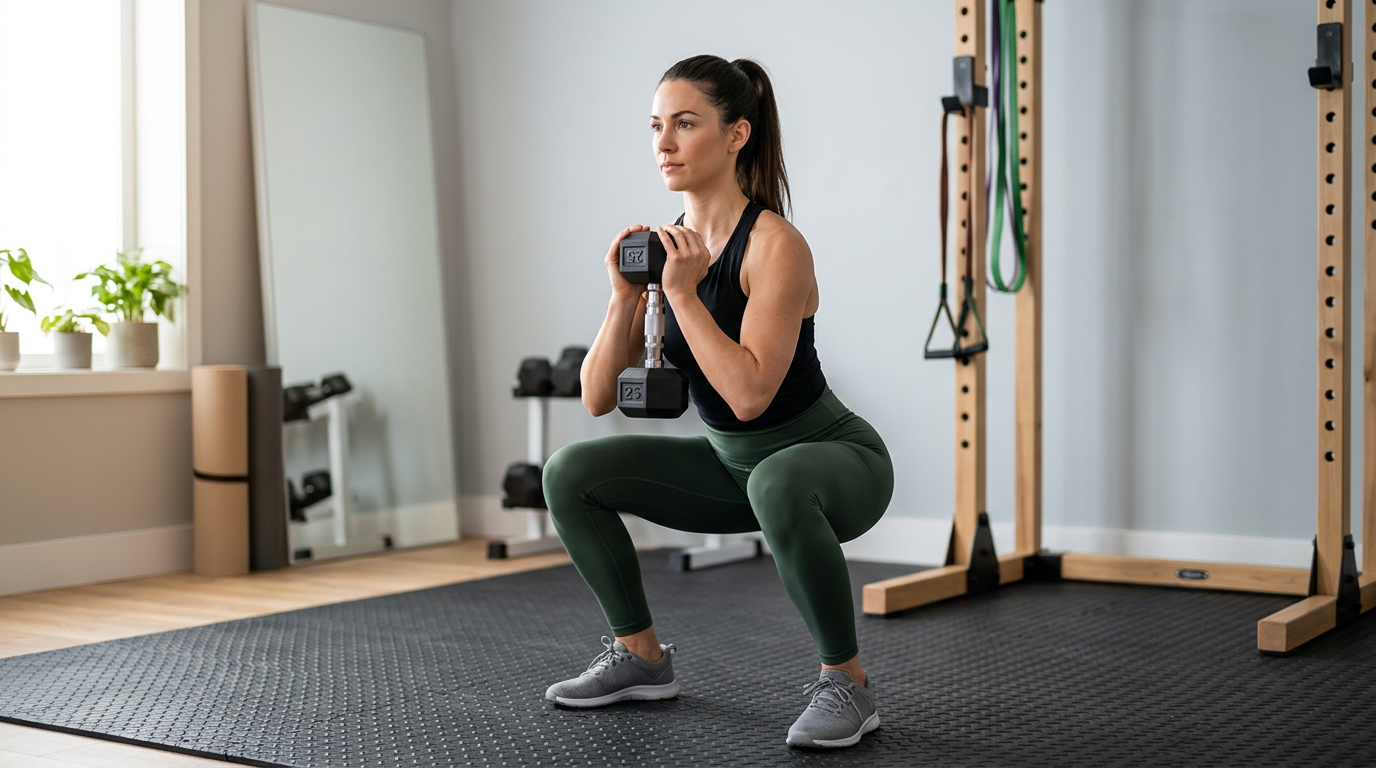
Woman performing a goblet squat with a dumbbell at chest level in a home gym setting, demonstrating proper upright posture and depth
Key Takeaways
- Weighted squats build significantly more strength and muscle than bodyweight variations by applying progressive overload to your lower body
- Start with lighter weights to master form before progressing, focusing on depth, knee alignment, and core engagement
- Multiple variations (goblet, barbell back, front squats) allow you to target different muscles and work around equipment limitations
- Proper form is essential for safety and results—keep your chest up, knees tracking over toes, and weight distributed through your full foot
- Progressive overload through increased weight, reps, or sets drives continuous strength gains and body composition changes
What Are Weighted Squats and Why Should Women Do Them?
Weighted squats involve performing the squat movement pattern while holding external resistance. This added load challenges your muscles beyond what bodyweight alone can provide, triggering greater strength adaptations and muscle development.
The primary benefit of weighted squats is their ability to create progressive overload, the fundamental principle behind building strength and changing your body composition. When you consistently challenge your muscles with increasing resistance, they respond by becoming stronger and more defined.
The Science Behind Weighted Resistance Training
When you add weight to your squats, you increase the mechanical tension on your muscle fibers. This tension signals your body to adapt by building more muscle tissue and strengthening connective tissues like tendons and ligaments.
Research consistently shows that resistance training with external loads produces superior strength and muscle gains compared to bodyweight training alone. The beauty of weighted squats is that they work multiple muscle groups simultaneously, making them incredibly time-efficient.
Benefits Beyond Muscle Building
Weighted squats offer advantages that extend far beyond aesthetics. They increase bone density, which is particularly important for women as we age and face higher osteoporosis risk. The load-bearing nature of squats stimulates bone formation.
Additionally, building lower body strength improves functional fitness for daily activities. Carrying groceries, climbing stairs, playing with children, and maintaining independence as you age all become easier when you have a strong foundation.
- Increased metabolic rate: More muscle tissue means your body burns more calories at rest
- Improved athletic performance: Stronger legs translate to better performance in running, cycling, and sports
- Enhanced core stability: Weighted squats require significant core engagement to maintain proper posture
- Better posture and balance: Strengthening your posterior chain helps counteract sitting and forward posture
- Hormonal benefits: Compound exercises like squats can positively influence hormone production
How to Perform Weighted Squats with Perfect Form
Proper form is non-negotiable when performing weighted squats. Good technique keeps you safe, prevents injury, and ensures you're actually targeting the muscles you want to develop. Let's break down the essential form elements.
The Setup and Starting Position
Begin by standing with your feet slightly wider than hip-width apart, toes pointed slightly outward at about 15-30 degrees. This stance allows for proper hip and knee mechanics during the descent.
Your weight should be distributed evenly across your entire foot, not just your toes or heels. Think about maintaining three points of contact: your big toe, little toe, and heel should all press into the ground throughout the movement.
Before you begin the descent, engage your core by taking a breath and bracing your abdominals as if preparing for someone to tap your stomach. This intra-abdominal pressure protects your spine under load.
The Descent Phase
Initiate the squat by simultaneously pushing your hips back and bending your knees. Imagine sitting back into a chair rather than just dropping straight down. Your knees should track in line with your toes throughout the movement.
Descend until your thighs are at least parallel to the ground, or deeper if your mobility allows. Going to proper depth ensures you're working through a full range of motion and engaging your glutes effectively.
Keep your chest proud and your gaze forward or slightly upward. Avoid rounding your upper back or letting your chest collapse forward, as this places unnecessary stress on your spine.
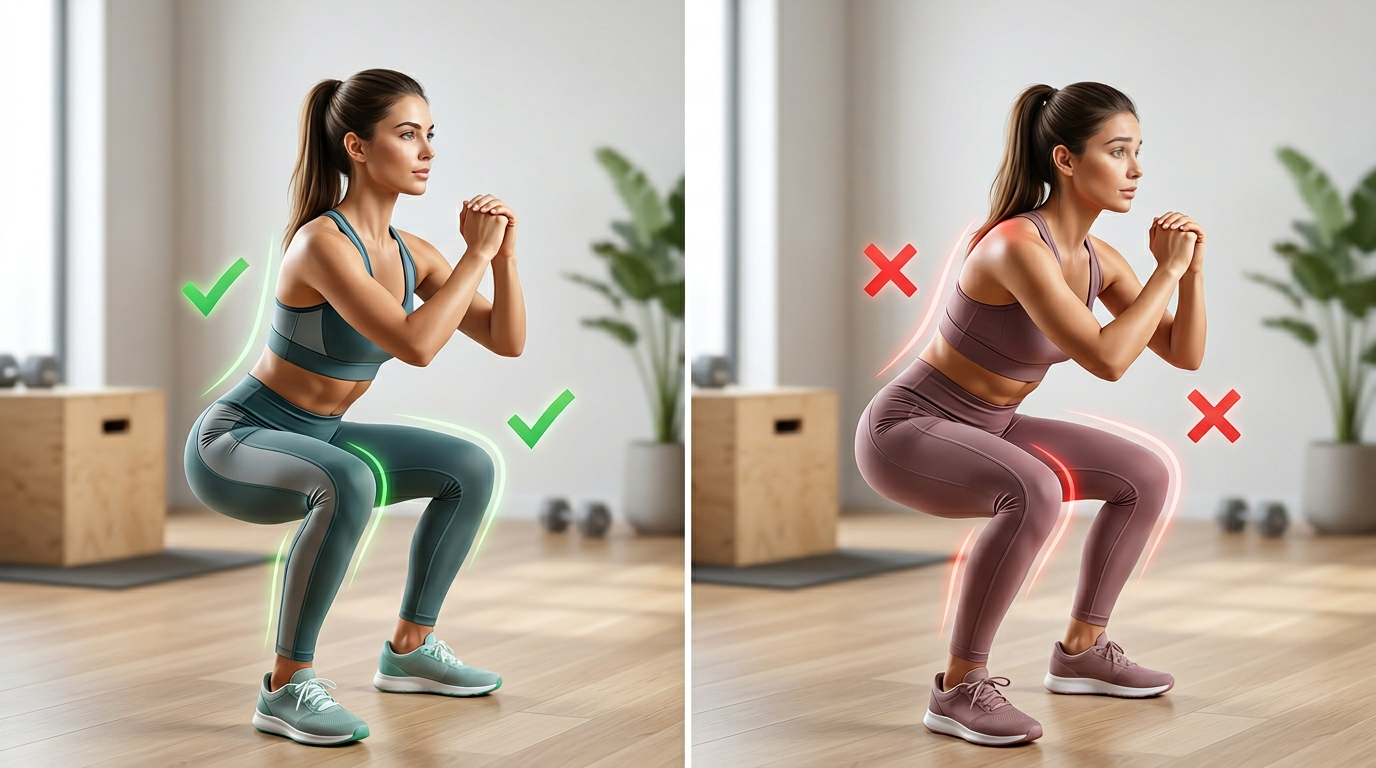
Side-by-side comparison showing proper squat form versus common mistakes, highlighting knee alignment, back position, and depth
The Ascent Phase
Drive through your entire foot to return to standing, thinking about pushing the floor away from you. Your hips and shoulders should rise at the same rate to maintain a consistent torso angle.
Squeeze your glutes at the top of the movement and fully extend your hips. Avoid hyperextending your lower back or thrusting your hips forward excessively.
Maintain core tension throughout the entire repetition, not just during the descent. This continuous engagement protects your spine and maximizes power transfer.
Best Weighted Squat Variations for Women
Different squat variations allow you to target specific muscles, work around equipment limitations, or address individual mobility restrictions. Understanding these options helps you build a well-rounded lower body training program.
Goblet Squats
The goblet squat is the perfect starting point for learning weighted squats. You hold a single dumbbell or kettlebell at chest level, which naturally encourages an upright torso position and makes it easier to maintain proper form.
This variation is excellent for building quad and glute strength while being extremely accessible for home workouts. The front-loaded weight also challenges your core significantly.
To perform a goblet squat, hold the weight close to your chest with both hands, elbows pointing down. Squat as described above, using the weight as a counterbalance to help you sit deeper into the movement.
Barbell Back Squats
The barbell back squat allows you to load the most weight and is considered the king of lower body exercises. The bar rests across your upper back, either in a high bar position (on your traps) or low bar position (on your rear delts).
High bar squats tend to keep you more upright and emphasize the quads, while low bar squats involve more forward lean and engage the posterior chain more heavily. Both are effective; choose based on your goals and comfort.
Start with just the barbell to practice the movement pattern before adding weight plates. Many women worry about building bulky legs, but barbell squats actually create beautiful shape and definition.
Front Squats
Front squats position the barbell across the front of your shoulders, resting on your anterior deltoids. This variation forces an extremely upright torso position and shifts emphasis more heavily to your quads and core.
The front-loaded position is also easier on your lower back compared to back squats, making it a good option if you have any back sensitivity. However, it requires good shoulder and wrist mobility to hold the bar comfortably.
Dumbbell Squats
Holding dumbbells at your sides or on your shoulders provides another accessible option for weighted squats. This variation works well for home training and allows for natural arm positioning.
You can hold the dumbbells in a farmer's carry position (arms at sides) or racked on your shoulders. The farmer's carry position is simpler but may be limited by your grip strength as weights get heavier.
- Bulgarian split squats: Single-leg variation with rear foot elevated that intensely targets glutes and quads
- Sumo squats: Wide stance with toes pointed out, emphasizing inner thighs and glutes
- Box squats: Squatting to a box or bench helps develop power and ensures consistent depth
- Pause squats: Adding a 2-3 second pause at the bottom builds strength in the most challenging position
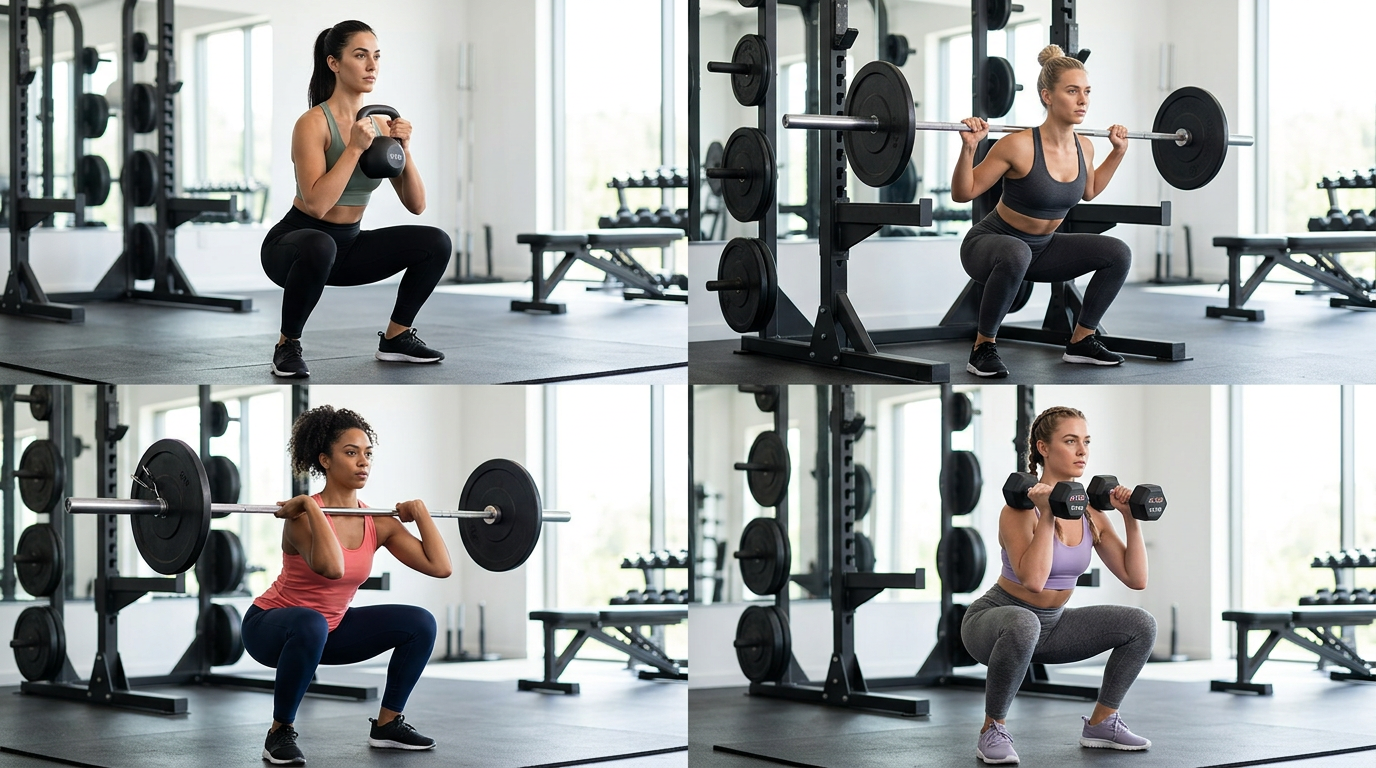
Collage showing four different weighted squat variations: goblet squat, barbell back squat, front squat, and dumbbell squat with proper form demonstrated
How to Progress Your Weighted Squats Safely
Progressive overload is the key to continuous improvement, but it must be applied intelligently to avoid injury and burnout. Here's how to systematically increase the challenge of your weighted squats over time.
Starting Weight Recommendations
If you're new to weighted squats, start conservatively. For goblet squats, many women begin with a 10-15 pound dumbbell. For barbell squats, start with just the 45-pound Olympic bar or a lighter training bar.
The weight should feel challenging by your last few reps but still allow you to maintain perfect form throughout every repetition. If your form breaks down, the weight is too heavy.
Perform 3-4 sets of 8-12 repetitions to build both strength and muscle endurance. This rep range is ideal for most women's goals of building strength while sculpting their lower body.
Progressive Overload Strategies
You can progress your squats through several methods. The most straightforward is adding weight once you can complete all your sets with good form and the prescribed reps feel manageable.
- Increase weight by small increments: Add 2.5-5 pounds for upper body, 5-10 pounds for lower body exercises like squats
- Add repetitions: If you're doing 3 sets of 8 reps, progress to 3 sets of 10, then 12, before adding weight
- Increase sets: Move from 3 sets to 4 sets while maintaining the same weight and reps
- Improve tempo: Slow down the eccentric (lowering) phase to 3-4 seconds for greater time under tension
- Reduce rest periods: Decreasing rest from 90 seconds to 60 seconds between sets increases workout density
When to Deload and Recovery Considerations
You don't need to push for heavier weights every single week. Your body needs time to adapt to training stress. Plan deload weeks every 4-6 weeks where you reduce volume or intensity by 30-50%.
Listen to your body's signals. If you're experiencing persistent soreness, decreased performance, or feeling mentally burned out, these are signs you need more recovery time.
Adequate protein intake (0.7-1 gram per pound of body weight), quality sleep (7-9 hours), and proper hydration all support your recovery and strength gains. Training is only part of the equation.
Common Mistakes and How to Fix Them
Even experienced lifters sometimes develop form issues with weighted squats. Being aware of these common mistakes helps you self-correct and train more effectively.
Knees Caving Inward
Knee valgus, or knees collapsing inward during the squat, is one of the most common form breakdowns. This places stress on your knee ligaments and indicates weak glutes or poor motor control.
Fix this by actively thinking about pushing your knees outward throughout the movement, as if spreading the floor apart with your feet. Resistance band work around your knees can help build awareness and strengthen the muscles responsible for proper knee tracking.
Excessive Forward Lean
While some forward lean is natural and varies based on your proportions, excessive forward lean shifts too much stress to your lower back and reduces glute activation.
This often results from weak core muscles or limited ankle mobility. Work on core strengthening exercises and ankle mobility drills. Elevating your heels slightly on small plates can temporarily help while you improve mobility.
Rising on Toes
Shifting your weight forward onto your toes during squats reduces stability and limits how much weight you can safely handle. It also places excessive stress on your knees.
Focus on keeping your entire foot planted throughout the movement. Practice squatting with your toes lifted slightly off the ground to develop better awareness of weight distribution through your heels and midfoot.
- Inadequate depth: Not squatting to at least parallel reduces glute activation; work on hip and ankle mobility
- Holding breath: Breathe properly by inhaling at the top, holding during descent and ascent, then exhaling at the top
- Looking down: This causes your torso to fold forward; maintain a neutral neck position by looking forward
- Rushing repetitions: Control the tempo with a 2-second descent, brief pause, and powerful 1-second ascent
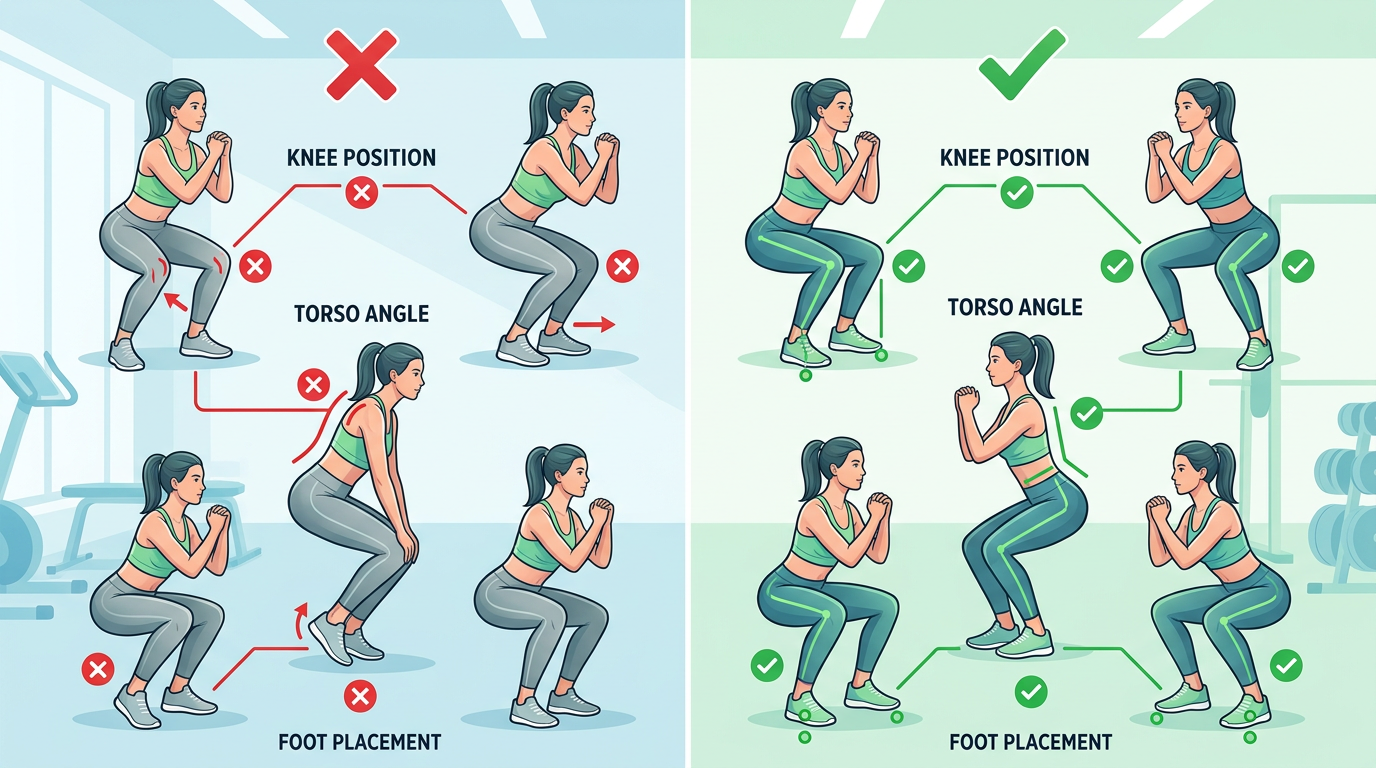
Annotated diagram showing common squat mistakes with red X marks and correct form with green check marks, focusing on knee position, torso angle, and foot placement
Building a Weighted Squat Workout Program
Incorporating weighted squats into a balanced training program requires thoughtful planning. Here's how to structure your workouts for optimal results without overtraining.
Weekly Training Frequency
Most women see excellent results training weighted squats 2-3 times per week. This frequency provides enough stimulus for strength gains while allowing adequate recovery between sessions.
If you're squatting three times weekly, vary the intensity and volume across sessions to prevent overtraining. For example, one heavy day (3-5 reps), one moderate day (8-12 reps), and one lighter technique day.
Separate squat sessions by at least 48 hours to allow for recovery. Your muscles grow and strengthen during rest periods, not during the workout itself.
Sample Weekly Lower Body Split
Here's an example of how to structure weighted squats within a comprehensive lower body program. Adjust based on your schedule and recovery capacity.
Day 1 - Heavy Squat Focus:
- Barbell back squats: 4 sets of 5 reps (heavier weight)
- Romanian deadlifts: 3 sets of 8 reps
- Walking lunges: 3 sets of 10 reps per leg
- Leg curls: 3 sets of 12 reps
Day 2 - Moderate Volume:
- Goblet squats: 3 sets of 12 reps
- Hip thrusts: 4 sets of 10 reps
- Bulgarian split squats: 3 sets of 8 reps per leg
- Calf raises: 3 sets of 15 reps
Combining with Upper Body Training
If you're following a full-body approach, pair your weighted squats with upper body exercises. This allows one muscle group to recover while you work another, making efficient use of your gym time.
For example, perform a set of squats, rest 60 seconds, perform a set of rows, rest 60 seconds, then return to squats. This approach can reduce total workout time while maintaining training quality.
Check out our guide on how many squats a day to understand optimal training volume and frequency for your goals.
Addressing Special Considerations and Concerns
Many women have specific questions or concerns about weighted squats related to health conditions, safety, or particular goals. Let's address these important considerations.
Weighted Squats and Joint Health
When performed with proper form, weighted squats actually strengthen the muscles, tendons, and ligaments surrounding your knees and hips, improving joint stability and health.
Research shows that squats performed through a full range of motion with appropriate loads are safe for healthy knees and may even have protective benefits. The key is progressing gradually and maintaining good form.
If you have existing knee issues, work with a physical therapist or qualified trainer to ensure your technique is sound. Modifications like box squats or reduced range of motion may be appropriate initially.
Squats for Bone Density
Weight-bearing exercises like weighted squats are among the best activities for building and maintaining bone density. The mechanical loading stimulates bone formation through a process called mechanotransduction.
This is particularly important for women, as bone density naturally declines with age and accelerates after menopause. Regular resistance training can slow or even reverse this decline.
If you have osteoporosis or osteopenia, weighted squats can still be beneficial but should be approached carefully. Start with lighter weights, focus on form, and consult with your healthcare provider about appropriate progression.
Pregnancy and Postpartum Considerations
Many women can safely continue weighted squats during pregnancy if they were already doing them before conceiving. However, you'll need to make adjustments as your pregnancy progresses.
Reduce weights as needed, avoid breath-holding (Valsalva maneuver), and stop if you experience pain, dizziness, or any concerning symptoms. Always consult with your healthcare provider about exercise during pregnancy.
Postpartum, wait until you're cleared for exercise (typically 6-8 weeks for vaginal delivery, longer for C-section). Rebuild your foundation with bodyweight squats before reintroducing weighted variations.
Metabolic Benefits of Weighted Squats
Beyond building strength and muscle, weighted squats offer metabolic advantages. The large muscle recruitment required for squats increases your energy expenditure both during and after your workout.
This elevated post-exercise oxygen consumption (EPOC) means you continue burning additional calories for hours after your training session ends. Compound exercises like squats create a greater EPOC effect than isolation exercises.
Additionally, building muscle tissue through resistance training increases your resting metabolic rate. Muscle is metabolically active tissue that requires energy even at rest, supporting long-term body composition goals.
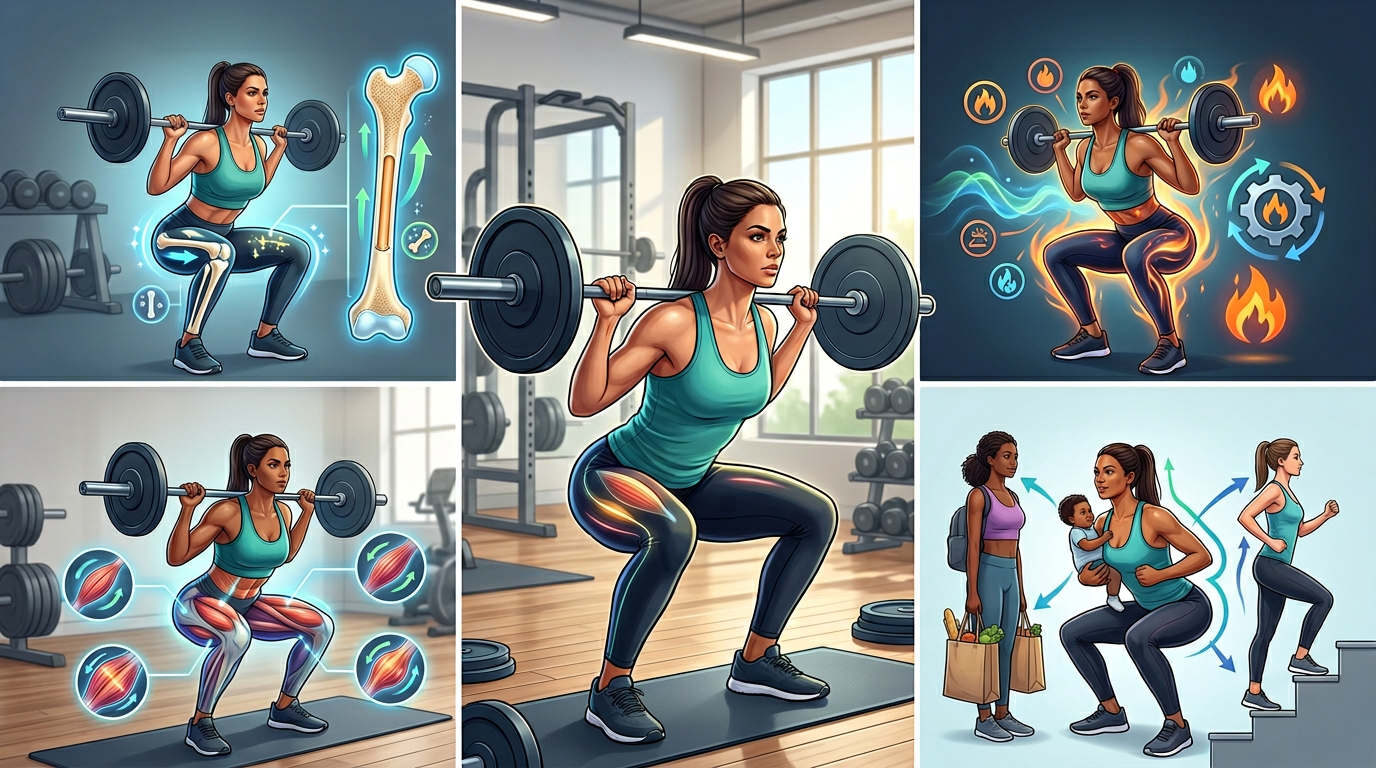
Infographic showing the multiple benefits of weighted squats for women including bone density, metabolic rate, muscle building, and functional strength
Equipment Options and Home Gym Setup
You don't need an expensive gym membership to start reaping the benefits of weighted squats. Several equipment options work well for home training at various price points.
Budget-Friendly Equipment
A set of adjustable dumbbells is one of the most versatile investments for home strength training. You can perform goblet squats, dumbbell squats, and many other exercises with a single equipment purchase.
Resistance bands offer another affordable option, though they provide a different resistance curve than free weights. They work well for beginners or as a complement to other equipment.
Kettlebells are excellent for goblet squats and offer a comfortable grip position. A single 25-35 pound kettlebell can provide months of progressive training for many women.
Intermediate Home Gym Setup
If you're ready to invest more seriously in home training, a barbell with weight plates opens up significantly more progression potential. You'll also need a squat rack for safety when lifting heavier weights.
A basic power rack or squat stand with safety bars allows you to train heavy squats safely without a spotter. This is a worthwhile investment if you're committed to long-term strength training.
Rubber or bumper plates are quieter and safer for home use than metal plates. They're designed to be dropped if necessary and protect your floors.
Gym Equipment Options
Commercial gyms offer access to a wider variety of equipment including Smith machines, hack squat machines, and leg press machines. While these can be useful tools, free weight squats should remain your primary focus.
Machine variations provide more stability and can be helpful when learning movement patterns or training to failure safely. However, they don't develop the same stabilizer muscle strength and coordination as free weights.
Use machines as supplementary exercises rather than replacements for traditional weighted squats to maximize your functional strength development.
Frequently Asked Questions
Is it good to do weighted squats?
Yes, weighted squats are excellent for building lower body strength, increasing bone density, and improving body composition. They work multiple muscle groups simultaneously, making them highly efficient for developing functional strength. When performed with proper form and appropriate progression, they're safe and effective for most women.
How heavy should I go with weighted squats?
Start with a weight that allows you to complete 8-12 reps with good form while feeling challenged by the last 2-3 reps. For goblet squats, many women begin with 10-20 pounds. For barbell squats, start with just the bar. Progress by adding 5-10 pounds when you can complete all sets comfortably.
Can squatting help sciatica?
Squats can help strengthen the muscles supporting your lower back and hips, potentially reducing sciatica symptoms over time. However, if you currently have acute sciatica pain, consult a healthcare provider before performing weighted squats. They may recommend modified versions or other exercises initially until symptoms improve.
Do squats regulate blood sugar?
Squats and other resistance exercises can help improve insulin sensitivity and glucose metabolism. Building muscle through weighted squats increases your body's capacity to store and use glucose effectively. Regular strength training is beneficial for blood sugar management, though it should complement, not replace, other health interventions.
Are squats safe if you have osteoporosis?
Weighted squats can actually benefit bone health by stimulating bone formation, but proper precautions are essential with osteoporosis. Start with bodyweight or very light weights, focus on perfect form, and avoid excessive forward flexion. Always consult your doctor before beginning a weighted squat program with osteoporosis.
How often should women do weighted squats?
Most women see optimal results training weighted squats 2-3 times per week with at least 48 hours between sessions. This frequency provides sufficient stimulus for strength gains while allowing adequate recovery. Varying intensity across sessions prevents overtraining and supports continuous progress toward your goals.
Will weighted squats make my legs bulky?
Weighted squats build strength and create shapely, toned legs rather than excessive bulk. Women have significantly lower testosterone levels than men, making it difficult to build large muscles. Squats create definition and firmness while supporting fat loss, resulting in a leaner, more sculpted appearance.
Conclusion
Weighted squats are a fundamental exercise for building lower body strength, improving bone density, and sculpting a strong, confident physique. By mastering proper form, choosing appropriate variations for your goals, and applying progressive overload strategically, you'll continue seeing results month after month.
Remember that consistency matters more than perfection. Start with weights that challenge you while maintaining good form, focus on gradual progression, and trust the process. The strength you build through weighted squats extends far beyond the gym, improving your functional fitness and quality of life.
Whether you're training at home with dumbbells or at the gym with a barbell, weighted squats deserve a central place in your strength training routine. Your future self will thank you for the investment you're making in your strength and health today.