Tone Upper Body With Resistance Band Workouts
An upper body resistance band workout uses elastic bands to build strength and tone muscles in the chest, back, shoulders, and arms through progressive resistance. These portable workouts target all major upper body muscle groups with exercises like rows, chest presses, and shoulder raises for sculpted, functional strength.
If you've ever felt frustrated by limited equipment or crowded gym spaces, you're not alone. Many women discover that achieving a strong, toned upper body doesn't require expensive machines or heavy dumbbells. An upper body resistance band workout offers a powerful, accessible alternative that fits into any lifestyle, whether you're traveling, working out at home, or simply prefer a more versatile approach to strength training.
Resistance bands provide constant tension throughout each movement, challenging your muscles in ways that traditional weights sometimes can't match. They're gentle on your joints while still delivering serious results, making them perfect for women at any fitness level. This comprehensive guide will show you exactly how to build a complete upper body training program using nothing but resistance bands.
You'll learn the most effective exercises for each muscle group, proper form techniques to maximize results, and how to structure your workouts for consistent progress. Whether you're looking to build strength, improve posture, or sculpt defined arms and shoulders, resistance bands deliver real, measurable results.
Key Takeaways
- Resistance bands provide progressive overload for all major upper body muscle groups without requiring heavy equipment or gym access
- Proper form and controlled movements matter more than speed or resistance level for building strength safely and effectively
- A complete upper body resistance band workout targets chest, back, shoulders, biceps, and triceps in 20-30 minutes
- Training 2-3 times per week with adequate rest allows muscles to recover and grow stronger between sessions
- Varying band tension and exercise angles prevents plateaus and ensures continuous progress toward your goals
Why Upper Body Resistance Band Workouts Work for Women
Resistance bands create tension that increases as you stretch them, providing what exercise scientists call variable resistance. This means your muscles work harder at the peak of each movement, exactly where they're strongest. This constant tension throughout the entire range of motion activates more muscle fibers than many traditional exercises.
Unlike free weights that rely on gravity, bands challenge your muscles from multiple angles. You can position yourself in various ways to target specific muscle groups more effectively. This versatility makes resistance bands incredibly efficient for home workouts.
Joint-Friendly Strength Building
Many women appreciate that resistance bands provide smooth, controlled resistance without the impact stress of heavy weights. The elastic nature of bands reduces strain on joints while still building significant strength. This makes them ideal if you're recovering from injury or managing joint concerns.
The progressive nature of band training allows you to start with lighter resistance and gradually increase tension as you build strength. You control the difficulty by choosing different band thicknesses or adjusting your positioning.
Functional Movement Patterns
Resistance band exercises often mimic real-world movements more closely than machine-based exercises. You engage stabilizer muscles throughout each movement, improving overall functional strength. This translates to better posture, easier daily activities, and reduced injury risk.
The portability factor cannot be overstated. A complete set of resistance bands weighs less than a pound and fits in any bag, yet provides enough resistance to challenge even advanced athletes.
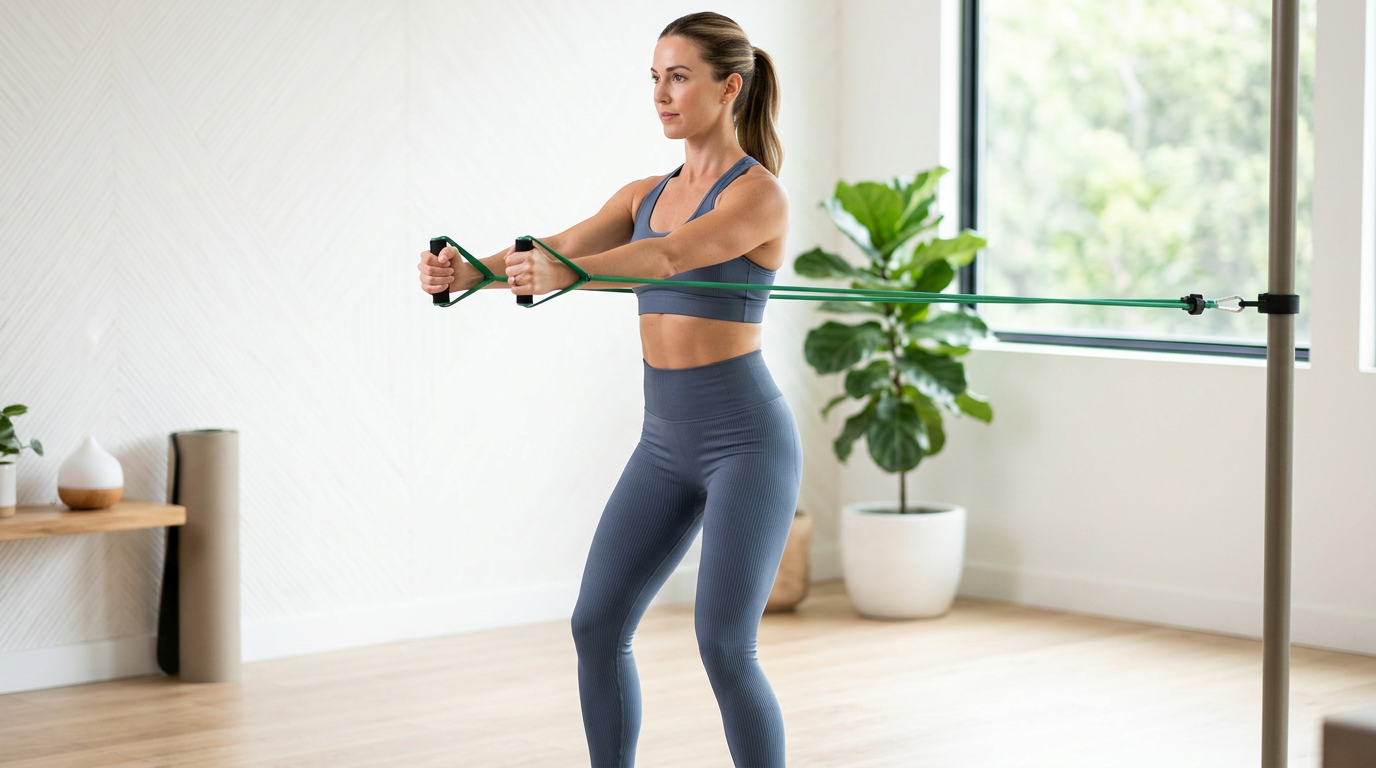
Woman demonstrating proper posture holding resistance bands in starting position for upper body workout, showing correct shoulder and spine alignment
Essential Upper Body Resistance Band Exercises
Building a strong, balanced upper body requires targeting all major muscle groups systematically. The following exercises form the foundation of any effective upper body resistance band workout program. Master these movements first before progressing to more advanced variations.
Chest Exercises for Definition
Resistance band chest presses directly target your pectoral muscles while engaging your shoulders and triceps as supporting muscles. To perform this exercise, anchor the band behind you at chest height, hold one handle in each hand, and press forward until your arms extend fully. Control the return to starting position.
Chest flies provide a different stimulus by emphasizing the stretch and contraction of your chest muscles. Stand with the band anchored behind you, arms extended to the sides, then bring your hands together in front of your chest in a hugging motion. Keep a slight bend in your elbows throughout.
For variety, try incline presses by anchoring the band low and pressing upward at a 45-degree angle. This targets your upper chest specifically, creating better overall chest development.
Back Exercises for Posture and Strength
Rows are essential for building a strong, sculpted back. Seated rows work beautifully with resistance bands. Sit with legs extended, loop the band around your feet, and pull the handles toward your ribcage while squeezing your shoulder blades together. This exercise counteracts the forward shoulder posture many women develop from desk work.
Single-arm rows allow you to focus on each side independently, correcting strength imbalances. Anchor the band at waist height, step back to create tension, and pull one handle toward your hip while keeping your core engaged. Alternate sides for balanced development.
Lat pulldowns target your latissimus dorsi muscles, creating that coveted V-shape taper. Anchor the band overhead, kneel or stand, and pull the band down toward your chest while keeping your back straight. Focus on pulling with your back muscles rather than your arms.
Shoulder Exercises for Strength and Shape
Shoulder presses build strength in all three deltoid heads. Stand on the band with feet shoulder-width apart, hold handles at shoulder height, and press upward until your arms fully extend. Lower with control to maximize muscle engagement.
Lateral raises specifically target your side deltoids, creating shoulder width and definition. Stand on the band, hold handles at your sides, and raise your arms out to the sides until they reach shoulder height. Keep a slight bend in your elbows and control the descent.
Front raises emphasize your anterior deltoids. With the same starting position, raise one or both arms forward to shoulder height. These exercises combined create well-rounded shoulder development.
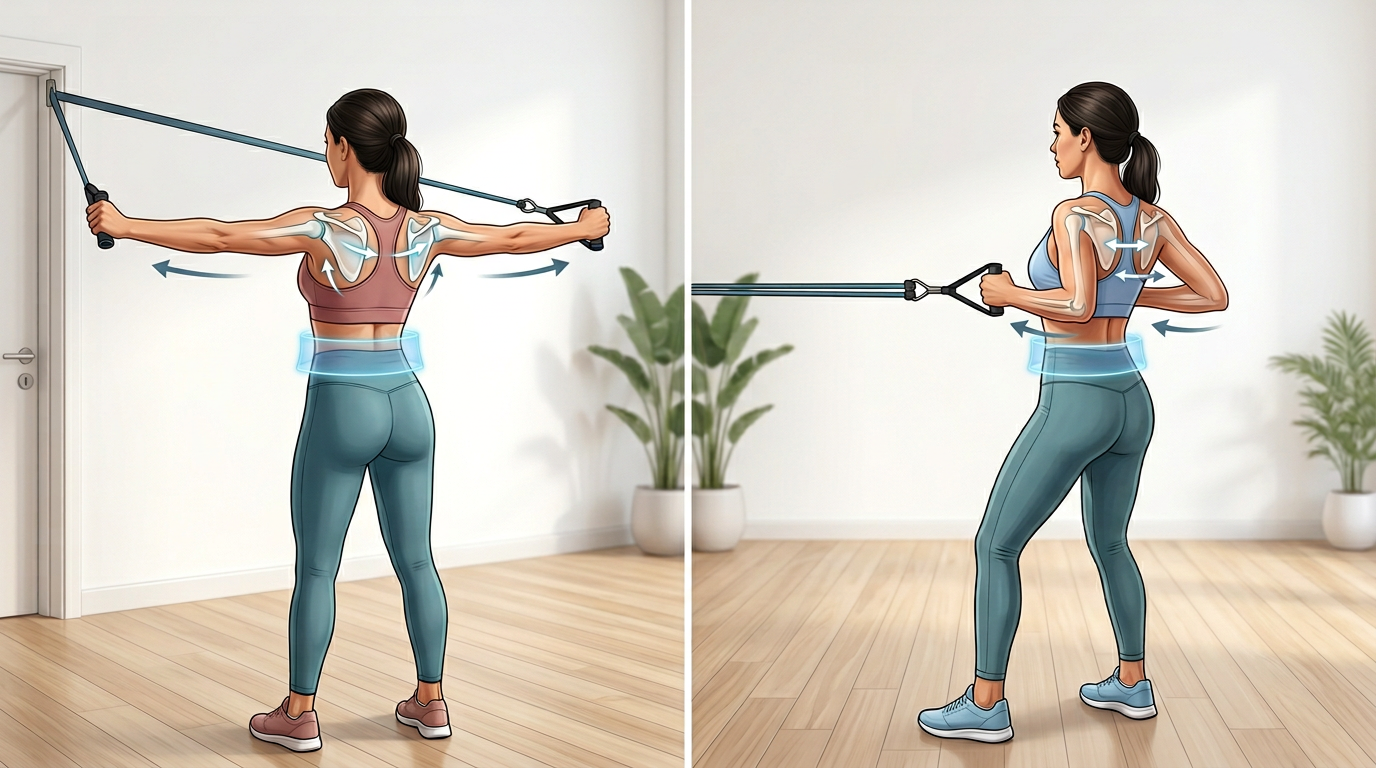
Split-screen demonstration showing proper form for resistance band chest press and row exercise, highlighting shoulder blade positioning and core engagement
Arm Exercises for Tone and Definition
Bicep curls with resistance bands provide constant tension throughout the movement. Stand on the band with feet hip-width apart, hold handles with palms facing forward, and curl upward while keeping your elbows stationary. Squeeze at the top before lowering slowly.
Hammer curls target both biceps and forearms. Use the same positioning but keep your palms facing each other throughout the movement. This variation builds functional arm strength.
Tricep extensions tone the back of your arms effectively. Anchor the band overhead, hold one or both handles behind your head, and extend your arms upward. Keep your elbows pointed forward throughout the movement.
Tricep kickbacks provide another excellent option. Hinge forward at your hips, hold the band with elbows bent at 90 degrees, then extend your arms backward while keeping your upper arms stationary. This exercise specifically targets the triceps long head.
How to Structure Your Upper Body Resistance Band Workout
Creating an effective workout structure ensures you target all muscle groups adequately while allowing proper recovery. The best upper body resistance band workout balances pushing and pulling movements to maintain muscular balance and prevent injury.
Workout Frequency and Volume
Training your upper body 2-3 times per week provides optimal results for most women. This frequency allows adequate recovery time between sessions while providing enough stimulus for strength gains. Space your workouts at least 48 hours apart to allow muscle repair.
Each session should include 6-8 exercises covering all major muscle groups. Perform 3-4 sets of each exercise with 10-15 repetitions per set. This rep range effectively builds both strength and muscular endurance.
Progressive Overload Strategies
Progressive overload means gradually increasing the challenge to continue making gains. With resistance bands, you can increase difficulty by:
- Using thicker bands with higher resistance levels
- Increasing the number of sets or repetitions performed
- Slowing down your tempo to increase time under tension
- Decreasing rest periods between sets to boost intensity
- Changing your position to increase band stretch at starting position
- Adding pause holds at peak contraction points
Track your workouts in a journal or app to monitor progress. When you can complete all prescribed sets and reps with good form, it's time to increase the challenge.
Sample Weekly Schedule
A balanced weekly schedule might look like this:
- Monday: Upper body resistance band workout focusing on chest and triceps
- Tuesday: Lower body or active recovery
- Wednesday: Upper body resistance band workout emphasizing back and biceps
- Thursday: Rest or light cardio
- Friday: Full upper body resistance band workout with compound movements
- Weekend: Active recovery with walking, yoga, or stretching
This schedule provides adequate training stimulus while incorporating sufficient recovery time. Adjust based on your individual recovery needs and other training commitments.
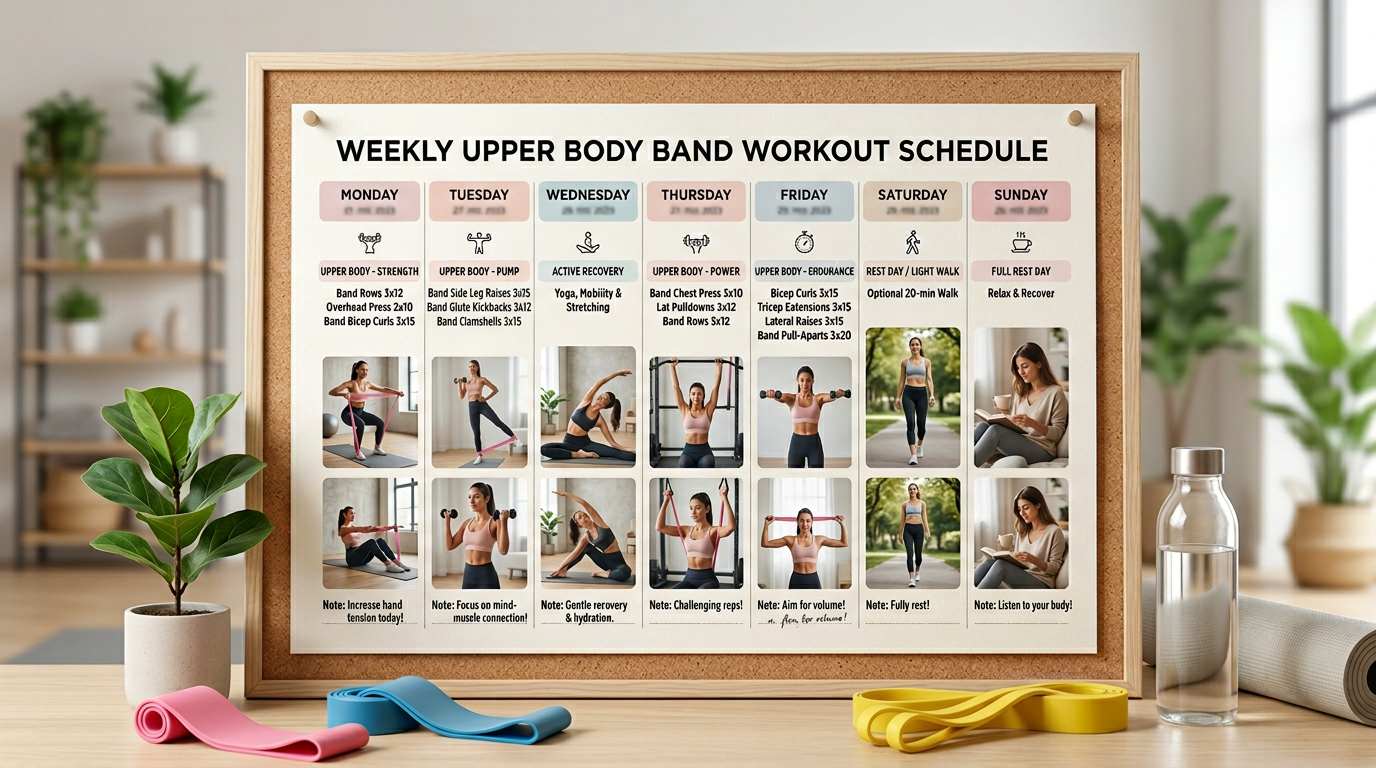
Weekly workout calendar showing upper body resistance band training schedule with rest days and progression notes
Proper Form and Technique Tips
Mastering proper form maximizes results while minimizing injury risk. Many women rush through exercises without focusing on the quality of each repetition. Controlled, deliberate movements with proper form build strength more effectively than fast, sloppy repetitions with heavier resistance.
Core Engagement Throughout Movements
Your core stabilizes your body during every upper body exercise. Before starting any movement, brace your core by gently pulling your navel toward your spine. Maintain this engagement throughout the exercise to protect your lower back and maximize power transfer.
Avoid arching your back excessively during pressing movements. Keep your ribcage down and spine neutral. This proper alignment ensures your target muscles do the work rather than compensating with your lower back.
Breathing Patterns for Maximum Power
Proper breathing enhances performance and safety. Exhale during the exertion phase (when pushing or pulling against resistance) and inhale during the easier phase (when returning to starting position). Never hold your breath during resistance training, as this increases blood pressure unnecessarily.
Rhythmic breathing helps you maintain tempo and focus. Count your breaths to ensure consistent pacing throughout your sets.
Common Form Mistakes to Avoid
Watch for these frequent errors that reduce effectiveness:
- Using momentum instead of muscle control to move the band
- Allowing shoulders to shrug up toward ears during exercises
- Locking out joints completely at full extension
- Rushing through the eccentric (lowering) phase of movements
- Holding tension in your neck and jaw instead of staying relaxed
- Choosing resistance that's too heavy to maintain proper form
Film yourself occasionally or work out near a mirror to check your form. Small adjustments make significant differences in results and safety.
Choosing the Right Resistance Bands
Not all resistance bands are created equal. Understanding the different types helps you select the best options for your upper body resistance band workout goals. Investing in quality bands that match your strength level ensures safe, effective training sessions.
Types of Resistance Bands
Loop bands (also called mini bands) form continuous circles and work well for certain exercises but have limitations for upper body work. They're excellent for warm-ups and activation exercises.
Tube bands with handles offer the most versatility for upper body training. The handles provide secure grip, and many sets include attachments for door anchors. These are ideal for mimicking traditional strength training exercises.
Flat therapy bands (long strips without handles) provide maximum flexibility for various grips and positions. They're budget-friendly but may be less comfortable for beginners.
Figure-8 bands and lateral resistance bands serve specific purposes but aren't essential for comprehensive upper body training.
Resistance Levels and Progression
Bands typically come in color-coded resistance levels, though colors aren't standardized across brands. Common progression from lightest to heaviest includes:
- Yellow or beige: Extra light (2-5 pounds equivalent)
- Red or pink: Light (5-10 pounds equivalent)
- Green: Medium (10-20 pounds equivalent)
- Blue: Heavy (20-30 pounds equivalent)
- Black or purple: Extra heavy (30-50 pounds equivalent)
Most women benefit from having at least three resistance levels. Start with light to medium bands and progress as you build strength. Different exercises may require different resistance levels based on muscle group size and strength.
Quality and Durability Considerations
Quality bands last longer and perform more safely. Look for bands made from natural latex or high-quality synthetic materials. Check for even thickness throughout the band without thin spots that could tear.
Inspect your bands regularly for signs of wear, including small tears, brittleness, or loss of elasticity. Replace damaged bands immediately to prevent injury from unexpected breakage during exercise.
Store bands away from direct sunlight and extreme temperatures, which degrade the material. Keep them clean by wiping with a damp cloth after sweaty workouts.
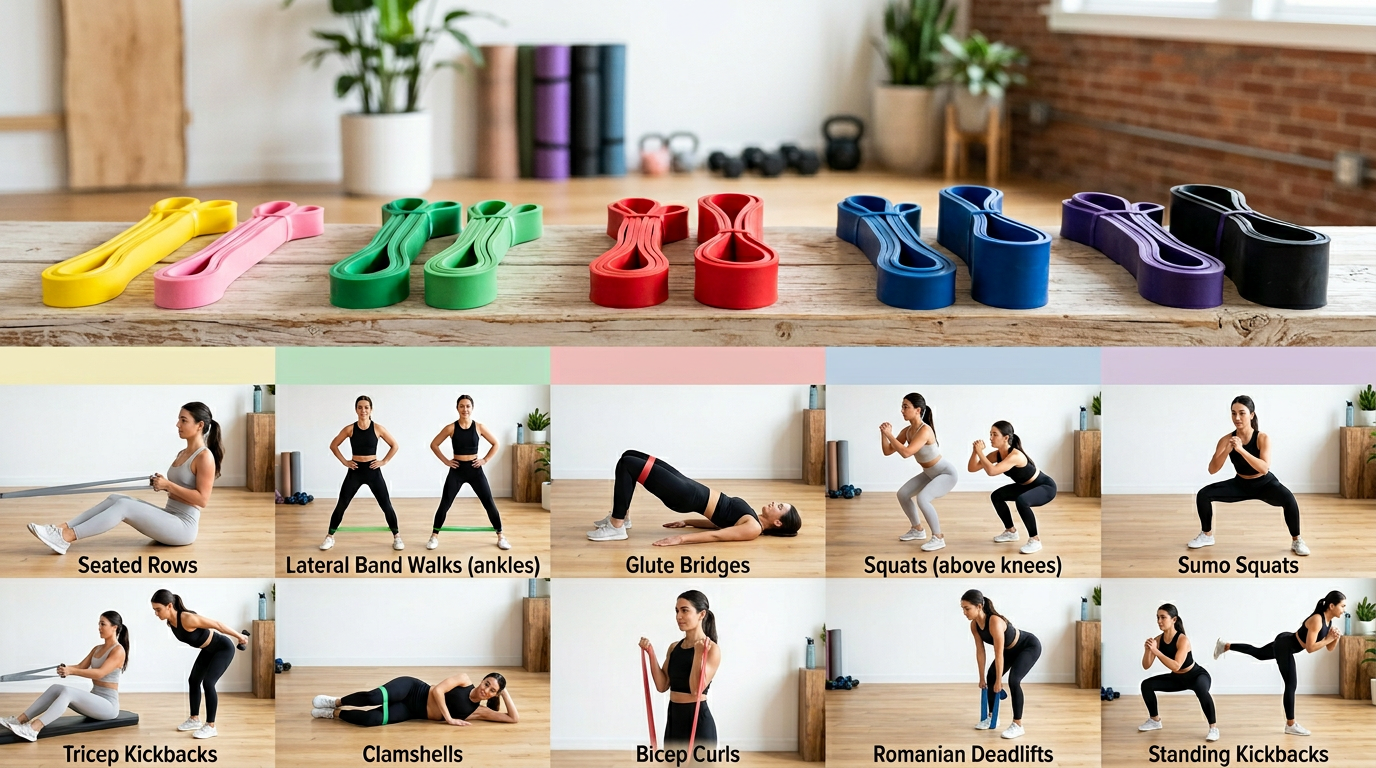
Array of different colored resistance bands arranged by resistance level with corresponding exercise recommendations for each strength level
Complete Upper Body Resistance Band Workout Routine
This comprehensive routine targets all major upper body muscle groups in one efficient session. Perform this workout 2-3 times weekly for best results. This balanced upper body resistance band workout routine takes 25-30 minutes and requires only a set of bands and a secure anchor point.
Warm-Up Sequence (5 minutes)
Prepare your muscles and joints before diving into resistance work:
- Arm circles forward and backward: 10 repetitions each direction
- Shoulder rolls: 10 repetitions forward, 10 backward
- Band pull-aparts with light resistance: 15 repetitions
- Cat-cow stretches: 8 repetitions to mobilize your spine
- Torso rotations: 10 repetitions each side
This warm-up increases blood flow, elevates body temperature, and prepares your nervous system for the work ahead.
Main Workout Circuit
Complete 3 rounds of the following exercises with 45-60 seconds rest between rounds:
- Resistance band chest press: 12-15 repetitions
- Seated resistance band rows: 12-15 repetitions
- Overhead shoulder press: 10-12 repetitions
- Bicep curls: 12-15 repetitions
- Tricep extensions: 12-15 repetitions
- Lateral raises: 10-12 repetitions
- Band pull-aparts: 15-20 repetitions
Rest 30-45 seconds between exercises within each round. Focus on controlled movements with 2 seconds for the concentric phase, 1 second pause at peak contraction, and 3 seconds for the eccentric phase.
Cool-Down and Stretching (5 minutes)
Never skip your cool-down. These stretches promote recovery and maintain flexibility:
- Chest doorway stretch: 30 seconds each side
- Overhead tricep stretch: 30 seconds each arm
- Cross-body shoulder stretch: 30 seconds each side
- Neck stretches in all directions: 15 seconds each
- Child's pose with arms extended: 60 seconds
- Thread the needle stretch: 30 seconds each side
Breathe deeply during stretches and avoid bouncing. Gentle, sustained stretches reduce soreness and improve range of motion over time.
Tracking Progress and Setting Goals
Measuring your progress keeps you motivated and helps you make informed adjustments to your training. Tracking your upper body resistance band workout progress through multiple metrics provides a complete picture of your fitness journey.
Performance Metrics to Monitor
Track these variables in your workout journal:
- Band resistance level used for each exercise
- Number of sets and repetitions completed
- Rest periods taken between sets
- Tempo and time under tension
- Energy levels and perceived exertion ratings
- Any modifications needed due to fatigue or discomfort
Review your journal weekly to identify patterns and progress. Celebrate when you increase resistance, add repetitions, or improve form quality.
Physical Changes to Observe
Beyond performance metrics, notice these physical indicators of progress:
Improved posture throughout your day signals stronger back and shoulder muscles. You'll stand taller naturally without conscious effort. Daily activities like carrying groceries or lifting objects overhead become noticeably easier.
Muscle definition gradually becomes more visible, particularly in your shoulders and arms. Take progress photos monthly in consistent lighting and positions to see changes that happen too gradually to notice daily.
Reduced muscle soreness after workouts indicates your body is adapting to training stimulus. While some soreness is normal initially, it should decrease as you become more conditioned.
Setting Realistic Milestones
Establish both short-term and long-term goals to maintain motivation. Short-term goals might include completing all prescribed sets without breaks or progressing to the next resistance level in a specific exercise. Long-term goals could involve performing advanced variations or achieving specific strength benchmarks.
Make goals specific, measurable, and time-bound. Instead of "get stronger arms," aim for "perform 15 bicep curls with blue band by end of month." This specificity makes progress trackable and success clear.
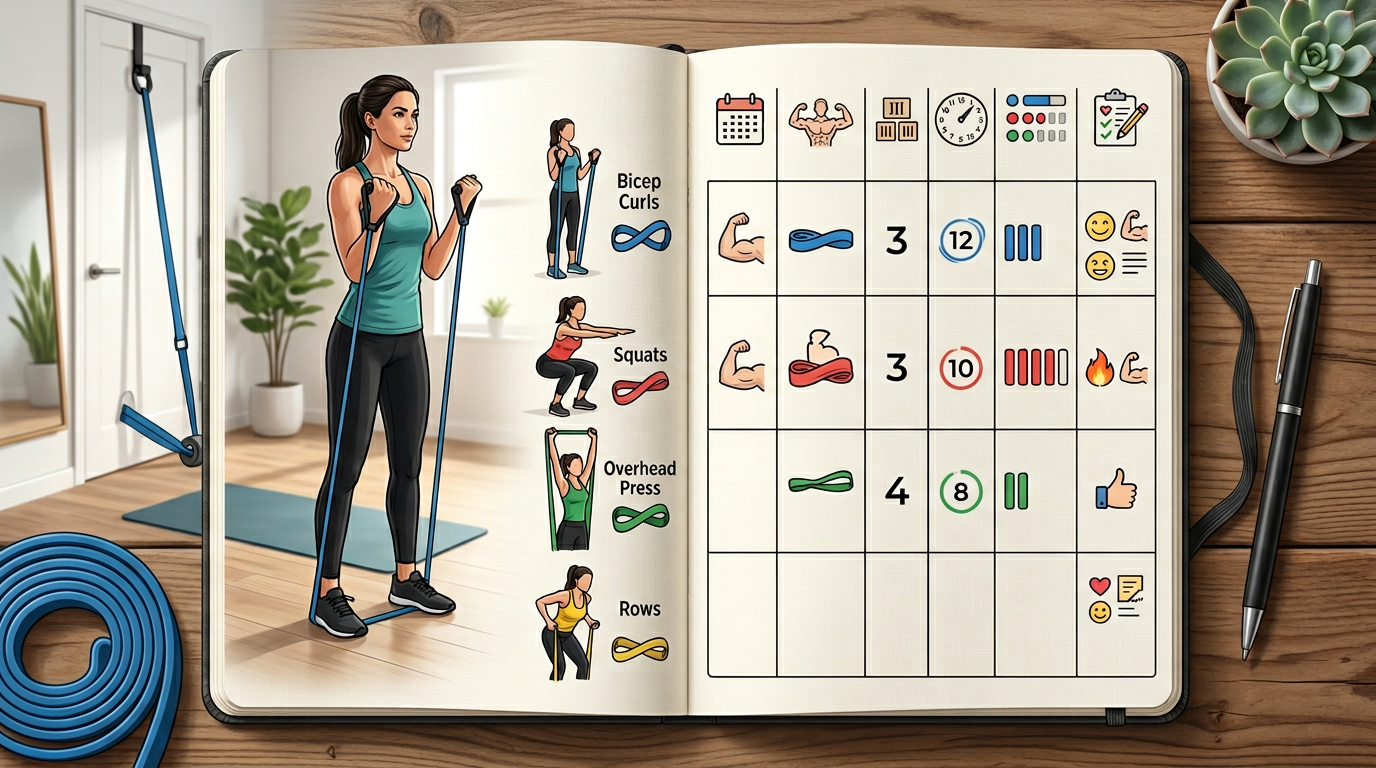
Fitness journal template showing how to track resistance band workout progress including sets, reps, resistance levels, and personal notes
Nutrition Tips to Support Upper Body Strength
Your training efforts require proper nutritional support to yield maximum results. Adequate protein intake combined with sufficient overall calories provides the building blocks your muscles need to recover and grow stronger after each upper body resistance band workout.
Protein Requirements for Muscle Development
Women engaged in regular resistance training benefit from consuming adequate protein throughout the day. Aim to include protein-rich foods at each meal to support muscle repair and growth. Good sources include lean meats, fish, eggs, Greek yogurt, legumes, and plant-based protein options.
Distribute protein intake evenly across meals rather than consuming most at dinner. This steady supply supports continuous muscle protein synthesis throughout the day.
Timing Your Nutrition Around Workouts
While precise nutrient timing matters less than overall daily intake, some strategies can optimize your energy and recovery. Eat a balanced meal containing carbohydrates and protein 2-3 hours before training to fuel your workout.
After training, consume protein within a few hours to support recovery. A post-workout meal or snack doesn't need to be immediate, but don't delay eating for many hours.
Hydration for Performance
Proper hydration significantly impacts strength and endurance. Drink water consistently throughout the day rather than chugging large amounts right before training. Dehydration reduces performance and increases perceived exertion, making workouts feel harder than necessary.
Monitor your hydration status by checking urine color. Pale yellow indicates good hydration, while dark yellow suggests you need more fluids. Increase intake during hot weather or particularly sweaty training sessions.
Overcoming Common Challenges
Every fitness journey includes obstacles. Understanding common challenges and having strategies to address them keeps you consistent with your upper body resistance band workout routine.
Dealing with Plateaus
Strength plateaus happen when your body fully adapts to your current training stimulus. Break through plateaus by changing variables in your routine. Switch exercise order, try new movement variations, adjust your tempo, or modify rest periods.
Sometimes plateaus indicate you need more recovery rather than more training. Ensure you're getting adequate sleep and managing stress effectively. Consider taking a deload week with reduced volume every 4-6 weeks.
Managing Time Constraints
Busy schedules make consistency challenging. Remember that shorter workouts done consistently outperform perfect workouts done sporadically. A focused 20-minute session provides significant benefits when time is limited.
Prepare your workout space and bands the night before. This simple step removes barriers when motivation is low. Schedule workouts like important appointments rather than fitting them in when convenient.
Staying Motivated Long-Term
Motivation naturally fluctuates over time. Build discipline to train even when motivation is low. Discipline means following through on commitments to yourself regardless of how you feel in the moment.
Find an accountability partner or join online communities focused on resistance band training. Sharing your journey with others provides support during challenging periods. Celebrate non-scale victories like improved energy, better sleep, or enhanced mood alongside physical changes.
Frequently Asked Questions
How long does it take to see results from upper body resistance band workouts?
Most women notice improved strength within 2-3 weeks of consistent training, while visible muscle definition typically appears after 6-8 weeks. Results depend on training frequency, nutrition, sleep quality, and starting fitness level. Progress happens gradually, so take monthly photos to track changes that occur too slowly to notice daily.
Can resistance bands build as much muscle as weights?
Resistance bands effectively build muscle when you apply progressive overload consistently. Research shows that muscles respond to tension regardless of the source. Bands provide adequate resistance for most women to build significant upper body strength and definition, though very advanced lifters may eventually need additional equipment for continued progress.
What resistance level should beginners start with?
Beginners should start with light to medium resistance bands that allow 12-15 repetitions with good form while feeling challenged by the last few reps. If you can easily perform 20 repetitions, increase resistance. If you cannot complete 10 repetitions with proper form, decrease resistance. Having multiple resistance levels allows appropriate progression for different muscle groups.
How many times per week should I train my upper body?
Training your upper body 2-3 times weekly provides optimal results for most women. This frequency allows adequate recovery between sessions while providing sufficient stimulus for strength gains. Space workouts at least 48 hours apart to allow muscle repair. Beginners may start with twice weekly, while more advanced trainees can handle three sessions effectively.
Do I need to anchor resistance bands for upper body exercises?
Many upper body exercises require anchoring bands to a stable point like a door, pole, or sturdy furniture. Exercises like rows, chest presses, and lat pulldowns need anchoring for proper resistance angles. However, exercises like bicep curls, shoulder presses, and lateral raises work effectively by standing on the band, requiring no additional anchor point.
Can resistance band training help reduce arm jiggle?
Resistance band training builds muscle in your arms, creating firmer, more defined appearance. However, reducing fat in specific areas requires overall body fat reduction through consistent training and appropriate nutrition. Combine your upper body resistance band workouts with balanced eating and patience for best results in improving arm tone and reducing excess softness.
What if one arm is stronger than the other?
Strength imbalances are completely normal, especially when starting resistance training. Address this by performing single-arm exercises and matching your weaker side's repetitions with your stronger side. Never let your strong side do more reps. Over time, your weaker side will catch up, creating better balance and reducing injury risk from compensatory movement patterns.
Building Your Stronger Upper Body Journey
Your journey to a stronger, more defined upper body doesn't require expensive equipment or gym memberships. An upper body resistance band workout provides everything you need to build functional strength, improve posture, and create the sculpted arms and shoulders you're working toward. The portability and versatility of resistance bands remove common barriers to consistency.
Remember that progress happens through consistent effort over time, not perfection. Start with appropriate resistance levels, focus on proper form, and gradually increase the challenge as you build strength. Track your progress through multiple metrics, celebrate small victories, and trust the process. Your muscles will respond to the progressive tension you provide through dedicated training.
The most effective workout program is the one you'll actually do consistently. Resistance bands make it easier to stay committed by fitting seamlessly into any schedule or location. Whether you're training at home, traveling, or simply prefer a more accessible approach to strength training, you now have the complete roadmap to build impressive upper body strength and definition.