Types of Deadlifts for Women: Build Strength
Types of deadlifts are strength training variations that target different muscle groups and movement patterns. The most effective include conventional deadlifts for overall posterior chain development, Romanian deadlifts for hamstring focus, sumo deadlifts for glute emphasis, and single-leg deadlifts for balance and stability, each building functional strength and bone density.
If you've ever felt intimidated walking past the weight section at the gym, you're not alone. But here's the truth: deadlifts are one of the most empowering exercises you can master as a woman. Understanding the different types of deadlifts opens up a world of strength-building possibilities that go far beyond aesthetics—we're talking about functional power that translates to carrying groceries, playing with your kids, and moving through life with confidence.
The beauty of deadlift variations is that there's no one-size-fits-all approach. Whether you're a complete beginner or you've been lifting for years, each type of deadlift offers unique benefits tailored to different goals, body types, and fitness levels. From building a stronger posterior chain to improving bone density and correcting muscle imbalances, these compound movements deliver results that isolation exercises simply can't match.
In this comprehensive guide, we'll break down the most effective deadlift variations specifically for women. You'll learn proper form, discover which variations align with your goals, and understand how to incorporate them into your training program safely and effectively. Let's dive into the world of deadlifts and find the perfect variations to elevate your strength training journey.
Key Takeaways
- Different deadlift variations target specific muscle groups, allowing you to customize your training based on your goals
- Proper form is essential for all deadlift types to maximize benefits and prevent injury
- Progressive overload with deadlifts builds functional strength and increases bone density
- Starting with lighter weights and mastering technique ensures long-term success and confidence
- Incorporating multiple deadlift variations creates balanced lower body and posterior chain development
Understanding the Fundamentals of Deadlift Variations
Before exploring specific types of deadlifts, it's important to understand what makes this exercise so valuable for women's fitness. Deadlifts are compound movements that engage multiple muscle groups simultaneously, making them incredibly efficient for building strength and burning calories.
Why Deadlifts Matter for Women
Deadlifts are particularly beneficial for women because they strengthen the posterior chain—the muscles along the back of your body that are often undertrained. This includes your glutes, hamstrings, lower back, and upper back muscles. These muscles are essential for maintaining good posture, preventing lower back pain, and building the functional strength you need for daily activities.
Beyond muscle building, deadlifts offer significant benefits for bone health. Weight-bearing exercises like deadlifts create the mechanical stress that signals your body to increase bone density, which is especially important for women as we age. This makes deadlifts a powerful tool for long-term health and injury prevention.
The Core Mechanics Shared Across All Deadlift Types
While each deadlift variation has unique characteristics, they all share fundamental principles. Every deadlift involves a hip hinge movement pattern—bending at the hips while maintaining a neutral spine. You'll lift the weight from the ground (or from a hanging position) using your posterior chain muscles rather than relying on your lower back.
Proper breathing and core engagement are critical across all variations. You'll want to brace your core before each lift, creating intra-abdominal pressure that protects your spine. This foundation of good technique transfers across all deadlift types and keeps you safe as you progress in weight.
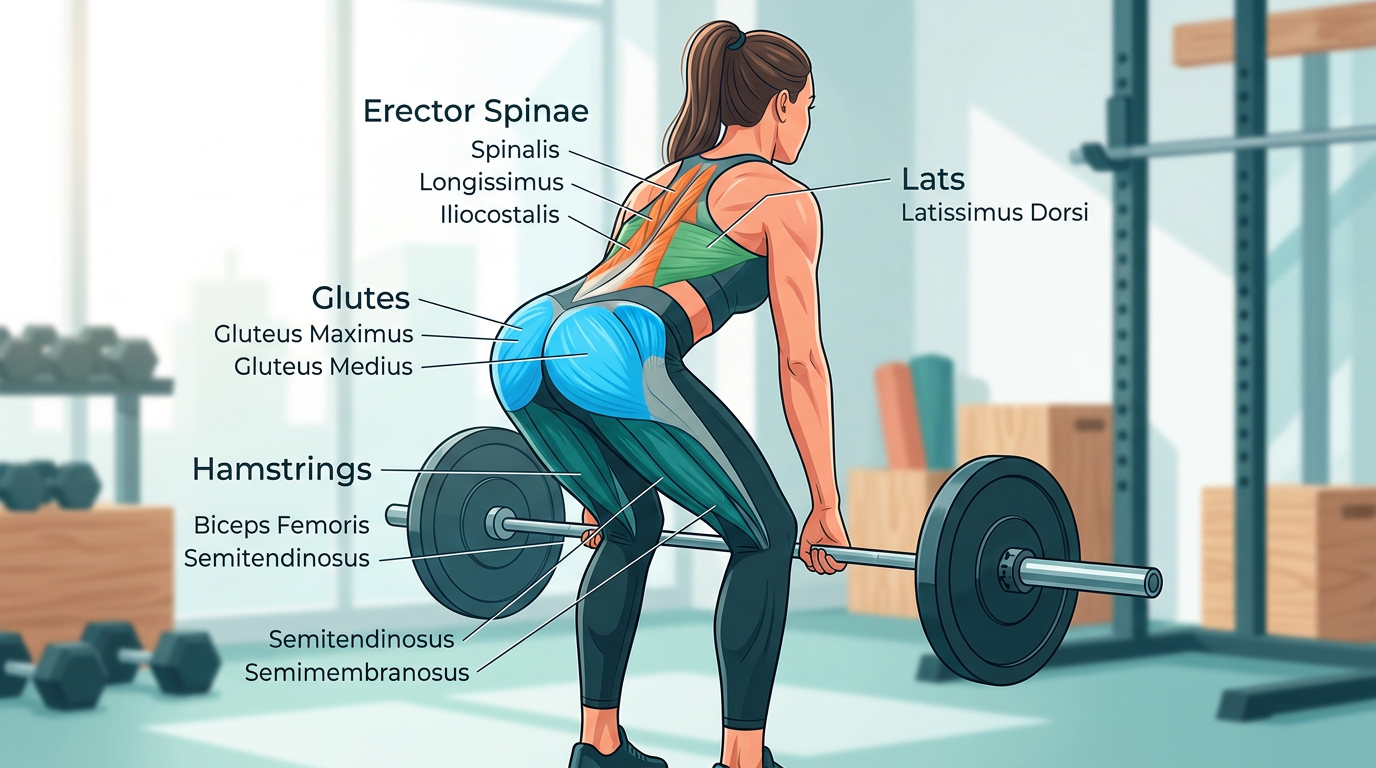
Anatomical diagram showing the posterior chain muscles activated during deadlifts, including glutes, hamstrings, erector spinae, and lats, with labels highlighting each muscle group
Conventional Deadlift: The Foundation Movement
The conventional deadlift is often considered the gold standard of deadlift variations. This is the version most people picture when they think of deadlifts: standing with feet hip-width apart, gripping a barbell outside your legs, and lifting the weight from the floor.
How to Perform the Conventional Deadlift
The conventional deadlift requires you to maintain a neutral spine while hinging at the hips and bending your knees to reach the barbell. Your shins should be close to the bar, and your shoulders should be slightly in front of the bar at the starting position. As you lift, drive through your heels and squeeze your glutes at the top of the movement.
Here's the step-by-step breakdown:
- Stand with feet hip-width apart, barbell over the middle of your feet
- Hinge at your hips and bend your knees to grip the bar just outside your legs
- Pull your shoulders back, engage your lats, and brace your core
- Drive through your heels, keeping the bar close to your body as you stand
- Lock out at the top by squeezing your glutes, keeping your shoulders back
- Lower the weight with control by hinging at the hips first, then bending your knees
Benefits and Best Uses
The conventional deadlift is excellent for overall posterior chain development and building total-body strength. It's particularly effective for women who want to develop their hamstrings, glutes, and lower back simultaneously. This variation also allows most people to lift the heaviest weight over time, making it ideal for progressive overload.
If your goal is to build maximum strength and you have good hip mobility, the conventional deadlift should be a staple in your program. It's also the best starting point for learning proper deadlift mechanics before moving to more specialized variations.
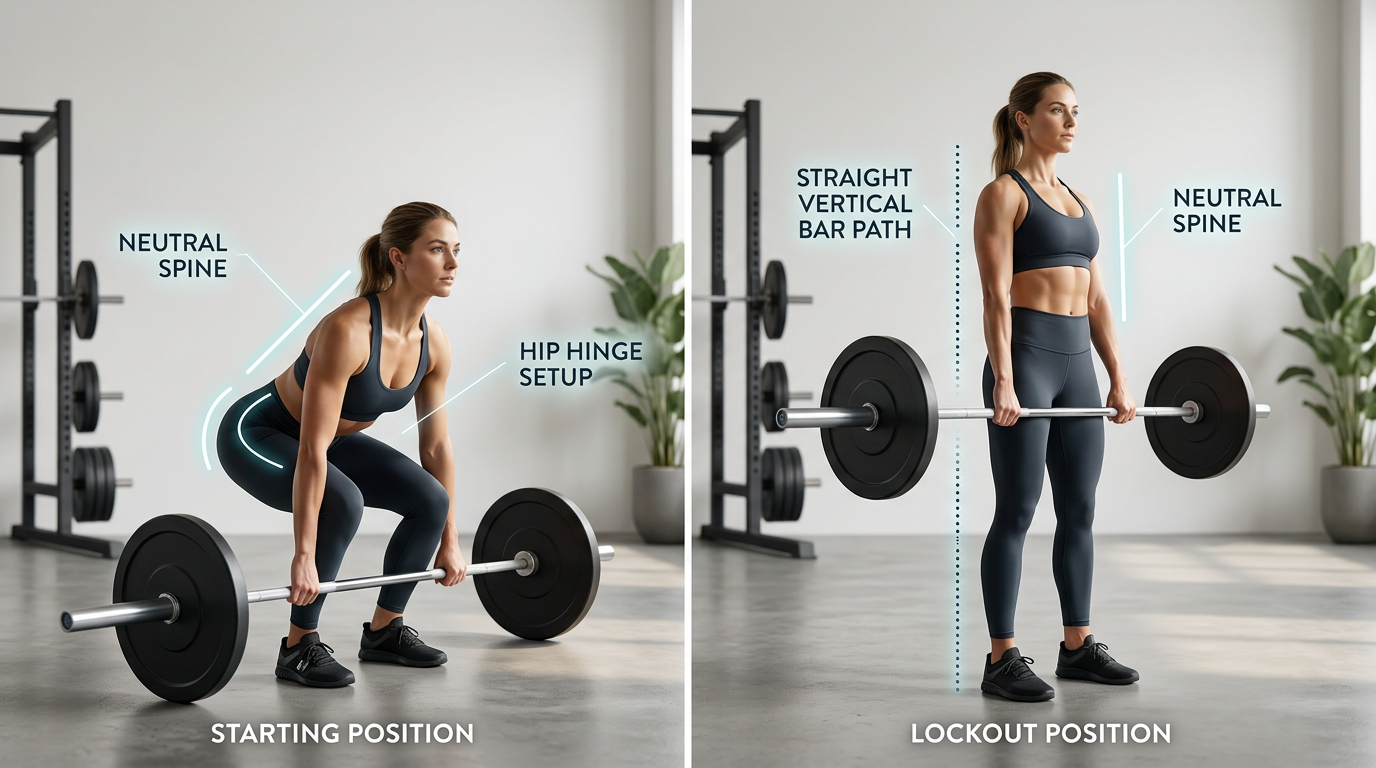
Side-by-side comparison showing proper conventional deadlift form from the starting position and lockout position, with form cues labeled including neutral spine, bar path, and hip hinge
Romanian Deadlift (RDL): Hamstring and Glute Focus
The Romanian deadlift, commonly called the RDL, is a game-changer for targeting your hamstrings and glutes. Unlike the conventional deadlift, the RDL starts from a standing position and emphasizes the eccentric (lowering) portion of the movement.
Proper RDL Technique
The Romanian deadlift keeps your legs relatively straight with only a slight knee bend, placing maximum tension on your hamstrings throughout the movement. You'll lower the weight by pushing your hips back while maintaining a neutral spine, stopping when you feel a deep stretch in your hamstrings rather than touching the weight to the floor.
Key form points for the RDL include:
- Start standing with the barbell at hip level, not on the floor
- Maintain a slight bend in your knees throughout the movement
- Push your hips back as far as possible while keeping your spine neutral
- Lower the weight until you feel a stretch in your hamstrings, typically mid-shin level
- Keep the bar close to your legs throughout the entire movement
- Drive your hips forward to return to standing, squeezing your glutes at the top
Why Women Love RDLs
The RDL is incredibly popular among women because it directly targets the glutes and hamstrings with less stress on the lower back compared to conventional deadlifts. This makes it an excellent choice if you're working on glute development or if you have any lower back sensitivity.
RDLs also teach you to properly feel the hip hinge pattern, making them a valuable teaching tool. Many women find that mastering the RDL first actually improves their conventional deadlift form because it reinforces the hip hinge movement pattern so effectively.
Sumo Deadlift: Wide Stance Power
The sumo deadlift takes its name from the wide stance used by sumo wrestlers. This variation features a significantly wider stance with your feet turned out and your hands gripping the bar inside your legs.
Sumo Deadlift Setup and Execution
The sumo deadlift shifts more emphasis to your glutes, quads, and inner thighs while reducing the range of motion and stress on your lower back. Your torso stays more upright compared to conventional deadlifts, which many women find more comfortable and natural.
To perform a sumo deadlift:
- Stand with feet wider than shoulder-width, toes pointed out at 30-45 degrees
- Lower down by bending your knees and pushing them out to align with your toes
- Grip the bar with hands inside your legs, arms straight down
- Keep your chest up and spine neutral as you brace your core
- Drive through your heels and push your knees out as you stand
- Squeeze your glutes hard at the top, pulling your hips through to the bar
When to Choose Sumo Over Conventional
The sumo deadlift is particularly beneficial for women with longer legs relative to their torso, as the wider stance reduces the distance the bar needs to travel. If you have hip mobility limitations or lower back concerns, sumo deadlifts might feel more natural and comfortable than conventional deadlifts.
This variation is also excellent for building glute strength and developing your inner thighs (adductors). Many women find they can maintain better form with sumo deadlifts, especially as they fatigue, because the more upright torso position is easier to maintain.
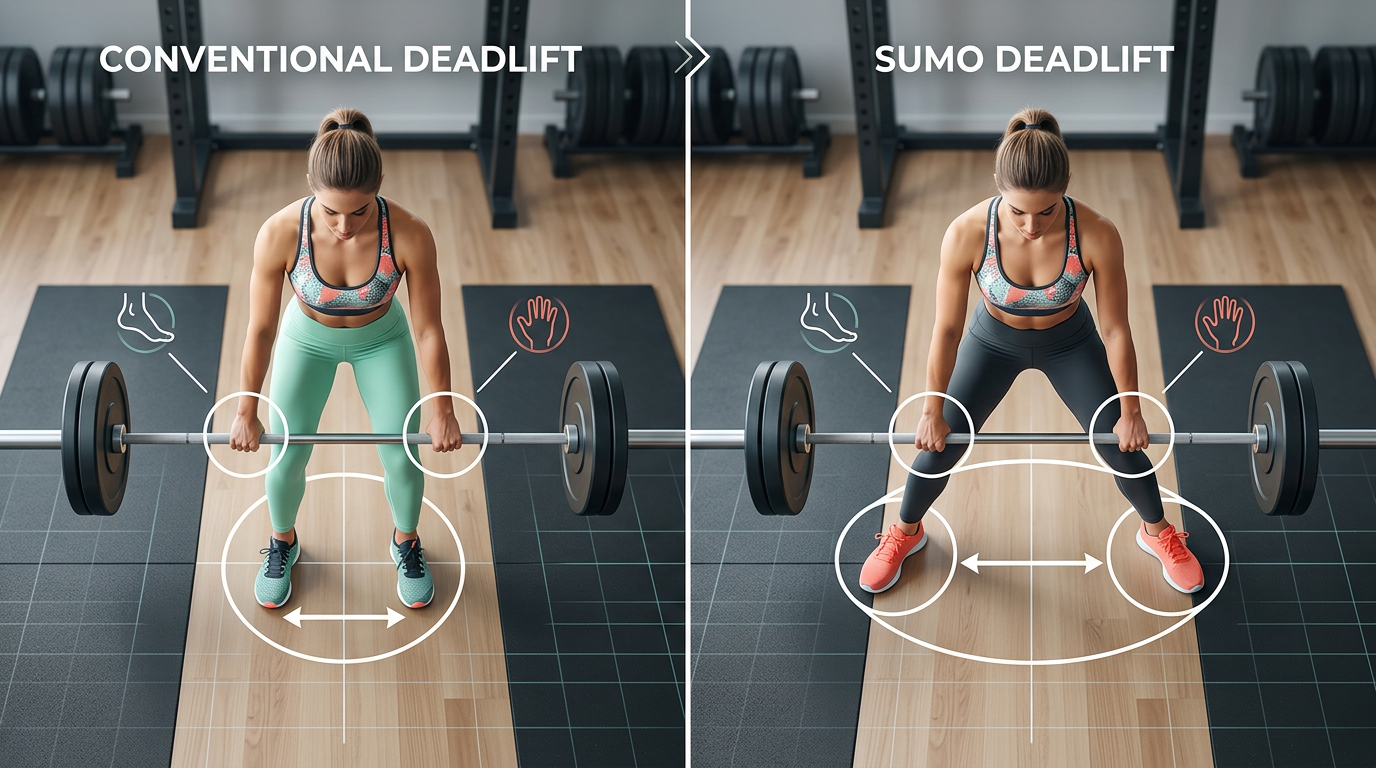
Overhead view comparison diagram showing foot positioning and hand placement differences between conventional deadlift and sumo deadlift stances
Single-Leg Deadlift: Balance and Stability
The single-leg deadlift (also called unilateral deadlift) is a powerful variation that challenges your balance while addressing muscle imbalances between your left and right sides.
Mastering the Single-Leg Deadlift
Single-leg deadlifts force each leg to work independently, revealing and correcting strength imbalances while dramatically improving your balance and core stability. You can perform this variation with dumbbells, kettlebells, or even just bodyweight when starting out.
Here's how to execute this movement safely:
- Stand on one leg holding a weight in the opposite hand (or both hands)
- Maintain a slight bend in your standing leg's knee
- Hinge at the hip, lowering the weight toward the ground while extending your free leg behind you
- Keep your hips square to the ground—avoid rotating your torso
- Lower until your torso is parallel to the ground or until you feel a hamstring stretch
- Drive through your standing heel to return to the starting position
- Keep your core engaged throughout to maintain balance
The Functional Strength Benefits
Single-leg deadlifts build the kind of strength that translates directly to real-life movements. Walking, running, climbing stairs—all of these activities require single-leg stability. By training one leg at a time, you develop better proprioception (body awareness) and prevent the stronger side from compensating for the weaker side.
This variation is also gentler on your lower back since you'll use lighter weights. It's an excellent option for active recovery days or when you want to work on form and stability rather than pure strength.
Trap Bar Deadlift: Beginner-Friendly Alternative
The trap bar deadlift (also called hex bar deadlift) uses a specialized hexagonal-shaped bar that you stand inside rather than behind. This design changes the mechanics in ways that benefit many women, especially beginners.
Why the Trap Bar Is Different
The trap bar deadlift allows you to maintain a more upright torso position and places the weight closer to your center of gravity, reducing stress on your lower back while still building serious strength. The handles are typically positioned higher than a standard barbell, which also reduces the range of motion.
The trap bar deadlift combines elements of both deadlifts and squats, recruiting more quad involvement than conventional deadlifts. This makes it an excellent choice if you want to build leg strength while still getting the posterior chain benefits of deadlifting.
Perfect for Building Confidence
Many women find the trap bar deadlift less intimidating than barbell variations. The neutral grip (palms facing each other) feels more natural, and the reduced technical demands make it easier to learn proper form. If you're new to deadlifting or returning after an injury, the trap bar is an excellent place to start or restart your deadlift journey.
The trap bar also allows most people to lift heavier weights compared to conventional deadlifts, which can be incredibly motivating. Seeing your strength increase quickly builds confidence and encourages consistency in your training.
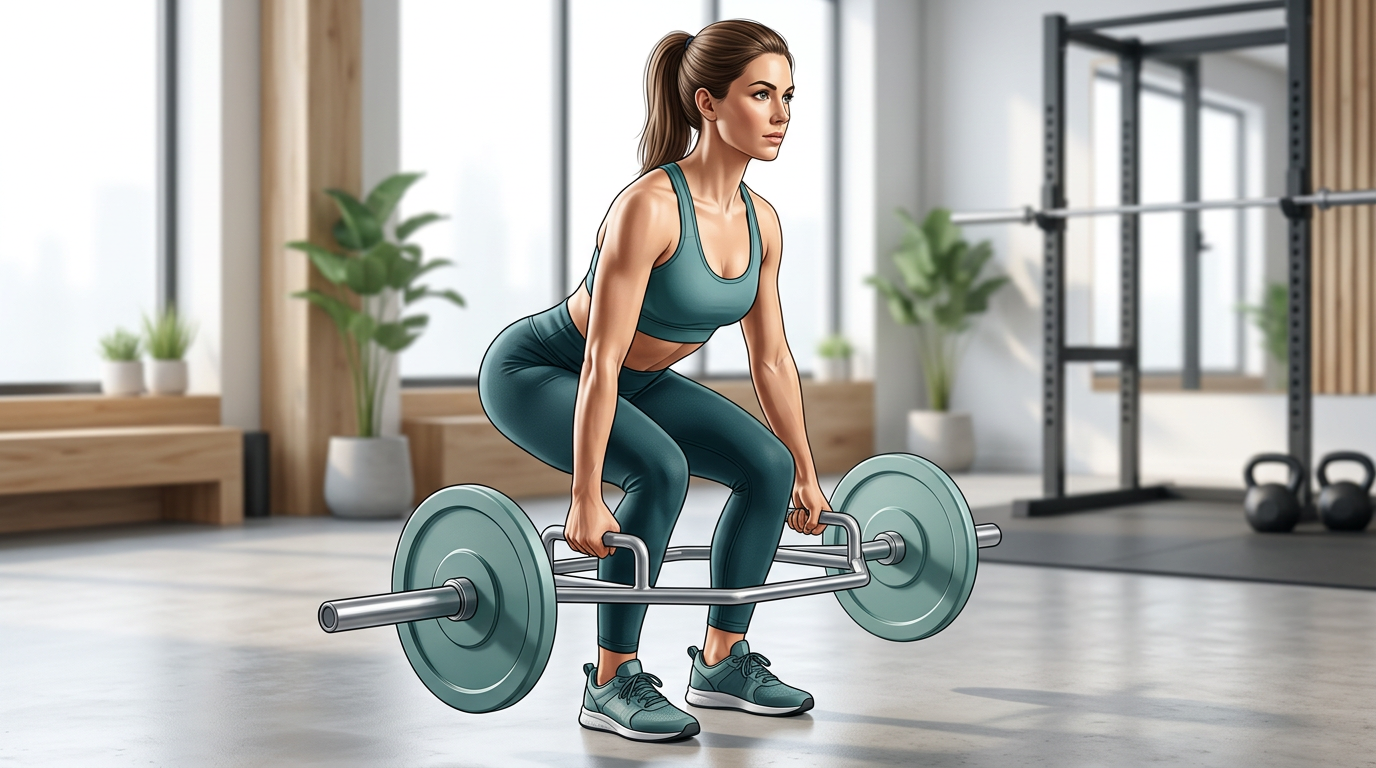
Illustration showing a woman performing a trap bar deadlift with proper form, highlighting the neutral grip position and upright torso angle compared to conventional deadlifts
Stiff-Leg Deadlift: Maximum Hamstring Stretch
The stiff-leg deadlift is similar to the Romanian deadlift but takes the hamstring emphasis even further. This variation uses almost completely straight legs, creating an intense stretch in the hamstrings.
Technique and Key Differences
Stiff-leg deadlifts maintain straighter legs than RDLs throughout the movement, maximizing hamstring engagement and stretch. However, this doesn't mean locking your knees—you'll maintain a very slight bend to protect your knee joints while keeping your legs as straight as possible.
Important considerations for stiff-leg deadlifts:
- Use lighter weights than you would for conventional or Romanian deadlifts
- Focus on the stretch and contraction in your hamstrings rather than moving heavy weight
- Lower the weight slowly and with control to maximize the eccentric phase
- Stop at a depth where you can maintain a neutral spine—never round your back to go lower
- This variation requires good hamstring flexibility, so progress gradually
When to Include Stiff-Leg Deadlifts
Stiff-leg deadlifts work best as an accessory movement rather than your main deadlift variation. They're excellent for targeting stubborn hamstrings, improving flexibility, or adding volume to your posterior chain training without the same systemic fatigue as heavier conventional deadlifts.
If you're working on glute and hamstring development, alternating between RDLs and stiff-leg deadlifts throughout the week provides slightly different stimuli to the same muscle groups, promoting balanced development.
Deficit Deadlift: Increasing Range of Motion
The deficit deadlift involves standing on a raised platform (typically 1-4 inches high) while performing a deadlift. This increases the range of motion, making the lift more challenging and building strength in the bottom portion of the movement.
Advanced Strength Building
Deficit deadlifts force you to start from a lower position, requiring greater hip and hamstring flexibility while building explosive strength off the floor. This variation is more advanced and should only be attempted after you've mastered conventional deadlift form.
The increased range of motion means you'll need to reduce the weight compared to regular deadlifts—typically by 10-20%. Focus on maintaining perfect form throughout the extended range rather than chasing heavy weights.
Strategic Application
Deficit deadlifts are particularly useful if you struggle with the initial pull from the floor during conventional deadlifts. By strengthening this weak point, you'll see improvements in your regular deadlift performance. However, the increased range of motion also means increased stress on your lower back, so use this variation strategically and not in every training session.
Choosing the Right Deadlift Variations for Your Goals
With so many types of deadlifts available, how do you decide which ones to include in your training program? The answer depends on your specific goals, experience level, and any physical limitations you might have.
Matching Variations to Your Objectives
Your training goals should dictate which deadlift variations you prioritize. Here's a practical guide:
For maximum overall strength: Focus on conventional or trap bar deadlifts with progressive overload, working in the 3-6 rep range with heavier weights.
For glute development: Prioritize Romanian deadlifts, sumo deadlifts, and single-leg deadlifts, using moderate weights for 8-12 reps to maximize time under tension.
For hamstring focus: Emphasize Romanian deadlifts and stiff-leg deadlifts, incorporating both into your weekly routine for comprehensive hamstring development.
For functional fitness and balance: Include single-leg deadlifts regularly, even if you're also doing bilateral variations, to address imbalances and improve stability.
For beginners building confidence: Start with trap bar deadlifts or Romanian deadlifts with lighter weights, focusing on perfect form before progressing to conventional deadlifts.
Creating a Balanced Deadlift Program
You don't need to do every deadlift variation in every workout—in fact, that would be counterproductive. Instead, select 1-2 variations per training session based on your split and goals. A well-designed program might include a heavy conventional or sumo deadlift on one day and lighter RDLs or single-leg deadlifts on another day.
Listen to your body and adjust based on how you feel. Some women find certain variations more comfortable than others due to individual biomechanics, and that's completely normal. The best deadlift variation is the one you can perform with excellent form and that you'll do consistently.
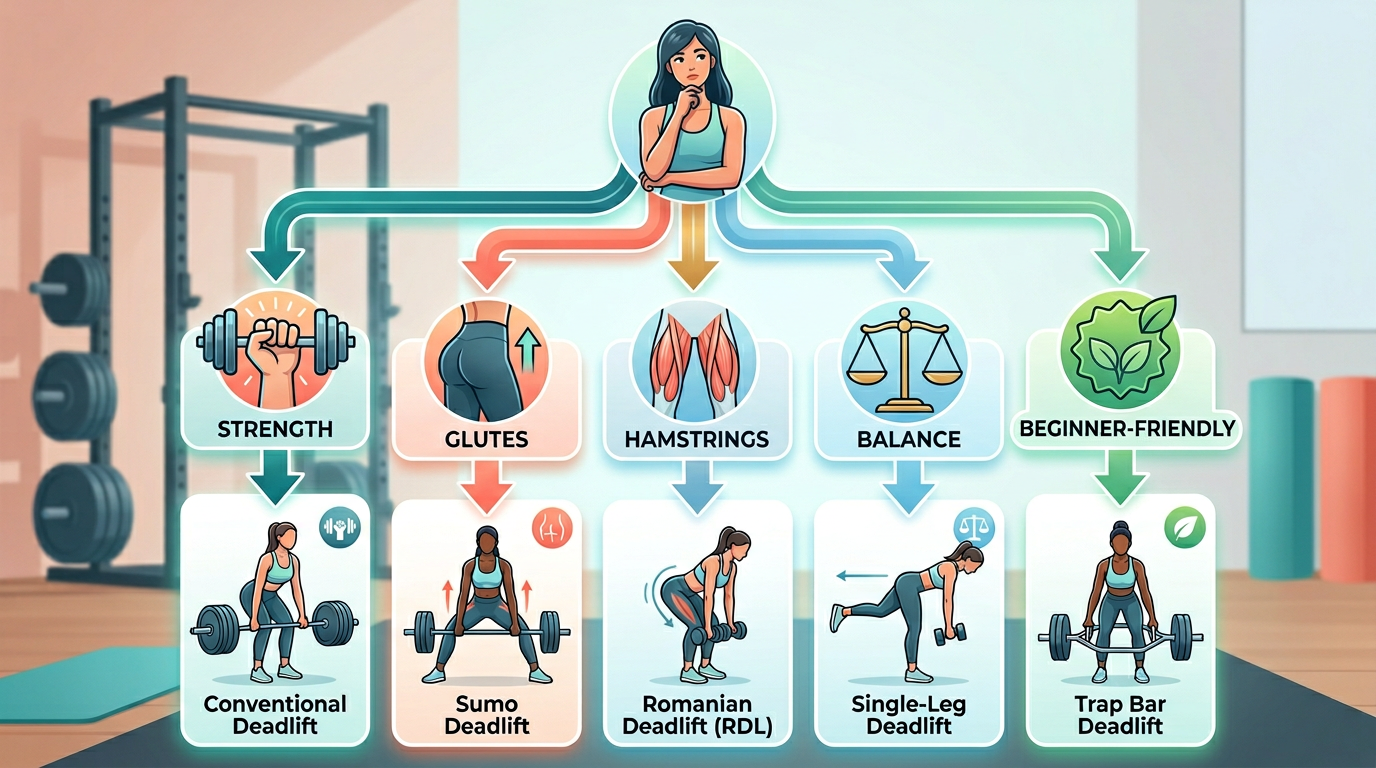
Flowchart or decision tree helping women choose the best deadlift variation based on their primary goal (strength, glutes, hamstrings, balance, or beginner-friendly)
Common Mistakes and How to Avoid Them
Even experienced lifters can develop bad habits with deadlifts. Being aware of common mistakes helps you maintain proper form and prevent injury across all deadlift variations.
Form Errors That Compromise Results
The most common deadlift mistake is rounding the lower back, which shifts stress from your strong glutes and hamstrings to your vulnerable spine. This usually happens when you try to lift too much weight or when you fail to properly brace your core before the lift.
Other frequent mistakes include:
- Starting with the bar too far from your shins, creating an inefficient bar path
- Letting your hips rise faster than your shoulders, turning the deadlift into a lower back exercise
- Hyperextending your back at the top instead of simply standing tall with neutral spine
- Failing to engage your lats, which provides crucial stability throughout the lift
- Looking up excessively, which can strain your neck and compromise spinal alignment
- Lowering the weight too quickly without control, missing out on the eccentric strength benefits
Progressive Overload Done Right
Progressive overload is essential for building strength, but it needs to be applied intelligently. Adding weight too quickly is a common mistake that compromises form and increases injury risk. Instead, aim to add small increments (2.5-5 pounds) only when you can complete all your sets with excellent form.
Remember that progressive overload doesn't always mean adding weight. You can also progress by increasing reps, adding sets, improving your tempo (especially slowing down the eccentric phase), or reducing rest periods between sets. These methods build strength while maintaining perfect form.
Safety Considerations and Injury Prevention
Deadlifts are safe when performed correctly, but they do require attention to detail and respect for the movement. Understanding how to protect yourself ensures you can enjoy the benefits of deadlifting for years to come.
Warming Up Properly
Never attempt heavy deadlifts without a thorough warm-up that includes both general movement and specific preparation sets. Start with 5-10 minutes of light cardio to increase blood flow, then perform dynamic stretches focusing on your hips, hamstrings, and thoracic spine.
Follow your general warm-up with specific warm-up sets using the deadlift variation you're about to perform. Start with just the bar or very light weight, gradually increasing the load across 3-5 warm-up sets until you reach your working weight. This prepares your nervous system and reinforces proper movement patterns.
Knowing When to Stop or Modify
Pain is different from discomfort. The burn in your muscles during a challenging set is normal, but sharp pain, especially in your lower back, is a signal to stop immediately. If you experience pain during deadlifts, reduce the weight, check your form, or choose a different variation that feels better.
Pregnancy, injuries, and certain health conditions may require modifications to your deadlift practice. Trap bar deadlifts or elevated deadlifts (starting with the bar on blocks) can be excellent alternatives that maintain the benefits while accommodating your current situation. Always consult with your healthcare provider about exercise modifications specific to your circumstances.
The Role of Accessories and Equipment
While you don't need much equipment to deadlift effectively, a few items can enhance your training. A lifting belt provides additional core support when lifting heavy weights, though it shouldn't be used as a crutch—you still need to brace your core properly.
Lifting straps can help when your grip strength becomes the limiting factor, allowing you to fully challenge your posterior chain. However, don't rely on straps exclusively—dedicate some training to grip strength development as well. Flat-soled shoes or lifting shoes provide better stability than cushioned running shoes, which compress under heavy loads.
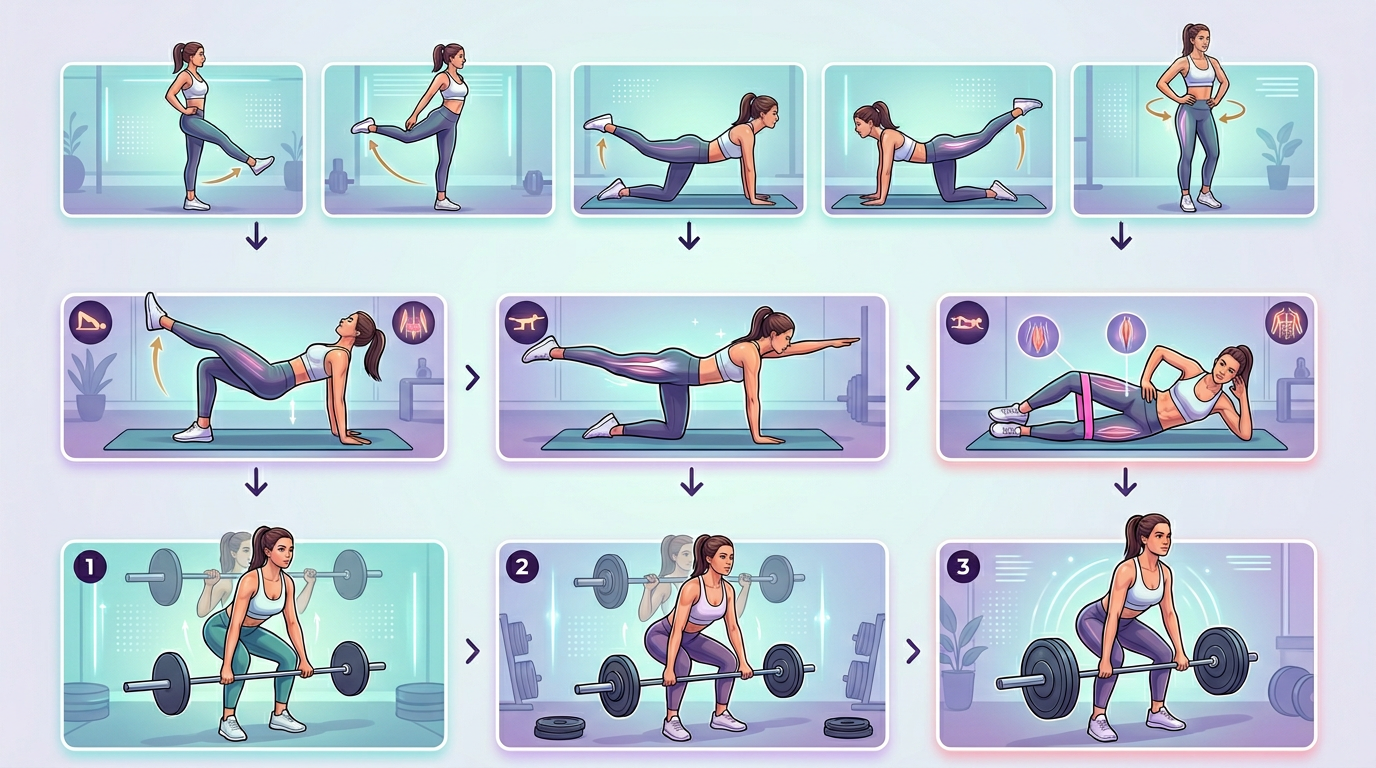
Infographic showing proper deadlift warm-up sequence including dynamic stretches, activation exercises, and progressive warm-up sets with recommended rep ranges
Frequently Asked Questions
How many types of deadlifts are there?
There are over a dozen recognized deadlift variations, with the most common being conventional, Romanian, sumo, single-leg, trap bar, stiff-leg, and deficit deadlifts. Each variation emphasizes different muscle groups and movement patterns. Most women benefit from incorporating 2-3 variations into their training program rather than attempting to master all types simultaneously.
What type of deadlift is best?
The best deadlift depends on your individual goals and biomechanics. Conventional deadlifts build overall strength, Romanian deadlifts target hamstrings and glutes, sumo deadlifts emphasize glutes with less lower back stress, and trap bar deadlifts offer a beginner-friendly option. Choose variations that feel comfortable and align with your specific training objectives.
Can deadlifts improve sciatica?
Deadlifts can help prevent sciatica by strengthening the posterior chain and core muscles that support your spine, but they should not be performed during acute sciatica flare-ups. Once cleared by a healthcare provider, starting with lighter trap bar or Romanian deadlifts may help rebuild strength. Always consult your doctor before deadlifting with any back condition.
Do deadlifts help with bone density?
Yes, deadlifts are excellent for building bone density because they create mechanical stress that signals your body to strengthen bones. This weight-bearing exercise is particularly beneficial for women, as bone density naturally decreases with age. Regular deadlift training with progressive overload can help maintain and even increase bone mineral density over time.
How often should women deadlift?
Most women benefit from deadlifting 1-3 times per week, depending on training experience and overall program design. Beginners should start with once weekly to allow adequate recovery, while advanced lifters might include different variations 2-3 times weekly. Always allow at least 48 hours between heavy deadlift sessions for proper muscle recovery and adaptation.
Should I feel deadlifts in my lower back?
You should feel your lower back muscles working during deadlifts, but not pain or excessive strain. Deadlifts should primarily target your glutes and hamstrings, with your lower back acting as a stabilizer. If you feel significant lower back fatigue or discomfort, check your form, reduce the weight, or try a variation like trap bar deadlifts.
Can beginners start with conventional deadlifts?
Beginners can start with conventional deadlifts if they master proper hip hinge mechanics first. However, many women find trap bar deadlifts or Romanian deadlifts easier to learn initially because they require less technical precision. Starting with bodyweight hip hinges and progressing to lighter variations builds confidence and proper movement patterns before advancing to conventional deadlifts.
Building Your Deadlift Journey
Understanding the different types of deadlifts empowers you to create a training program tailored to your unique goals and body. Whether you're drawn to the conventional deadlift for its strength-building potential, the Romanian deadlift for hamstring development, or the single-leg variation for balance and stability, each variation offers distinct benefits that contribute to your overall fitness.
Remember that mastering deadlifts is a journey, not a destination. Start with variations that feel comfortable and allow you to maintain excellent form. As your strength, confidence, and technical proficiency grow, you can explore more challenging variations and heavier weights. The key is consistency—showing up regularly, focusing on progressive overload, and celebrating the small victories along the way.
Deadlifts build more than just physical strength. They develop mental resilience, body awareness, and the confidence that comes from knowing you're capable of more than you imagined. By incorporating various types of deadlifts into your training program, you're investing in functional strength that will serve you both in and out of the gym for years to come. Start where you are, focus on proper form, and trust the process—your strongest self is waiting on the other side of consistent effort.