The Best Thigh Workouts for Women: Sculpt Stronger Legs
Thigh workouts are strength training exercises targeting the quadriceps, hamstrings, adductors, and abductors to build muscle, increase strength, and improve lower body function. The most effective include squats, lunges, deadlifts, and leg presses performed with progressive overload 2-3 times weekly for optimal results.
Your thighs are the foundation of your strength. Whether you're climbing stairs, sprinting for the bus, or simply standing up from a chair, your quadriceps, hamstrings, and inner and outer thigh muscles work together to power every movement. Yet many women struggle to find thigh workouts that deliver real results without requiring expensive equipment or hours at the gym.
The good news? Building stronger, more sculpted thighs doesn't require complicated routines or fancy machines. With the right exercises and a strategic approach, you can transform your lower body strength and confidence from the comfort of your home. This comprehensive guide breaks down the best thigh workouts for women, from beginner-friendly movements to advanced variations that challenge even seasoned lifters.
We'll explore ten proven exercises that target every angle of your thighs, explain proper form to maximize results and prevent injury, and show you how to structure these movements into an effective training program. Whether your goal is building strength, improving muscle definition, or enhancing athletic performance, these exercises will help you achieve it.
Key Takeaways
- Effective thigh training requires exercises that target all four major muscle groups: quadriceps, hamstrings, adductors, and abductors
- Progressive overload through increased weight, reps, or difficulty is essential for continued strength gains and muscle development
- Training thighs 2-3 times weekly with adequate recovery allows optimal muscle growth and prevents overtraining
- Compound movements like squats and lunges provide the most efficient strength and muscle-building benefits
- Proper form and full range of motion matter more than the amount of weight lifted
Quick Comparison: Top 10 Thigh Workouts
Exercise
Primary Target
Difficulty Level
Equipment Needed
Best For
Squats
Quadriceps, Glutes
Beginner-Advanced
Optional weights
Overall leg strength
Lunges
Quadriceps, Glutes
Beginner-Intermediate
Optional weights
Balance and coordination
Romanian Deadlifts
Hamstrings, Glutes
Intermediate
Dumbbells or barbell
Posterior chain development
Bulgarian Split Squats
Quadriceps, Glutes
Intermediate-Advanced
Bench, optional weights
Single-leg strength
Sumo Squats
Inner Thighs, Glutes
Beginner-Intermediate
Optional weight
Inner thigh activation
Step-Ups
Quadriceps, Glutes
Beginner-Intermediate
Box or bench
Functional strength
Leg Press
Quadriceps, Glutes
Beginner-Advanced
Leg press machine
Heavy loading safely
Side Lunges
Inner/Outer Thighs
Beginner-Intermediate
Optional weights
Lateral movement patterns
Wall Sits
Quadriceps
Beginner
Wall
Isometric endurance
Glute Bridges
Hamstrings, Glutes
Beginner
Optional weight
Hip extension strength
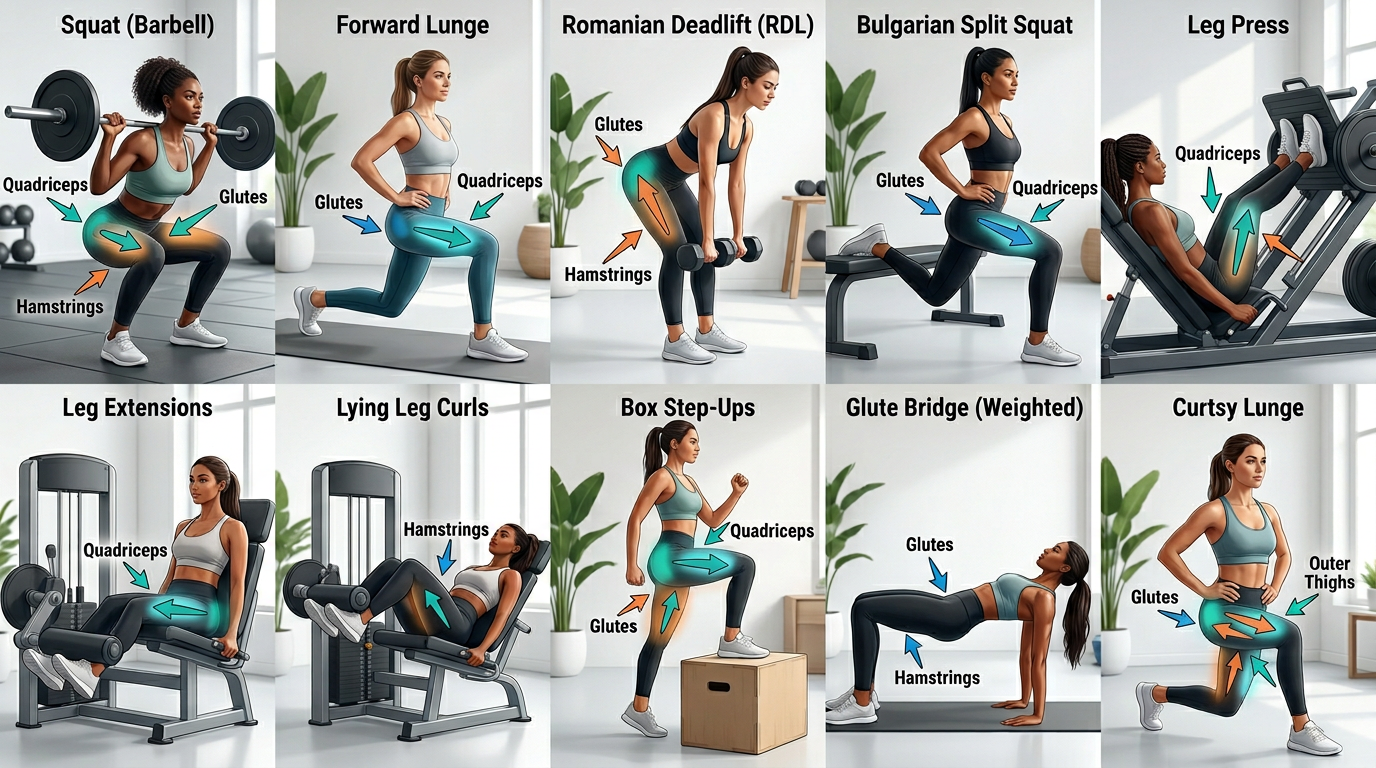
Infographic showing proper form for all 10 thigh exercises with arrows indicating primary muscle groups targeted
Understanding Your Thigh Muscles
Before diving into the best thigh workouts, understanding the anatomy of your thighs helps you select exercises that target your specific goals. Your thighs contain some of the largest and most powerful muscles in your body, and each muscle group serves distinct functions.
The Four Major Thigh Muscle Groups
The quadriceps (front of thigh) consist of four muscles that extend your knee and stabilize your kneecap. These muscles power movements like standing up, climbing stairs, and jumping. Strong quads improve athletic performance and protect your knees from injury.
The hamstrings (back of thigh) include three muscles that flex your knee and extend your hip. They work opposite to your quadriceps and are crucial for running, jumping, and maintaining proper posture. Balanced hamstring development prevents muscle imbalances that can lead to injury.
Your adductors (inner thigh) bring your legs toward your body's midline and stabilize your pelvis during movement. These muscles are often undertrained but essential for lateral stability and injury prevention.
The abductors (outer thigh) move your legs away from your body and stabilize your hips during single-leg activities. Strong abductors improve balance and reduce knee stress during walking and running.
Why Balanced Thigh Training Matters
Many women focus exclusively on exercises that target the quadriceps while neglecting the hamstrings and inner thigh muscles. This creates muscle imbalances that can lead to knee pain, poor posture, and increased injury risk. A comprehensive approach to thigh workouts addresses all four muscle groups for optimal strength, function, and aesthetics.
1. Squats
Squats reign as the undisputed champion of thigh exercises. This compound movement engages your quadriceps, hamstrings, glutes, and core simultaneously, making it one of the most efficient exercises for building lower body strength. The beauty of squats lies in their versatility—you can perform them with just your bodyweight or add resistance through dumbbells, barbells, or resistance bands.
To perform a proper squat, stand with feet shoulder-width apart, toes slightly turned out, and lower your hips back and down as if sitting in a chair while keeping your chest up and knees tracking over your toes. Descend until your thighs are at least parallel to the floor, then drive through your heels to return to standing. Keep your core engaged throughout the movement to protect your lower back.
Beginners should master bodyweight squats before adding external resistance. Focus on achieving full depth with good form rather than rushing to add weight. As you progress, you can explore variations like goblet squats (holding a dumbbell at chest height), back squats (barbell across upper back), or front squats (barbell across front shoulders) to continue challenging your muscles.
Pros
- Targets multiple muscle groups simultaneously for efficient training
- Builds functional strength that transfers to daily activities
- Scalable from beginner to advanced through weight progression
- Increases bone density and metabolic rate
Cons
- Requires good mobility in ankles, hips, and thoracic spine
- Form errors can lead to knee or lower back strain
- May be challenging for those with knee issues or limited flexibility
2. Lunges
Lunges challenge your balance while building unilateral leg strength, making them essential for correcting muscle imbalances between your left and right sides. This single-leg dominant exercise targets your quadriceps and glutes while engaging your core for stability. Lunges also improve coordination and functional movement patterns that translate directly to walking, running, and climbing.
Start in a standing position, step forward with one leg, and lower your back knee toward the ground until both knees form approximately 90-degree angles. Your front knee should track over your ankle, not extending past your toes. Push through your front heel to return to standing, then repeat on the opposite leg. Maintain an upright torso throughout the movement to maximize thigh engagement and minimize lower back stress.
Experiment with different lunge variations to target your thighs from multiple angles. Walking lunges cover distance and build endurance, reverse lunges reduce knee stress while emphasizing glutes, and stationary lunges allow you to focus on form without worrying about balance. Add dumbbells held at your sides or a barbell across your back to increase resistance as you build strength.
Pros
- Identifies and corrects strength imbalances between legs
- Improves balance and coordination
- Highly functional for everyday movement patterns
- Multiple variations prevent training plateaus
Cons
- Requires more balance and coordination than bilateral exercises
- Can be challenging for those with knee issues
- Takes longer to complete since you train one leg at a time
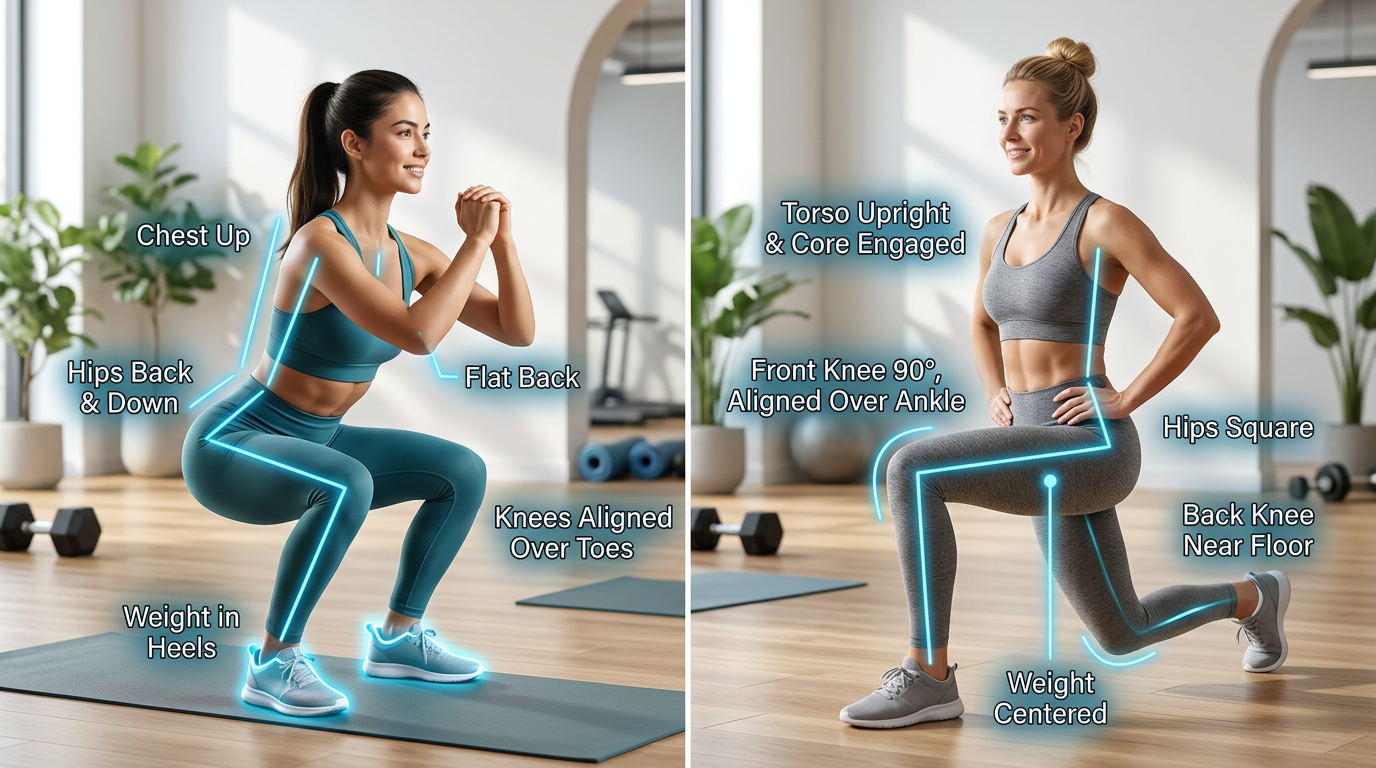
Side-by-side comparison showing proper squat form and proper lunge form with alignment cues highlighted
3. Romanian Deadlifts
Romanian deadlifts (RDLs) specifically target your hamstrings and glutes, providing essential posterior chain development that balances quad-dominant exercises like squats and lunges. This hip-hinge movement teaches proper movement mechanics while building strength in the muscles that support your lower back and improve posture.
Hold dumbbells or a barbell in front of your thighs with a slight bend in your knees, then push your hips back while lowering the weight down your legs, keeping the weight close to your body and your back flat. You should feel a stretch in your hamstrings as you descend. Once you reach mid-shin or feel a strong hamstring stretch, drive your hips forward to return to standing, squeezing your glutes at the top.
The key to effective RDLs is maintaining a neutral spine throughout the movement and initiating the motion from your hips, not your lower back. Start with light weight to master the hip-hinge pattern before progressing to heavier loads. Many women find that RDLs dramatically improve their hamstring strength and reduce lower back discomfort from sitting.
Pros
- Excellent hamstring and glute development
- Teaches proper hip-hinge mechanics that protect your back
- Improves posterior chain strength and posture
- Reduces muscle imbalances from quad-dominant training
Cons
- Requires good hamstring flexibility for full range of motion
- Form errors can strain the lower back
- Requires weights or resistance bands for effectiveness
4. Bulgarian Split Squats
Bulgarian split squats elevate your rear foot on a bench or step, creating an intense single-leg exercise that builds serious quadriceps and glute strength. This advanced variation challenges your balance while allowing you to achieve greater range of motion than traditional lunges, leading to superior muscle development and functional strength gains.
Position yourself two to three feet in front of a bench with one foot elevated behind you. Lower your body by bending your front knee until your thigh is parallel to the ground or slightly below, keeping your torso upright. Drive through your front heel to return to the starting position. The elevated rear foot increases the demand on your front leg, making this one of the most effective single-leg exercises for building thigh strength.
Start with bodyweight only until you master the balance requirements, then progress to holding dumbbells at your sides or a barbell across your back. Bulgarian split squats are demanding, so don't be discouraged if you need to use lighter weights than you would for bilateral exercises. The unilateral nature of the movement makes it inherently more challenging.
Pros
- Superior muscle activation compared to standard lunges
- Excellent for identifying and correcting leg strength imbalances
- Greater range of motion leads to better muscle development
- Builds functional single-leg strength and stability
Cons
- Requires significant balance and coordination
- Can be intimidating for beginners
- Needs a bench or elevated surface
- More fatiguing than bilateral exercises
5. Sumo Squats
Sumo squats take a wider stance than traditional squats, shifting emphasis to your inner thighs (adductors) and glutes while still engaging your quadriceps. This variation is particularly effective for women looking to strengthen their inner thighs, an area often neglected in standard training programs. The wider stance also allows for a more upright torso position, reducing stress on the lower back.
Stand with feet wider than shoulder-width apart and toes turned out at approximately 45 degrees. Hold a dumbbell or kettlebell at chest height or between your legs. Lower your hips straight down, keeping your knees tracking over your toes and your chest lifted. Descend until your thighs are parallel to the floor, then drive through your heels to stand, squeezing your glutes and inner thighs at the top.
The key to maximizing inner thigh activation in sumo squats is maintaining tension throughout the movement by actively thinking about pushing your knees out. This internal cue engages your abductors and adductors more effectively than simply moving through the range of motion. For more targeted inner thigh work, check out our guide to inner thigh exercises that complement sumo squats perfectly.
Pros
- Excellent inner thigh and glute activation
- More upright torso reduces lower back stress
- Suitable for those with limited ankle mobility
- Can be performed with various equipment options
Cons
- Requires good hip mobility for proper depth
- May feel awkward initially due to wide stance
- Less quadriceps emphasis than traditional squats
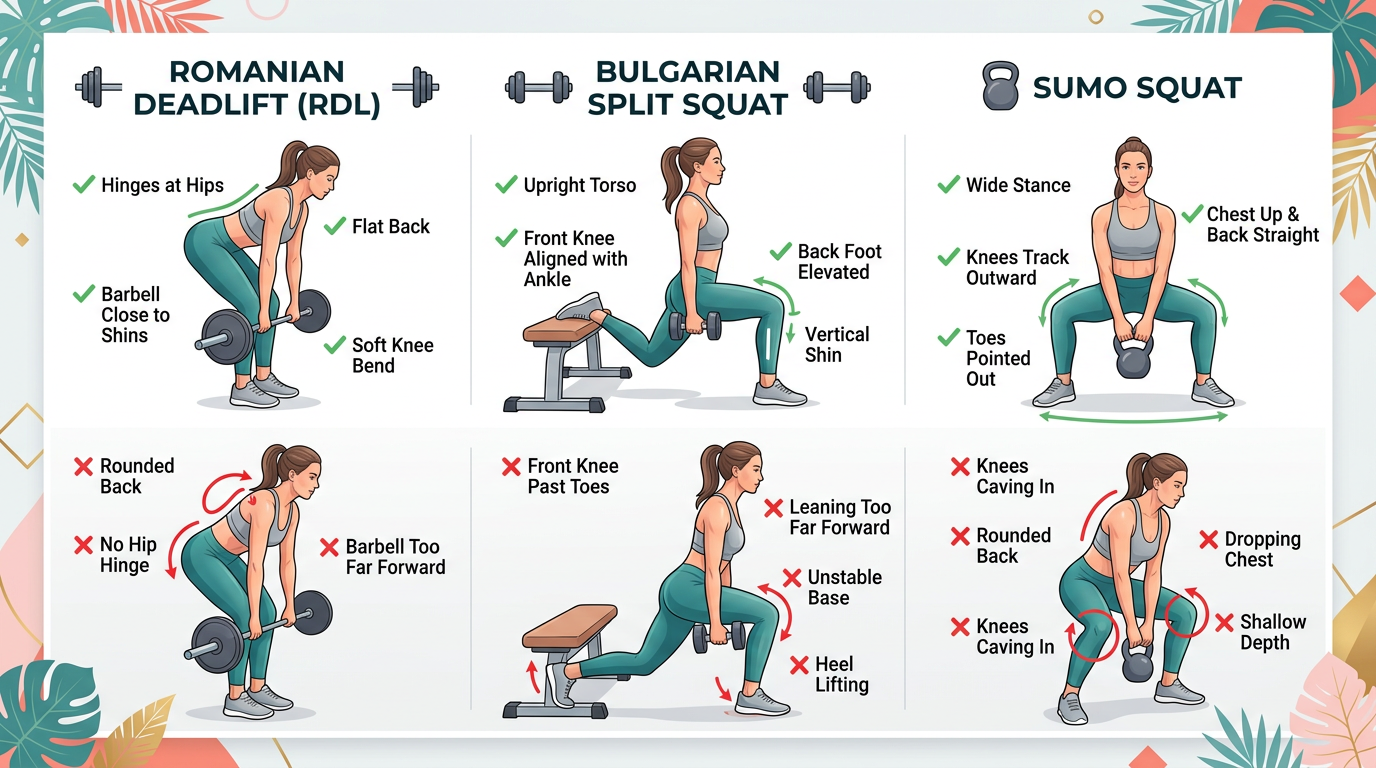
Demonstration of Romanian deadlift, Bulgarian split squat, and sumo squat with proper form and common mistakes to avoid
6. Step-Ups
Step-ups mimic the natural movement of climbing stairs while providing an excellent unilateral thigh workout. This functional exercise builds quadriceps and glute strength while improving balance and coordination. Step-ups are particularly valuable for women who want to improve their ability to perform daily activities with greater ease and confidence.
Stand facing a box, bench, or sturdy step that's approximately knee height. Place one foot completely on the elevated surface, then drive through that heel to lift your body up until your leg is fully extended. Step down with control and repeat. Avoid pushing off with your bottom foot—all the work should come from the elevated leg. This ensures maximum thigh engagement and prevents cheating the movement.
The height of your step determines the difficulty and muscle emphasis. Lower steps (8-12 inches) work well for beginners and emphasize quadriceps, while higher steps (16-20 inches) increase glute involvement and challenge your strength more significantly. Add dumbbells held at your sides once bodyweight step-ups become comfortable for 12-15 reps per leg.
Pros
- Highly functional for everyday activities
- Adjustable difficulty through step height and added weight
- Builds single-leg strength and balance
- Low impact compared to jumping exercises
Cons
- Requires a sturdy elevated surface
- Can stress knees if step height is too high initially
- Easy to compensate by pushing off the bottom foot
7. Leg Press
The leg press machine allows you to safely load your thighs with heavy weight while minimizing stress on your lower back and core. This makes it an excellent option for pushing your quadriceps, hamstrings, and glutes to their limits without the balance and coordination requirements of free-weight exercises. The leg press is particularly valuable for building pure leg strength and muscle mass.
Sit in the leg press machine with your back firmly against the pad and feet positioned shoulder-width apart on the platform. Release the safety handles and lower the platform by bending your knees until they reach approximately 90 degrees. Push through your entire foot to extend your legs, stopping just short of locking your knees. The controlled nature of the machine allows you to focus entirely on pushing maximum weight without worrying about balance.
Experiment with foot placement to emphasize different areas of your thighs. A higher foot position shifts emphasis to hamstrings and glutes, while a lower position targets quadriceps more directly. Wider stance activates inner thighs, while a narrower stance emphasizes outer quads. This versatility makes the leg press a valuable tool for comprehensive thigh development.
Pros
- Allows heavy loading safely without balance requirements
- Reduces lower back stress compared to squats
- Versatile foot positions target different muscle groups
- Excellent for progressive overload and muscle building
Cons
- Requires gym access or expensive home equipment
- Less functional than free-weight exercises
- Doesn't engage stabilizer muscles or core
- Can encourage ego-lifting with excessive weight
8. Side Lunges
Side lunges move in the frontal plane, targeting your inner and outer thighs while building lateral strength and mobility. Most thigh exercises move forward and backward, but side lunges train movement patterns that improve athletic performance and reduce injury risk during lateral movements. This makes them essential for well-rounded thigh development.
Stand with feet together, then take a wide step to one side. Bend the knee of your stepping leg while keeping your other leg straight, pushing your hips back as you lower into a side lunge. Your bent knee should track over your toes, and your chest should remain upright. Push through your bent leg to return to standing, then repeat on the opposite side.
Side lunges challenge your adductors (inner thighs) eccentrically on the straight leg while concentrically working the bent leg, providing comprehensive inner thigh training. Add a dumbbell held at chest height (goblet style) to increase resistance as you build strength. The lateral movement pattern also improves hip mobility, which benefits your performance in all other thigh exercises.
Pros
- Targets often-neglected lateral movement patterns
- Excellent inner and outer thigh activation
- Improves hip mobility and flexibility
- Reduces injury risk from lateral movements
Cons
- Requires good hip mobility for proper depth
- May feel awkward initially due to unfamiliar movement pattern
- Can strain adductors if progressed too quickly
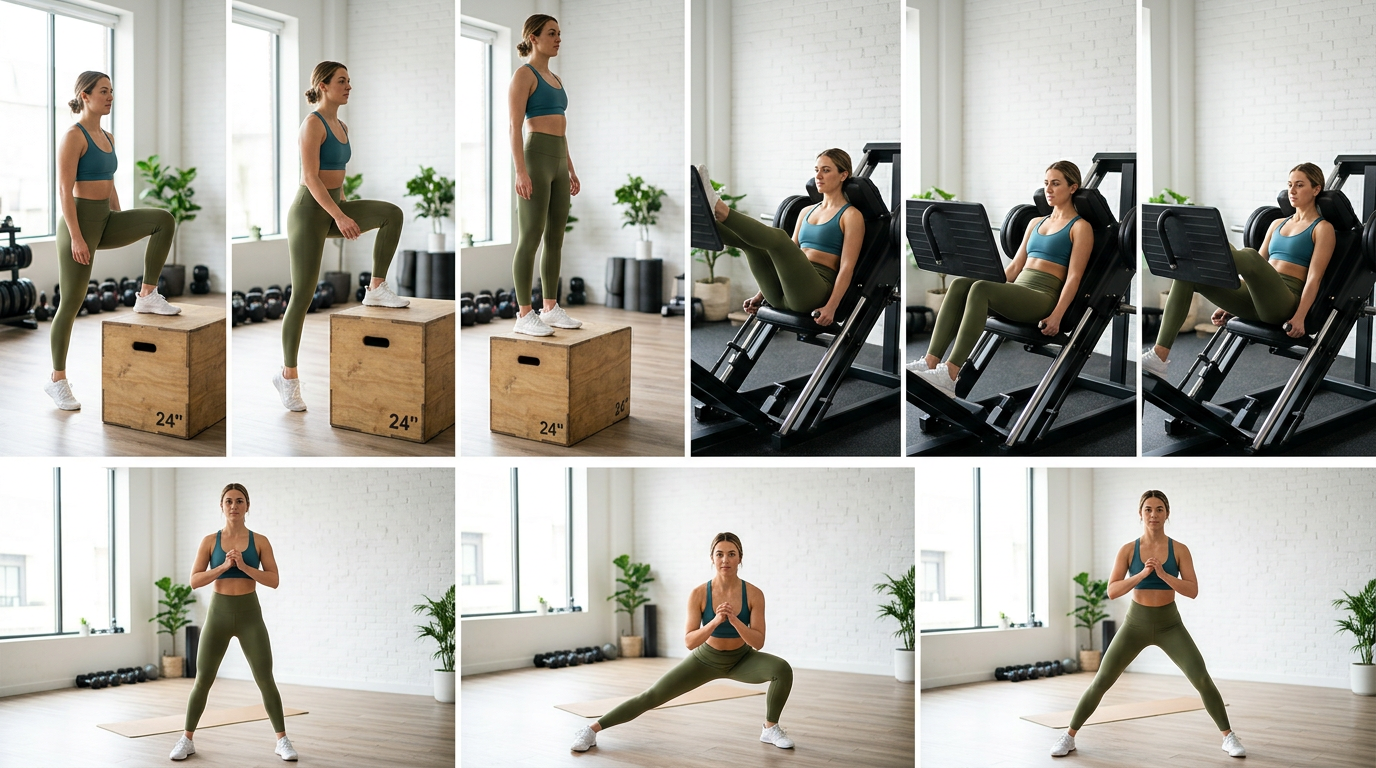
Photo sequence showing step-ups, leg press foot positions, and side lunges with proper form
9. Wall Sits
Wall sits build isometric quadriceps strength and muscular endurance through sustained muscle contraction. This simple yet brutally effective exercise requires nothing but a wall and the mental fortitude to hold the position as your thighs burn. Wall sits are perfect for home workouts and can be performed anywhere, making them ideal for women with limited time or equipment.
Stand with your back against a wall, then slide down until your thighs are parallel to the floor and your knees form 90-degree angles. Your feet should be far enough from the wall that your knees don't extend past your toes. Hold this position, keeping your back flat against the wall and your core engaged. Start with 20-30 second holds and progressively work up to 60 seconds or longer.
The isometric nature of wall sits builds a different type of strength than dynamic exercises like squats and lunges. They improve your ability to maintain muscle tension over time, which enhances endurance for activities like hiking, skiing, or simply standing for long periods. Add wall sits at the end of your thigh workout as a burnout exercise to fully fatigue your quadriceps.
Pros
- No equipment required—just a wall
- Builds exceptional quadriceps endurance
- Low injury risk with proper form
- Can be performed anywhere, anytime
Cons
- Doesn't build strength through full range of motion
- Can be mentally challenging to hold positions
- Limited progression options beyond time and single-leg variations
10. Glute Bridges
While primarily a glute exercise, glute bridges significantly engage your hamstrings, making them valuable for complete posterior thigh development. This exercise teaches proper hip extension mechanics while building strength in the muscles that support your lower back and improve posture. Glute bridges are particularly beneficial for women who sit for extended periods and need to counteract hip flexor tightness.
Lie on your back with knees bent and feet flat on the floor, positioned hip-width apart and close enough that you can nearly touch your heels with your fingertips. Drive through your heels to lift your hips toward the ceiling, squeezing your glutes and engaging your hamstrings at the top. Your body should form a straight line from shoulders to knees. Lower with control and repeat.
Progress glute bridges by adding a barbell or dumbbell across your hips, elevating your shoulders on a bench (hip thrusts), or performing single-leg variations. The key to maximizing hamstring engagement is thinking about pulling your heels toward your glutes as you lift your hips. This subtle cue activates your hamstrings more effectively than simply pushing your hips up.
Pros
- Excellent hamstring and glute activation
- Improves hip extension strength and posture
- Low stress on lower back and knees
- Easily modified for all fitness levels
Cons
- Less quadriceps involvement than other thigh exercises
- Can be uncomfortable with heavy weight across hips
- Requires progressive resistance for continued gains
Creating Your Thigh Workout Program
Now that you understand the best thigh workouts, let's discuss how to structure these exercises into an effective training program. The key to results lies not just in exercise selection but in proper programming that allows for progressive overload and adequate recovery.
Training Frequency and Volume
Train your thighs 2-3 times per week with at least 48 hours of recovery between sessions for optimal muscle growth and strength development. Your muscles grow during rest, not during training, so adequate recovery is essential. Each session should include 3-5 exercises targeting different angles and muscle groups within your thighs.
For each exercise, perform 3-4 sets of 8-15 repetitions. Lower rep ranges (6-8) with heavier weight build maximum strength, moderate ranges (8-12) optimize muscle growth, and higher ranges (12-15) improve muscular endurance. Vary your rep ranges across different training phases to develop well-rounded thigh strength and development.
Sample Thigh Workout Routines
Here are three sample routines for different training goals:
Beginner Routine (2x per week):
- Bodyweight Squats: 3 sets of 12-15 reps
- Reverse Lunges: 3 sets of 10 reps per leg
- Glute Bridges: 3 sets of 15 reps
- Wall Sits: 3 sets of 30 seconds
Intermediate Routine (3x per week):
- Goblet Squats: 4 sets of 10-12 reps
- Romanian Deadlifts: 3 sets of 10-12 reps
- Bulgarian Split Squats: 3 sets of 8-10 reps per leg
- Sumo Squats: 3 sets of 12-15 reps
- Side Lunges: 3 sets of 10 reps per side
Advanced Routine (3x per week):
- Barbell Back Squats: 4 sets of 6-8 reps
- Leg Press: 4 sets of 10-12 reps
- Romanian Deadlifts: 4 sets of 8-10 reps
- Bulgarian Split Squats: 3 sets of 8-10 reps per leg
- Walking Lunges: 3 sets of 12 reps per leg
- Wall Sits: 3 sets to failure
Progressive Overload Principles
To continue seeing results, you must progressively increase the demands on your muscles over time. This can be achieved through several methods:
- Increase weight: Add 5-10 pounds when you can complete all prescribed reps with good form
- Increase reps: Add 1-2 reps per set before increasing weight
- Increase sets: Add an additional set once you adapt to your current volume
- Decrease rest periods: Reduce rest between sets to increase training density
- Improve tempo: Slow down the eccentric (lowering) phase for greater time under tension
- Advance variations: Progress to more challenging exercise variations
Track your workouts in a training journal or app to ensure you're consistently progressing. Small, incremental improvements compound over time to produce significant strength and muscle gains.
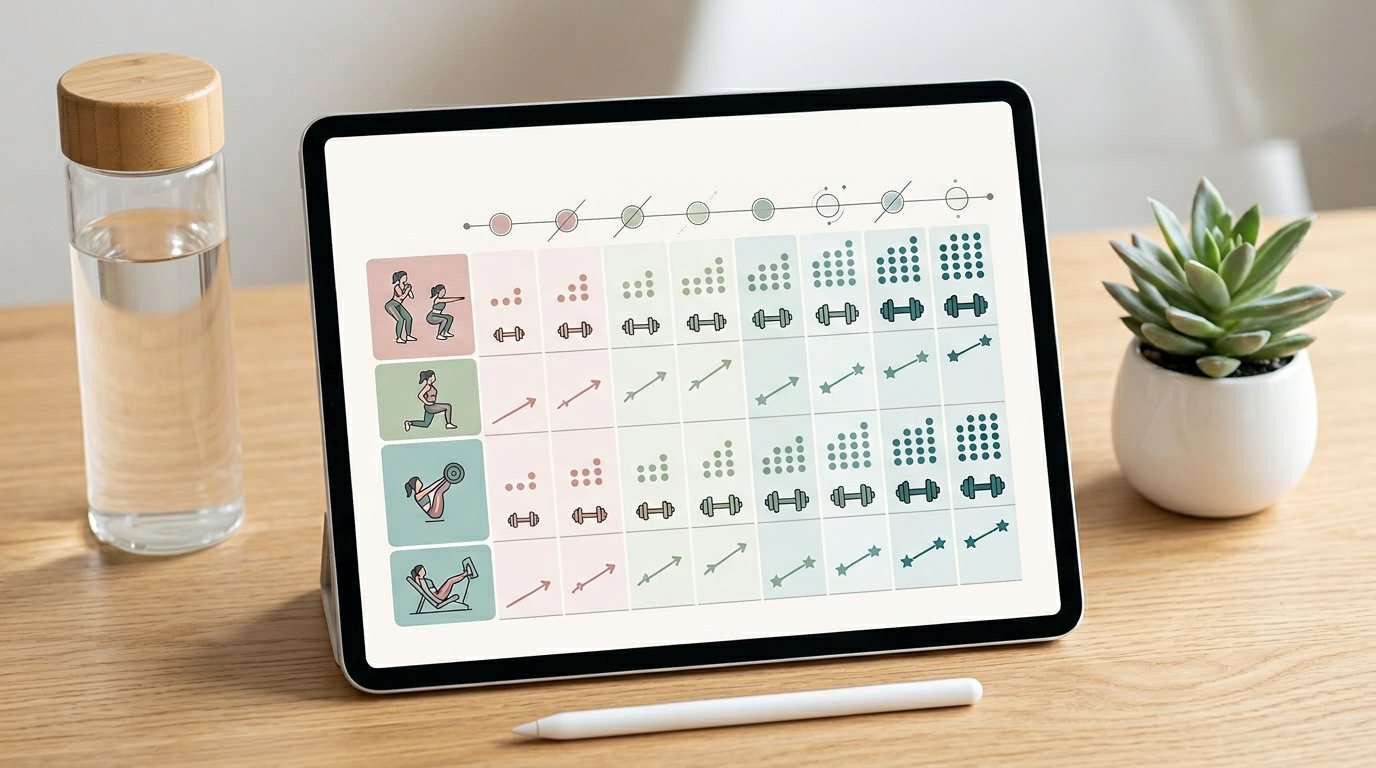
Workout tracking template showing progressive overload for thigh exercises over 8 weeks
Common Mistakes to Avoid
Even with the best thigh workouts, certain mistakes can limit your results or increase injury risk. Avoid these common pitfalls to maximize your training effectiveness.
Neglecting Hamstring Development
Many women focus heavily on quadriceps-dominant exercises like squats and lunges while neglecting hamstring work. This creates muscle imbalances that can lead to knee pain and poor posture. Ensure your program includes dedicated hamstring exercises like Romanian deadlifts, glute bridges, and hamstring curls to maintain balanced development.
Using Momentum Instead of Muscle
Rushing through repetitions and using momentum to complete movements reduces muscle engagement and limits results. Control every phase of each exercise, particularly the eccentric (lowering) portion, which produces significant muscle growth stimulus. If you can't control the weight throughout the full range of motion, reduce the load.
Insufficient Range of Motion
Partial reps limit muscle development and strength gains. Aim for full range of motion on all exercises unless mobility limitations prevent it. For squats and lunges, this means descending until thighs are at least parallel to the floor. For Romanian deadlifts, lower until you feel a strong hamstring stretch. Full range of motion ensures comprehensive muscle fiber recruitment.
Ignoring Recovery and Nutrition
Your thighs won't grow stronger without adequate recovery and proper nutrition. Ensure you're getting sufficient protein (0.7-1 gram per pound of body weight), sleeping 7-9 hours nightly, and allowing 48 hours between intense thigh training sessions. Overtraining leads to plateaus, fatigue, and increased injury risk.
Which Thigh Workout Is Best For You?
The ideal thigh workout depends on your current fitness level, available equipment, and specific goals. Here's how to match exercises to your situation:
If you're a complete beginner: Start with bodyweight squats, reverse lunges, glute bridges, and wall sits. These foundational movements build basic strength and teach proper movement patterns without requiring equipment. Master these exercises before progressing to weighted variations.
If you train at home with minimal equipment: Focus on goblet squats, Romanian deadlifts with dumbbells, Bulgarian split squats, step-ups, and sumo squats. These exercises deliver excellent results with just dumbbells or resistance bands and can be performed in small spaces.
If you have gym access: Incorporate barbell squats, leg press, barbell Romanian deadlifts, and weighted lunges. The additional equipment allows for heavier loading and continued progression as you build strength.
If you want to emphasize inner thighs: Prioritize sumo squats, side lunges, and wide-stance leg press variations. Complement these with dedicated inner thigh exercises from our comprehensive inner thigh workout guide.
If you have knee concerns: Focus on exercises that minimize knee stress like glute bridges, wall sits, Romanian deadlifts, and leg press with higher foot placement. Avoid deep lunges and squats until you build sufficient strength and address any underlying issues.
If you want maximum efficiency: Prioritize compound movements like squats, lunges, and Romanian deadlifts that engage multiple muscle groups simultaneously. These exercises deliver the most results per minute of training time.
Frequently Asked Questions
What is the best exercise for your thighs?
Squats are the most effective single exercise for overall thigh development because they engage quadriceps, hamstrings, glutes, and core simultaneously. They build functional strength, increase muscle mass, and can be scaled from bodyweight to heavy barbell variations as you progress.
How can I slim my thighs fast?
You cannot spot-reduce fat from your thighs through exercise alone. Combine strength training thigh workouts with a calorie deficit through proper nutrition and cardiovascular exercise to reduce overall body fat. Strength training builds muscle that increases metabolism and creates definition as fat decreases.
Can elderly regain leg strength?
Yes, older adults can absolutely regain leg strength through progressive resistance training. Studies show significant strength improvements are possible at any age with consistent training. Start with bodyweight exercises like chair squats and wall sits, then gradually progress to weighted movements under professional guidance.
What is the 5 4 3 2 1 workout method?
The 5-4-3-2-1 workout involves performing 5 exercises for decreasing reps: 5 reps of exercise one, 4 reps of exercise two, 3 reps of exercise three, 2 reps of exercise four, and 1 rep of exercise five. This descending rep scheme works well for high-intensity circuits but isn't optimal for building thigh strength.
How often should I do thigh workouts?
Train your thighs 2-3 times per week with at least 48 hours of recovery between sessions. This frequency allows sufficient stimulus for muscle growth while providing adequate recovery time. Beginners should start with twice weekly, while advanced lifters can handle three sessions with proper programming and recovery.
Should I feel sore after thigh workouts?
Muscle soreness is common but not required for effective training. Delayed onset muscle soreness typically occurs 24-48 hours after workouts, especially when trying new exercises or increasing intensity. Soreness decreases as your body adapts, but you're still building strength even without soreness.
Can I do thigh workouts every day?
Daily intense thigh training prevents adequate recovery and limits muscle growth. Your muscles need 48 hours to repair and strengthen between sessions. Light movement like walking or stretching on rest days promotes recovery, but save intense thigh workouts for 2-3 non-consecutive days weekly.
Conclusion
Building stronger, more sculpted thighs requires a strategic approach that targets all four major muscle groups through proven exercises and progressive training principles. The best thigh workouts combine compound movements like squats, lunges, and deadlifts with targeted exercises that address specific areas like your inner thighs and hamstrings.
Remember that consistency and progressive overload matter more than perfection. Start with exercises that match your current fitness level, focus on proper form, and gradually increase the challenge as you build strength. Whether you're training at home with minimal equipment or have full gym access, these ten exercises provide everything you need to develop powerful, functional legs that support you in every aspect of life. Train your thighs 2-3 times weekly, fuel your body with adequate protein and nutrition, and trust the process as you build the strong foundation you deserve.