Stop Skipping Standing Core Exercises: 10 Moves for Real Results
Standing core exercises are strength movements performed upright that engage your abs, obliques, and deep stabilizers without floor work. The most effective include wood chops, standing knee drives, and overhead marches, which challenge balance and coordination while building functional core strength for daily activities and athletic performance.
If you think the only way to build a strong core is by lying on the floor doing endless crunches, it's time to stand up and reconsider. Standing core exercises offer a functional, joint-friendly approach to sculpting your midsection while improving balance, posture, and real-world strength. These movements engage your entire core—including your abs, obliques, transverse abdominis, and lower back—while challenging your body in ways that translate directly to everyday activities like carrying groceries, playing with your kids, or maintaining proper form during other workouts.
Many women skip standing core work because they assume floor exercises are more effective. The truth is that standing movements activate your core in a more functional context, requiring stabilization against gravity and rotational forces. This guide to standing core exercises will show you exactly why these moves deserve a permanent spot in your routine and how to perform ten highly effective exercises that deliver real results.
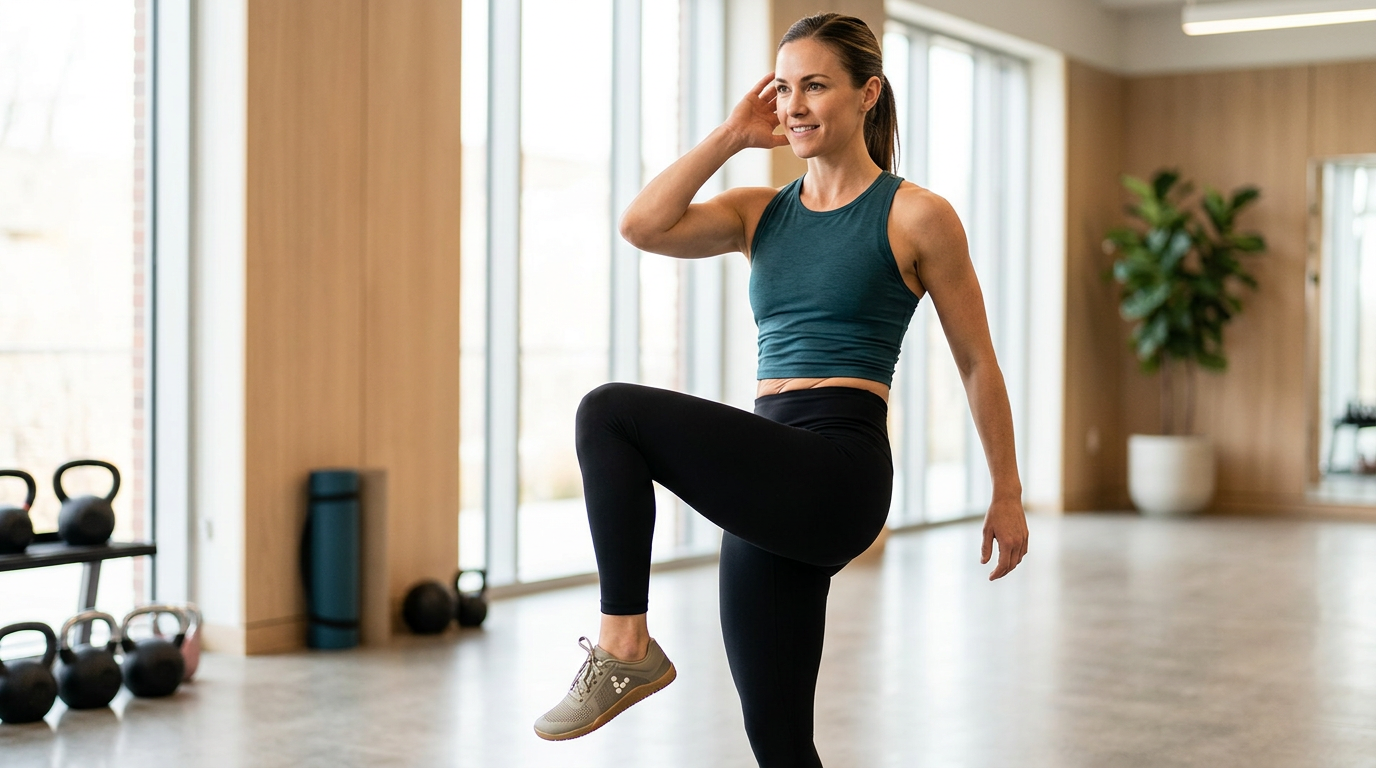
Woman performing standing core exercise with proper form in a bright gym, demonstrating engaged core muscles and confident posture
Key Takeaways
- Standing core exercises build functional strength that transfers to daily activities and athletic performance
- These movements are gentler on your neck and lower back compared to traditional floor crunches
- You can perform most standing core exercises anywhere with minimal or no equipment
- Proper breathing and core engagement are essential for maximizing results and preventing injury
- Progressive overload through added resistance or increased complexity ensures continued strength gains
Why Standing Core Exercises Are Essential for Women's Fitness
Standing core exercises represent a shift from isolated ab work to integrated, functional movement patterns. When you perform core exercises while standing, you're not just working your abs—you're training your entire body to work as a coordinated unit.
The Functional Advantage
Your core functions primarily as a stabilizer in real life, not as a flexor. Think about when you reach overhead to grab something from a high shelf, twist to look behind you while driving, or carry a heavy bag on one shoulder. These movements all require your core to stabilize your spine while your limbs move. Standing core exercises mimic these natural movement patterns, making you stronger where it actually matters.
Traditional floor exercises like crunches isolate the rectus abdominis through spinal flexion. While this can build visible ab muscles, it doesn't necessarily translate to better function. Standing movements engage your deep core stabilizers—particularly your transverse abdominis—which act like a natural weight belt to protect your spine during movement.
Joint-Friendly and Accessible
Many women experience neck strain or lower back discomfort during floor ab exercises. Standing core exercises eliminate these issues by working with gravity rather than against it. You maintain a neutral spine position throughout most movements, reducing compression on your vertebrae and allowing you to focus on muscle engagement rather than managing discomfort.
This accessibility makes standing core exercises ideal for women at any fitness level. Whether you're postpartum, recovering from injury, or simply new to strength training, these movements offer a safe entry point to core strengthening.
Time Efficiency and Versatility
Standing core exercises can be performed anywhere—no mat required. This makes them perfect for:
- Quick workouts during work breaks
- Hotel room training while traveling
- Outdoor workouts at parks or beaches
- Home sessions when floor space is limited
- Active recovery days when you want gentle movement
You can also easily integrate standing core work into your existing strength training routine by incorporating these moves between sets of other exercises.
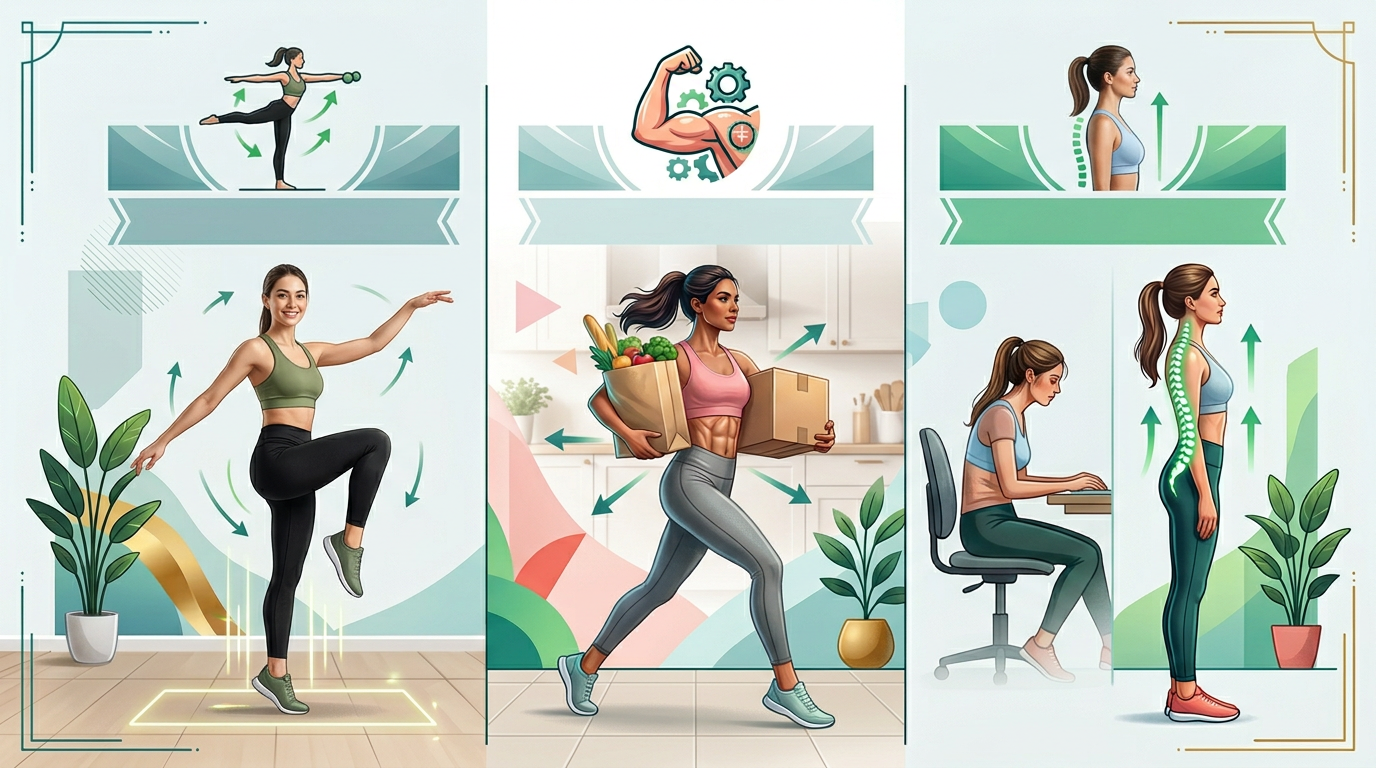
Infographic showing the benefits of standing core exercises including improved balance, functional strength, and better posture with icons and brief descriptions
Understanding Core Engagement: The Foundation of Effective Standing Core Exercises
Before diving into specific exercises, you need to understand what proper core engagement feels like. Many women mistakenly hold their breath or simply suck in their stomach, neither of which creates true core stability.
The 360-Degree Brace
Effective core engagement involves creating tension around your entire midsection, not just pulling your belly button in. Imagine you're about to receive a gentle punch to your stomach—you'd naturally brace all the muscles around your core, including your abs, obliques, and lower back. This creates intra-abdominal pressure that stabilizes your spine.
To practice this, place your hands on the sides of your ribcage and take a deep breath into your belly and sides. As you exhale, maintain that expanded feeling while gently drawing your lower abs in and up. You should feel tension all around your midsection, not just in the front.
Breathing While Bracing
A common mistake is holding your breath during core exercises. Proper breathing maintains core tension while allowing oxygen flow. Practice breathing into your ribcage laterally rather than letting your belly fully relax on each inhale. This keeps your core engaged throughout the movement.
Posture and Alignment
Standing core exercises require proper postural alignment to be effective. Stand with:
- Feet hip-width apart with weight evenly distributed
- Knees slightly soft, never locked
- Pelvis in neutral position (not tilted forward or tucked under)
- Ribcage stacked over pelvis, not flared out
- Shoulders back and down, away from ears
- Chin parallel to the ground with neck long
This alignment ensures your core muscles work efficiently and reduces compensation from other muscle groups.
10 Best Standing Core Exercises for Real Results
These ten standing core exercises target every aspect of core function—anti-extension, anti-rotation, anti-lateral flexion, and controlled rotation. Perform them with intention and proper form for maximum benefit.
1. Standing Wood Chop
The wood chop is one of the most effective standing core exercises for targeting your obliques and training rotational power. This movement mimics natural twisting patterns while building strength through a full range of motion.
Stand with feet shoulder-width apart, holding a dumbbell or medicine ball with both hands. Start with the weight at your right hip, then rotate your torso as you bring the weight diagonally across your body to above your left shoulder. Your eyes should follow the weight. Control the movement back to the starting position. Complete all reps on one side before switching.
Key points: Keep your core braced throughout, initiate the movement from your torso (not just your arms), and allow your back foot to pivot naturally as you rotate. Start with 8-12 reps per side for 3 sets.
2. Standing Knee Drive
This exercise challenges your balance while engaging your entire core, particularly your lower abs and hip flexors. Stand on your right leg with your left leg extended behind you and arms overhead. Drive your left knee up toward your chest while simultaneously bringing your arms down. Return to the starting position with control.
Focus on maintaining a tall spine throughout the movement rather than crunching forward. Your standing leg should remain stable with minimal wobbling. Perform 10-15 reps per side for 3 sets.
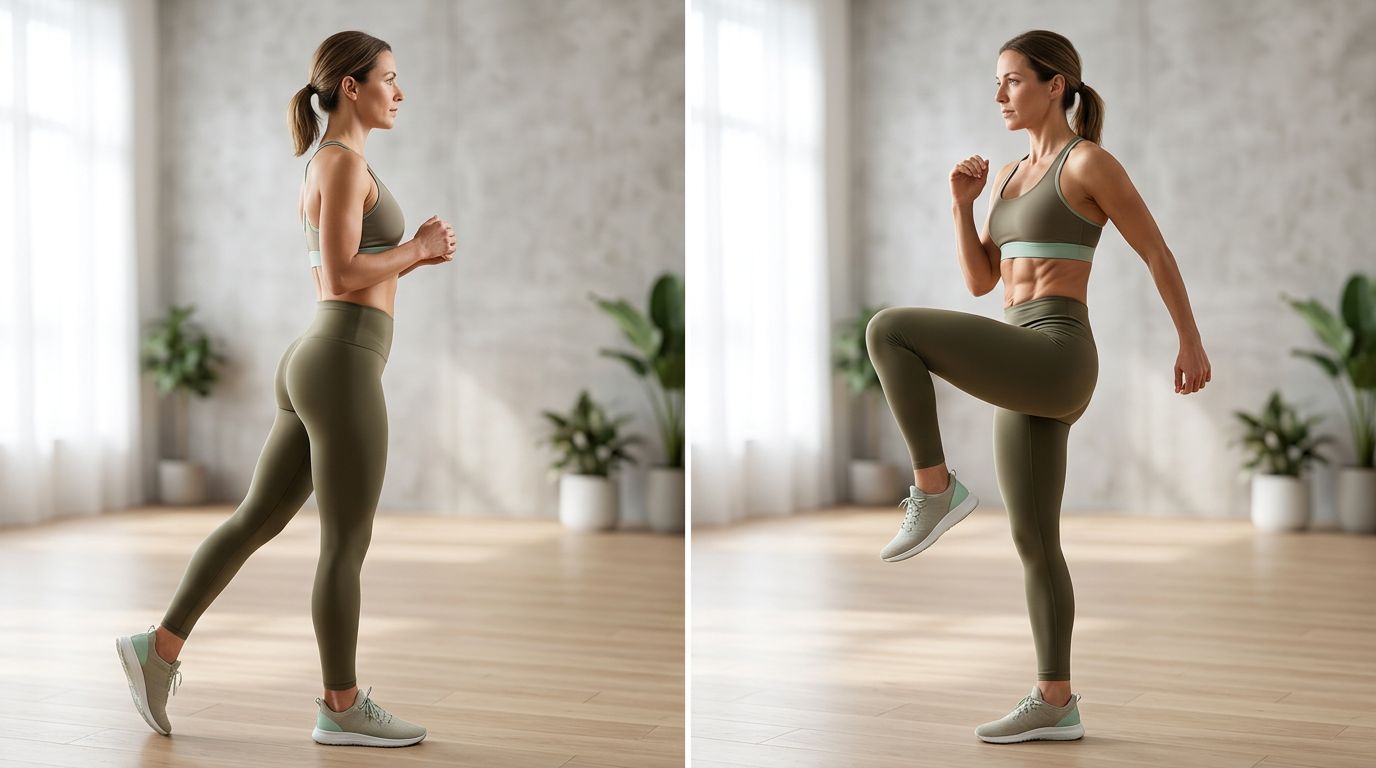
Step-by-step demonstration of standing knee drive exercise showing starting position with leg extended back and finishing position with knee raised, highlighting core engagement
3. Standing Oblique Crunch
This lateral movement targets your obliques while improving balance and coordination. Stand with feet hip-width apart and hands behind your head. Shift your weight to your left leg, then lift your right knee out to the side while bringing your right elbow down to meet it. Your torso should bend laterally, not forward.
The key is to create a side crunch through your waistline while maintaining a stable pelvis. Avoid rotating your torso or leaning forward. Complete 12-15 reps per side for 3 sets.
4. Overhead March
This anti-extension exercise forces your core to resist the pull of gravity while your arms are overhead. Hold a weight plate, dumbbell, or even a water bottle overhead with arms fully extended. March in place, lifting your knees to hip height while keeping your torso completely still.
Your core must work hard to prevent your lower back from arching as you lift each leg. Keep your ribcage down and core braced throughout. March for 30-60 seconds for 3 sets.
5. Standing Pallof Press
The Pallof press is an anti-rotation exercise that builds incredible core stability. Anchor a resistance band at chest height or hold a cable handle. Stand perpendicular to the anchor point with the band creating tension. Hold the handle at your chest with both hands, then press straight out in front of you, resisting the pull of the band trying to rotate you.
Your hips and shoulders should remain square forward throughout the movement. Hold the extended position for 2-3 seconds before returning the handle to your chest. Perform 10-12 reps per side for 3 sets.
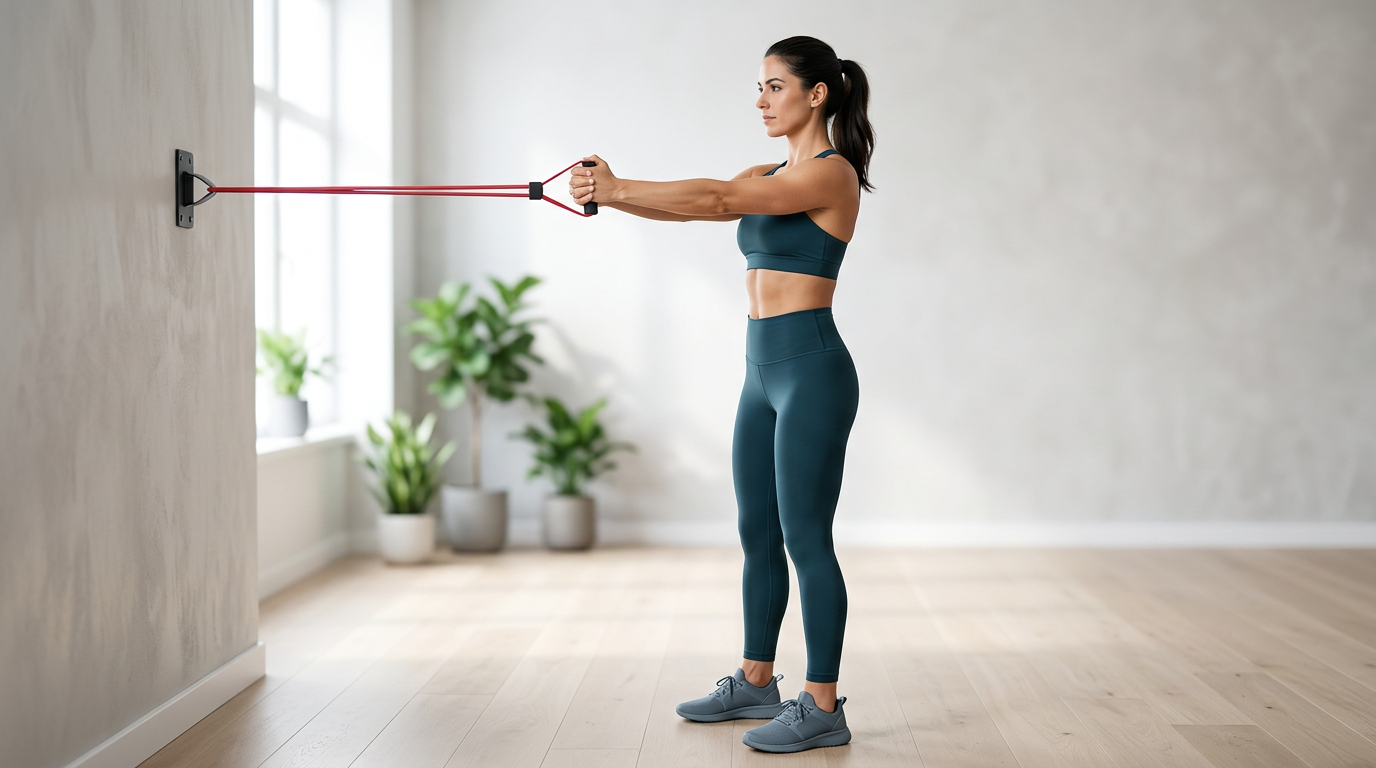
Woman performing standing Pallof press with resistance band, showing proper form with squared hips and shoulders, core engaged
6. Standing Bird Dog
This balance-focused exercise engages your entire posterior chain while challenging core stability. Stand on your right leg with a slight knee bend. Hinge forward at your hips, extending your left leg behind you and reaching your right arm forward. Your body should form a straight line from fingertips to heel.
Focus on keeping your hips level rather than letting the lifted hip rotate upward. Your core must work intensely to maintain this position. Hold for 15-30 seconds per side for 3 sets, or perform 8-10 slow repetitions per side.
7. Standing Side Bend
This lateral flexion exercise targets your obliques and quadratus lumborum. Hold a dumbbell in your right hand with your arm at your side. Keep your left hand behind your head or reaching overhead. Slowly bend to your right, letting the weight pull you down laterally. Engage your left obliques to return to the starting position.
Avoid leaning forward or backward—movement should be purely lateral. The eccentric (lowering) phase is where the magic happens, so control it slowly. Perform 12-15 reps per side for 3 sets.
8. Standing Bicycle
This dynamic movement combines rotation with balance for a comprehensive core challenge. Stand with hands behind your head and elbows wide. Lift your right knee while rotating your torso to bring your left elbow toward your right knee. Return to center, then repeat on the opposite side.
Maintain an upright posture rather than hunching forward. Focus on rotating from your torso, not just moving your elbows. Perform 20-30 total reps (10-15 per side) for 3 sets.
9. Standing Windmill
The windmill is an advanced movement that builds rotational mobility while strengthening your core and shoulders. Hold a light dumbbell or kettlebell in your right hand and press it overhead. Keep your eyes on the weight as you hinge at your hips and reach your left hand toward your left foot. Your right arm stays overhead throughout.
This exercise requires significant shoulder mobility and core control, so start with no weight until you master the movement pattern. Perform 6-8 reps per side for 2-3 sets.
10. Standing Torso Twist
This controlled rotation exercise builds rotational strength and mobility. Hold a medicine ball or weight at chest height with arms extended. Keep your hips facing forward as you rotate your torso to the right, then to the left. The movement should come from your core, not your arms.
Focus on maintaining a stable lower body while your upper body rotates. Move with control rather than momentum. Perform 20-30 total rotations (10-15 per side) for 3 sets.
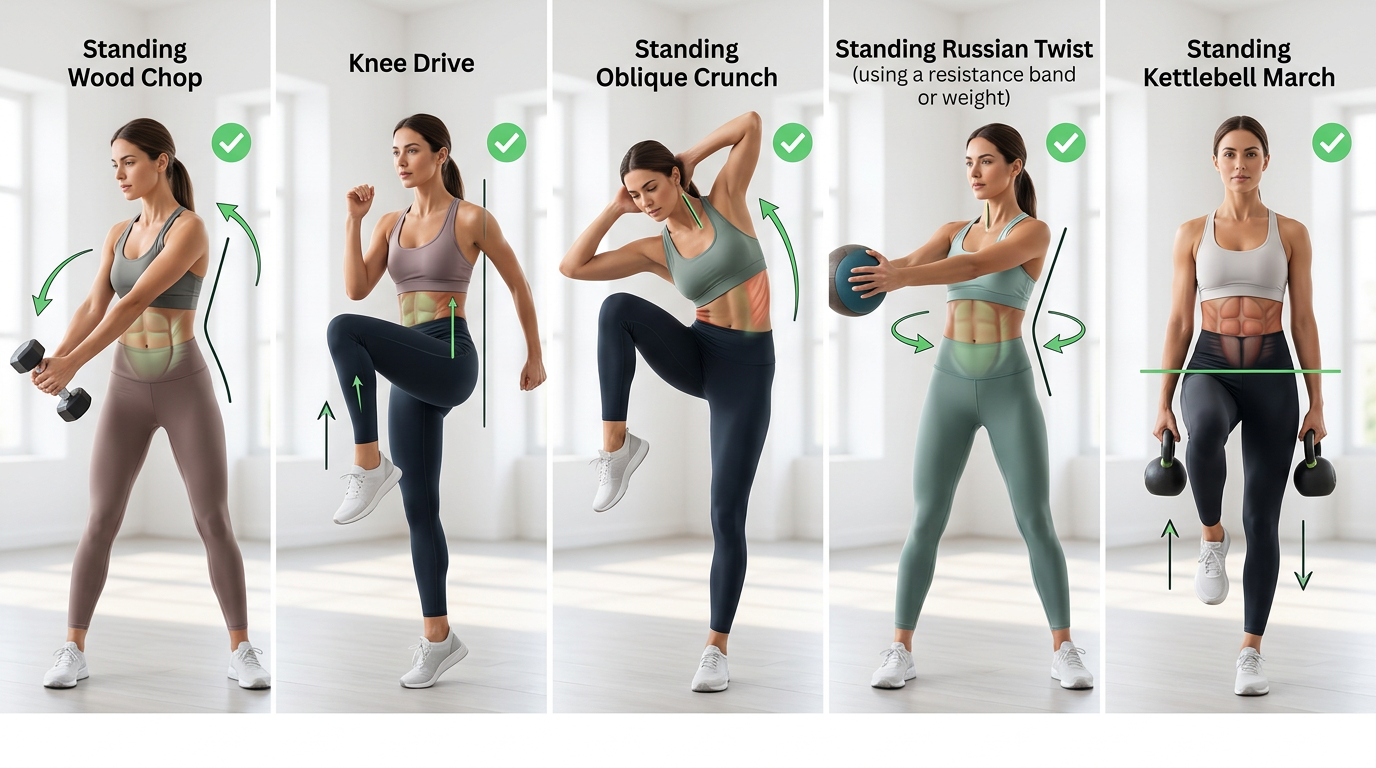
Collage showing proper form for five different standing core exercises including wood chop, knee drive, and oblique crunch with form cues labeled
How to Program Standing Core Exercises Into Your Routine
Knowing the best standing core exercises is only half the battle—you need to understand how to incorporate them effectively into your training program for maximum results.
Frequency and Volume
Your core can be trained more frequently than other muscle groups because it's primarily composed of slow-twitch muscle fibers designed for endurance. You can safely perform standing core exercises 3-5 times per week without overtraining.
For each session, select 3-4 exercises that target different movement patterns. For example:
- One anti-rotation exercise (Pallof press)
- One rotational exercise (wood chop)
- One anti-extension exercise (overhead march)
- One lateral or balance exercise (standing bird dog)
Perform 2-3 sets of each exercise with 8-15 repetitions or 30-60 second holds, depending on the movement.
Integration Strategies
Standing core exercises fit seamlessly into various workout structures:
- Warm-up activation: Perform 1-2 standing core exercises before your main workout to activate your stabilizers
- Supersets: Pair standing core work with upper body exercises during rest periods
- Finishers: Complete a 5-10 minute standing core circuit at the end of your workout
- Standalone sessions: Dedicate 15-20 minutes to focused core work on active recovery days
- Daily movement breaks: Perform a few standing core exercises during work breaks to combat prolonged sitting
Progressive Overload Principles
To continue seeing results from your standing core exercises, you must progressively challenge your muscles. Apply these progression strategies:
- Add resistance: Increase the weight you're using for exercises like wood chops or side bends
- Increase time under tension: Slow down the tempo or add pauses at peak contraction
- Reduce stability: Close your eyes or stand on one leg to increase balance demands
- Increase volume: Add more sets or repetitions as exercises become easier
- Advance the variation: Progress from basic to more complex versions of each movement
Track your workouts to ensure you're consistently progressing over time rather than simply repeating the same routine.
Common Mistakes That Sabotage Your Standing Core Workout
Even with the best standing core exercises, poor execution can limit your results and increase injury risk. Avoid these common pitfalls.
Mistake #1: Moving Too Quickly
Speed kills effectiveness when it comes to core training. Rushing through repetitions relies on momentum rather than muscular control, drastically reducing the training stimulus. Slow down your movements, focusing on a 2-3 second eccentric (lowering) phase, a brief pause at peak contraction, and a controlled concentric (lifting) phase.
Mistake #2: Holding Your Breath
Breath-holding during core exercises creates excessive intra-abdominal pressure and can spike blood pressure. It also limits your ability to maintain proper core engagement throughout a set. Practice rhythmic breathing—exhale during the exertion phase and inhale during the easier phase of each movement.
Mistake #3: Neglecting Mind-Muscle Connection
Simply going through the motions won't build a strong core. You need to actively feel your core muscles working during each repetition. Before starting a set, take a moment to engage your core properly, then maintain that connection throughout the exercise. If you can't feel the target muscles working, reduce the weight or complexity until you can establish that connection.
Mistake #4: Ignoring Lower Body Stability
Your standing core exercises are only as effective as your foundation. If your feet, ankles, and legs aren't stable, your core can't work optimally. Ensure you're distributing weight evenly through your feet, maintaining soft knees, and keeping your lower body engaged throughout each movement.
Mistake #5: Training Only One Plane of Motion
Your core moves in multiple directions—forward and back (sagittal plane), side to side (frontal plane), and rotationally (transverse plane). A balanced program includes standing core exercises that challenge all three planes of motion. Don't just perform forward-focused movements like knee drives; include lateral work like side bends and rotational exercises like wood chops.
Maximizing Results: Nutrition and Recovery for Core Development
Your standing core exercises are just one piece of the puzzle. To see visible results and build functional strength, you need to support your training with proper nutrition and recovery strategies.
The Role of Nutrition
No amount of core training will reveal defined abs if they're covered by excess body fat. Core visibility is primarily a function of body composition, which is largely determined by your nutrition. Focus on consuming adequate protein (0.7-1 gram per pound of body weight) to support muscle recovery and development, along with a balanced intake of complex carbohydrates and healthy fats.
If fat loss is your goal, create a modest caloric deficit of 300-500 calories below your maintenance level. Avoid extreme restriction, which can compromise recovery and lead to muscle loss. For more guidance on supporting your fitness goals with nutrition, check out our standing ab exercises resource, which includes nutritional tips alongside exercise guidance.
Recovery and Adaptation
Muscle growth and strength gains occur during recovery, not during your workouts. Ensure you're getting 7-9 hours of quality sleep each night, as this is when your body repairs muscle tissue and adapts to training stress. Manage stress through practices like meditation, yoga, or simply taking time for activities you enjoy, as chronic stress elevates cortisol levels that can interfere with body composition goals.
Hydration and Performance
Proper hydration is essential for optimal muscle function and core engagement. Even mild dehydration can impair performance and reduce your ability to maintain proper form during standing core exercises. Aim for at least half your body weight in ounces of water daily, more if you're training intensely or in hot conditions.

Visual guide showing the relationship between exercise, nutrition, and recovery for core development with three interconnected circles and key points for each
Adapting Standing Core Exercises for Different Fitness Levels
One of the greatest advantages of standing core exercises is their scalability. Whether you're just starting your fitness journey or you're an advanced athlete, these movements can be modified to match your current abilities.
Beginner Modifications
If you're new to core training or returning after a break, start with these adjustments:
- Perform exercises without added resistance, using only your body weight
- Reduce the range of motion until you build strength and stability
- Use a wall or chair for balance support during single-leg movements
- Focus on shorter hold times (15-20 seconds) for isometric exercises
- Begin with 1-2 sets per exercise rather than 3
- Take longer rest periods (60-90 seconds) between sets
Mastering the basics with perfect form is more valuable than rushing into advanced variations with poor technique. Spend at least 4-6 weeks building foundational strength and motor patterns before progressing.
Intermediate Progressions
Once you've built a solid foundation, challenge yourself with these progressions:
- Add light to moderate resistance (5-15 pounds for most exercises)
- Increase hold times to 30-45 seconds for isometric movements
- Reduce your base of support by bringing feet closer together
- Incorporate tempo changes, such as 3-second eccentric phases
- Perform exercises in a circuit format with minimal rest between movements
Advanced Variations
Advanced trainees can maximize the challenge of standing core exercises through:
- Significant added resistance (15-30+ pounds depending on the exercise)
- Single-leg variations of traditionally bilateral movements
- Eyes-closed execution to eliminate visual balance cues
- Unstable surfaces like balance pads or foam rollers
- Combination movements that blend multiple exercises
- Extended time under tension (60+ seconds for holds)
Remember that progression isn't linear—some days you'll feel stronger than others. Listen to your body and adjust accordingly rather than forcing progression when you're fatigued or recovering from other intense training.
Frequently Asked Questions
How often should I do standing core exercises?
Perform standing core exercises 3-5 times per week for optimal results. Your core muscles recover quickly due to their endurance-focused fiber composition, allowing for frequent training. Select 3-4 exercises per session, completing 2-3 sets of each with proper form and progressive resistance.
Are standing core exercises as effective as floor exercises?
Standing core exercises are equally effective and often more functional than floor exercises. They engage your entire core while challenging balance and coordination, training movement patterns you use in daily life. Floor exercises can isolate specific muscles, but standing variations build integrated, practical strength.
Can I get visible abs from standing core exercises alone?
Standing core exercises build strong abdominal muscles, but visible abs require low body fat percentage achieved primarily through nutrition. These exercises strengthen and develop your core, but you must combine them with a balanced diet and caloric management to reveal definition.
What equipment do I need for standing core exercises?
Most standing core exercises require minimal equipment. A single dumbbell or medicine ball enhances many movements, while a resistance band adds variety for exercises like the Pallof press. However, many effective standing core exercises use only your body weight, making them accessible anywhere.
How long should I hold standing core exercises?
Hold isometric standing core exercises for 15-60 seconds depending on your fitness level. Beginners should start with 15-20 second holds, intermediate trainees can aim for 30-45 seconds, and advanced individuals can extend to 60 seconds or longer while maintaining perfect form throughout.
Will standing core exercises help with lower back pain?
Standing core exercises can reduce lower back pain by strengthening the stabilizing muscles that support your spine. They promote neutral spine alignment and build endurance in your core muscles, which helps prevent compensatory patterns that contribute to back discomfort. Always consult a healthcare provider for persistent pain.
Can I do standing core exercises during pregnancy?
Many standing core exercises are safe during pregnancy with modifications, as they avoid lying flat and reduce pressure on your pelvic floor. Focus on gentle movements emphasizing stability rather than intense flexion or rotation. Always get clearance from your healthcare provider before starting any exercise program during pregnancy.
Conclusion
Standing core exercises offer a practical, effective approach to building functional strength that translates directly to your daily life and athletic performance. By incorporating movements like wood chops, Pallof presses, and standing bird dogs into your routine, you'll develop a resilient core that supports proper posture, reduces injury risk, and enhances your overall fitness capabilities. These ten standing core exercises provide everything you need to build real results without ever lying on the floor.
Start by selecting 3-4 exercises that challenge different movement patterns, perform them 3-5 times per week with progressive resistance, and support your training with adequate nutrition and recovery. Whether you're new to fitness or an experienced athlete, standing core work deserves a permanent place in your training program. Begin with the basics, focus on quality over quantity, and watch your core strength transform.