Standing Abs Workout: 12 Moves for Maximum Core Strength
A standing abs workout is a core-strengthening routine performed entirely upright, eliminating floor exercises. These moves include standing oblique crunches, wood chops, and high knee twists that engage your abs while improving balance, posture, and functional strength for everyday activities.
Tired of getting down on the floor for endless crunches? You're not alone. Many women find traditional ab workouts uncomfortable, inconvenient, or simply boring. The good news is that a standing abs workout can deliver incredible core strength without ever hitting the mat.
Standing ab exercises aren't just about convenience—they're about building functional strength that translates to real life. When you strengthen your core while standing, you're training the muscles to work the way they're designed to: supporting your spine, stabilizing your movements, and powering you through daily activities from carrying groceries to playing with your kids.
This comprehensive guide will walk you through 12 powerful standing ab moves that target every angle of your core. Whether you're a beginner or advanced athlete, these exercises will challenge your abs, obliques, and deep stabilizers while keeping you on your feet. Let's build that core strength together.
Key Takeaways
- Standing ab workouts build functional core strength that improves balance, posture, and everyday movement patterns
- These exercises engage multiple muscle groups simultaneously, making them more efficient than isolated floor exercises
- You can perform an effective standing abs workout anywhere with minimal or no equipment
- Proper form and mind-muscle connection matter more than speed or repetitions for maximum results
- Combining different movement patterns targets all core muscles including rectus abdominis, obliques, and transverse abdominis
Why Choose a Standing Abs Workout Over Traditional Floor Exercises
Standing ab exercises offer unique advantages that make them an excellent choice for women at any fitness level. Understanding these benefits will help you appreciate why adding vertical core work to your routine is a game-changer.
Functional Strength for Real-Life Movement
Standing exercises train your core the way you actually use it throughout the day—upright and in motion. Unlike crunches that isolate your abs in an unnatural position, standing moves challenge your core to stabilize your entire body while you twist, bend, and balance.
This translates to better posture at your desk, more power during workouts, and reduced risk of injury during everyday activities. Your core muscles learn to work together with your legs, glutes, and back—exactly how they function in real life.
Joint-Friendly and Accessible
Floor exercises can be tough on your neck, lower back, and tailbone. Standing abs workouts eliminate this discomfort entirely. You'll never worry about neck strain from lifting your head or pressure on your spine from lying on a hard surface.
This makes standing ab exercises perfect for pregnant women, postpartum recovery, anyone with existing back issues, or those who simply want a more comfortable core workout. The accessibility means you're more likely to stay consistent—and consistency is what builds results.
Calorie Burn and Multi-Muscle Engagement
Standing exercises naturally engage more muscle groups than their floor-based counterparts. Your legs work to keep you stable, your glutes fire to maintain alignment, and your arms often contribute to the movement pattern.
This increased muscle recruitment means you burn more calories during your workout. While spot reduction isn't possible, the combination of core strengthening and higher energy expenditure supports overall body composition goals when paired with proper nutrition.
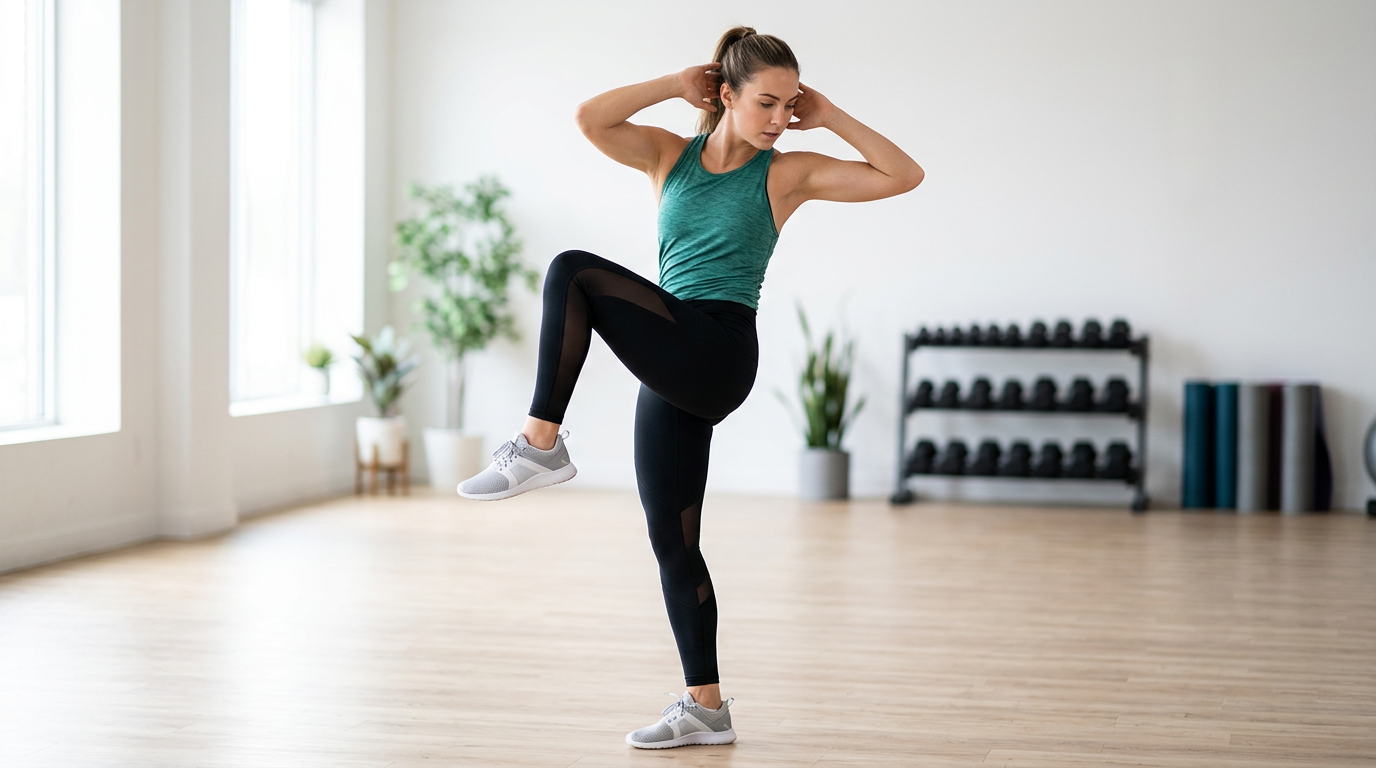
Woman performing standing oblique crunch exercise in workout attire, demonstrating proper form with hand behind head and knee lifted toward elbow, bright fitness studio background
Understanding Your Core Anatomy
Before diving into the exercises, let's briefly explore what makes up your core. This knowledge will help you connect with each movement and understand why variety matters in your standing abs workout routine.
The Four Key Core Muscle Groups
Your core consists of much more than just the six-pack muscles you can see. A complete core includes the rectus abdominis, internal and external obliques, transverse abdominis, and the deeper stabilizers that support your spine.
- Rectus Abdominis: The front ab muscles responsible for spinal flexion (bending forward)
- External Obliques: Side muscles that control rotation and lateral bending
- Internal Obliques: Deeper side muscles working with the external obliques for twisting movements
- Transverse Abdominis: The deepest core layer that acts like a natural weight belt, stabilizing your entire midsection
Why Movement Variety Matters
Each muscle group responds to different movement patterns. That's why this standing abs workout includes exercises that involve flexion, rotation, lateral bending, and anti-rotation (resisting movement).
By targeting all these patterns, you'll build a balanced, strong core that looks great and performs even better. No muscle gets left behind, and you'll develop the kind of functional strength that makes everything else in life easier.
The 12 Best Standing Abs Workout Moves
Now let's get to the exercises that will transform your core strength. Each move targets different aspects of your abdominal muscles while keeping you upright and engaged. Perform 12-15 repetitions per exercise, or hold for 30-45 seconds for static moves.
1. Standing Oblique Crunch
Stand with feet hip-width apart and hands behind your head. Lift your right knee toward your right elbow while crunching your torso sideways. Focus on using your oblique muscles to create the movement rather than just pulling with your arms.
This exercise directly targets your side abs and helps create that defined waistline. Keep your core tight throughout and avoid leaning backward. Alternate sides or complete all reps on one side before switching.
2. Wood Chop
Hold a dumbbell, medicine ball, or even just clasp your hands together. Start with arms extended above your right shoulder, then "chop" diagonally across your body toward your left hip, pivoting your back foot as you move.
Wood chops engage your entire core through rotation while also working your shoulders and legs. The diagonal movement pattern mimics real-life activities like lifting and carrying, making this one of the most functional standing ab exercises available.
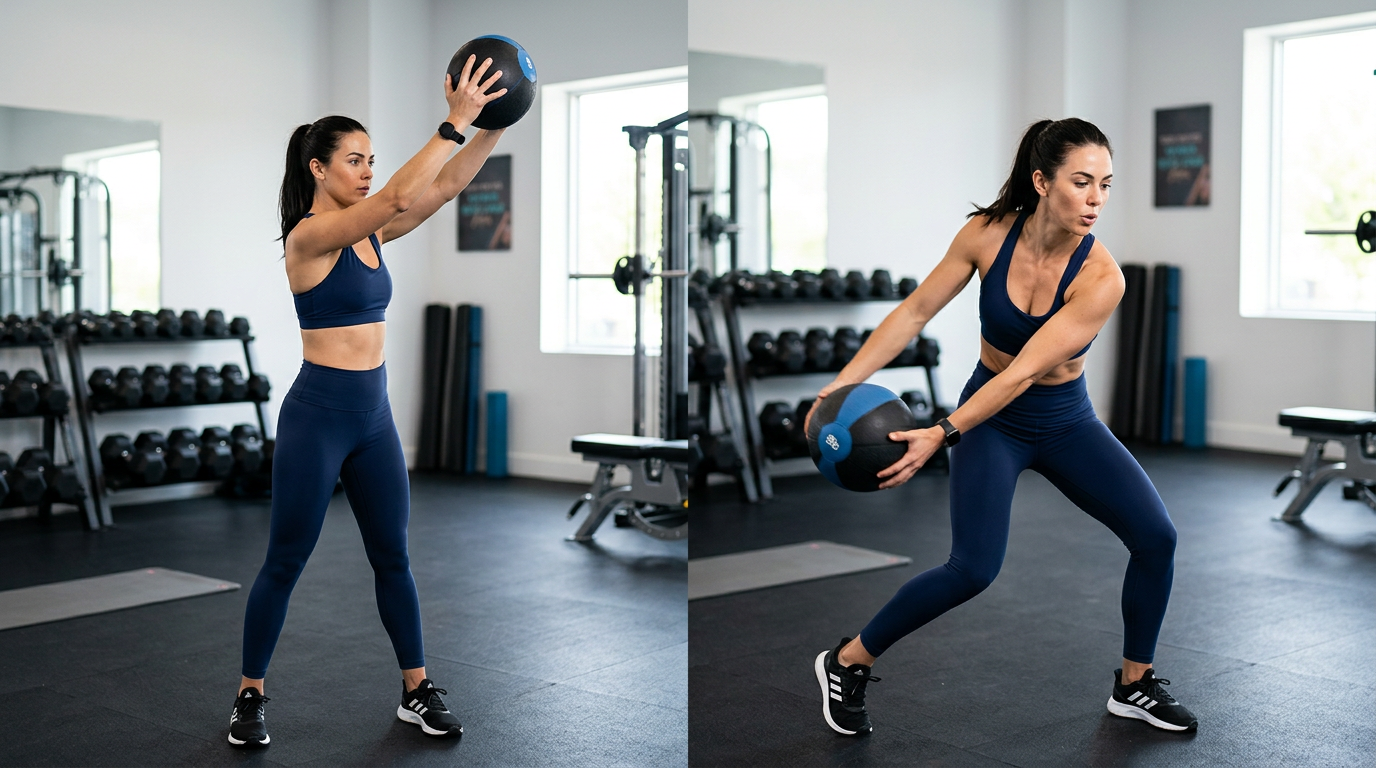
Woman demonstrating wood chop exercise with medicine ball, showing start position with ball overhead and finish position at opposite hip, athletic wear, gym setting
3. High Knee Twist
Stand tall with hands behind your head or extended in front of you. Drive your right knee up toward chest height while simultaneously rotating your torso to bring your left elbow toward that knee.
This dynamic move combines cardio with core strengthening, making it perfect for elevating your heart rate while sculpting your abs. Keep your movements controlled rather than rushing through reps. The rotation component heavily engages your obliques.
4. Standing Bicycle Crunch
With hands behind your head, lift your right knee and bring your left elbow down to meet it, crunching through your core. Alternate sides in a controlled, rhythmic pattern that resembles pedaling a bicycle.
This standing variation of the classic bicycle crunch maintains all the ab-sculpting benefits while adding a balance challenge. Focus on the twist in your torso rather than just moving your limbs. Your obliques and rectus abdominis work together throughout this movement.
5. Standing Side Bend
Hold a dumbbell in your right hand and let it hang at your side. Keeping your core engaged, bend laterally to the right, lowering the weight toward your knee. Return to center using your left oblique muscles.
Side bends specifically target the obliques through lateral flexion. The key is moving slowly and with control—this isn't about how far you can bend, but about feeling your side muscles work. Complete all reps on one side before switching the weight to the other hand.
6. Standing Mountain Climbers
Stand with feet together and arms extended overhead. Drive your right knee up toward your chest while simultaneously bringing your arms down. Return to start and repeat on the left side.
This vertical take on mountain climbers gets your heart pumping while engaging your lower abs and hip flexors. The standing version is gentler on your wrists and shoulders while still delivering serious core activation. Maintain an upright posture throughout rather than leaning forward.
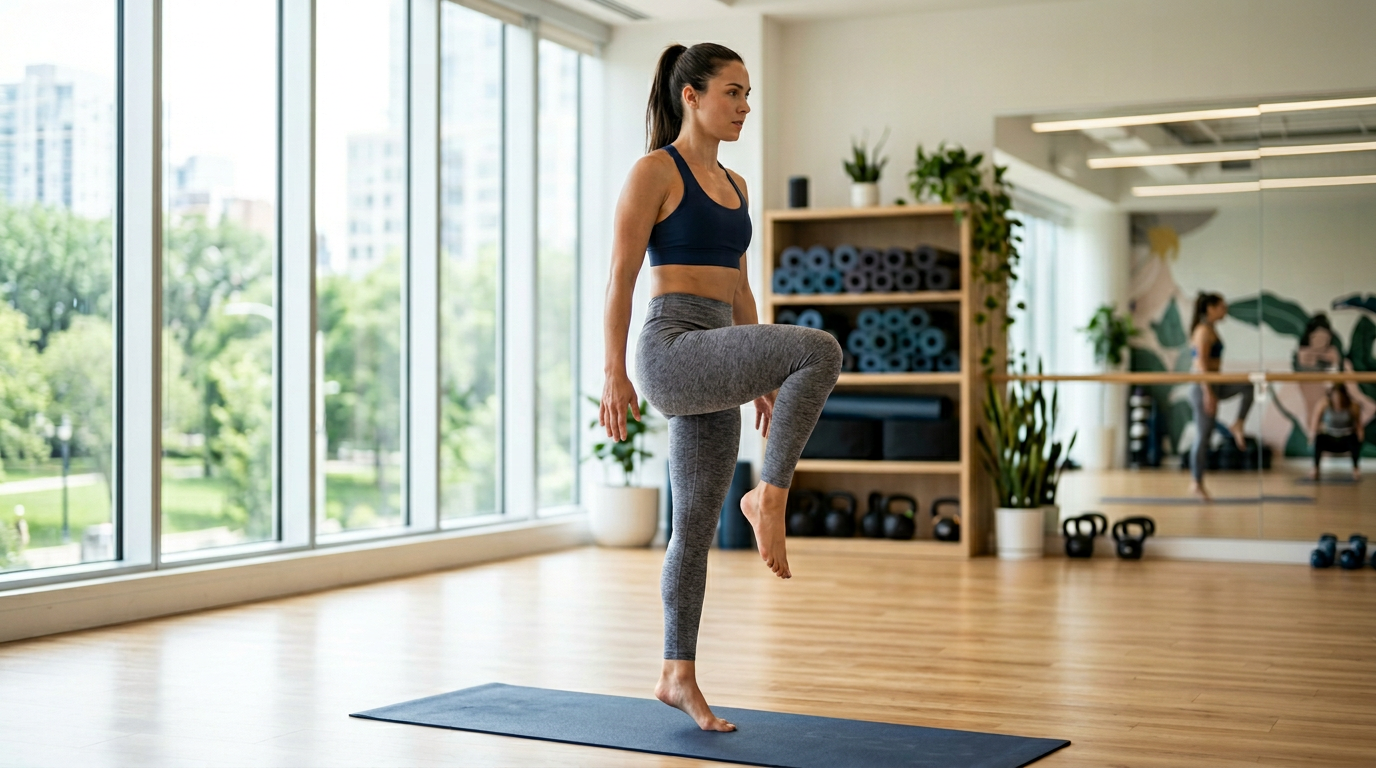
Woman performing standing mountain climber with knee raised high and arms lowered, demonstrating proper upright posture, fitness studio with natural lighting
7. Standing Russian Twist
Hold a weight at chest height with arms extended. Keeping your hips facing forward, rotate your torso to the right, then to the left. Your arms and the weight move with your upper body while your lower body stays stable.
Russian twists are renowned for oblique development, and the standing version adds an anti-rotation challenge for your lower body. Keep the movement controlled and originating from your core, not your arms. You can increase difficulty by holding the weight farther from your body.
8. Standing Knee to Elbow
Extend your arms overhead in a slight V-shape. Simultaneously bring your right knee up and your right elbow down to meet it, crunching through your side abs. Return to start and repeat on the left side.
This same-side crunch variation intensely targets your obliques while also engaging your hip flexors. Focus on the compression through your side body. The balance component adds an extra stability challenge that deepens core engagement.
9. Standing Pallof Press
Attach a resistance band to a stable object at chest height or hold a cable machine handle. Stand sideways to the anchor point and hold the band at your chest with both hands. Press your arms straight out in front of you, resisting the band's pull to rotate your body.
The Pallof press is one of the most effective anti-rotation exercises for building deep core stability. Your abs work hard to prevent your torso from twisting toward the resistance. This translates directly to better spinal stability during daily activities and other exercises.
10. Standing Cross-Body Toe Touch
Stand with feet wider than hip-width. Reach your right hand toward your left foot while lifting that foot slightly off the ground. Return to center and repeat on the opposite side.
This exercise combines rotation with a slight forward fold, engaging your entire core while also stretching your hamstrings. Keep your back relatively straight rather than rounding your spine. The crossing motion heavily recruits your obliques and challenges your balance.
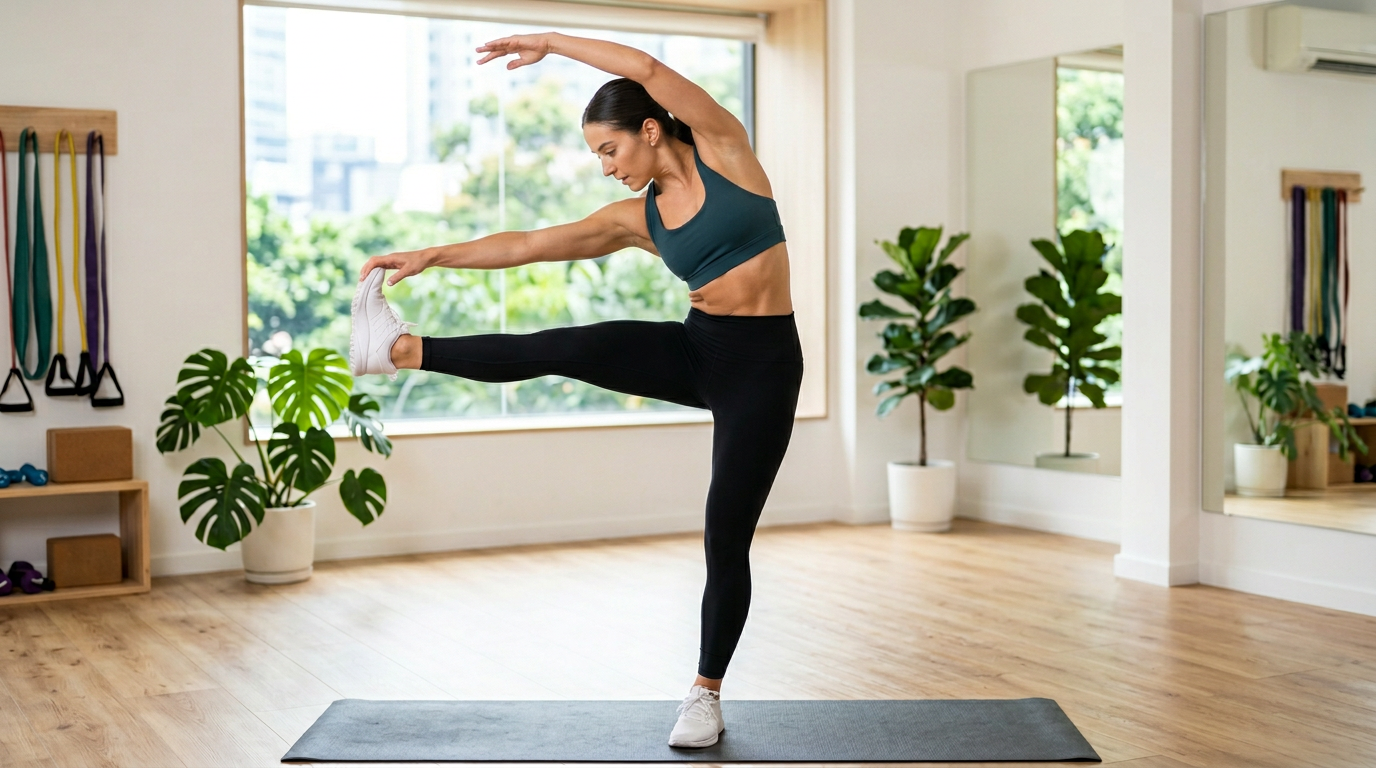
Woman demonstrating cross-body toe touch, reaching right hand to left foot with proper form, showing core engagement and balance, bright workout space
11. Standing Ab Wheel Rollout
Stand holding an ab wheel or resistance band anchored low in front of you. Engage your core and slowly extend your arms forward and slightly downward, maintaining a strong plank position through your torso. Pull back to start using your abs.
While this exercise requires equipment, it's incredibly effective for the entire anterior core. The standing version is more accessible than floor rollouts while still providing significant challenge. Keep your glutes engaged and avoid arching your lower back.
12. Standing Plank with Reach
Stand facing a wall at arm's length. Place your hands on the wall at shoulder height and step back into an inclined plank position. Keeping your core tight, lift one hand off the wall and reach forward. Return and alternate sides.
This exercise teaches your core to stabilize while your limbs move—exactly what it does during most daily activities. The anti-rotation and anti-extension demands make this simple-looking move surprisingly challenging for deep core muscles. Adjust difficulty by changing your distance from the wall.
How to Structure Your Standing Abs Workout
Having great exercises is only part of the equation. How you organize them into a workout determines your results. Here's how to create an effective standing abs workout routine that fits your schedule and fitness level.
Beginner-Friendly Approach
If you're new to focused core work, start with 6-8 of these exercises performed for 10-12 repetitions each. Take 30-45 seconds of rest between exercises. Complete 2 rounds total, which should take about 15-20 minutes.
Focus on learning proper form before increasing intensity. It's better to perform fewer reps with excellent technique than rush through with poor form. As these movements become easier, gradually add reps, rounds, or additional exercises.
Intermediate to Advanced Programming
More experienced exercisers can perform all 12 moves in a circuit format. Complete 12-15 reps of each exercise with minimal rest between moves. After finishing all 12, rest for 60-90 seconds, then repeat for 2-3 total rounds.
You can also increase difficulty by adding weight to appropriate exercises, slowing down the tempo (3 seconds down, 3 seconds up), or incorporating pauses at the point of maximum contraction. Progressive overload applies to ab training just like any other muscle group.
Workout Frequency and Recovery
Your core muscles recover relatively quickly compared to larger muscle groups, but they still need rest. Aim for 3-4 standing abs workout sessions per week with at least one rest day between targeted core training.
On non-core days, you can still perform full-body workouts—your abs will engage naturally during compound movements like squats and deadlifts. This balanced approach builds comprehensive strength without overtraining.
- Monday: Full standing abs workout (all 12 exercises)
- Tuesday: Lower body or cardio (core engages but isn't targeted)
- Wednesday: Upper body strength training
- Thursday: Standing abs workout (focus on rotation exercises)
- Friday: Full body or active recovery
- Saturday: Standing abs workout (focus on flexion and anti-rotation)
- Sunday: Complete rest or gentle yoga
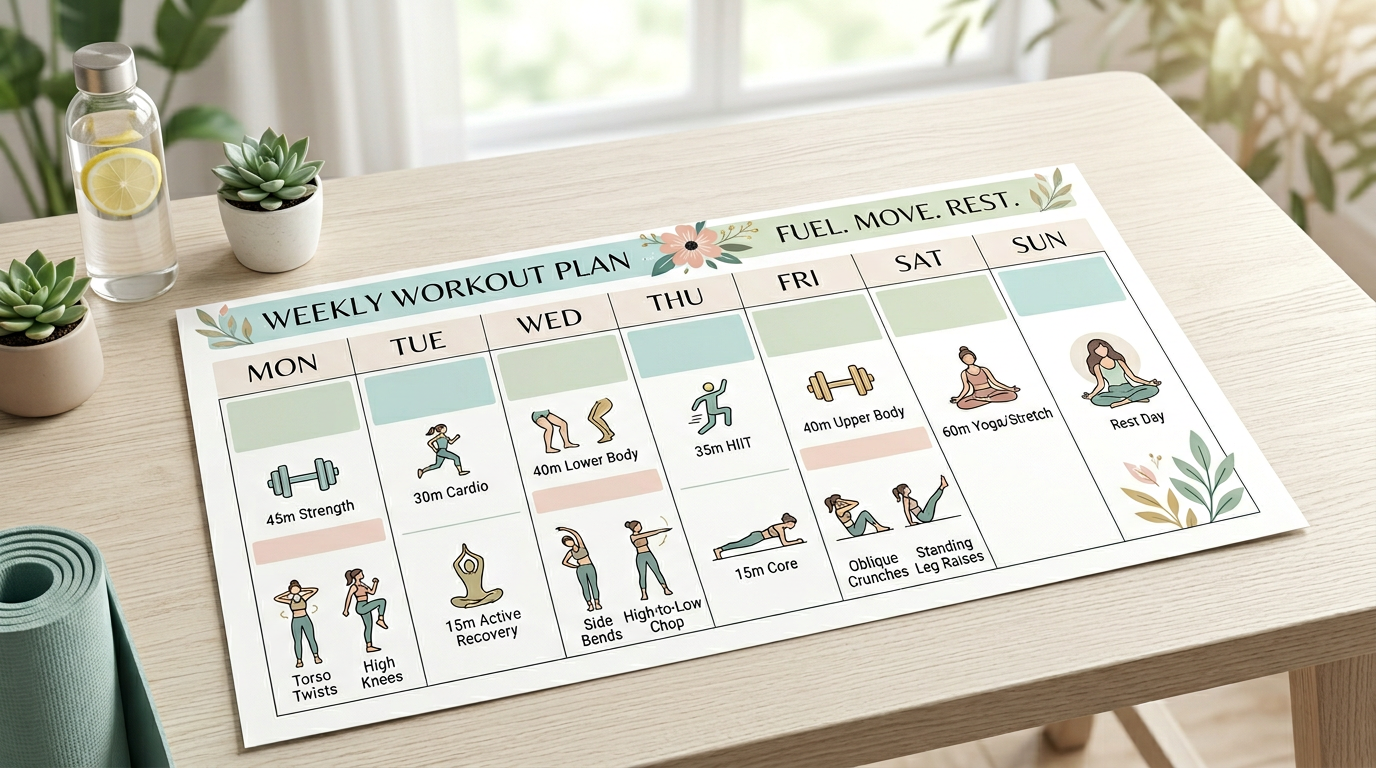
Weekly workout calendar showing standing abs workout schedule integrated with other training days, clean design with exercise icons, motivational layout
Common Mistakes to Avoid
Even with great exercises, poor execution can limit your results or lead to discomfort. Watch out for these common errors when performing your standing abs workout.
Rushing Through Repetitions
Speed doesn't equal effectiveness in ab training. When you rush, momentum does the work instead of your muscles. Slow, controlled movements with focused muscle contraction build strength and definition far more effectively than fast, sloppy reps.
Try counting to two on the contraction phase and two on the release. This tempo keeps your muscles under tension longer, maximizing the training stimulus. Quality always trumps quantity.
Holding Your Breath
Many people unconsciously hold their breath during core exercises, especially challenging ones. This increases internal pressure and can cause dizziness or headaches.
Instead, exhale during the exertion phase (the crunch, twist, or contraction) and inhale during the release. Proper breathing not only prevents discomfort but actually helps engage your transverse abdominis more effectively. Think of your breath as part of the exercise.
Neglecting the Mind-Muscle Connection
Going through the motions without mentally connecting to your core muscles significantly reduces exercise effectiveness. Your brain needs to actively tell your abs to contract.
Before each rep, consciously think about the muscles you're targeting. Visualize them contracting and working. Place your hand on your abs between sets to physically connect with the area. This intentional focus can dramatically improve your results from the same exercises.
Ignoring Proper Alignment
Standing exercises require good posture to be effective and safe. Avoid leaning too far forward or backward, which shifts the work away from your core and onto your lower back.
Maintain a neutral spine position with shoulders stacked over hips. Engage your glutes slightly to prevent excessive arching in your lower back. If you feel strain in your back rather than work in your abs, check your alignment and reduce the range of motion until you can maintain proper form.
Maximizing Results: Beyond the Exercises
Your standing abs workout is powerful, but it's just one piece of the core strength puzzle. These additional strategies will help you see faster, more dramatic results.
Nutrition for Visible Abs
You've probably heard that "abs are made in the kitchen," and there's truth to this. Core exercises build the muscle, but your nutrition determines whether that muscle is visible.
Focus on adequate protein intake to support muscle recovery and growth—aim for 0.7-1 gram per pound of body weight daily. Include plenty of fiber-rich vegetables and whole grains to support digestion and reduce bloating. Stay hydrated, as water retention can mask abdominal definition.
Rather than extreme calorie restriction, create a modest deficit if fat loss is your goal. Sustainable nutrition habits beat crash diets every time. Remember, building core strength improves your health and function regardless of visible definition.
Progressive Overload Principles
Your muscles adapt to the demands you place on them, so you need to gradually increase those demands to continue seeing progress. This concept, called progressive overload, applies to ab training just like any other muscle group.
You can progress your standing abs workout by adding repetitions, increasing sets, reducing rest time, adding weight or resistance, slowing down your tempo, or advancing to more challenging exercise variations. Track your workouts so you know when it's time to increase difficulty.
Complementary Training
While standing ab exercises are excellent, a well-rounded fitness program includes various training modalities. Combine your core work with strength training for other muscle groups, cardiovascular exercise for heart health, and flexibility work for mobility.
Compound exercises like squats, deadlifts, and overhead presses also engage your core significantly. This integrated approach builds functional fitness and ensures balanced development across your entire body. Your strong core will enhance performance in all these other activities.
Adapting Your Standing Abs Workout for Special Situations
Life circumstances sometimes require modifications to your exercise routine. Here's how to adapt your standing abs workout for specific situations while still making progress.
Pregnancy and Postpartum Considerations
Standing ab exercises are generally safer during pregnancy than floor-based moves that require lying on your back. However, avoid exercises involving deep twisting or extreme ranges of motion, especially in the second and third trimesters.
Focus on gentle standing exercises that maintain core connection without excessive strain. Standing side bends, modified knee lifts, and standing pelvic tilts can help maintain core strength. Always consult your healthcare provider before starting or continuing any exercise program during pregnancy.
Postpartum, these standing exercises are excellent for gradually rebuilding core strength, particularly if you're dealing with diastasis recti. Start gently and progress slowly, giving your body time to heal properly.
Working Around Lower Back Pain
Many women choose standing ab exercises specifically because they have lower back issues. The good news is that building core strength often helps reduce back pain over time.
If certain movements cause discomfort, reduce your range of motion or skip those exercises temporarily. Focus on anti-rotation and stabilization exercises like the Pallof press and standing plank variations, which strengthen your core without aggravating your back. Avoid exercises that require excessive spinal flexion if that triggers pain.
Core strength and back health are intimately connected—your abs support your spine and help maintain proper posture. Consistent, pain-free core training often leads to reduced back discomfort over time.
Travel and Limited Space
One of the best aspects of a standing abs workout is its portability. You can perform most of these exercises in a hotel room, office, or any small space with just your bodyweight.
Create a quick 10-minute routine using 5-6 exercises that require no equipment: standing oblique crunches, high knee twists, standing bicycle crunches, cross-body toe touches, and knee to elbow movements. This mini-workout maintains your core strength even when your normal routine is disrupted.
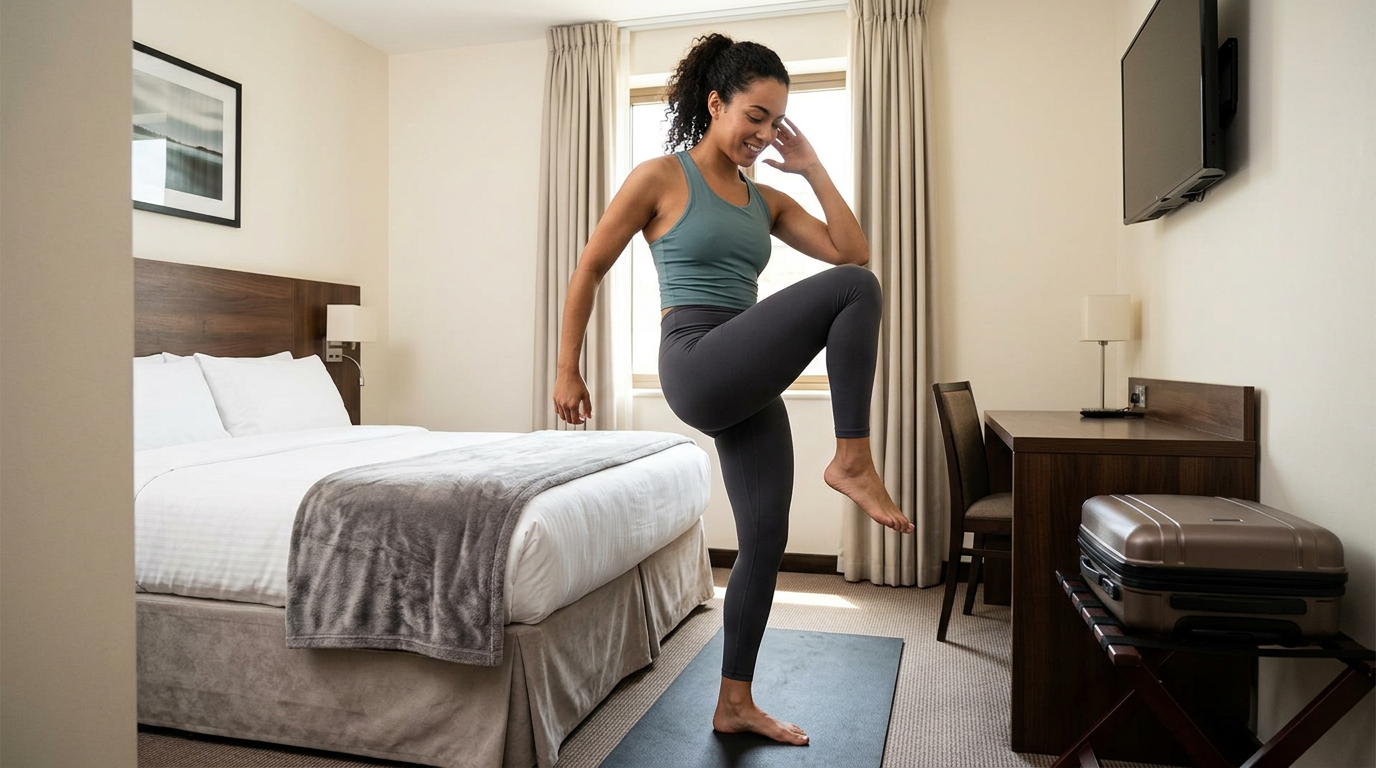
Woman performing standing abs workout in small hotel room, demonstrating exercises possible in limited space, travel-friendly fitness concept, clean modern setting
Frequently Asked Questions
How can you work your abs while standing?
You work your abs while standing through exercises that create spinal flexion, rotation, or anti-rotation movements in an upright position. Standing oblique crunches, wood chops, high knee twists, and Pallof presses all effectively engage core muscles without lying down. These movements challenge your abs to stabilize your body while maintaining balance.
Can standing abs workout reduce belly fat?
Standing abs workouts build core muscle but don't specifically target belly fat, as spot reduction isn't possible. However, these exercises burn calories and increase muscle mass, which supports overall fat loss when combined with proper nutrition and a calorie deficit. Stronger abs improve posture, which can make your midsection appear leaner immediately.
Do lower ab exercises help with back pain?
Strengthening your lower abs and entire core can significantly reduce lower back pain by improving spinal stability and posture. Standing exercises that engage the transverse abdominis and obliques help support your spine during daily activities. However, if you have existing back pain, consult a healthcare provider before starting new exercises.
Can abs be hypertrophied?
Yes, abdominal muscles can be hypertrophied (grown larger) just like any other skeletal muscle through progressive resistance training. Apply the same principles used for other muscles: gradually increase resistance, perform 8-15 reps per set, and ensure adequate protein intake and recovery. Weighted standing ab exercises effectively build thicker, more developed core muscles.
How often should I do standing abs workouts?
Perform dedicated standing abs workouts 3-4 times per week with at least one rest day between sessions for optimal results. Your core recovers relatively quickly but still needs recovery time to grow stronger. On non-core days, your abs still engage during compound movements like squats and deadlifts, providing additional training stimulus.
Are standing ab exercises effective for beginners?
Standing ab exercises are excellent for beginners because they're more accessible than floor exercises and easier to perform with proper form. Start with bodyweight versions of movements like standing oblique crunches and knee lifts, performing 10-12 reps for 2 sets. Progress gradually by adding repetitions, sets, or resistance as your strength improves.
What equipment do I need for a standing abs workout?
Most standing ab exercises require no equipment at all—just your bodyweight and enough space to move comfortably. To add variety and intensity, optional equipment includes dumbbells, resistance bands, a medicine ball, or cable machine access. Even with zero equipment, you can build impressive core strength through bodyweight standing movements.
Build Your Strongest Core Yet
A standing abs workout offers everything you need to build impressive core strength: accessibility, effectiveness, and functional benefits that extend far beyond aesthetics. These 12 exercises target every aspect of your abdominal muscles while keeping you comfortable and engaged throughout your training.
Remember that consistency beats perfection every time. Start with the exercises that feel most comfortable, focus on proper form over speed or repetitions, and gradually progress as your strength improves. Your core muscles will respond to regular challenge with increased strength, better posture, and improved performance in all your activities.
The beauty of this standing abs workout is that you can do it anywhere, anytime, with minimal or no equipment. No more excuses about not having time to get on the floor or dealing with uncomfortable positions. Strong curves start with a strong core—and you're now equipped with the knowledge to build yours. Start with your first workout today and feel the difference that functional core strength makes in your daily life.