Standing Ab Exercises for Women: Sculpt Your Core Without Crunches
Standing ab exercises are core-strengthening movements performed in an upright position without lying down. The most effective include wood chops, standing oblique crunches, and high knees, which engage your entire core while improving balance and functional strength for everyday activities.
Are you tired of getting down on the floor for endless crunches that strain your neck and back? You're not alone. Many women find traditional floor-based ab work uncomfortable, especially during pregnancy, postpartum recovery, or when dealing with back issues. The good news? Standing ab exercises deliver powerful core-strengthening results while being gentler on your body and more functional for real-life movement patterns.
Your core muscles do so much more than create visible abs. They stabilize your spine during daily activities like carrying groceries, lifting children, and maintaining good posture at your desk. Standing ab exercises train your core in the way you actually use it throughout the day—while upright and moving.
This comprehensive guide will walk you through the best standing ab exercises for women, explain why they work so effectively, and show you how to build a complete core routine without ever touching the floor. Whether you're a busy mom, a fitness beginner, or someone looking to add variety to your workout routine, these exercises will transform how you think about core training.
Key Takeaways
- Standing ab exercises strengthen your core while improving balance, posture, and functional movement patterns used in daily life
- These exercises are ideal for women who experience discomfort with floor work, including during pregnancy and postpartum recovery
- A complete standing core routine should include rotation, side bending, and stabilization movements to target all core muscle groups
- You can achieve significant core strength gains without traditional crunches by focusing on controlled movement and proper form
- Standing exercises engage more muscle groups simultaneously, making them efficient for total-body conditioning
Why Standing Ab Exercises Work for Women
Standing ab exercises activate your core muscles in functional movement patterns that translate directly to daily activities and athletic performance. Unlike isolated floor exercises, these movements require your abs to work alongside your stabilizer muscles, creating a more comprehensive training effect.
The Science Behind Standing Core Work
When you perform standing ab exercises, your core must work against gravity in multiple planes of motion. This challenges your rectus abdominis (the six-pack muscle), obliques (side abs), and transverse abdominis (deep core stabilizer) simultaneously. Your body also recruits hip muscles, back muscles, and shoulder stabilizers to maintain balance and control.
This integrated approach builds what fitness professionals call "functional strength"—the kind of core power you actually use when twisting to grab something from the backseat, carrying a heavy bag on one side, or maintaining balance on uneven surfaces.
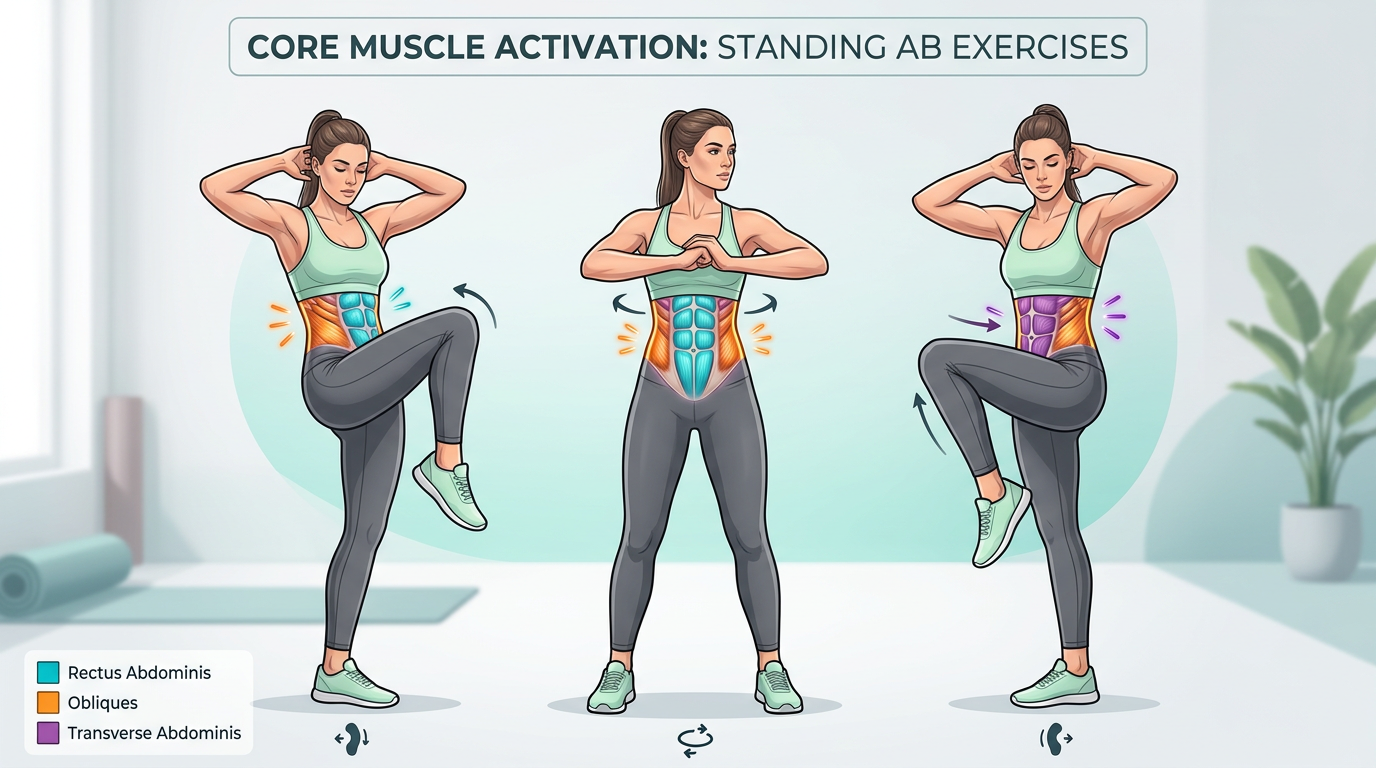
Anatomical illustration showing the core muscles activated during standing ab exercises, including rectus abdominis, obliques, and transverse abdominis highlighted in different colors
Benefits Beyond Traditional Floor Exercises
Standing ab exercises offer several advantages that make them particularly valuable for women at all fitness levels:
- Accessibility: No need to get up and down from the floor, making them perfect for those with mobility limitations or joint concerns
- Pregnancy-friendly: Many standing exercises can be safely performed throughout pregnancy with proper modifications
- Postpartum recovery: Gentler on the pelvic floor and easier to perform while managing diastasis recti
- Time efficiency: Engage more muscle groups simultaneously for a complete workout in less time
- Balance training: Improve proprioception and stability alongside core strength
- Reduced neck strain: Eliminate the neck discomfort many women experience during crunches
- Real-world application: Build strength that directly improves posture, movement quality, and injury prevention
Do Standing Ab Exercises Really Work?
Yes, standing ab exercises effectively strengthen your core when performed with proper form and progressive resistance. Research shows that exercises requiring balance and stability in standing positions activate core muscles as effectively as traditional floor exercises, while providing additional functional benefits. The key is maintaining tension throughout each movement and focusing on controlled execution rather than speed or momentum.
The misconception that you must lie down to work your abs stems from outdated fitness thinking. Your core muscles don't know whether you're horizontal or vertical—they respond to resistance, tension, and the challenge you provide through movement patterns.
The Best Standing Ab Exercises for Women
This collection of standing ab exercises targets every aspect of core function. Incorporate these movements into your routine for comprehensive core development without floor work.
Standing Oblique Crunches
Standing oblique crunches specifically target your side abs while improving lateral stability and waist definition. This exercise is excellent for beginners and can be progressed by adding resistance.
How to perform: Stand with feet hip-width apart, hands behind your head. Lift your right knee toward your right elbow while crunching your torso sideways. Keep your chest lifted and avoid pulling on your neck. Lower with control and repeat for 12-15 reps before switching sides.
Focus on the contraction in your obliques rather than how high you lift your knee. Quality beats quantity every time.
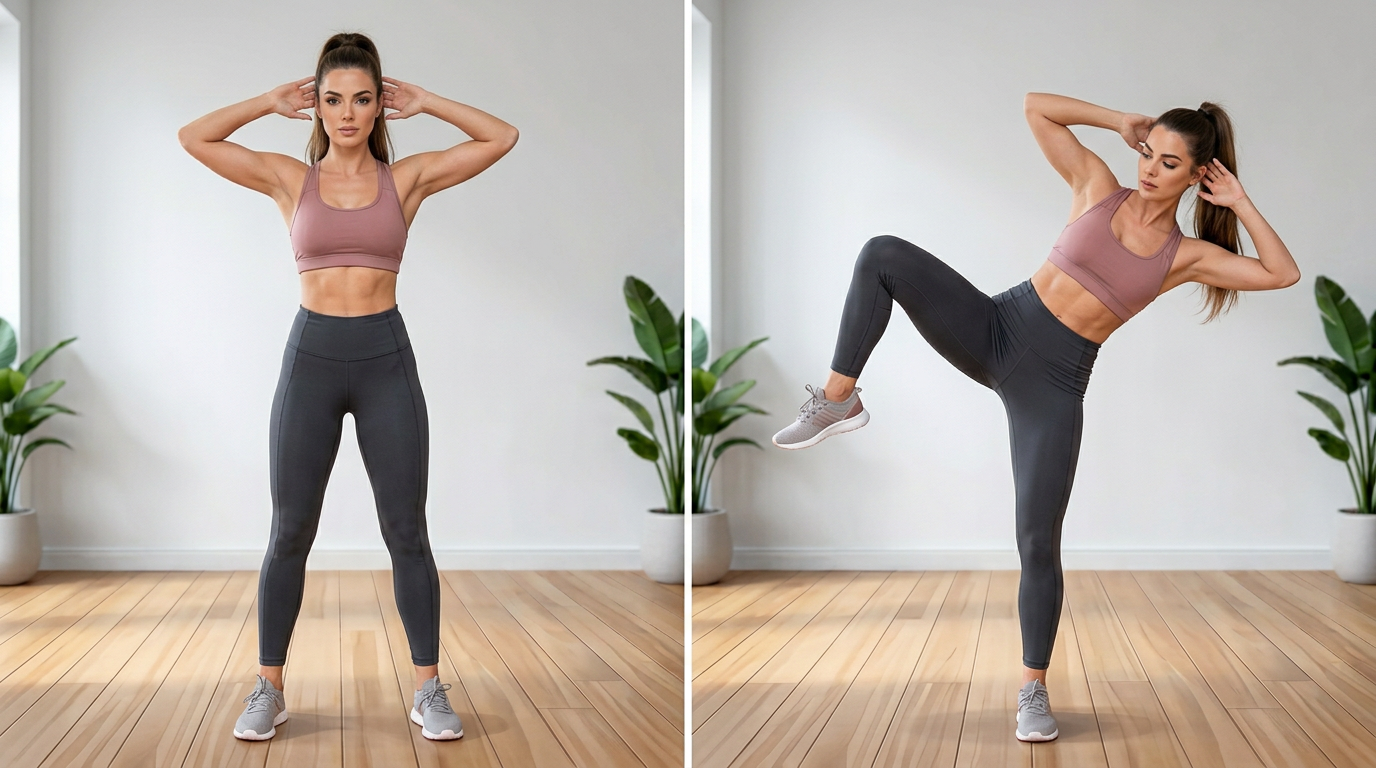
Step-by-step demonstration of standing oblique crunches showing starting position and the knee-to-elbow crunch position from front view
Wood Chops
Wood chops train rotational power while engaging your entire core, shoulders, and legs. This dynamic movement mimics real-life twisting motions and builds functional strength.
How to perform: Stand with feet shoulder-width apart, holding a dumbbell or medicine ball with both hands. Start with the weight at your right hip. Rotate your torso and raise the weight diagonally across your body to above your left shoulder, pivoting on your right foot. Control the weight back to the starting position. Complete 10-12 reps per side.
Keep your arms relatively straight and let the rotation come from your core, not your arms. Your eyes should follow the weight throughout the movement.
Standing Bicycle Crunches
This standing variation of the classic bicycle crunch combines rotation with balance challenges for comprehensive core activation.
How to perform: Stand tall with hands behind your head. Lift your right knee while rotating your left elbow toward it, bringing them together at your midline. Return to center and repeat on the opposite side. Alternate sides for 20-30 total repetitions.
Maintain an upright posture throughout and focus on the twist rather than just bringing your knee up high.
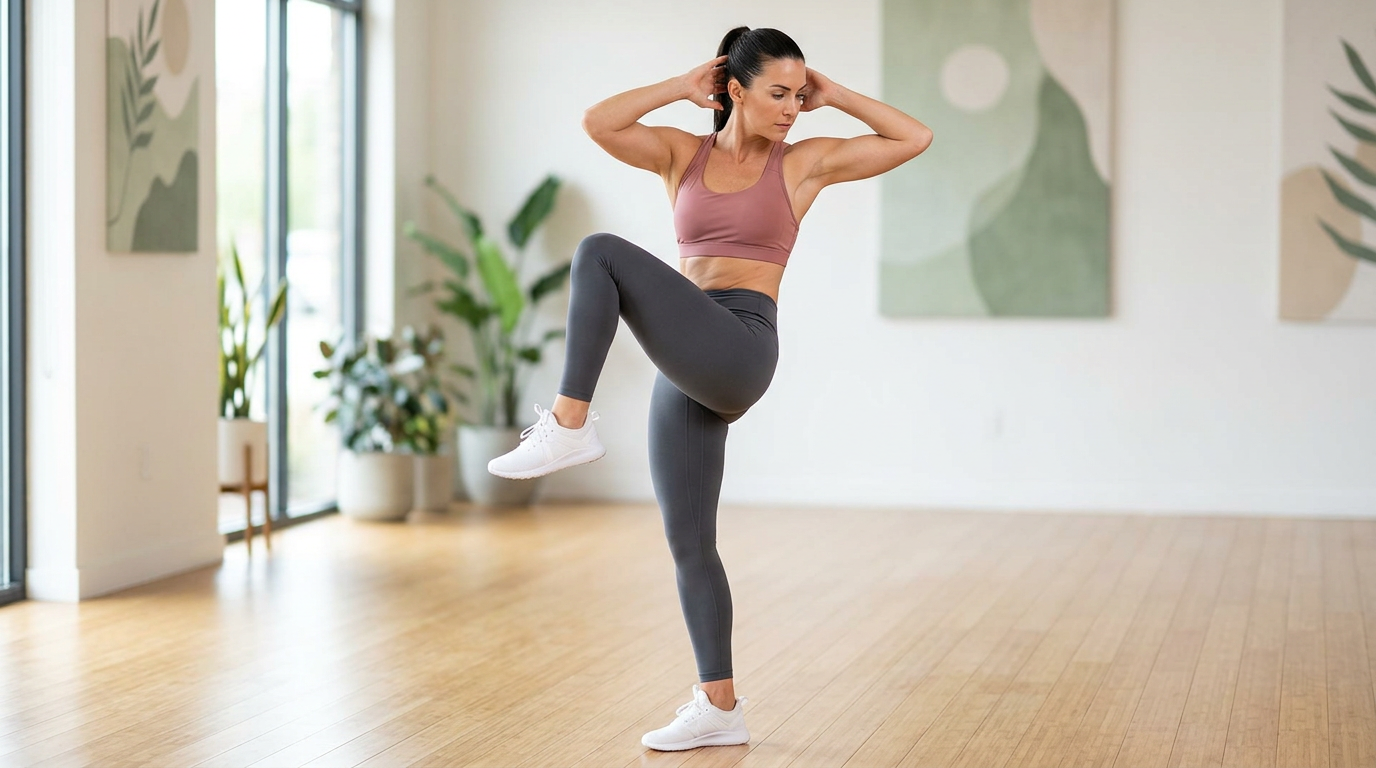
Woman performing standing bicycle crunches showing the rotation and knee lift with proper form
High Knees with Core Engagement
High knees combine cardiovascular conditioning with core strengthening, making them efficient for total-body fitness. When performed with intentional core engagement, they become a powerful ab exercise rather than just cardio.
How to perform: Stand tall with core braced. Drive your right knee up toward your chest while pumping your left arm forward. Quickly switch legs, maintaining a steady rhythm. Focus on pulling your knee up with your lower abs rather than just lifting your leg. Perform for 30-60 seconds.
The key difference between high knees as cardio versus ab work is the intentional core contraction. Think about pulling your belly button toward your spine with each knee lift.
Standing Side Bends
Side bends isolate the obliques and quadratus lumborum (lower back muscles) for improved lateral stability and waist strength.
How to perform: Stand with feet hip-width apart, holding a dumbbell in your right hand. Place your left hand behind your head. Slowly bend to the right, lowering the weight toward your knee. Use your left obliques to pull yourself back to standing. Complete 12-15 reps before switching sides.
Avoid bending forward or backward—move purely in the lateral plane. Control the descent and use your core to return to the starting position rather than momentum.
Standing Knee Tucks
Knee tucks emphasize the lower portion of your rectus abdominis while challenging your balance and coordination.
How to perform: Stand on your left leg with your right leg extended behind you and arms overhead. Crunch your torso forward while driving your right knee up and pulling your arms down toward the knee. Extend back to the starting position. Complete 10-12 reps per side.
This exercise requires balance, so feel free to perform it near a wall for support as you build strength and stability.
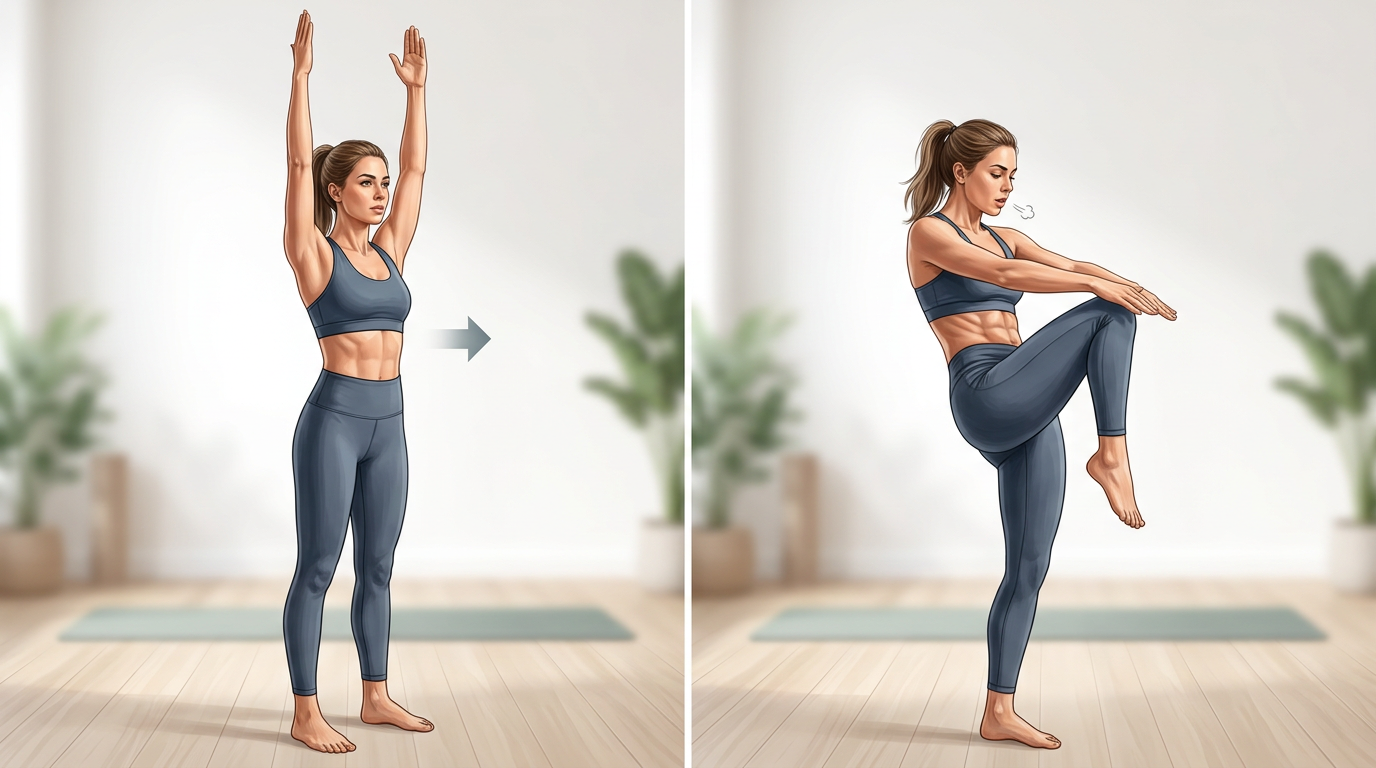
Demonstration of standing knee tucks showing the extended starting position and the crunched position with knee raised
Overhead March
The overhead march builds anti-extension core strength—your abs' ability to resist arching your lower back under load. This is crucial for spine health and injury prevention.
How to perform: Stand holding a light weight plate, dumbbell, or medicine ball overhead with arms fully extended. Brace your core and march in place, lifting your knees to hip height. Maintain a neutral spine throughout—don't let your back arch. March for 30-60 seconds.
This exercise looks simple but demands intense core stabilization. Start with light weight and focus on keeping your ribs down and core engaged.
Building Your Standing Ab Workout Routine
Creating an effective standing ab workout requires thoughtful exercise selection and proper programming. Follow these guidelines to maximize your results.
Workout Structure and Frequency
Train your core with standing exercises 2-4 times per week, allowing at least one day of recovery between sessions. Your abs are muscles like any other and need rest to grow stronger.
A complete standing ab workout should take 10-15 minutes and include exercises that address all core functions:
- Flexion: Movements that bring your ribs toward your pelvis (standing crunches, knee tucks)
- Rotation: Twisting movements that target obliques (wood chops, standing bicycle crunches)
- Lateral flexion: Side-bending movements (standing side bends, oblique crunches)
- Stability: Anti-movement exercises that resist motion (overhead march, single-leg stands)
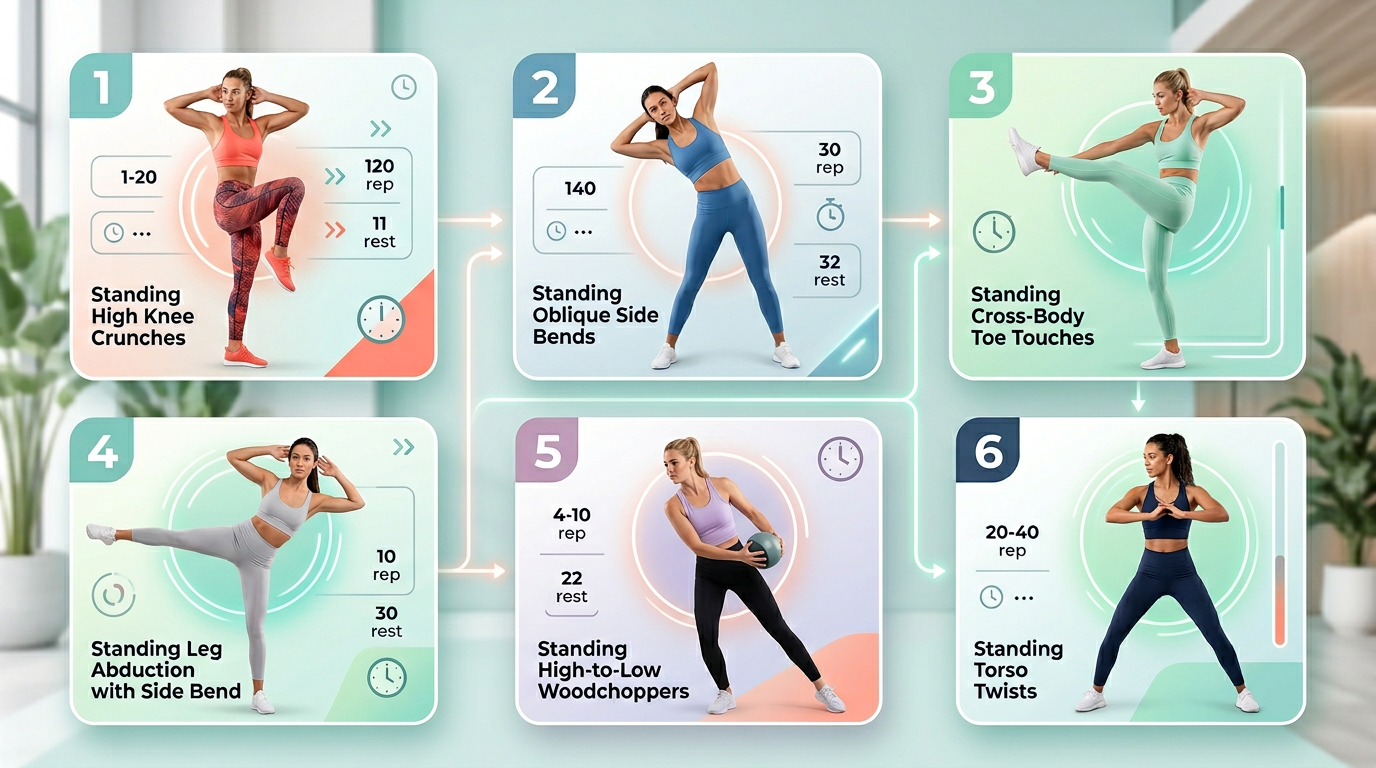
Sample standing ab workout routine displayed as an infographic showing 6 exercises with rep ranges and rest periods
Sample Standing Ab Workout for Beginners
Start with this foundational routine three times per week:
- Standing oblique crunches: 12 reps per side
- High knees with core engagement: 30 seconds
- Wood chops (bodyweight or light weight): 10 reps per side
- Standing side bends: 12 reps per side
- Standing knee tucks: 10 reps per side
Perform 2-3 rounds with 30-60 seconds rest between exercises. Focus on mastering form before adding weight or increasing speed.
Progressive Overload for Standing Ab Exercises
To continue seeing results, you must progressively challenge your core. Apply these progression strategies:
- Add resistance: Hold dumbbells, medicine balls, or resistance bands
- Increase time under tension: Slow down your repetitions, especially the lowering phase
- Reduce stability: Perform exercises on one leg or with eyes closed (advanced)
- Increase volume: Add more sets or repetitions
- Decrease rest periods: Challenge your muscular endurance by shortening rest between exercises
Implement one progression variable at a time and give your body 2-3 weeks to adapt before adding another challenge.
Standing Ab Exercises for Special Considerations
Women experience unique physical situations that require modified approaches to core training. Here's how to adapt standing ab exercises for different circumstances.
Pregnancy and Prenatal Core Training
Standing ab exercises are generally safer during pregnancy than floor-based movements, but always consult your healthcare provider before starting any exercise program. As your pregnancy progresses, avoid exercises that create a doming or coning appearance in your belly, which indicates excessive intra-abdominal pressure.
Safe standing ab exercises during pregnancy include:
- Modified standing side bends without weights
- Gentle standing marches with core engagement
- Standing pelvic tilts
- Wall-supported standing knee lifts
Avoid deep twisting movements and exercises that require lying flat on your back after the first trimester. Focus on maintaining core connection rather than building intense strength.
Postpartum Recovery and Diastasis Recti
Are standing abs good for diastasis recti? Standing ab exercises can be beneficial during diastasis recti recovery when chosen carefully. Focus on exercises that promote core reconnection without creating excessive pressure, such as standing marches, gentle side bends, and breathing-based core engagement. Avoid aggressive twisting and crunching movements until your abdominal separation has healed. Work with a pelvic floor physical therapist for personalized guidance.
Begin with foundational exercises like standing belly breathing and progress gradually. Monitor for any doming, bulging, or pain, which are signs to modify or stop an exercise.
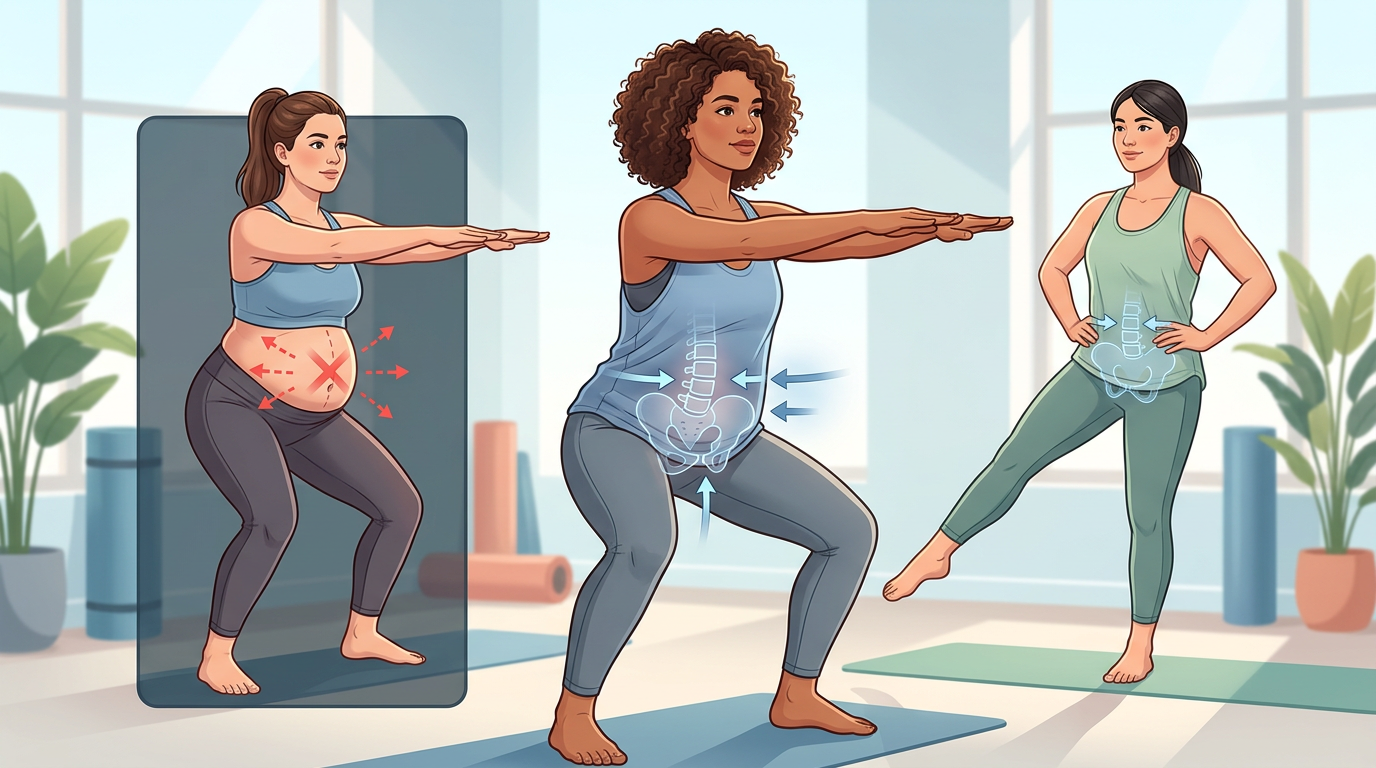
Illustration showing proper core engagement during standing exercises for postpartum women with visual cues for diastasis recti safety
Standing Ab Exercises for Back Pain
Can ab exercises help with back pain? Yes, strengthening your core through standing ab exercises can help reduce back pain by improving spinal stability and posture. Standing exercises are often better tolerated than floor work for people with back issues because they maintain the spine's natural curves and avoid positions that compress the lower back. Focus on exercises that emphasize stability and control rather than aggressive movement.
Best standing ab exercises for back health:
- Overhead march (teaches anti-extension)
- Standing pallof press (anti-rotation stability)
- Gentle standing side bends
- Standing bird dog (balance and stability)
If you experience pain during any exercise, stop immediately and consult a healthcare professional. Core training should never cause back pain when performed correctly.
Common Mistakes and How to Fix Them
Even simple-looking standing ab exercises can be performed incorrectly, reducing their effectiveness and potentially causing injury. Avoid these common errors.
Using Momentum Instead of Muscle
The most frequent mistake in standing ab exercises is swinging or using momentum rather than controlled muscular contraction. When you rush through repetitions or use jerky movements, your abs don't work as hard and you miss the training effect.
Fix it: Slow down each repetition, focusing on a 2-second lift, 1-second pause, and 2-second lower. If you can't maintain this tempo, the exercise is too advanced or you're using too much weight.
Neglecting Your Breath
Many women hold their breath during core exercises, which increases intra-abdominal pressure and reduces exercise effectiveness. Proper breathing enhances core engagement and protects your pelvic floor.
Fix it: Exhale during the exertion phase (when you're crunching, twisting, or lifting) and inhale during the release. This breathing pattern naturally engages your deep core muscles.
Arching Your Lower Back
Allowing your lower back to arch during standing ab exercises places stress on your spine and reduces core activation. This is especially common in overhead exercises and single-leg movements.
Fix it: Think about keeping your ribs down and pelvis neutral. Imagine a string pulling your belly button toward your spine. If you can't maintain this position, reduce the difficulty of the exercise.
Pulling on Your Neck
When fatigue sets in, there's a tendency to pull on your head or neck during standing crunches and similar exercises. This creates neck strain without adding core benefit.
Fix it: Keep your hands lightly touching your head rather than interlaced behind it. Look straight ahead rather than down. If your neck hurts, cross your arms over your chest instead.
Maximizing Results from Standing Ab Exercises
Getting the most from your standing ab workouts requires more than just performing the exercises. These strategies will accelerate your progress and help you achieve your core strength goals.
The Mind-Muscle Connection
Research indicates that consciously focusing on the muscle you're working increases activation and improves results. Instead of mindlessly going through the motions, actively think about your abs contracting with each repetition.
Before each set, place your hand on the area you're targeting (like your obliques during side bends). Feel the muscle contract as you perform the movement. This tactile feedback strengthens the neural pathways between your brain and muscles.
Nutrition for Core Definition
While standing ab exercises build core strength, visible definition requires addressing body composition through nutrition. You cannot spot-reduce fat from your midsection, but you can create the caloric deficit needed for overall fat loss while building muscle.
Focus on adequate protein intake (0.7-1 gram per pound of body weight), consistent meal timing, and a moderate caloric deficit if fat loss is your goal. Remember that core strength and visible abs are two different things—you can have powerful abs without a six-pack, and that's perfectly healthy.
Combining Standing Abs with Full-Body Training
Your core doesn't work in isolation during daily life, so your training shouldn't isolate it completely either. Integrate standing ab exercises into comprehensive workouts that include lower body, upper body, and cardiovascular training.
Effective integration strategies:
- Superset standing ab exercises with upper body movements during strength sessions
- Use standing core work as active recovery between heavy compound lifts
- Incorporate standing ab exercises into circuit training for metabolic conditioning
- Add a 10-minute standing ab finisher after your main workout
What Is the Most Effective Standing Ab Exercise?
While all standing ab exercises offer benefits, wood chops with resistance are widely considered the most effective single exercise. Wood chops engage your entire core through rotation while incorporating your shoulders, back, and legs, making them a comprehensive functional movement. They build rotational power that translates directly to athletic performance and daily activities.
That said, the most effective exercise for you depends on your specific goals, fitness level, and any physical limitations. A complete standing ab routine should include multiple exercises targeting different movement patterns rather than relying on a single "best" exercise.
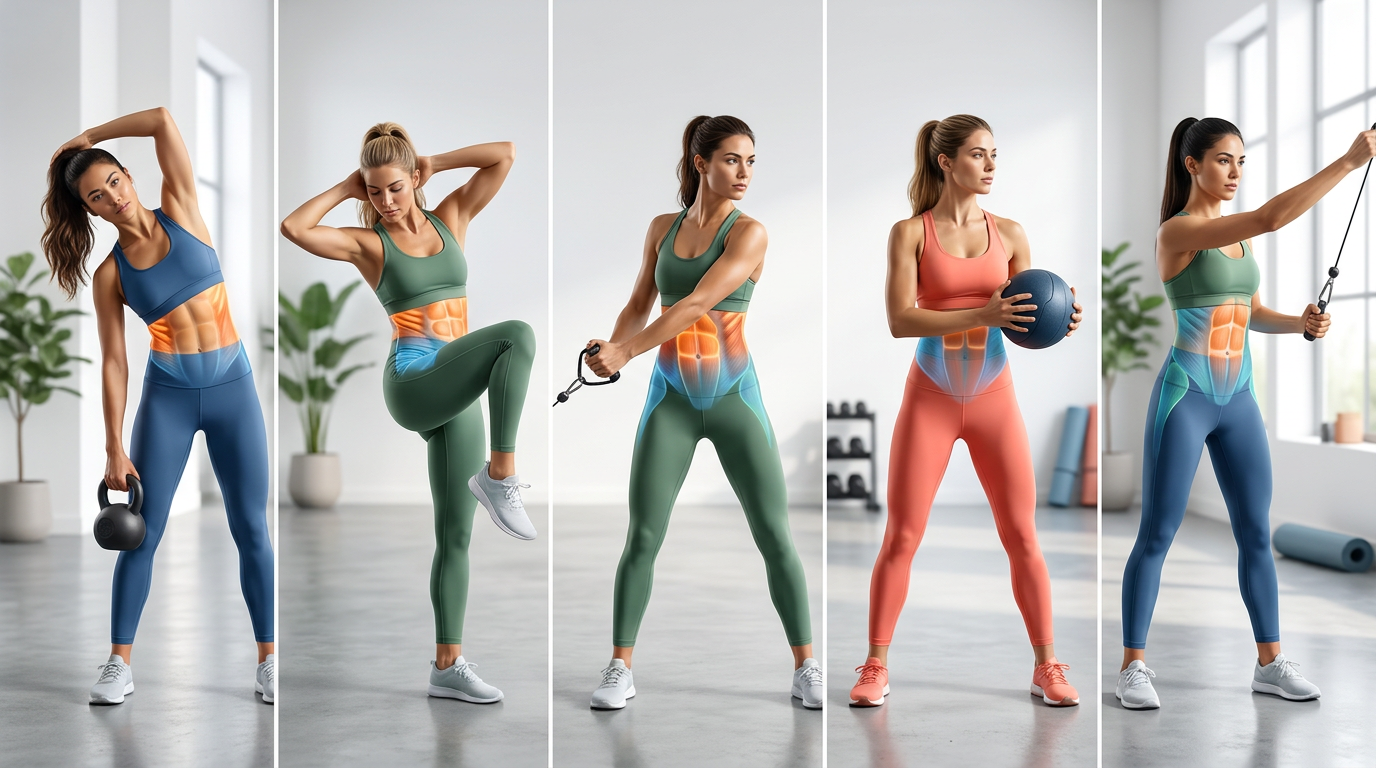
Comparison chart showing muscle activation patterns for the top 5 standing ab exercises with highlighted muscle groups
Creating Long-Term Core Strength
Building lasting core strength requires consistency, progression, and patience. Standing ab exercises provide the foundation, but your approach to training determines your long-term success.
Tracking Your Progress
Measure your improvement beyond just aesthetics. Track these functional indicators of core strength:
- How long you can hold an overhead march without form breakdown
- The weight you can control during wood chops
- Your balance during single-leg standing exercises
- Improvements in posture throughout the day
- Reduced back pain or discomfort during daily activities
Take progress photos and measurements monthly, but remember that strength gains often precede visible changes. Celebrate functional improvements as much as aesthetic ones.
Preventing Plateaus
Your body adapts to training stimuli within 4-6 weeks. Prevent plateaus by varying your standing ab routine every 6-8 weeks. Change exercises, adjust rep ranges, modify tempo, or alter rest periods to provide new challenges.
You don't need to completely overhaul your routine—small modifications create sufficient stimulus for continued adaptation. Add a pause at the peak contraction, perform exercises unilaterally, or incorporate resistance bands for variable tension.
Rest and Recovery
Your abs grow stronger during recovery, not during the workout itself. Ensure adequate sleep (7-9 hours nightly), manage stress, and fuel your body with nutritious foods. Overtraining your core can lead to decreased performance and increased injury risk.
If you're experiencing persistent soreness, decreased performance, or loss of motivation, take an extra rest day. Your body will thank you with better results when you return to training.
Frequently Asked Questions
How long does it take to see results from standing ab exercises?
Most women notice improved core strength and posture within 3-4 weeks of consistent training. Visible definition depends on body composition and typically takes 8-12 weeks with proper nutrition. Focus on functional improvements like better balance and reduced back discomfort as early indicators of progress.
Can you get a flat stomach from standing ab exercises alone?
Standing ab exercises build core strength but cannot spot-reduce belly fat. A flat stomach requires combining core training with overall fat loss through caloric deficit, full-body strength training, and cardiovascular exercise. Nutrition plays the primary role in revealing abdominal definition.
Are standing ab exercises better than floor exercises?
Standing ab exercises offer different benefits rather than being universally better. They provide greater functional strength, improved balance, and accessibility for those with mobility limitations. Floor exercises allow for specific isolation and certain movement patterns. An ideal program includes both types for comprehensive core development.
How many standing ab exercises should I do per workout?
Include 4-6 standing ab exercises per dedicated core workout, performing 2-3 sets of 10-15 reps each. Choose exercises that target different core functions including rotation, side bending, and stability. Total workout time should be 10-15 minutes with proper rest between sets.
Do I need equipment for standing ab exercises?
Many effective standing ab exercises require no equipment and use only bodyweight. Adding dumbbells, medicine balls, or resistance bands increases difficulty and provides progressive overload for continued strength gains. Start with bodyweight movements to master form before adding resistance.
Can standing ab exercises help with lower belly fat?
Standing ab exercises strengthen the muscles beneath lower belly fat but cannot target fat loss in that specific area. Spot reduction is not physiologically possible. Reduce overall body fat through caloric deficit and full-body training while building core strength through standing exercises.
Should I do standing ab exercises every day?
Train your core with standing ab exercises 2-4 times per week, allowing rest days for recovery and muscle adaptation. Daily training can lead to overuse and decreased performance. Your abs need recovery time like any other muscle group to grow stronger and avoid fatigue.
Conclusion
Standing ab exercises offer a powerful, accessible approach to building core strength without the discomfort and limitations of traditional floor work. By incorporating movements like wood chops, standing oblique crunches, and overhead marches into your routine, you'll develop functional strength that improves your posture, balance, and daily movement quality. These exercises are particularly valuable for women navigating pregnancy, postpartum recovery, or back concerns, while remaining effective for anyone seeking efficient, joint-friendly core training.
Remember that consistent training with proper form delivers better results than perfect programming performed inconsistently. Start with the beginner routine, focus on the mind-muscle connection, and progress gradually by adding resistance or complexity. Your core strength will improve within weeks, supporting everything from lifting your children to maintaining energy throughout long workdays. The best standing ab exercises are the ones you'll actually do regularly, so find the movements you enjoy and make them a sustainable part of your fitness lifestyle.