Rear Delt Exercises: Target Shoulder Definition
Rear delt exercises are strength movements targeting the posterior deltoid muscles at the back of your shoulders. The most effective include bent-over reverse flys, face pulls, and band pull-aparts, which improve posture, shoulder stability, and create balanced upper body definition for women.
Introduction
Ever catch yourself hunched forward and wonder when your posture started to slip? After years at a desk, on your phone, and carrying kids, the muscles meant to hold you upright—your rear deltoids and upper back—quietly switch off. These small but mighty muscles at the back of your shoulders are the ones most women never train.
Incorporating rear delt exercises into your fitness regimen isn't just about aesthetics. These movements are essential for correcting rounded shoulders caused by desk work, preventing injury, and building the functional strength you need for everyday activities like carrying groceries or lifting children. Created by certified trainer Shelley Darlington with 15+ years experience, this comprehensive guide will show you exactly how to target these often-forgotten muscles for balanced shoulder development.
Whether you're working out at home or in the gym, you'll discover the most effective exercises, proper form cues, and programming strategies to build strong, defined shoulders that support your entire upper body. Let's transform those shoulders from the back forward.
Key Takeaways
- Rear delts are crucial for shoulder health, posture correction, and preventing muscle imbalances that lead to injury
- The best rear delt exercises include bent-over reverse flys, face pulls, band pull-aparts, and single-arm rows
- Training rear delts 2-3 times weekly with 8-15 reps per set produces optimal strength and definition results
- Proper form with lighter weights is more effective than heavy loads with momentum for isolating posterior deltoids
- Progressive overload through increased volume, resistance, or time under tension drives continuous improvement
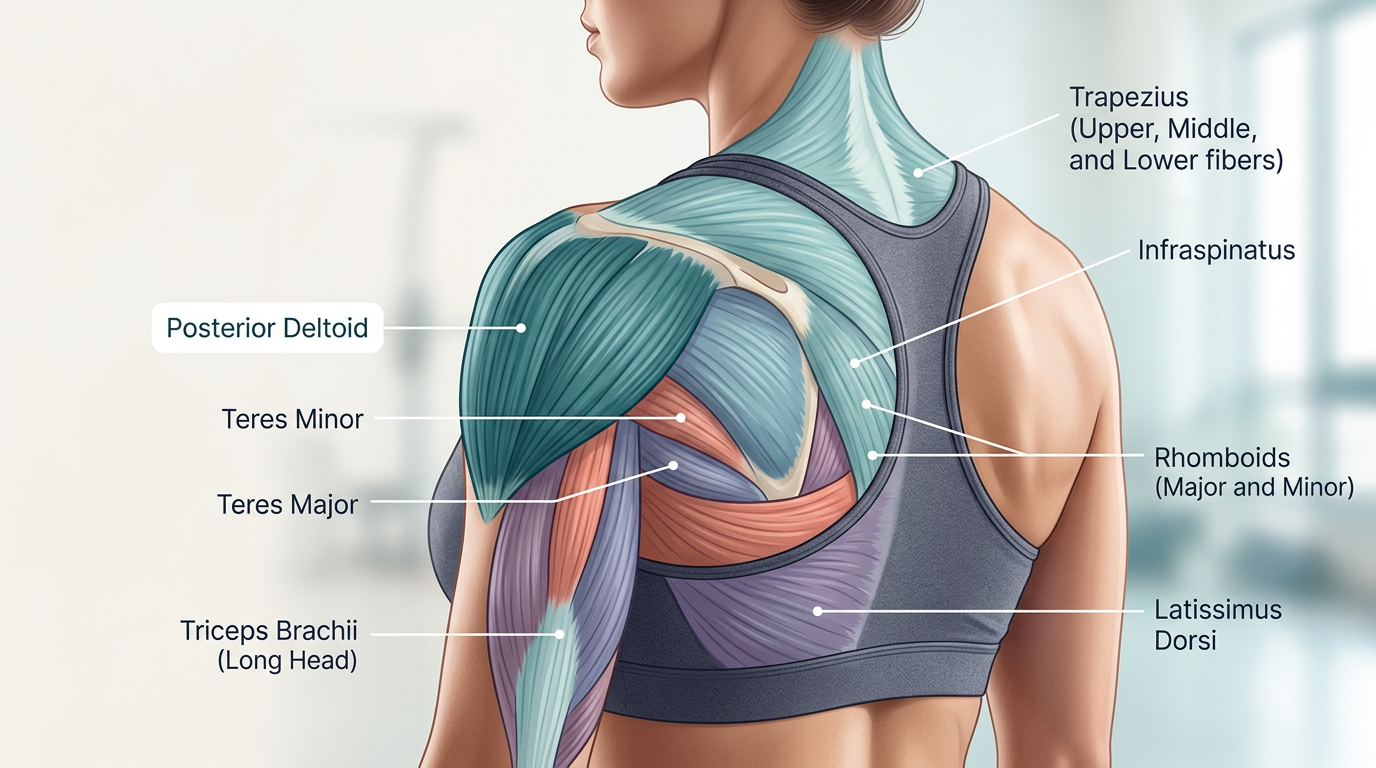
Anatomical illustration showing the rear deltoid muscle location on the posterior shoulder with labeled muscle fibers and surrounding upper back muscles
Understanding Your Rear Deltoids: The Foundation of Shoulder Health
What Are Rear Delts and Why Do They Matter?
Your rear deltoids, or posterior deltoids, are one of three heads that make up your shoulder muscles. Located at the back of your shoulders, they work alongside your upper back muscles to pull your arms backward and rotate your shoulders externally.
These muscles are essential for maintaining proper posture and preventing the forward shoulder roll that plagues women who spend hours at desks or looking at phones. When rear delts are weak compared to your chest and front shoulders, you create a muscle imbalance that can lead to shoulder pain, rotator cuff issues, and limited mobility.
For women 35+ focused on strength training and body recomposition, rear delt development becomes even more critical. As we age, maintaining shoulder stability protects joint health and preserves the ability to perform daily tasks without discomfort.
The Connection Between Rear Delts and Posture
Your rear deltoids act as postural anchors, pulling your shoulders back and down into proper alignment. When these muscles are underdeveloped, your chest muscles and anterior deltoids pull your shoulders forward, creating that hunched appearance.
Training your rear delts consistently helps:
- Counteract the forward pull from chest-dominant exercises like push-ups and bench press
- Open up your chest cavity for improved breathing and confidence
- Reduce neck and upper back tension caused by poor shoulder positioning
- Create visual balance between your front and back body
- Support proper scapular movement during overhead activities
According to research on muscle activation patterns, most women have significantly weaker rear delts compared to their front shoulders, making targeted training essential rather than optional.
Common Mistakes That Prevent Rear Delt Development
Many women unknowingly sabotage their rear delt training with these common errors:
- Using too much weight: Heavy loads force you to use momentum and recruit larger back muscles instead of isolating the rear delts
- Insufficient training frequency: Hitting rear delts once weekly isn't enough stimulus for growth
- Poor exercise selection: Relying solely on compound back exercises doesn't provide adequate rear delt isolation
- Neglecting the mind-muscle connection: Rushing through reps without focusing on the target muscle
- Inconsistent range of motion: Partial reps limit muscle fiber recruitment
The Two-Part Fix: Release First, Then Strengthen
Here's what most rear delt guides skip: rounded shoulders aren't only about weak rear delts. They're a whole-body pattern. The front of you — your chest and your lats (the big muscles down the sides of your back) — gets tight and pulls you forward. The back of you — your rear delts and the muscles between your shoulder blades — gets long, weak, and switches off.
This is why strengthening alone often disappoints. If the tight front is still pulling like a stretched rubber band, you can train the back all day and barely move the needle. The fix has two halves: release the tight front, then strengthen the weak back — and the release work should come first, every time.
It's worth knowing this is the upper-body half of a bigger picture. Rounded shoulders often travel with an anterior pelvic tilt at the other end of your spine — the same forward-loaded posture, top and bottom.
Release and mobilise the tight front (do this first)
Spend five minutes here before any strengthening. All of it works at home with a band, a light dumbbell, a foam roller, and a massage ball.
- Pec trigger-ball release: Place a massage ball between the front of your shoulder and a wall, find the tender spot, and hold for up to two minutes while you breathe and relax.
- Supported pec stretch: Lie back over a bench or foam roller holding light dumbbells (around 1kg), open your arms wide, and let gravity gently open the chest for 30–60 seconds.
- Thoracic extension over a foam roller: With the roller under your mid-back and a light dumbbell held overhead, exhale and extend gently back over the roller for 3–5 slow reps.
- Wall angels: Stand with your back against a wall and slide your arms up and down in a goalpost shape, keeping contact the whole time to wake up the mid-back.
Best Rear Delt Exercises for Women: A Complete Guide
Bent-Over Reverse Flys: The Gold Standard
Bent-over reverse flys are the most effective isolation exercise for targeting rear deltoids because they minimize involvement from other muscle groups. This movement allows you to focus entirely on the posterior shoulder muscles while maintaining control throughout the entire range of motion.
How to perform bent-over reverse flys:
- Hold light dumbbells (3-10 pounds) and hinge forward at your hips until your torso is nearly parallel to the floor
- Let your arms hang straight down with palms facing each other and a slight bend in your elbows
- Squeeze your shoulder blades together as you raise both arms out to the sides in a wide arc
- Lift until your arms are parallel to the floor, pause for one second, then lower with control
- Complete 3-4 sets of 12-15 reps with perfect form
Form tips: Keep your neck neutral by looking at the floor about two feet in front of you. Avoid using momentum by maintaining a slow, controlled tempo. Your elbows should stay slightly bent throughout the movement—locking them out shifts tension to your triceps.
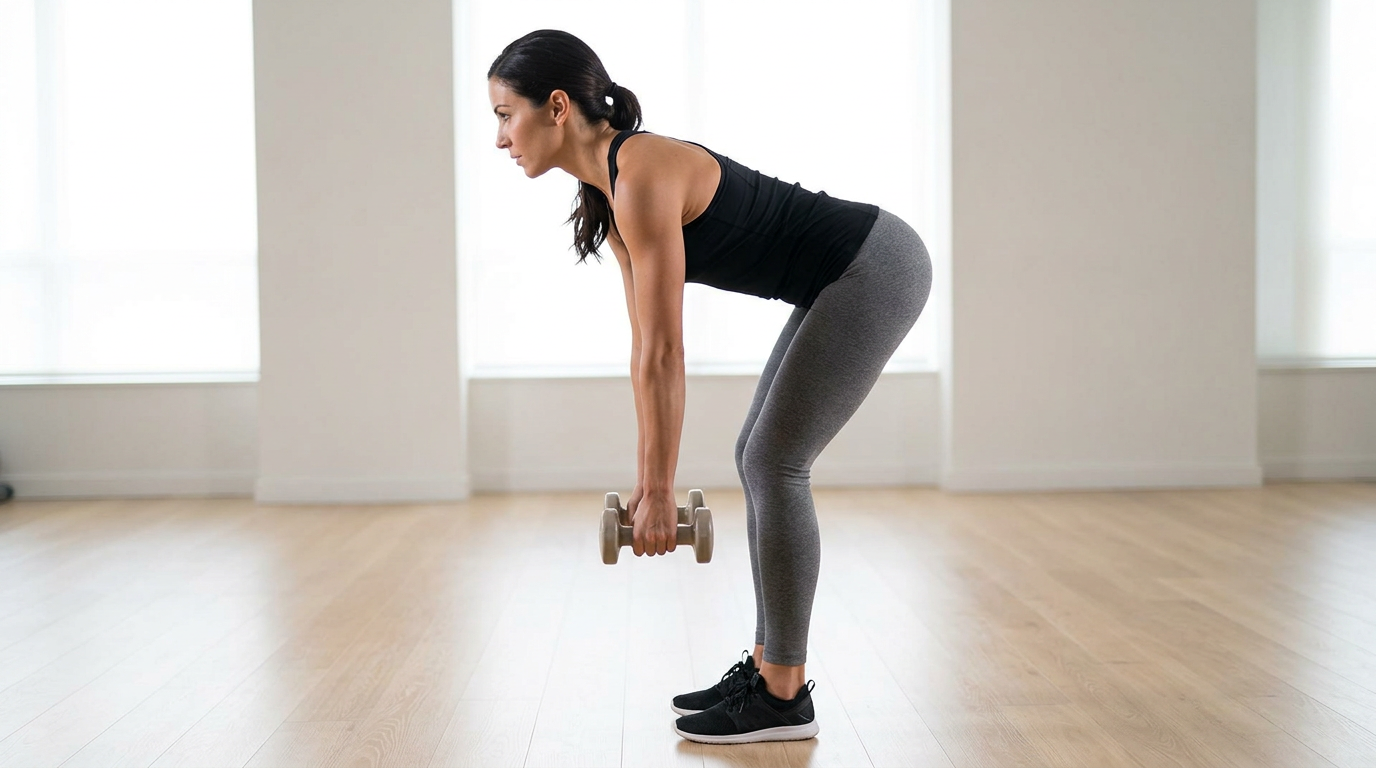
Step-by-step demonstration of a woman performing bent-over reverse flys showing starting position, mid-range, and peak contraction positions with proper hip hinge and arm path
Face Pulls: Functional Strength Meets Shoulder Health
Face pulls combine rear delt activation with rotator cuff strengthening, making them invaluable for shoulder health. This exercise requires a cable machine or resistance band anchored at upper chest height.
Execution steps:
- Attach a rope handle to a cable machine at face height or secure a resistance band at the same level
- Grasp the rope with both hands using an overhand grip, thumbs pointing toward you
- Step back until your arms are fully extended with tension on the cable
- Pull the rope toward your face while simultaneously separating your hands
- Focus on pulling your elbows back and squeezing your shoulder blades together
- Return to the starting position with control and repeat for 10-15 reps
The key to effective face pulls is the hand separation at the end of the movement—this external rotation component activates your rear delts more completely than keeping your hands together. Perform 3 sets of 12-15 reps, focusing on the squeeze at peak contraction.
Band Pull-Aparts: The Perfect Warm-Up and Finisher
Band pull-aparts are incredibly versatile rear delt exercises that require only a resistance band. They're excellent for warming up before upper body workouts or as high-rep finishers to create metabolic stress.
Proper technique:
- Hold a resistance band with both hands at shoulder width, arms extended in front of you at chest height
- Keep your elbows straight (but not locked) as you pull the band apart
- Stretch the band across your chest while squeezing your shoulder blades together
- Control the return to starting position without letting the band snap back
- Perform 15-20 reps for 2-3 sets
Variations to try: Adjust hand placement (wider for easier, narrower for harder), change the angle (pull apart at face height or lower chest), or use different band resistances to match your strength level.
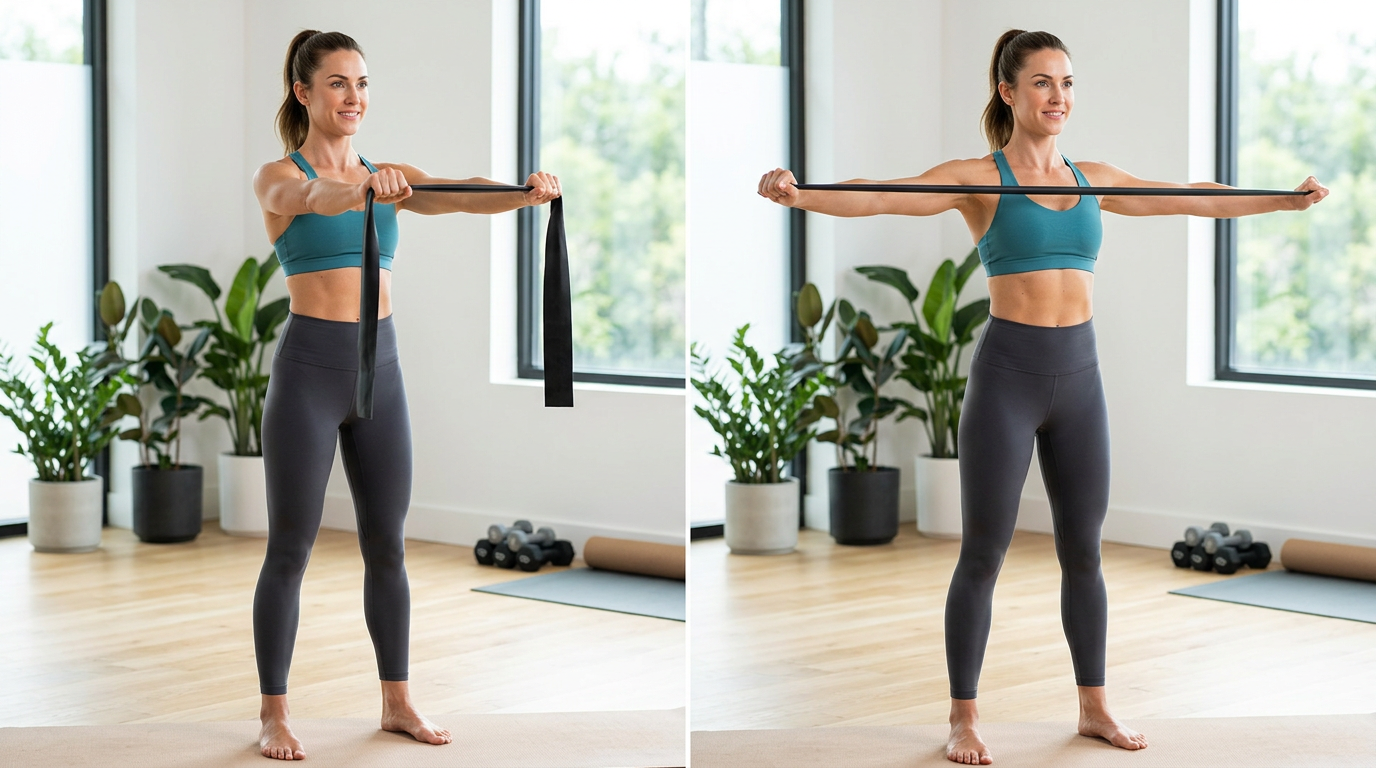
Woman demonstrating band pull-aparts from front view showing starting position with arms extended and ending position with band stretched across chest and shoulder blades squeezed
Single-Arm Dumbbell Rows: Compound Movement with Rear Delt Emphasis
While primarily a back exercise, single-arm rows effectively target rear delts when performed with proper form and intentional muscle engagement. This movement also builds functional pulling strength.
Step-by-step instructions:
- Place your left hand and left knee on a bench with your right foot planted on the floor
- Hold a dumbbell in your right hand with your arm hanging straight down
- Pull your elbow back and slightly out to the side (about 45 degrees from your body)
- Focus on leading with your elbow and squeezing your shoulder blade toward your spine
- Lower the weight with control and complete 8-12 reps before switching sides
To maximize rear delt activation during rows, think about pulling your elbow back and up toward the ceiling rather than pulling the weight straight up. This angle shift recruits more posterior shoulder fibers.
Chest-Supported Reverse Flys: Eliminate Momentum Completely
Chest-supported reverse flys remove lower back strain and prevent cheating by stabilizing your torso against an incline bench. This variation is ideal for women who struggle with maintaining proper hip hinge position during bent-over movements.
Setup and execution:
- Set an adjustable bench to a 30-45 degree incline
- Lie face-down on the bench with your chest supported and feet planted firmly
- Hold light dumbbells with arms hanging straight down
- Perform the reverse fly motion by raising your arms out to the sides
- Squeeze at the top position before lowering with control
The chest support allows you to use perfect form with zero momentum, making lighter weights feel significantly more challenging and effective for rear delt isolation. Aim for 3 sets of 12-15 reps with a 2-second pause at peak contraction.
Rear Delt Machine: Controlled Isolation for Beginners
The rear delt machine (reverse pec deck) provides a fixed movement path that helps beginners learn proper muscle activation without worrying about stabilization. This machine is available in most commercial gyms.
How to use the rear delt machine effectively:
- Adjust the seat height so the handles are at shoulder level when seated
- Position your chest against the pad with arms extended forward
- Grasp the handles with palms facing each other or facing down
- Pull the handles back in a wide arc while keeping your elbows slightly bent
- Squeeze your shoulder blades together at the back of the movement
- Return to starting position with control, maintaining tension throughout
Machine benefits include consistent resistance throughout the range of motion and the ability to safely train to muscular failure without a spotter. Perform 3-4 sets of 10-15 reps as part of your shoulder workout routine.
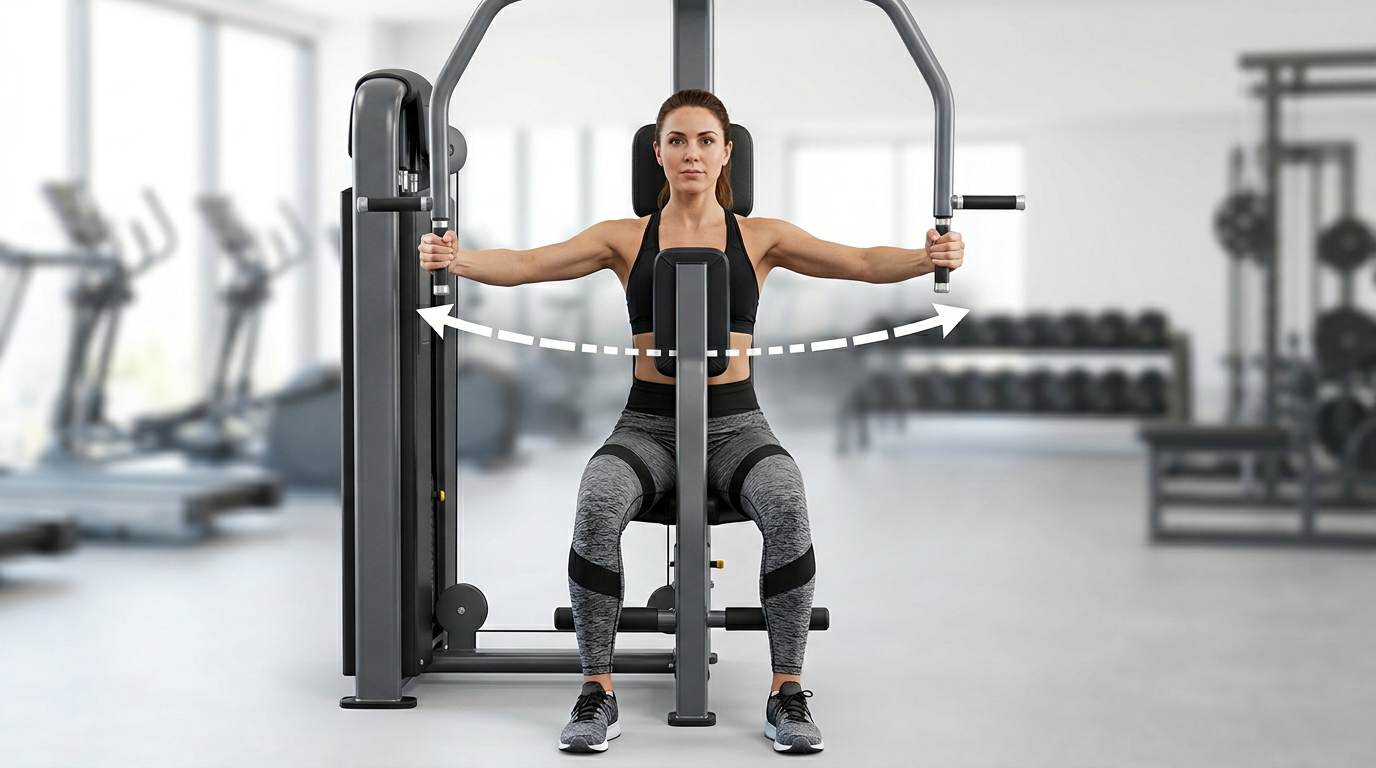
Woman seated at rear delt machine demonstrating proper chest pad positioning and handle grip with arrows showing the movement path of the exercise
The Back Exercises That Make Rounded Shoulders Worse
Here's something almost no one mentions: some of the most popular back exercises can actually make rounded shoulders worse. Pull-ups, chin-ups, heavy lat pulldowns, and rack pulls all hammer your lats — and your lats attach high up at the front of your upper arm. When they're already tight and you keep loading them heavy while your mid-back is still weak, they pull your shoulders even further forward. You get stronger in the very muscle that's part of the problem.
You don't have to give them up forever. But while you're retraining your posture, ease off the heavy lat work and favour mid-back movements instead — lighter, controlled, and aimed at the muscles that pull you back into alignment:
- Incline dumbbell rows
- Face pulls
- Underhand-grip rows
How to Program Rear Delt Exercises Into Your Training
Optimal Training Frequency and Volume
Training your rear delts 2-3 times per week with 9-15 total sets produces the best results for muscle development and strength gains. This frequency provides adequate stimulus while allowing sufficient recovery time between sessions.
Based on feedback from thousands of Strong Curves app users, women see noticeable improvements in shoulder definition within 6-8 weeks when following consistent rear delt programming. The key is distributing volume across multiple sessions rather than performing all sets in one workout.
Sample weekly structure:
- Monday (Upper Body A): 3 sets bent-over reverse flys, 3 sets face pulls
- Wednesday (Back Focus): 3 sets single-arm rows, 2 sets band pull-aparts
- Friday (Upper Body B): 3 sets chest-supported reverse flys, 2 sets rear delt machine
Rep Ranges and Intensity Guidelines
Rear delts respond well to moderate rep ranges with controlled tempos. Unlike larger muscle groups that benefit from heavy, low-rep training, posterior deltoids require higher reps to accumulate sufficient volume.
Recommended rep ranges by exercise type:
- Isolation exercises (reverse flys, face pulls): 12-15 reps per set
- Compound movements (rows): 8-12 reps per set
- Activation and finisher work (band pull-aparts): 15-20 reps per set
- Machine exercises: 10-15 reps per set with controlled tempo
Tempo matters significantly for rear delt development. Use a 2-1-2 tempo (2 seconds lifting, 1 second pause, 2 seconds lowering) to maximize time under tension and minimize momentum-based cheating.
Progressive Overload Strategies for Continuous Growth
Progressive overload—gradually increasing training stress over time—is essential for continued rear delt development. Since these are small muscles, progress comes through multiple variables rather than just adding weight.
Five ways to progress your rear delt training:
- Increase resistance: Add 1-2 pounds to dumbbell exercises or increase band resistance when you can complete all sets with perfect form
- Add volume: Include an additional set once weekly when recovery allows
- Extend time under tension: Add a 2-3 second pause at peak contraction
- Improve range of motion: Focus on achieving fuller contraction and stretch positions
- Reduce rest periods: Decrease rest between sets from 90 seconds to 60 seconds to increase metabolic stress
Track your workouts in a training journal or app to ensure you're implementing progressive overload consistently. Small improvements each week compound into significant strength and definition gains over months.
Common Form Mistakes and How to Fix Them
Using Momentum Instead of Muscle Tension
The most common error in rear delt training is using momentum to swing weights through the movement rather than controlling the resistance with muscle tension. This happens when you select weights that are too heavy or rush through reps.
Fix: Reduce your weight by 30-40% and focus on a controlled tempo with a 1-2 second pause at peak contraction. If you can't hold the top position without shaking or dropping, the weight is too heavy for effective rear delt isolation.
During bent-over movements, your torso should remain completely still—any rocking or swaying indicates you're using momentum. Film yourself from the side to check for unwanted movement patterns.
Insufficient Shoulder Blade Retraction
Many women perform rear delt exercises without properly engaging their shoulder blades, which limits muscle activation and reduces exercise effectiveness. Your shoulder blades should squeeze together at the end of every rear delt movement.
Correction strategy:
- Before starting your set, practice squeezing your shoulder blades together without any weight
- Think about pinching a pencil between your shoulder blades during the contraction phase
- Hold the squeeze for 2 seconds at the top of each rep
- Use lighter weights that allow you to focus on scapular movement rather than just moving the resistance
Elbow Position Errors
Incorrect elbow positioning shifts tension away from rear delts and onto other muscles. Your elbows should maintain a slight bend throughout reverse fly movements and stay at the proper angle during rows.
Proper elbow mechanics:
- Reverse flys: Maintain a 10-15 degree bend in your elbows throughout the entire movement—never lock out or bend excessively
- Face pulls: Keep elbows high (at or above shoulder level) as you pull back
- Rows: Pull your elbow back at a 45-degree angle from your torso, not tight against your side
If you feel your biceps burning during rear delt exercises, your elbows are bending too much. Reset your form and focus on moving from the shoulder joint rather than the elbow.
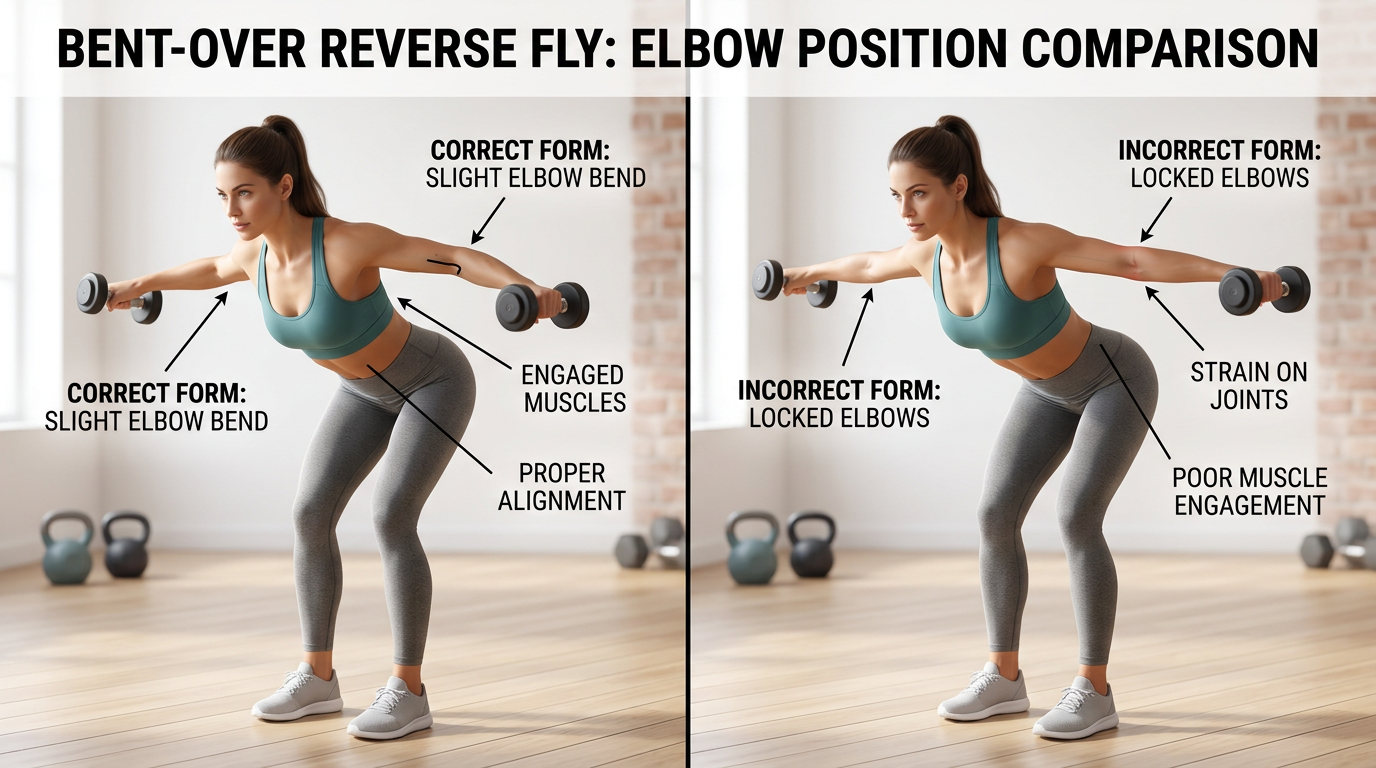
Side-by-side comparison showing correct versus incorrect elbow position during bent-over reverse flys with annotations highlighting proper slight bend versus locked elbows
Rear Delt Training for Different Fitness Levels
Beginner-Friendly Approach
If you're new to rear delt training, start with exercises that provide stability and allow you to focus on learning proper movement patterns. The Strong Curves glute-focused approach to functional fitness emphasizes building foundational strength before adding complexity.
Beginner workout structure (2x per week):
- Band pull-aparts: 2 sets of 15 reps (warm-up and activation)
- Rear delt machine: 3 sets of 12 reps (learning proper muscle engagement)
- Chest-supported reverse flys: 2 sets of 10 reps with very light weights
Focus on perfecting form before increasing weight or volume. It's better to spend 4-6 weeks mastering movement patterns than to rush into heavier loads with poor technique.
Intermediate Training Strategies
Once you've established solid form and can perform rear delt exercises with a strong mind-muscle connection, increase training frequency and incorporate more challenging variations.
Intermediate program (3x per week):
- Day 1: Bent-over reverse flys (3x12), Face pulls (3x15), Band pull-aparts (2x20)
- Day 2: Single-arm rows (3x10 each side), Rear delt machine (3x12)
- Day 3: Chest-supported reverse flys (4x12), Face pulls (2x15)
At this level, implement progressive overload by adding 1-2 pounds every 2-3 weeks or increasing reps before adding weight. Track your performance to ensure consistent progress.
Advanced Techniques for Experienced Lifters
Advanced trainees can use intensity techniques to maximize rear delt development and break through plateaus. These methods increase metabolic stress and muscle fiber recruitment.
Advanced training techniques:
- Drop sets: Complete a set of reverse flys to failure, immediately reduce weight by 30%, and continue for another 8-10 reps
- Supersets: Pair rear delt exercises with chest exercises (reverse flys + push-ups) for balanced antagonist training
- Pause reps: Hold the peak contraction for 3-5 seconds on every rep to increase time under tension
- Pre-exhaust: Perform isolation exercises (reverse flys) before compound movements (rows) to fatigue rear delts first
Use these techniques sparingly—once or twice per week—to avoid overtraining. Your rear delts need adequate recovery time to grow stronger.
Equipment Alternatives for Home Workouts
Training Rear Delts Without a Gym
You don't need expensive equipment or a gym membership to build strong, defined rear delts. Resistance bands, light dumbbells, and household items can provide effective training stimulus when used correctly.
Resistance bands are the most versatile tool for home-based rear delt training because they provide constant tension throughout the entire range of motion and are available in multiple resistance levels. A set of light, medium, and heavy bands costs less than $30 and enables dozens of exercise variations.
Effective Equipment Substitutions
When you don't have access to traditional gym equipment, these substitutions work excellently for rear delt exercises:
- Cable machine → Resistance bands: Anchor bands to a door frame or sturdy post at the appropriate height for face pulls and other cable exercises
- Dumbbells → Water bottles or canned goods: Use filled water bottles (16-32 oz) for reverse flys when starting out
- Rear delt machine → Band reverse flys: Loop a band around a stable object at chest height and perform reverse fly movements
- Bench → Stability ball or ottoman: Use a stability ball or firm ottoman for chest-supported exercises
The key is maintaining proper form and progressive overload regardless of equipment. As you get stronger with bands, move to heavier resistance levels or increase reps and sets.
Bodyweight Options for Rear Delt Activation
While challenging to isolate rear delts with bodyweight alone, certain exercises provide activation when equipment isn't available:
- Prone Y-raises: Lie face-down on the floor and raise your arms overhead in a Y position, lifting your chest slightly off the ground
- Wall slides with external rotation: Stand with your back against a wall and slide your arms up while rotating your palms forward
- Superman holds: Lie face-down and lift your arms, chest, and legs off the ground simultaneously, holding for 20-30 seconds
These bodyweight movements work best as activation exercises before your main training or as finishers to accumulate additional volume. For more guidance on home workout programming, consider structured plans that progress systematically.
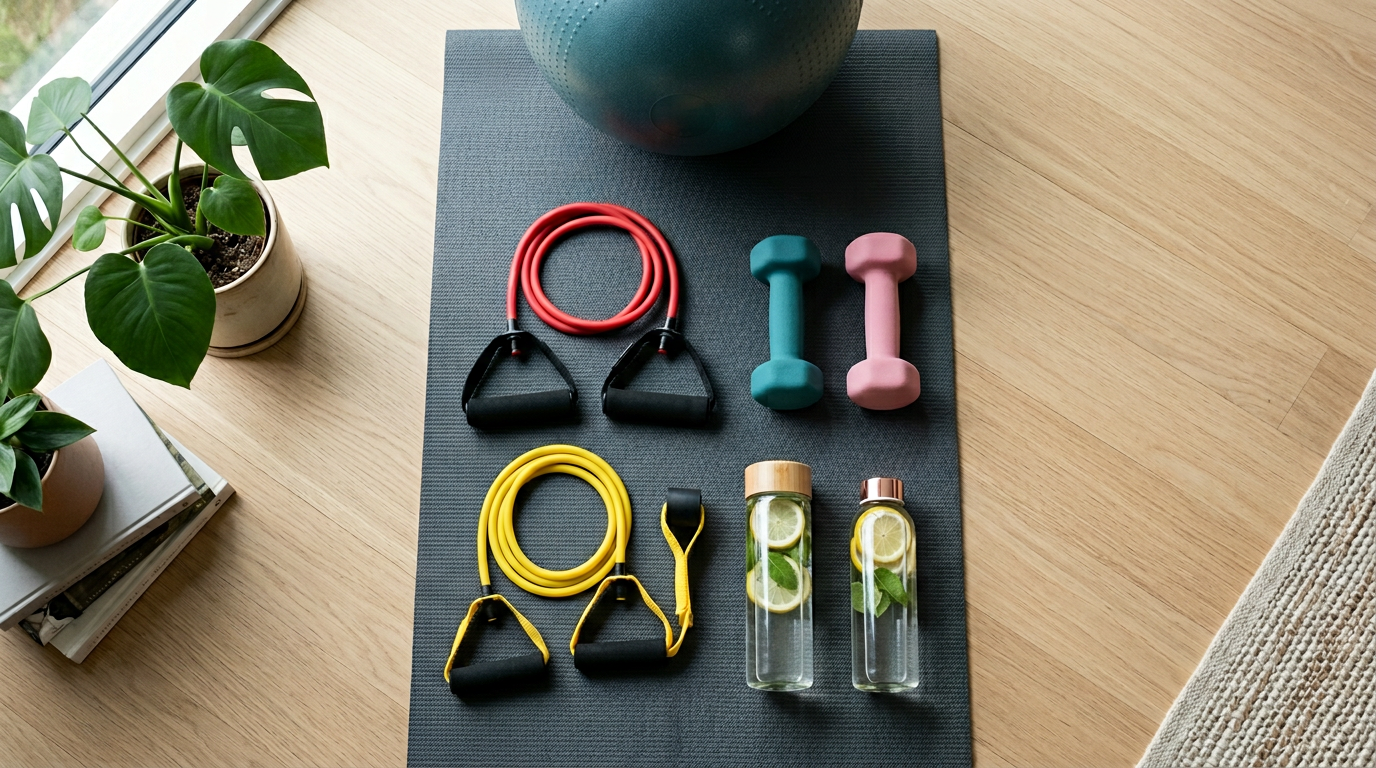
Overhead view of home workout equipment alternatives for rear delt training including resistance bands, light dumbbells, water bottles, and a stability ball arranged on a yoga mat
Nutrition and Recovery for Shoulder Development
Protein Requirements for Muscle Growth
Building defined shoulders requires adequate protein intake to support muscle protein synthesis. Research shows women need approximately 0.7-1.0 grams of protein per pound of body weight daily when training for muscle development.
For a 150-pound woman, this translates to 105-150 grams of protein daily, distributed across 3-4 meals. Consuming 25-40 grams of protein per meal optimizes muscle building throughout the day.
Quality protein sources include:
- Chicken breast, turkey, and lean beef
- Fish and seafood (salmon, tuna, shrimp)
- Greek yogurt and cottage cheese
- Eggs and egg whites
- Plant-based options like tofu, tempeh, and legumes
Recovery Strategies for Optimal Results
Your muscles grow during recovery periods, not during workouts. Implementing proper recovery strategies ensures your rear delts can repair and strengthen between training sessions.
Essential recovery practices:
- Sleep 7-9 hours nightly: Growth hormone release peaks during deep sleep, facilitating muscle repair
- Allow 48 hours between intense rear delt sessions: Small muscles need adequate recovery time
- Stay hydrated: Aim for half your body weight in ounces of water daily
- Manage stress: Chronic stress elevates cortisol, which impairs muscle recovery
- Consider active recovery: Light movement like walking or yoga promotes blood flow without adding training stress
When you pair the right recovery with consistent training, the results take care of themselves. Don't sacrifice sleep or nutrition in pursuit of more training volume.
Supplements That Support Shoulder Health
While whole foods should form the foundation of your nutrition plan, certain supplements may support joint health and recovery as you increase training intensity.
Potentially beneficial supplements:
- Omega-3 fatty acids: Support joint health and reduce exercise-induced inflammation (2-3 grams daily)
- Collagen peptides: May support connective tissue health (10-15 grams daily)
- Creatine monohydrate: Enhances strength and power output (3-5 grams daily)
- Vitamin D: Supports muscle function and bone health (2000-4000 IU daily if deficient)
Consult with a healthcare provider before starting any supplement regimen, especially if you have existing health conditions or take medications. For comprehensive guidance on nutrition for strength training, explore evidence-based meal planning strategies.
Tracking Progress and Setting Realistic Goals
Measurable Progress Indicators
Progress in rear delt development manifests through multiple indicators beyond just visual changes—tracking strength gains, posture improvements, and functional capacity provides a complete picture of your advancement. Don't rely solely on mirror assessments, which can be subjective and inconsistent.
Key metrics to track:
- Strength increases: Weight used for 10-12 reps on key exercises like reverse flys
- Volume progression: Total sets completed per week with good form
- Posture changes: Shoulder position in relaxed standing (have someone photograph you from the side monthly)
- Range of motion: Ability to reach behind your back or overhead without discomfort
- Shoulder circumference: Measurement around the widest part of your shoulders
Realistic Timeline for Results
Understanding realistic timelines prevents frustration and helps you stay consistent with your training. Muscle development is a gradual process that requires patience and persistence.
Expected progress timeline:
- Weeks 1-3: Improved mind-muscle connection, better form, initial strength gains from neurological adaptations
- Weeks 4-8: Noticeable strength increases, improved posture, beginning of visible muscle definition
- Weeks 9-16: Clear visual changes in shoulder shape, significant strength gains, better shoulder stability
- Months 4-6: Substantial rear delt development, balanced shoulder appearance, plateau in initial rapid progress
In our experience with women who train rear delts consistently 2-3 times weekly with proper nutrition, most notice meaningful changes in shoulder definition within 8-12 weeks. However, individual results vary based on genetics, training history, and recovery capacity.
When to Adjust Your Program
Knowing when and how to modify your rear delt training ensures continued progress and prevents plateaus. Stagnation indicates your body has adapted to the current training stimulus.
Signs it's time to adjust your program:
- No strength increases for 3-4 consecutive weeks: Add volume, change exercises, or implement intensity techniques
- Persistent soreness or joint discomfort: Reduce volume or frequency to allow better recovery
- Loss of motivation: Introduce new exercise variations to maintain engagement
- Consistent progress: Continue your current program—don't change what's working
Adjust one variable at a time so you can identify what drives results. Changing multiple factors simultaneously makes it impossible to determine what's effective.
Frequently Asked Questions
What is the best exercise for rear delts?
Bent-over reverse flys are the best rear delt exercise because they isolate the posterior deltoids with minimal involvement from other muscles. Face pulls are a close second, offering rear delt activation plus rotator cuff strengthening. Perform 3-4 sets of 12-15 reps twice weekly for optimal results.
Does exercise help arthritis in the shoulders?
Yes, appropriate exercise helps manage shoulder arthritis by strengthening supporting muscles, improving joint stability, and maintaining range of motion. Low-impact rear delt exercises like band pull-aparts and face pulls reduce joint stress while building strength. Always consult your doctor before starting new exercises with arthritis.
How to get overdeveloped rear delts?
Overdeveloped rear delts result from training them 4-5 times weekly with high volume (15+ sets) and progressive overload over many months. Most women don't need to worry about overdevelopment—rear delts are typically underdeveloped. Focus on balanced training with 9-12 weekly sets for proportional shoulder development.
What is the alternative to the rear delt machine?
The best alternatives to the rear delt machine are chest-supported reverse flys using dumbbells or resistance band reverse flys. Both provide similar isolation benefits without requiring specialized equipment. Adjust an incline bench to 30-45 degrees for chest support, or anchor a band at chest height for effective machine-free training.
How often should I train rear delts per week?
Train rear delts 2-3 times per week with 48 hours between sessions for optimal growth and recovery. This frequency provides sufficient stimulus while allowing adequate repair time. Distribute 9-15 total weekly sets across these sessions, focusing on different exercises and rep ranges each workout for balanced development.
Can I build rear delts with just resistance bands?
Yes, resistance bands effectively build rear delt strength and definition when used with progressive overload. Band pull-aparts, face pulls, and reverse flys provide constant tension throughout the movement. Progress by using heavier resistance bands, increasing reps, or adding sets as you get stronger for continued muscle development.
Why do my traps take over during rear delt exercises?
Trap dominance during rear delt exercises occurs when using weights that are too heavy or shrugging your shoulders upward during the movement. Reduce weight by 30-40%, focus on pulling your elbows back rather than up, and actively depress your shoulder blades downward throughout each rep to minimize trap involvement.
Conclusion
Building strong, defined rear delts transforms more than just your shoulder appearance—it improves your posture, prevents injury, and creates the balanced upper body strength you need for daily life and athletic performance.
The key takeaways for effective rear delt training:
- Prioritize isolation exercises like bent-over reverse flys and face pulls that target posterior deltoids specifically
- Train with appropriate frequency—2-3 sessions weekly with 9-15 total sets produces optimal results
- Focus on form over weight by using lighter loads with perfect technique and strong mind-muscle connection
- Implement progressive overload through multiple variables including weight, volume, tempo, and range of motion
- Support your training with adequate protein intake (0.7-1.0g per pound of body weight) and 7-9 hours of quality sleep
Remember that consistency beats intensity every time. Women who train their rear delt exercises regularly with proper form see transformative results within 8-12 weeks, building the strong, sculpted shoulders that support confident movement and powerful performance.
Ready to take your shoulder training to the next level? The Strong Curves app provides structured workout programs specifically designed for women, complete with video demonstrations, progress tracking, and personalized guidance from certified trainers. Download the app today and join thousands of women who are building stronger, more balanced physiques through science-backed training methods.
What's your biggest challenge with rear delt training? Share your questions in the comments below, and let's build stronger shoulders together!