Quad exercises are strength training movements that target the quadriceps muscles on the front of your thighs. The most effective include squats, lunges, Bulgarian split squats, leg press, and step-ups, which build lower body strength, improve functional movement, and enhance athletic performance for women at all fitness levels.
Best Quad Exercises for Women
Strong quads aren't just about aesthetics—they're the foundation of every movement you make. Whether you're climbing stairs, running after your kids, or pushing through that final rep, your quadriceps muscles power you through life's demands. Yet many women focus exclusively on glute training while neglecting these crucial muscles on the front of their thighs.
The truth is, balanced leg development creates both functional strength and the sculpted lower body you're working toward. Your quads are the largest muscle group in your body, comprising four distinct muscles that work together to extend your knee and stabilize your entire lower body. When you strengthen them properly, you'll notice improvements in everything from your squat depth to your walking endurance.
This comprehensive guide breaks down the best quad exercises for women, whether you're training at home or in the gym. You'll discover how to target all four quad muscles, modify movements for knee concerns, and build a progressive training plan that delivers real results. Let's transform your leg training with exercises that build strength, confidence, and power.
Key Takeaways
- The quadriceps consist of four muscles that require varied exercises to fully develop strength and definition
- Compound movements like squats and lunges provide the most efficient quad development while burning maximum calories
- Proper form and progressive overload matter more than exercise selection for long-term quad growth
- Women with knee concerns can still build strong quads using modified exercises and proper technique
- Training quads 2-3 times weekly with adequate recovery produces optimal strength and aesthetic results
Understanding Your Quadriceps Muscles
Before diving into specific exercises, understanding your quad anatomy helps you train smarter. Your quadriceps femoris consists of four distinct muscles: the rectus femoris, vastus lateralis, vastus medialis, and vastus intermedius. Each plays a unique role in knee extension and hip flexion.
The Four Heads of the Quadriceps
The rectus femoris is the only quad muscle that crosses both your hip and knee joints, making it active during hip flexion exercises. The vastus lateralis forms the outer sweep of your thigh, while the vastus medialis creates that teardrop shape above your knee. The vastus intermedius sits beneath the rectus femoris, contributing to overall quad thickness.
To hit all four heads effectively, you need exercise variety that includes different knee angles, foot positions, and ranges of motion. This approach ensures balanced development and reduces injury risk from overworking any single muscle.
Why Quad Strength Matters for Women
Strong quads protect your knees from injury by stabilizing the joint during movement. They improve your athletic performance in running, jumping, and changing direction. Beyond function, well-developed quads create visual balance with your glutes and hamstrings, enhancing your overall physique.
Women often experience knee issues as they age, making quad strength essential for long-term mobility. Building these muscles now creates a protective buffer that serves you for decades to come.
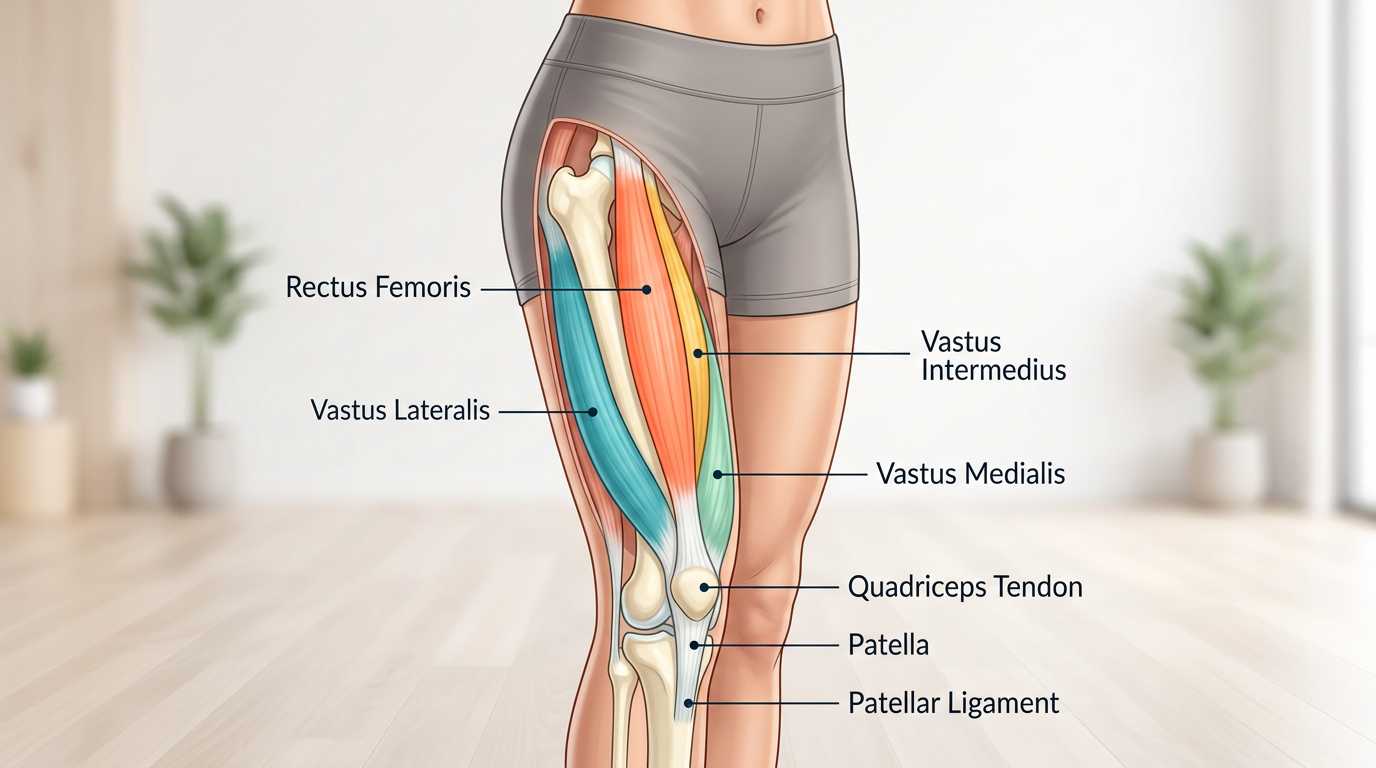
Anatomical diagram showing the four quadriceps muscles (rectus femoris, vastus lateralis, vastus medialis, vastus intermedius) labeled on a female leg with different colors for each muscle
Comparison of Best Quad Exercises for Women
Exercise
Difficulty Level
Equipment Needed
Quad Activation
Best For
Goblet Squat
Beginner
Dumbbell/Kettlebell
High
Learning squat form
Bulgarian Split Squat
Intermediate
Bench, optional weights
Very High
Unilateral strength
Front Squat
Advanced
Barbell
Very High
Maximum quad emphasis
Walking Lunges
Beginner-Intermediate
Optional dumbbells
High
Functional movement
Leg Press
Beginner-Intermediate
Leg press machine
High
High volume training
Step-Ups
Beginner
Box/bench, optional weights
Moderate-High
Home workouts
Sissy Squat
Advanced
None or sissy squat bench
Very High
Quad isolation
Leg Extension
Beginner
Leg extension machine
High (isolation)
Finishing movement
Cyclist Squat
Intermediate
Wedge/plates, optional weights
Very High
Targeting rectus femoris
Reverse Sled Drag
Intermediate-Advanced
Sled and weights
High
Eccentric strength
1. Goblet Squat
The goblet squat is the perfect entry point for women new to quad exercises. By holding a dumbbell or kettlebell at chest height, you naturally maintain an upright torso that emphasizes quad engagement over hip dominance. This front-loaded position also teaches proper squat mechanics that transfer to more advanced movements.
To perform a goblet squat, hold a weight vertically against your chest with both hands cupping the top. Stand with feet shoulder-width apart, toes slightly turned out. Descend by pushing your hips back and bending your knees, keeping your chest proud. Drive through your entire foot to return to standing, squeezing your quads at the top of each repetition.
Start with 3 sets of 10-12 reps, focusing on controlled tempo rather than heavy weight. As you progress, increase the load gradually while maintaining perfect form. The goblet squat builds foundational strength that prepares you for barbell variations.
Pros
- Easy to learn with intuitive weight positioning
- Promotes upright torso and proper squat depth
- Minimal equipment needed for home workouts
- Lower back-friendly compared to back squats
Cons
- Limited by how much weight you can hold at chest
- Upper body fatigue may limit quad training volume
- Less effective for advanced lifters seeking maximum load
2. Bulgarian Split Squat
The Bulgarian split squat delivers unmatched quad activation while addressing muscle imbalances between legs. This single-leg exercise places your rear foot on an elevated surface, forcing your front leg to handle the majority of the load. The result is intense quad recruitment that builds both strength and stability.
Position yourself two to three feet in front of a bench or box, placing your rear foot on the elevated surface. Hold dumbbells at your sides or a barbell across your back. Lower your body until your front thigh reaches parallel to the ground, keeping your torso relatively upright. The front knee should track over your toes without excessive forward travel, creating maximum tension in your quad muscles.
Perform 3-4 sets of 8-12 reps per leg, treating each leg as a separate set. This exercise exposes strength discrepancies quickly, so don't be surprised if one leg feels significantly weaker. Consistency will balance things out over time. Many women find Bulgarian split squats more knee-friendly than bilateral squats because the movement pattern allows natural joint alignment.
Pros
- Exceptional quad activation and muscle growth stimulus
- Identifies and corrects left-right strength imbalances
- Improves balance and single-leg stability
- Versatile with various equipment options
Cons
- Requires balance and coordination to execute properly
- Time-consuming since each leg trains separately
- Finding optimal foot positioning takes practice
- Can be challenging for those with balance issues
3. Front Squat
The front squat is the king of quad-dominant exercises, forcing an upright torso position that shifts emphasis from your hips to your thighs. With the barbell resting across your front deltoids and clavicles, you can't lean forward without losing the bar, making this movement incredibly effective for quad development.
Set up in a squat rack with the barbell at shoulder height. Position the bar across your front delts, either using a clean grip with elbows high or a cross-arm grip. Unrack the bar and step back with feet shoulder-width apart. Descend while keeping your elbows up and chest proud, preventing forward lean. Drive through your midfoot and heels to stand, maintaining that upright position throughout the entire range of motion.
Begin with 3-4 sets of 6-10 reps, using lighter weight than you would for back squats. The front squat is technically demanding, so prioritize form over ego. As your technique solidifies and your core strength improves, you'll be able to progressively overload this movement for serious quad gains. Women often find front squats more comfortable than back squats because the loading pattern reduces lower back stress.
Pros
- Maximum quad emphasis due to upright torso requirement
- Develops core strength and upper back stability
- More knee-friendly than back squats for many lifters
- Transfers well to athletic movements and Olympic lifts
Cons
- Steep learning curve with challenging bar positioning
- Requires good wrist and shoulder mobility
- Can't load as heavily as back squats initially
- Bar pressure on clavicles can be uncomfortable
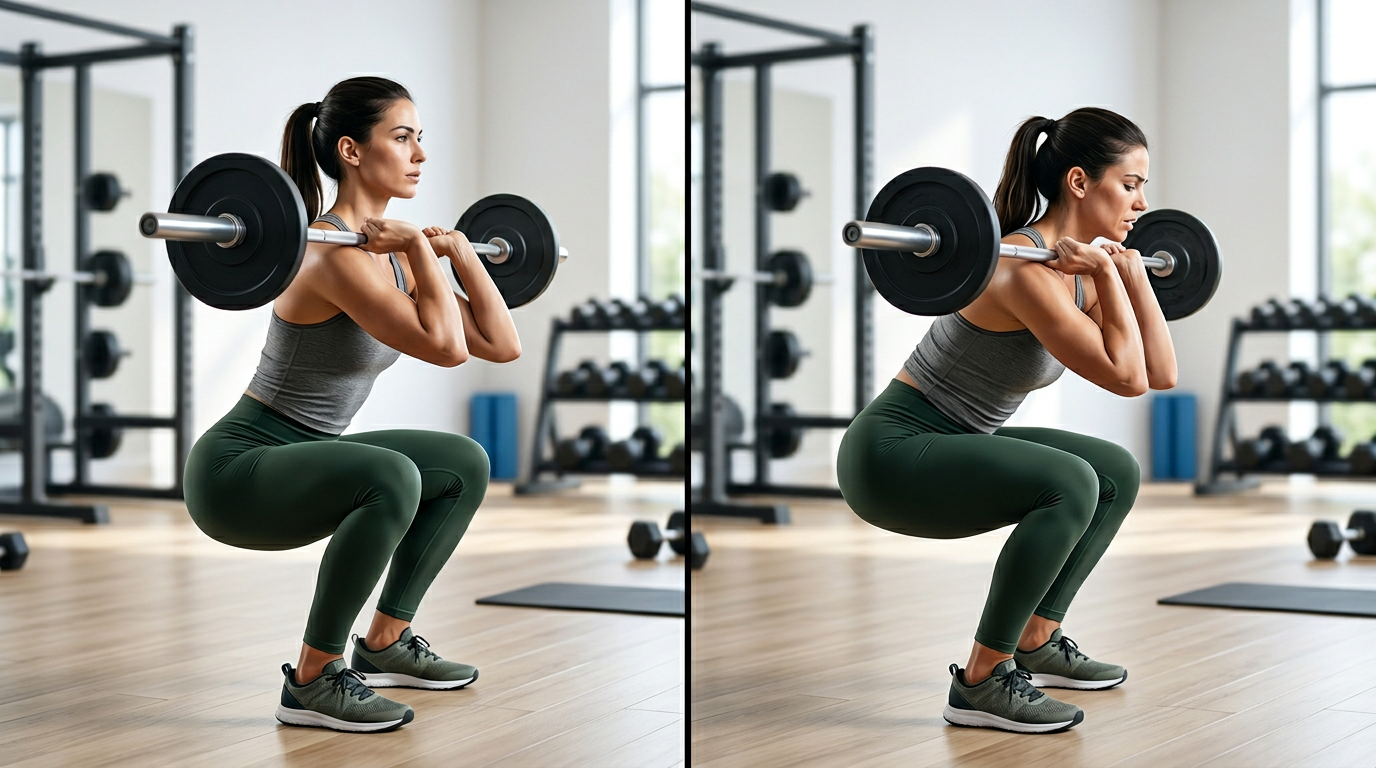
Side-by-side comparison showing proper front squat form versus common mistakes, featuring a woman demonstrating correct upright torso position with high elbows versus incorrect forward lean
4. Walking Lunges
Walking lunges combine quad strength with functional movement patterns that translate directly to real-life activities. Each step forward requires your lead leg's quad to decelerate your body weight and then powerfully extend your knee to propel you forward. This dynamic exercise builds strength through a full range of motion while improving coordination and balance.
Start standing with dumbbells at your sides or a barbell across your back. Step forward with your right leg, lowering your body until both knees form approximately 90-degree angles. Your rear knee should hover just above the ground. Push through your front heel to bring your back leg forward into the next lunge. Maintain an upright torso throughout the movement, avoiding excessive forward lean that shifts work away from your quads.
Perform 3 sets of 10-12 steps per leg, focusing on controlled movement rather than speed. Walking lunges work exceptionally well as a finisher after heavy compound lifts or as a primary movement in home workouts. The continuous tension keeps your quads under load longer than stationary exercises, creating a powerful growth stimulus.
Pros
- Functional movement pattern that improves daily activities
- Continuous tension creates metabolic stress for growth
- Can be performed anywhere with minimal equipment
- Builds single-leg strength and stability simultaneously
Cons
- Requires adequate space for walking forward
- Balance challenges may limit load initially
- Knee discomfort possible if form breaks down
- Difficult to perform in crowded gym environments
5. Leg Press
The leg press machine allows you to load your quads heavily without the stability and technique demands of free weight squats. This makes it valuable for pushing high volume work that stimulates muscle growth, especially when you're fatigued from earlier exercises. By adjusting foot position, you can emphasize different areas of your quads.
Sit in the leg press machine with your back and head firmly against the pad. Place your feet on the platform at shoulder-width, positioned slightly higher than hip level. Release the safety handles and lower the platform by bending your knees, bringing them toward your chest. Press through your entire foot to extend your legs, stopping just short of locking out your knees to maintain constant tension on your quads.
Perform 3-4 sets of 10-15 reps with a controlled tempo, emphasizing the squeeze at the top. The leg press is excellent for higher rep ranges that would be risky with free weights. For maximum quad emphasis, keep your feet higher on the platform and maintain a narrow to moderate stance. Avoid letting your lower back round off the seat pad at the bottom of the movement.
Pros
- Allows heavy loading without balance or stability concerns
- Excellent for high-volume training and muscle building
- Adjustable foot positions target different quad areas
- Reduced lower back stress compared to squats
Cons
- Requires access to leg press machine
- Less functional carryover than free weight exercises
- Easy to use excessive range that stresses lower back
- May encourage poor movement patterns if used exclusively
6. Step-Ups
Step-ups are the ultimate home-friendly quad exercise, requiring nothing more than a sturdy box, bench, or even a staircase. This unilateral movement mimics everyday activities like climbing stairs while building serious single-leg strength. The concentric-focused nature of step-ups makes them less fatiguing on your nervous system than squats, allowing for higher training frequency.
Stand facing a box or bench that's knee-height or slightly lower. Place your entire right foot on the elevated surface, not just your toes. Drive through your right heel to lift your body onto the box, bringing your left foot up to meet your right. Step back down with control, leading with the same leg that stepped up, to maximize quad engagement throughout the entire repetition.
Complete 3 sets of 10-15 reps per leg, holding dumbbells for added resistance as you progress. Focus on using your top leg to do all the work rather than pushing off with your bottom leg. Step-ups are incredibly versatile—adjust box height to modify difficulty, or perform them at a faster tempo for cardiovascular benefits alongside strength gains.
Pros
- Requires minimal equipment, perfect for home workouts
- Natural movement pattern with excellent functional carryover
- Less fatiguing than bilateral squats, allowing frequent training
- Easy to scale difficulty by adjusting box height
Cons
- Temptation to cheat by pushing off bottom leg
- Finding appropriate box height can be challenging
- Less overall load than bilateral movements
- May feel awkward initially for those with balance issues
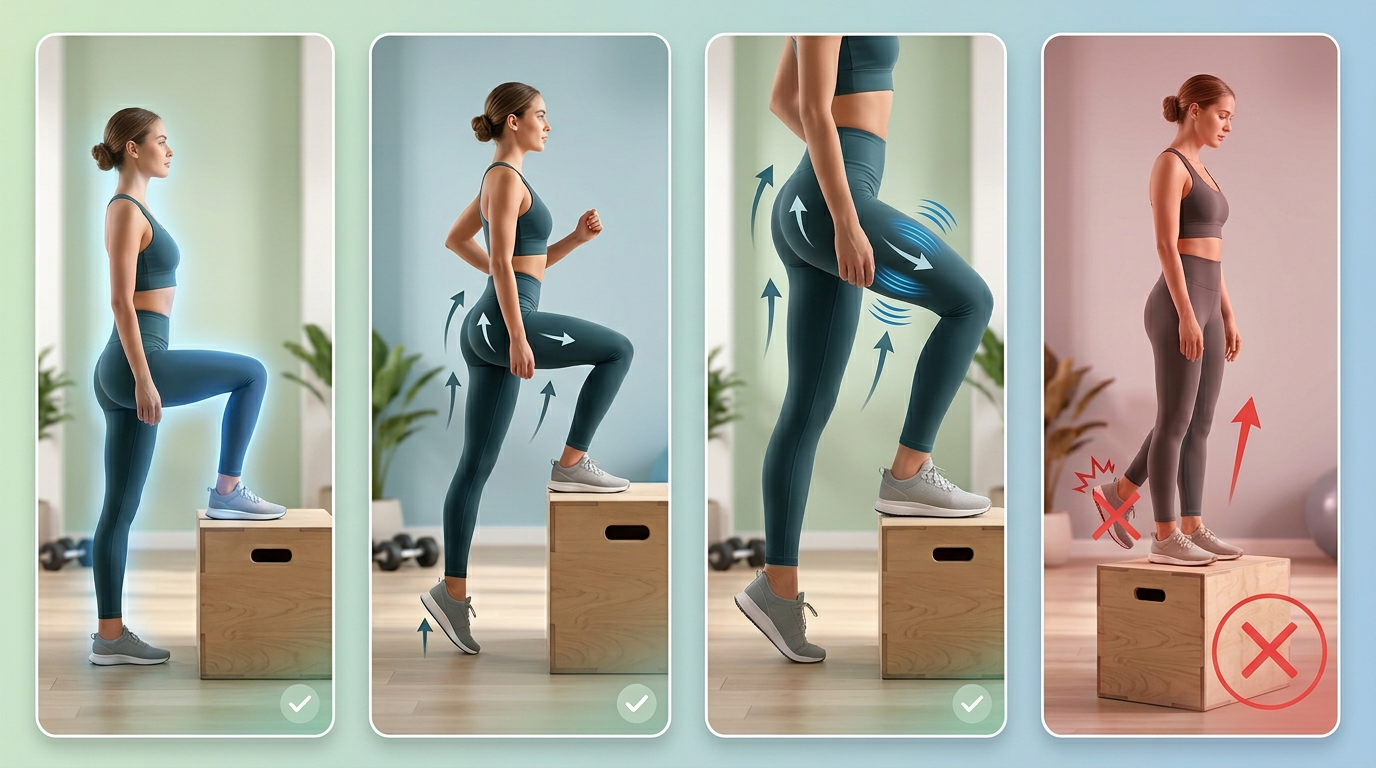
Demonstration sequence showing proper step-up technique with a woman performing the exercise on a box, highlighting the working leg doing all the lifting versus the common mistake of pushing off with the bottom leg
7. Sissy Squat
The sissy squat is an advanced bodyweight movement that isolates your quads like few other exercises can. Despite the name, there's nothing easy about this exercise—it creates intense tension throughout your quads by positioning your torso and shins at extreme angles. This old-school bodybuilding exercise has regained popularity for good reason: it works.
Stand with feet hip-width apart, holding onto a stable surface for balance. Rise onto your toes while simultaneously leaning your torso backward and bending your knees forward. Lower your body by allowing your knees to travel far forward while keeping your hips extended and torso in line with your thighs. Descend until you feel maximum stretch in your quads, then contract them forcefully to return to the starting position.
Begin with 2-3 sets of 6-10 reps, using assistance for balance as needed. The sissy squat is incredibly demanding on your knee joint, so build up gradually and avoid this exercise if you have existing knee issues. As you advance, you can add weight by holding a plate against your chest or wear a weighted vest. This movement is best reserved for the end of your workout as a finishing exercise.
Pros
- Exceptional quad isolation with minimal equipment
- Unique angle creates novel stimulus for muscle growth
- Builds quad strength through extreme range of motion
- Can be performed almost anywhere with balance support
Cons
- Very challenging on knee joints, not suitable for everyone
- Requires significant quad strength to perform properly
- Steep learning curve with balance and coordination
- Limited loading options compared to other exercises
8. Leg Extension
The leg extension machine provides pure quad isolation that's impossible to achieve with compound movements. While it shouldn't form the foundation of your quad training, it serves as an excellent finishing exercise that pumps maximum blood into your quads. The constant tension throughout the range of motion creates metabolic stress that contributes to muscle growth.
Sit in the leg extension machine with your back against the pad and the roller positioned just above your ankles. Adjust the seat so your knees align with the machine's pivot point. Extend your legs by contracting your quads, lifting the weight until your legs are straight. Squeeze your quads hard at the top for a one-second count, then lower with control to maintain tension throughout the set.
Perform 3-4 sets of 12-20 reps at the end of your leg workout. The leg extension is ideal for higher rep ranges that would be impractical with squats or lunges. Focus on the mind-muscle connection rather than ego-lifting heavy weight. This exercise particularly targets the vastus medialis, helping develop that teardrop shape above your knee.
Pros
- Complete quad isolation without fatigue from other muscles
- Easy to learn with simple movement pattern
- Excellent for high-rep pump sets and drop sets
- Allows training through fatigue safely
Cons
- Requires leg extension machine access
- Non-functional movement pattern with limited carryover
- Can stress knee joint if performed with excessive weight
- Should supplement, not replace, compound movements
9. Cyclist Squat
The cyclist squat, also called the heel-elevated squat, places your quads under maximum tension by shifting your center of gravity forward. By elevating your heels on weight plates or a wedge, you increase ankle dorsiflexion and allow your knees to travel further forward. This biomechanical change transforms a regular squat into a quad-dominant powerhouse.
Place your heels on weight plates or a squat wedge, with the balls of your feet on the ground. Hold dumbbells at your sides or a barbell across your back. Descend into a squat while allowing your knees to travel forward over your toes more than usual. Maintain an upright torso throughout the movement, feeling the intense stretch and tension in your quads as you reach the bottom position.
Start with 3 sets of 8-12 reps, using moderate weight as you adapt to the new movement pattern. The cyclist squat earned its name because competitive cyclists use it to build the massive quads needed for explosive power. This variation is particularly effective for women who struggle to feel their quads working during regular squats, as the heel elevation makes quad engagement undeniable.
Pros
- Maximizes quad activation by shifting center of gravity forward
- Reduces mobility requirements for deep squatting
- Allows upright torso even with limited ankle flexibility
- Creates unique growth stimulus for stubborn quads
Cons
- Increased knee stress due to greater forward travel
- Requires heel elevation equipment or improvisation
- May feel unstable initially until you adapt
- Not ideal for those with existing knee problems
10. Reverse Sled Drag
The reverse sled drag is a game-changing exercise that builds quad strength and size while being remarkably joint-friendly. Walking backward while pulling a weighted sled creates constant tension on your quads throughout the movement, with an emphasis on the eccentric phase that's crucial for muscle growth. This low-impact exercise allows for high training volume without the joint stress of traditional exercises.
Load a sled with an appropriate weight and attach straps or handles. Hold the straps at chest height or by your sides, then walk backward with controlled steps. Keep your torso upright and take deliberate steps, allowing each leg to fully extend before planting the opposite foot. The continuous backward motion keeps your quads under constant tension, creating a unique training stimulus that promotes both strength and hypertrophy.
Perform 3-5 sets of 30-60 seconds or 20-40 yards, adjusting weight based on your strength level. The reverse sled drag is exceptional for active recovery between heavy training sessions because it floods your quads with blood without creating significant muscle damage. Many women find this exercise easier on their knees than squats or lunges, making it valuable for those managing joint issues while still building impressive quad strength.
Pros
- Extremely joint-friendly despite high training volume
- Constant tension throughout movement maximizes time under tension
- Excellent for conditioning alongside strength development
- Can be performed frequently without excessive fatigue
Cons
- Requires access to sled and appropriate training space
- Not available in most home gym setups
- Difficult to progressively overload precisely
- Weather-dependent if training outdoors
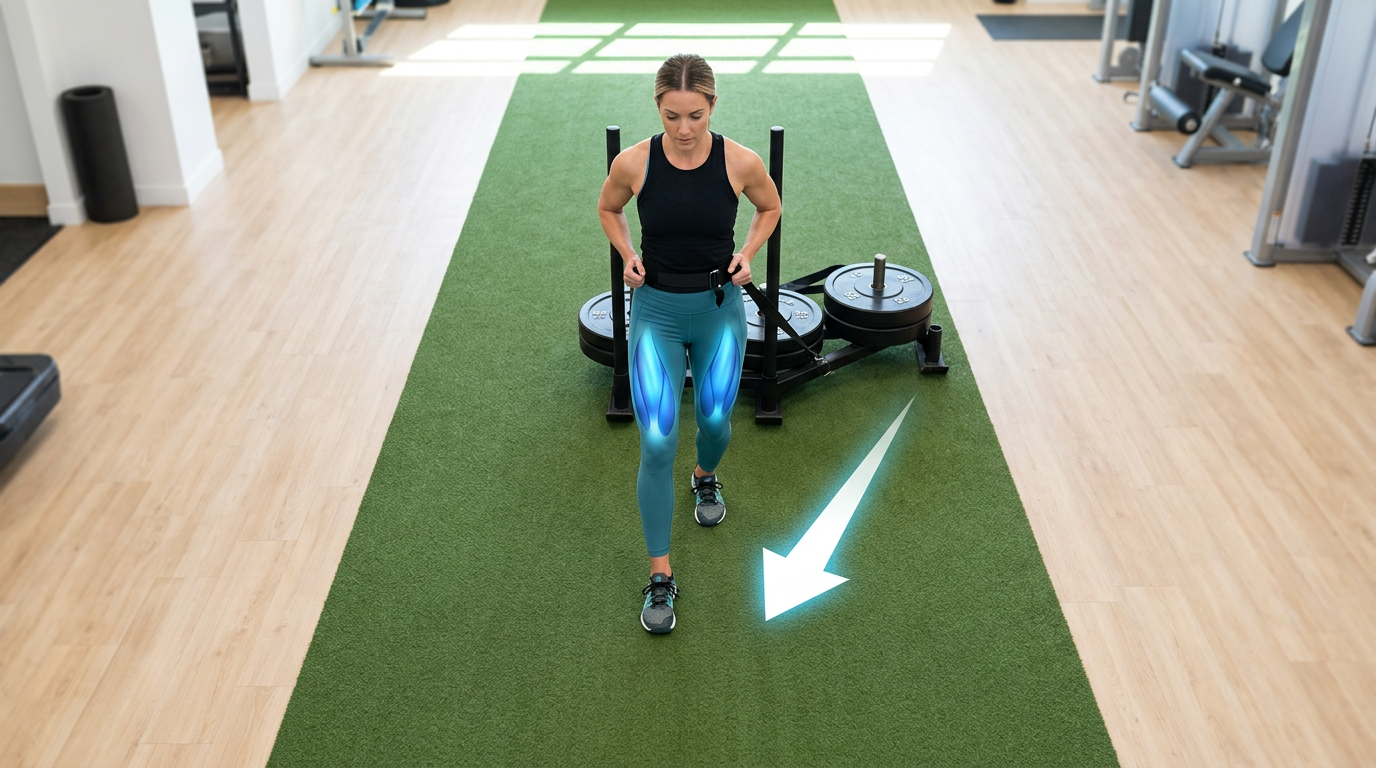
Overhead view showing proper reverse sled drag technique with a woman walking backward while pulling a loaded sled, with arrows indicating direction of movement and muscle engagement in the quadriceps
How to Structure Your Quad Training
Building strong, defined quads requires more than just knowing the best exercises—you need a strategic approach to training frequency, volume, and progression. Your quads are large, resilient muscles that respond well to frequent training, but they also need adequate recovery to grow.
Training Frequency and Volume
Train your quads directly 2-3 times per week for optimal results. This frequency allows you to accumulate sufficient training volume while providing recovery time between sessions. A typical week might include one heavy compound day, one moderate volume day, and one lighter technique-focused or high-rep day.
Aim for 10-20 total sets per week targeting your quads, spread across your training sessions. Beginners should start at the lower end of this range, while advanced lifters may benefit from higher volumes. Quality always trumps quantity—ten perfect sets will outperform twenty sloppy sets every time.
Progressive Overload Strategies
Progressive overload is the key to continued quad development. This doesn't always mean adding weight to the bar. You can progress by increasing reps, adding sets, improving tempo control, reducing rest periods, or enhancing range of motion. Track your workouts to ensure you're progressing in at least one variable every few weeks.
For compound movements like squats, aim to add 5-10 pounds every 2-4 weeks. For isolation exercises like leg extensions, focus on increasing reps or improving the mind-muscle connection before adding weight. Small, consistent improvements compound into dramatic transformations over months and years.
Sample Quad-Focused Workout
Here's an effective quad-focused workout you can implement immediately:
- Goblet Squat (warm-up): 2 sets x 12 reps
- Front Squat or Cyclist Squat: 4 sets x 6-8 reps
- Bulgarian Split Squat: 3 sets x 10 reps per leg
- Walking Lunges: 3 sets x 12 steps per leg
- Leg Extension: 3 sets x 15-20 reps
This workout progresses from heavy compound movements to lighter isolation work, maximizing quad stimulation while managing fatigue. Adjust exercise selection based on your available equipment and experience level.
Training Quads with Knee Concerns
Knee discomfort doesn't mean you can't build strong quads—it means you need to train smarter. Many women experience knee issues that require exercise modifications, but with the right approach, you can still achieve impressive quad development while protecting your joints.
Exercise Modifications for Knee Health
If traditional squats bother your knees, try box squats where you sit back onto a box at parallel depth. This reduces shearing forces on your knee joint while still building quad strength. The reverse sled drag is another excellent option that loads your quads without the impact of traditional exercises.
Step-ups and split squats often feel better than bilateral squats for women with knee concerns because they allow more natural joint alignment. Experiment with foot position and stance width to find what feels comfortable. Pain is a signal, not a challenge to overcome—if an exercise consistently causes sharp knee pain, choose a different movement.
The Importance of Quad Strength for Knee Health
Weak quads actually contribute to knee problems by failing to stabilize the joint properly. The vastus medialis in particular plays a crucial role in tracking your kneecap correctly during movement. By strengthening your quads through appropriate exercises, you create a protective effect that can reduce knee pain over time.
Terminal knee extensions, where you extend your knee the final 15-20 degrees against resistance, specifically target the vastus medialis. Perform these with a resistance band for 2-3 sets of 15-20 reps to build stability around your knee joint. Combine this with the exercises listed above for comprehensive quad development that supports long-term knee health.
Which Quad Exercise Is Best For You?
The ideal quad exercise depends on your training experience, available equipment, and specific goals. Here's how to match exercises to your situation:
For Complete Beginners
Start with goblet squats and step-ups to build foundational strength and movement patterns. These exercises teach proper mechanics while building confidence. Add walking lunges once you're comfortable with basic movements. Focus on mastering technique with lighter weights before progressing to more complex exercises.
For Home Workouts
Prioritize goblet squats, Bulgarian split squats, step-ups, and walking lunges—all highly effective with minimal equipment. A single dumbbell or kettlebell provides enough resistance for months of progress. Sissy squats offer an advanced bodyweight option when you're ready for a serious challenge.
For Maximum Quad Growth
Front squats, Bulgarian split squats, and cyclist squats deliver the most dramatic quad development. Combine these compound movements with leg extensions as a finishing exercise. Train in the 6-12 rep range for primary exercises and 12-20 reps for isolation work.
For Those with Knee Issues
Reverse sled drags, box squats, and step-ups with controlled tempo provide quad stimulation while minimizing knee stress. Avoid sissy squats and deep cyclist squats until your knee health improves. Focus on building the vastus medialis through terminal knee extensions to improve knee stability.
For Athletes and Functional Strength
Walking lunges, Bulgarian split squats, and front squats build quad strength that transfers directly to athletic performance. These exercises develop single-leg stability and power that improves running, jumping, and change-of-direction movements. Include reverse sled drags for conditioning that doesn't interfere with skill training.
Frequently Asked Questions
What is the best exercise for the quads?
Front squats are the most effective quad exercise because they force an upright torso position that maximizes quad engagement. Bulgarian split squats are a close second, providing exceptional single-leg quad activation while addressing muscle imbalances. Both exercises allow progressive overload for continued strength gains.
How to hit all four heads of quads?
Target all four quad muscles by varying your exercises, foot positions, and knee angles. Include squats for overall development, cyclist squats for rectus femoris emphasis, and leg extensions with toes pointed out for vastus medialis. Use narrow and wide stances across different exercises to ensure complete quad development.
How to build quads with bad knees?
Build quads safely with knee issues by using reverse sled drags, box squats to parallel depth, and controlled step-ups. These exercises load your quads effectively while minimizing knee joint stress. Strengthen your vastus medialis through terminal knee extensions to improve knee stability and reduce pain over time.
Can weak quads cause weak knees?
Yes, weak quads directly contribute to knee instability and pain. Your quadriceps muscles, especially the vastus medialis, stabilize your kneecap and control knee joint movement. Strengthening your quads through appropriate exercises creates a protective effect that reduces injury risk and alleviates existing knee discomfort.
How often should women train quads per week?
Train quads 2-3 times weekly for optimal strength and muscle development. This frequency allows sufficient training volume while providing adequate recovery between sessions. Structure your week with one heavy day, one moderate volume day, and optionally one lighter high-rep or technique-focused day.
Should women do different quad exercises than men?
No, women and men benefit from the same quad exercises. The biomechanics of muscle contraction don't differ by gender. Women may need to focus more on quad strength relative to hamstrings due to hormonal factors affecting injury risk, but the exercise selection remains identical for both sexes.
What rep range builds quads fastest?
Build quads effectively using multiple rep ranges throughout your training. Perform compound exercises like squats for 6-12 reps with heavier weight, then finish with isolation movements for 12-20 reps. This combination maximizes both mechanical tension and metabolic stress for comprehensive quad development.
Conclusion
Building strong, defined quads transforms not just your physique but your entire functional capacity. The best quad exercises for women include front squats, Bulgarian split squats, goblet squats, walking lunges, and leg press—each offering unique benefits for different training situations. By incorporating exercise variety, training 2-3 times weekly with progressive overload, and choosing movements appropriate for your experience level and any knee concerns, you'll develop powerful quads that support every aspect of your active life.
Remember that consistency and proper form outweigh any single exercise choice. Start with movements that match your current fitness level, focus on quality repetitions, and gradually increase the challenge as your strength improves. Your quads are incredibly responsive to training, and the results you'll see from dedicated quad work will motivate you to keep pushing forward.
Implement these quad exercises into your training routine and track your progress over the coming weeks and months.