Progressive Overload for Women: Build Strength Without Burnout
Progressive overload is a strength training principle where you gradually increase workout demands through weight, reps, sets, or intensity to continuously challenge muscles. This systematic approach builds strength sustainably by adding small increments weekly, preventing plateaus while minimizing injury risk for lasting fitness results.
If you've been showing up consistently for months and your body looks exactly the same, I can almost guarantee what's missing — and it's not another new workout program. It's progressive overload: the principle that separates training that changes your body from training that just maintains it. I'm Shelley — Cert IV Personal Trainer and Nutritionist — and after years of coaching women through Strong Curves, this is the one concept I find myself explaining more than any other.
Progressive overload is the science-backed method that transforms your body by continuously challenging your muscles to adapt. Without it, your workouts become maintenance sessions rather than growth opportunities. The good news? You don't need to exhaust yourself or risk injury to apply this principle effectively.
This guide covers the complete system: seven ways to progress, the training protocols that structure them, how to avoid burnout, and how to track it all so your results are never guesswork. And because so many of you train in your living room rather than a gym, there's a dedicated section on progressing at home with limited dumbbells — including the video where I walk through exactly that.
Key Takeaways
- Progressive overload requires systematic increases in training demands through weight, reps, sets, or intensity rather than random workout changes
- Women can safely add 1–2.5 kg (2.5–5 lb) to lower body exercises and 0.5–1 kg (1–2.5 lb) to upper body movements as they adapt, without risking burnout
- Multiple progression methods exist beyond adding weight, including increasing reps, sets, training frequency, or decreasing rest periods
- Proper recovery, adequate protein intake, and deload weeks are essential components of sustainable progressive overload
- Tracking your workouts allows you to measure progress objectively and make informed decisions about when and how to progress
Understanding Progressive Overload: The Foundation of Strength Training
Progressive overload is the deliberate and systematic increase of stress placed on your body during exercise to drive continuous adaptation and improvement. When you challenge your muscles beyond their current capacity, they respond by growing stronger, building endurance, and increasing in size. This adaptation process is your body's survival mechanism, preparing itself to handle similar stress more efficiently in the future.
The principle applies to all forms of resistance training, from bodyweight exercises to heavy barbell lifts. Without progressive overload, your body has no reason to change. Once your muscles adapt to a specific workout stimulus, they maintain that level of strength but won't develop further unless you provide a new challenge.
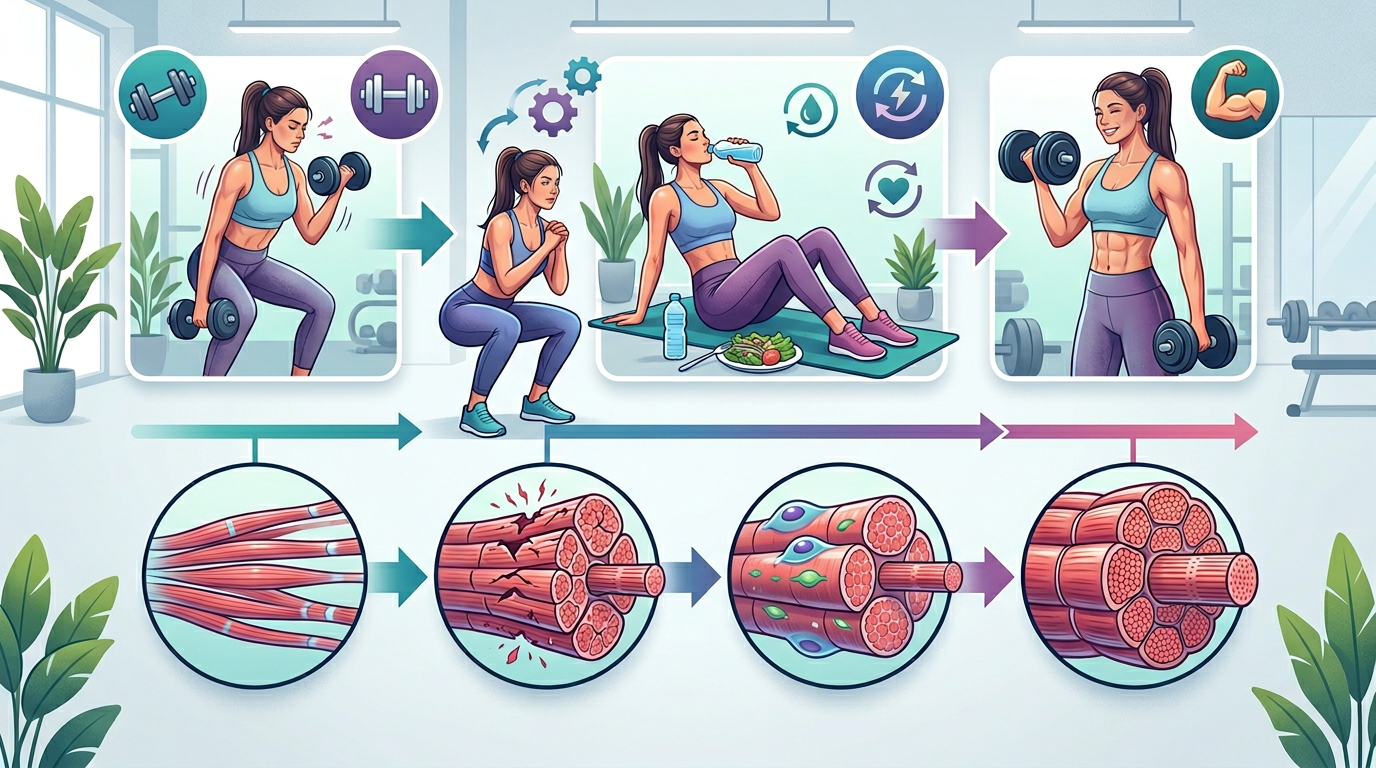
Infographic showing the progressive overload cycle: stress, adaptation, and growth with visual representation of muscle fibers strengthening over time
Why Progressive Overload Matters for Women
Many women hesitate to push their training intensity, worried about bulking up or getting injured. This cautious approach often leads to stagnant results. The reality is that women have significantly lower testosterone levels than men, making it physiologically difficult to build excessive muscle mass without deliberate, intense effort over years.
What progressive overload actually delivers for women is increased bone density, improved metabolic rate, enhanced functional strength for daily life — and yes, the "toned" look so many women tell me they're after. Here's the reframe: "toned" is simply muscle you've built, carried on a body strong enough to keep it. Deliberately getting stronger is exactly how you get it. Research shows women respond exceptionally well to progressive resistance training, often seeing faster relative strength gains than men when they start.
The Science Behind Muscle Adaptation
When you perform resistance exercise, you create microscopic tears in muscle fibers. During recovery, your body repairs these tears and adds extra protein structures, making the muscle slightly stronger and sometimes larger. This process, called muscle protein synthesis, requires adequate nutrition, rest, and progressive stimulus.
Your nervous system also adapts through progressive overload. Initially, strength gains come primarily from improved neuromuscular efficiency, your brain learning to recruit more muscle fibers simultaneously. After several weeks, structural changes in muscle tissue become the primary driver of continued strength development.
Seven Methods to Progressive Overload Your Workouts
Progressive overload isn't limited to adding weight to the bar. Multiple progression strategies exist, each offering unique benefits and applications. Understanding these methods allows you to continue progressing even when one approach reaches its practical limit.
1. Increase Weight (Load Progression)
Adding resistance is the most straightforward progressive overload method and typically the most effective for building strength. Once you can complete your target reps with good form, add a small amount of weight to the exercise. For lower body movements like squats and deadlifts, increase by 1–2.5 kg (2.5–5 lb). For upper body exercises like presses and rows, add 0.5–1 kg (1–2.5 lb).
Fractional weight plates or micro-increments (0.25–0.5 kg) make smaller jumps possible on upper body exercises. These micro-loads prevent the frustrating scenario where the next weight up feels too heavy but your current weight feels too easy.
2. Increase Repetitions (Volume Progression)
When adding weight isn't feasible, increasing reps provides an effective alternative. If you performed 3 sets of 8 reps last week, aim for 3 sets of 9 or 10 reps this week with the same weight. Once you reach the top of your rep range (typically 12-15 reps), increase the weight and drop back to the lower rep range. And this isn't a consolation prize: a 2022 randomised controlled trial found that lifters who progressed by adding reps built just as much muscle as lifters who progressed by adding load (Plotkin et al., 2022: https://pmc.ncbi.nlm.nih.gov/articles/PMC9528903/). Your muscles count effort, not kilos.
This approach works particularly well for best upper glute exercises and other isolation movements where adding weight in small increments proves challenging.
3. Increase Sets (Volume Progression)
Adding an extra set to your exercises increases total training volume. If you're performing 3 sets of an exercise, progress to 4 sets while maintaining the same weight and reps. This method increases overall muscle stimulus without requiring heavier loads.
Be cautious with this approach as it extends workout duration and increases fatigue. It works best when you have adequate recovery capacity and aren't already performing high-volume training.
4. Increase Training Frequency
Training a muscle group more frequently throughout the week can drive additional adaptation. If you currently train legs once weekly, increasing to twice weekly provides more growth stimulus. Research suggests training each muscle group 2-3 times per week optimizes strength and hypertrophy for most women.
When increasing frequency, reduce volume per session initially to manage total weekly stress. Two moderate sessions often produce better results than one exhausting workout.
5. Decrease Rest Periods
Reducing rest time between sets increases workout density and metabolic demand. If you currently rest 90 seconds between sets, try reducing to 60-75 seconds. This approach challenges your cardiovascular system and muscular endurance while maintaining the same weight and reps.
This method works best for hypertrophy goals but may compromise performance on heavy strength-focused lifts that require longer recovery between sets.
6. Improve Exercise Technique and Range of Motion
Performing exercises through a fuller range of motion or with stricter form increases difficulty without changing external variables. For example, progressing from partial squats to full-depth squats, or slowing down the eccentric (lowering) portion of each rep creates additional muscle tension.
This often-overlooked method builds better movement patterns while increasing training stimulus. It's particularly valuable when recovering from injury or working around limitations.
7. Increase Time Under Tension
Slowing down your rep tempo extends how long muscles work during each set. A 3-second lowering phase followed by a 1-second pause and 1-second lift creates significantly more muscle stimulus than rushing through reps. This approach enhances mind-muscle connection and control.
Time under tension works exceptionally well for exercises like inner thigh workout movements where maintaining tension throughout the range of motion maximizes effectiveness.
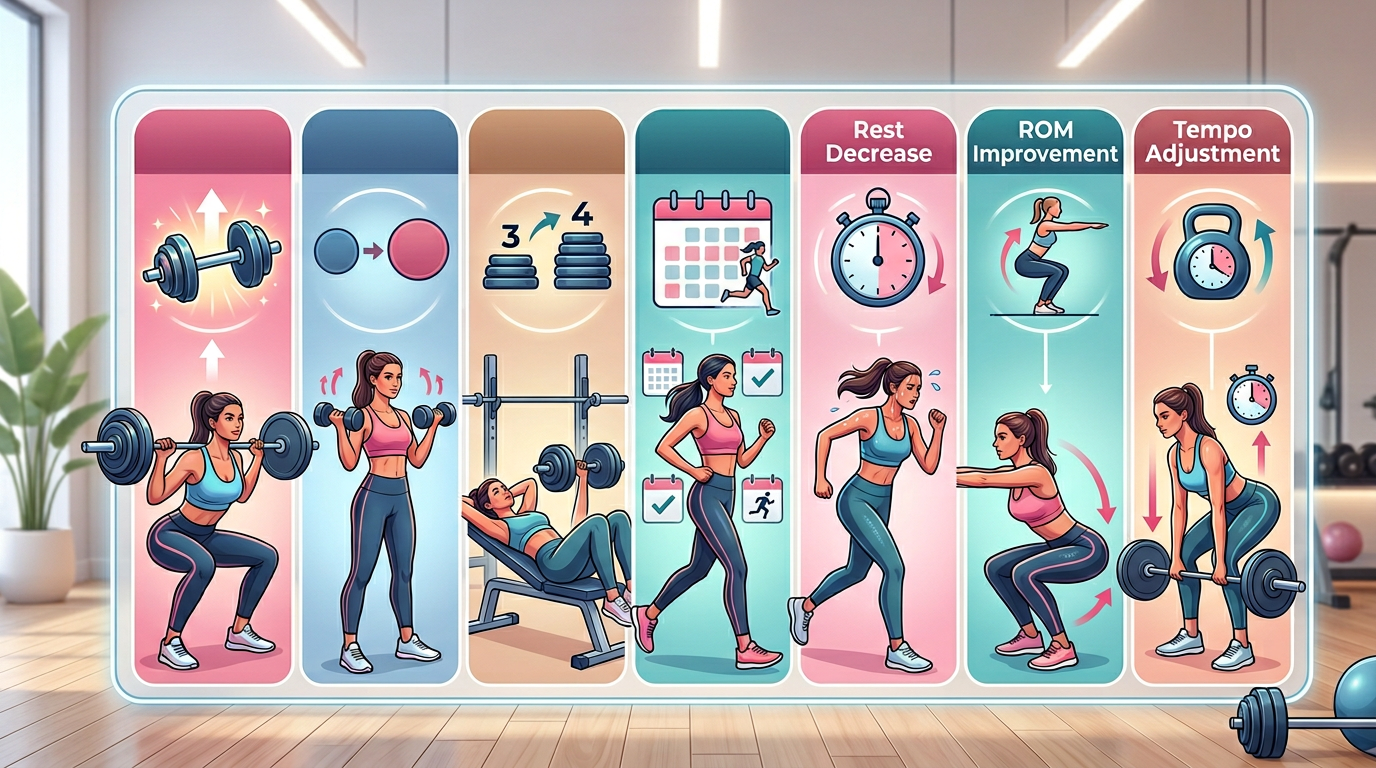
Visual chart comparing the seven progressive overload methods with icons showing weight increase, rep increase, set increase, frequency increase, rest decrease, range of motion improvement, and tempo adjustment
Progressive Overload at Home with Limited Dumbbells
This is the question I get more than any other: "My dumbbells only go up to 10 kilos — do I just keep going?" Here's the maths nobody talks about. In a gym, a barbell lets you progress in jumps of 2.5% or less. At home, going from an 8 kg dumbbell to a 10 kg dumbbell is a twenty-five percent jump. If you've stalled training at home, that's almost certainly why — the increments are working against you, not your body.
The fix is to use the other levers from this guide to bridge the jump: push your reps to the top of your range, add a set, slow your tempo, add pauses and pulses, or pair exercises back to back with no rest. Work through those progressions at your current weight, and by the time you pick up the next dumbbell, it meets you at the bottom of your rep range — 8 reps, even 6 — instead of an impossible leap to 12s. That's also the honest sign it's time to buy the next weight up: when the top of your range, at a slow tempo, with pauses, still isn't close to failure, that dumbbell has become your warm-up.
I filmed a complete video on exactly this — the full no-gym system for women 35+, with every technique demonstrated:
How to Progressive Overload Safely Without Burnout
Applying progressive overload effectively requires strategic planning and self-awareness. Pushing too hard too fast leads to burnout, injury, or both. These guidelines help you progress sustainably while respecting your body's recovery capacity.
The 10% Rule for Gradual Progression
Increase training volume or intensity by no more than 10% per week to minimize injury risk while maintaining consistent progress. If you performed 100 total reps last week, aim for approximately 110 reps this week. This conservative approach allows connective tissues, which adapt more slowly than muscles, to strengthen gradually.
The 10% rule applies to total weekly volume rather than individual sessions. You might increase one workout significantly while keeping others the same, as long as the weekly total stays within the 10% guideline.
Implement Deload Weeks
Every 4-6 weeks of progressive training, schedule a deload week where you reduce training volume or intensity by 40-50%. This strategic recovery period allows accumulated fatigue to dissipate while maintaining your training stimulus. Deloads prevent overtraining and often lead to strength gains as your body fully recovers and adapts to previous training stress.
During deload weeks, maintain your regular workout schedule but use lighter weights, perform fewer sets, or reduce training frequency. The goal is active recovery, not complete rest.
Listen to Your Body's Warning Signs
Progressive overload requires pushing yourself, but not to the point of injury or exhaustion. Warning signs that you're progressing too aggressively include persistent muscle soreness lasting beyond 72 hours, decreased performance despite adequate rest, disrupted sleep patterns, increased resting heart rate, mood changes, or loss of motivation.
If you experience these symptoms, take an extra rest day, reduce training intensity, or implement an early deload week. Sustainable progress means occasionally taking one step back to take two steps forward.
Prioritize Recovery and Nutrition
Progressive overload creates the stimulus for adaptation, but growth happens during recovery. Ensure you're getting 7-9 hours of quality sleep nightly, consuming adequate protein (1.6–2.2 g per kg of body weight), and eating enough total calories to support training demands.
Undereating while attempting progressive overload creates a recipe for burnout. Your body needs fuel to build strength and recover from increasingly challenging workouts. Moderate calorie surpluses support muscle growth, while maintenance calories can still drive strength gains, especially for newer lifters.

Illustration showing the recovery triangle with three equal sides labeled sleep, nutrition, and rest days, demonstrating that all three components are equally important for progressive overload success
Progressive Overload Training Protocols for Women
Several established training protocols incorporate progressive overload principles with specific structures. Understanding these frameworks helps you design effective programs or recognize quality training plans.
Double Progression — The Strong Curves Default
Double progression is the system I teach in every Strong Curves program, and it's the one I recommend you run first. Pick a rep range for each exercise — say 8 to 12. Your only job each session is to beat one number from last time: last week's 8, 8, 7 becomes this week's 8, 8, 8. When you can hit the top of your range with good form across all sets, move up to the next weight and drop back to the bottom of the range. Two variables — reps first, then load — hence "double" progression. It works in any gym, and it's especially powerful at home, where the jump between dumbbells is too big to progress on load alone.
The 2-for-2 Rule
The 2-for-2 rule is the green-light check inside double progression: when you can hit the top of your rep range across all sets, with good form, for 2 consecutive workouts, increase the weight by the smallest possible increment and return to the bottom of your range. For example, working in an 8–12 range: complete 12, 12, 12 for two straight sessions, then move up to the next weight and restart at 8s.
This conservative approach ensures you've truly adapted to the current load before progressing, reducing injury risk while maintaining steady advancement.
The 5-3-1 Method
The 5-3-1 rule is a periodized strength training program that cycles through different rep ranges over a four-week period. Week one focuses on 5 reps, week two on 3 reps, week three on 1 rep (or a heavy set of 5), and week four is a deload. Each cycle, you increase your training maxes by small increments, typically 2.5 kg (5 lb) for lower body and 1 kg (2.5 lb) for upper body.
This protocol works exceptionally well for compound movements like squats, deadlifts, and presses. The varied rep ranges develop different strength qualities while the built-in deload prevents burnout. It's best suited to barbell training in a gym, where small plates make those increments possible — if you're at home with dumbbells, run double progression instead.
The 6-12-25 Protocol
The 6-12-25 rule structures workouts around three distinct rep ranges targeting different adaptations. Perform 6 reps of a heavy compound movement for strength, 12 reps of a moderate weight exercise for hypertrophy, and 25 reps of a lighter isolation exercise for muscular endurance and metabolic stress.
This approach provides comprehensive muscle development by hitting multiple rep ranges in a single session. It works particularly well for lower body training, combining heavy squats (6 reps), moderate lunges (12 reps), and high-rep glute bridges (25 reps) for complete leg development.
Linear Periodization for Beginners
Linear periodization involves progressively increasing weight while decreasing reps over several weeks. You might start with 3 sets of 12 reps, progress to 3 sets of 10 reps with more weight, then 3 sets of 8 reps with even more weight. After completing the cycle, you reset to higher reps with a weight heavier than your original starting point.
This straightforward approach works exceptionally well for beginners who can make consistent progress session to session. It provides clear progression targets and builds confidence as you lift increasingly heavier weights.
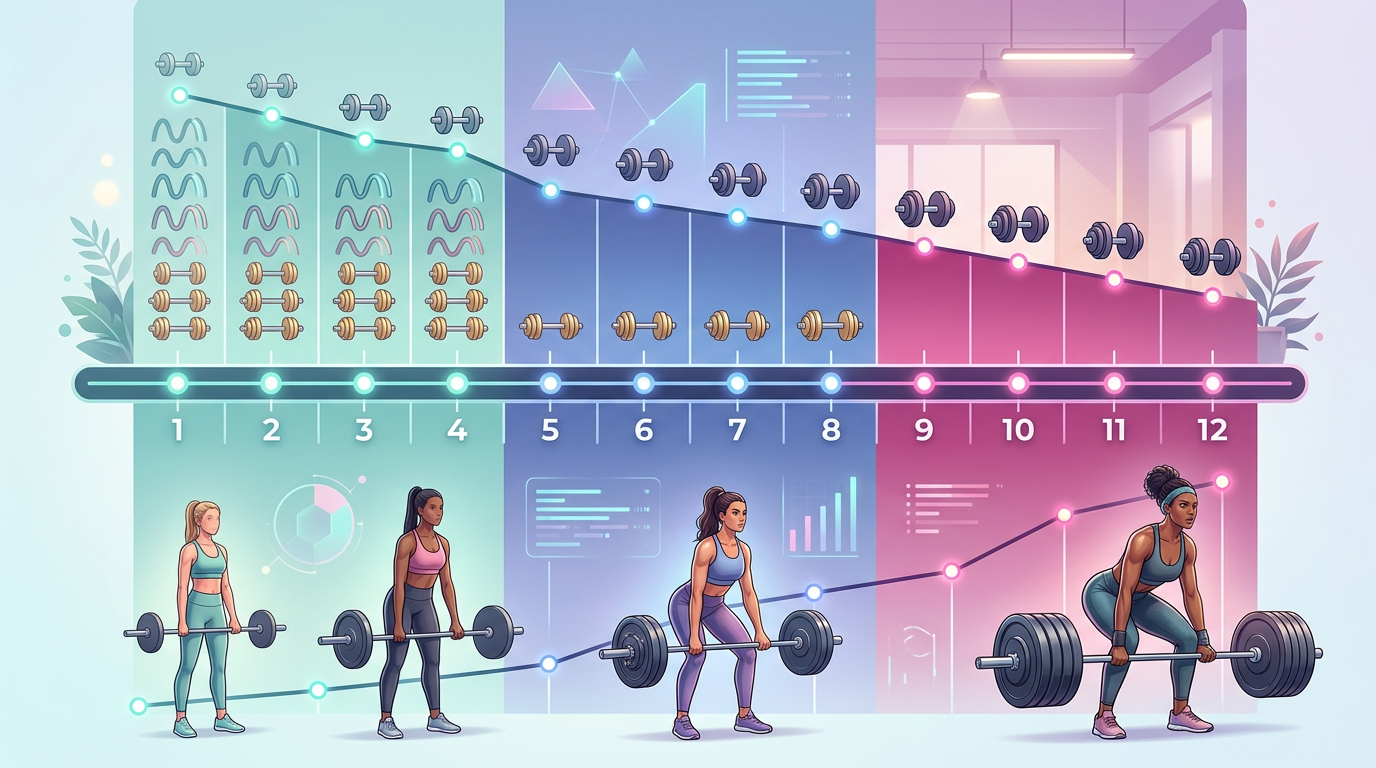
Timeline graphic showing a 12-week linear periodization program with weight increases and rep decreases marked at each phase, demonstrating how both variables change over time
Tracking Your Progressive Overload Journey
You cannot manage what you don't measure. Tracking workouts transforms progressive overload from guesswork into a systematic process. Without records, you're relying on memory to remember last week's weights and reps, a notoriously unreliable method.
What to Track in Your Workout Log
Record these essential data points for each exercise:
- Exercise name: Be specific (goblet squat vs. back squat)
- Weight used: Include the bar weight if using a barbell
- Sets and reps completed: Note if you failed to complete target reps
- Rest periods: Especially important if using rest manipulation for progression
- Rate of perceived exertion (RPE): Scale of 1-10 indicating how difficult the set felt
- Notes: Form issues, energy levels, or anything affecting performance
This information creates a complete picture of your training, allowing you to identify patterns and make informed progression decisions.
Digital vs. Paper Tracking
Both methods work effectively. Digital apps offer convenience, automatic calculations, and progress graphs. Popular options include Strong, FitNotes, and the Strong Curves app designed specifically for women's training programs. Paper notebooks provide a distraction-free option and work well if you prefer writing by hand.
Choose whichever method you'll actually use consistently. The best tracking system is the one you maintain long-term.
Reviewing Progress and Adjusting Your Plan
Review your training log weekly to assess progress and plan the next week's workouts. Look for exercises where you've stalled for multiple sessions, indicating you may need to change your progression strategy or take additional recovery. Celebrate exercises where you're progressing consistently, as these validate your current approach.
Monthly reviews provide a broader perspective on your training trajectory. Compare your current performance to 4-8 weeks prior to appreciate meaningful progress that daily tracking might obscure.
Common Progressive Overload Mistakes to Avoid
Even with good intentions, many women fall into predictable traps when implementing progressive overload. Recognizing these mistakes helps you avoid setbacks and maintain steady progress.
Progressing Too Quickly
The most common mistake is adding too much weight too soon, compromising form and increasing injury risk. Ego lifting, where you prioritize heavier weights over proper technique, delivers short-term satisfaction but long-term problems. Connective tissues adapt more slowly than muscles, so aggressive progression can lead to tendonitis, joint pain, or acute injuries.
If you must sacrifice form to complete a rep, the weight is too heavy. Drop back to a load you can control through the full range of motion with proper technique.
Only Using One Progression Method
Relying exclusively on adding weight eventually leads to plateaus. Some exercises have practical weight limits based on available equipment or your strength level. When you can't add more weight, switch to increasing reps, sets, or frequency to continue progressing.
Varying progression methods also prevents accommodation, where your body becomes so adapted to a specific stimulus that it no longer responds optimally.
Ignoring Accessory Movements
Many women focus progressive overload efforts solely on compound lifts like squats and deadlifts while performing accessory exercises with the same weight indefinitely. Smaller movements like rear delt exercises and bat wings exercises also benefit from systematic progression.
Apply progressive overload principles across your entire program for balanced development and injury prevention. Weak accessory muscles eventually limit performance on compound movements.
Neglecting Exercise Variety
While consistency matters, performing identical exercises indefinitely can lead to overuse injuries and mental burnout. Incorporate squat variations and different exercise angles every 6-8 weeks to challenge muscles from new directions while giving frequently stressed tissues a break.
Exercise variation doesn't mean random workout changes. Maintain core movement patterns while adjusting specific exercises within those patterns.
Comparing Your Progress to Others
Everyone progresses at different rates based on genetics, training history, recovery capacity, and life circumstances. Comparing your week-to-week improvements to someone else's journey creates unnecessary frustration. Focus on becoming stronger than your previous self rather than matching someone else's numbers.
Your progressive overload journey is uniquely yours. Celebrate your personal records regardless of how they compare to others.
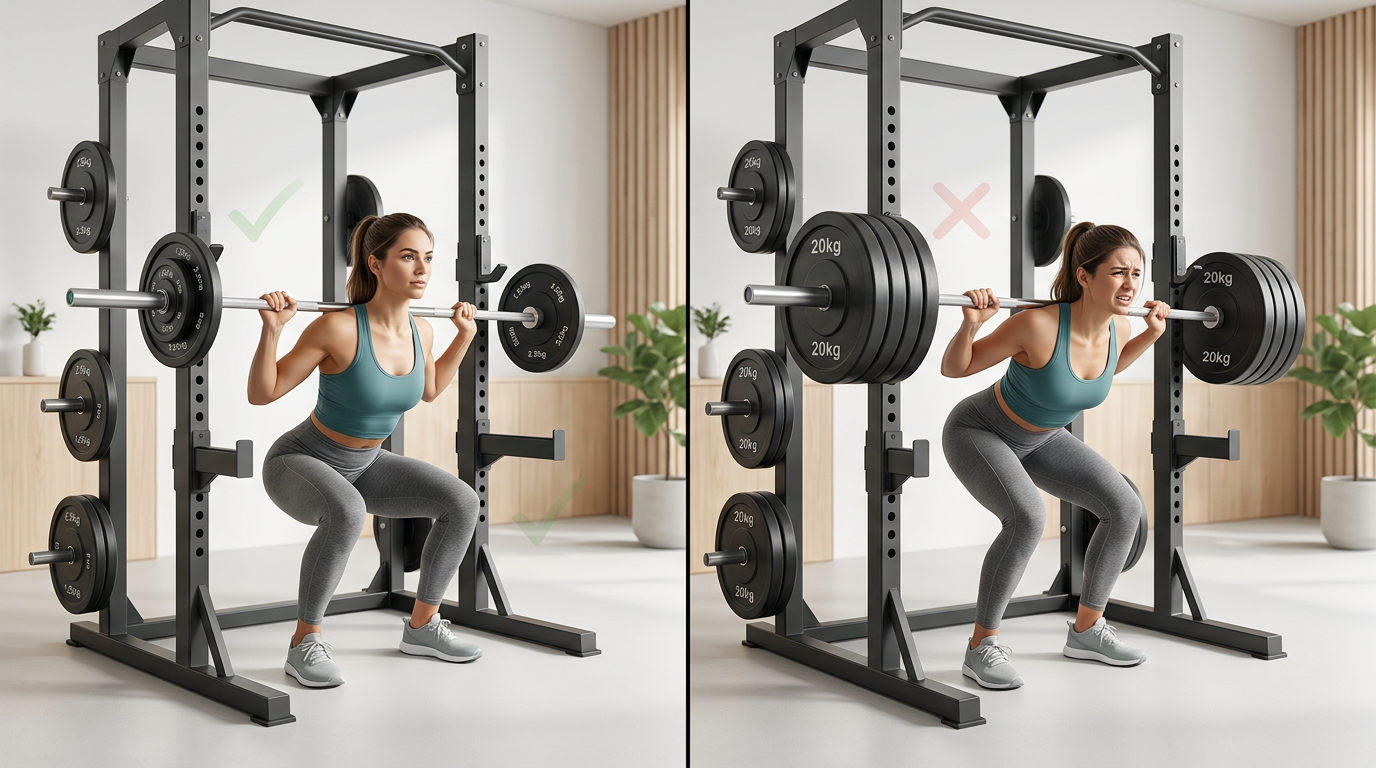
Side-by-side comparison showing correct progressive overload (small incremental changes with good form) versus incorrect approach (large weight jumps with compromised form)
Progressive Overload for Specific Goals
While the fundamental principle remains consistent, how you apply progressive overload varies based on your specific fitness objectives. Tailoring your approach maximizes results for your particular goals.
Building Muscle and Curves
For hypertrophy goals like developing glutes or sculpting arms, focus on the 8-12 rep range with moderate weights. Progress by increasing reps until you reach 12-15, then add weight and drop back to 8 reps. Volume (total sets × reps × weight) drives muscle growth, so gradually increasing total weekly volume produces the best results.
Exercises like best hamstring exercises and glute-focused movements respond particularly well to higher volume training with progressive overload applied consistently over months.
Increasing Strength
Maximal strength development requires heavier loads in the 3-6 rep range. Progress by adding small weight increments more frequently, even if that means using fractional plates. Strength training benefits from longer rest periods (2-3 minutes) to allow complete recovery between sets.
Compound movements like squats, deadlifts, and presses should form the foundation of strength-focused programs, with progressive overload applied systematically to these core lifts.
Fat Loss and Body Recomposition
During calorie deficits, maintaining strength becomes the priority rather than aggressive progression. Focus on preserving your current performance levels to signal your body to maintain muscle mass while losing fat. When possible, continue progressing on some exercises, but don't expect the same rate of advancement as when eating at maintenance or surplus calories.
Progressive overload during fat loss helps maintain metabolic rate and ensures the weight you lose comes primarily from fat rather than muscle tissue.
Functional Fitness and Daily Life
If your goal is improved functional capacity for daily activities, apply progressive overload to movement patterns that mirror real-life tasks. Increase your ability to perform exercises like daily squats, carries, and pushing/pulling movements with greater ease.
Functional training benefits from progressing both strength and endurance, so vary between heavier weights for lower reps and lighter weights for higher reps throughout your training week.
Creating Your Progressive Overload Plan
Putting progressive overload into practice requires a structured approach. This step-by-step framework helps you design an effective progression strategy for your current fitness level and goals.
Step 1: Establish Your Baseline
Spend 1-2 weeks determining appropriate starting weights for each exercise in your program. Select loads that allow you to complete your target reps with good form while feeling challenged on the last 2-3 reps. This baseline provides your starting point for future progression.
Record all baseline numbers in your training log. These become your reference points for measuring future progress.
Step 2: Choose Your Primary Progression Method
Select one primary progression method for each exercise based on your goals and available equipment. Compound movements typically progress best with weight increases, while isolation exercises might benefit from rep progression. Having a clear plan prevents decision paralysis during workouts.
Step 3: Set Realistic Progression Targets
Establish achievable weekly or bi-weekly progression goals. Beginners might add weight every 1-2 weeks, while advanced lifters may only progress monthly on some exercises. Setting realistic expectations prevents frustration and keeps you motivated.
Step 4: Schedule Deload Weeks
Mark deload weeks on your calendar every 4-6 weeks before you start training. This proactive approach ensures you actually take them rather than pushing through when fatigue accumulates. Scheduled deloads are a feature of smart programming, not a sign of weakness.
Step 5: Track and Adjust
Maintain your workout log consistently and review it regularly. If an exercise stalls for 2-3 consecutive sessions, implement a different progression method or reduce intensity temporarily. Flexibility within your structured plan allows you to work with your body rather than against it.
Remember that progress isn't always linear. Some weeks you'll crush your goals, others you'll maintain, and occasionally you might regress slightly. The overall trend over months matters more than individual workout performance.
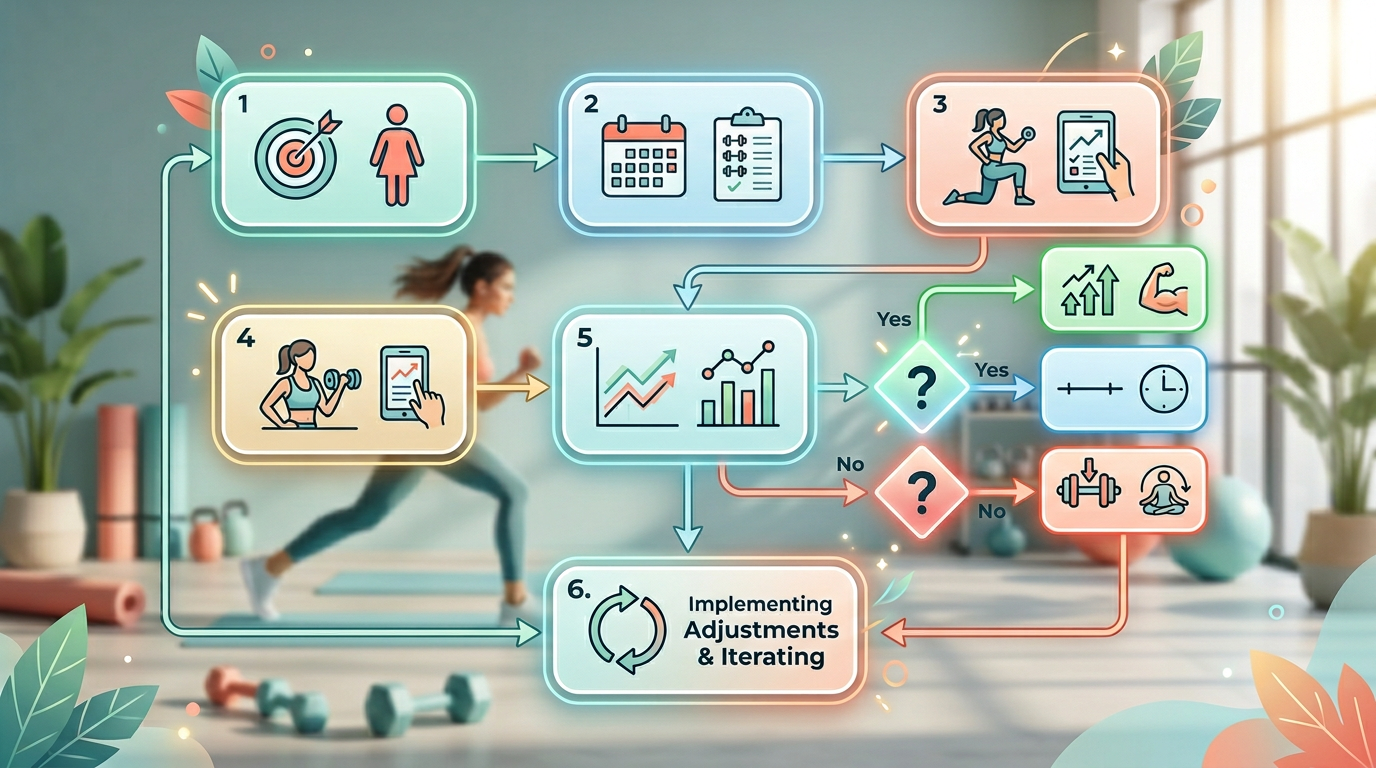
Flowchart showing the five-step progressive overload planning process with decision points for when to progress, maintain, or deload based on performance indicators
Frequently Asked Questions
What is an example of a progressive overload?
An example of progressive overload is performing goblet squats with an 8 kg dumbbell for 3 sets of 10 reps one week, building to 3 sets of 12 reps over the following weeks, and then progressing to a 10 kg dumbbell for 3 sets of 8–10 reps once you can hit 12s across all sets for two straight sessions.
What is the 6-12-25 rule?
The 6-12-25 rule is a training protocol that structures workouts around three exercises with different rep ranges: 6 reps of a heavy compound lift for strength, 12 reps of a moderate exercise for muscle growth, and 25 reps of a lighter isolation movement for endurance and metabolic stress.
What is the 2-for-2 rule for progressive overload?
The 2-for-2 rule is the green-light check for adding weight: when you can hit the top of your rep range across all sets, with good form, for 2 consecutive workouts, increase the weight by the smallest possible increment and drop back to the bottom of your rep range to build up again.
What is the 5-3-1 rule?
The 5-3-1 rule is a periodized strength program that cycles through different rep ranges over four weeks: week one uses sets of 5 reps, week two uses 3 reps, week three uses 1 rep or heavy sets of 5, and week four is a deload with reduced intensity.
How long does it take to see results from progressive overload?
Most women notice strength improvements within 2-4 weeks of consistent progressive overload training as neuromuscular adaptations occur. Visible physical changes typically appear after 6-8 weeks, while significant body composition changes require 12-16 weeks of sustained progressive training with proper nutrition and recovery.
Can beginners use progressive overload?
Beginners benefit most from progressive overload and typically progress faster than advanced lifters. Start with bodyweight exercises or light weights, focus on mastering proper form, then gradually increase difficulty through small increments. Beginners can often progress every workout during the first few months of training.
Should I progressive overload every workout?
You don't need to progress every single workout. Beginners may progress weekly, while intermediate and advanced lifters might only increase demands every 2-4 weeks on certain exercises. Focus on progressing when you've clearly adapted to your current training stimulus rather than forcing progression prematurely.
Will progressive overload make women bulky?
No. Women's testosterone levels make it physiologically very difficult to build large amounts of muscle without years of deliberate, focused effort. Progressive overload — even with heavier weights — builds the strength and shape most women are actually after. Adding two reps to your squats will not make you bulky; deliberately getting stronger is exactly how you get the look you want.
Can you do progressive overload with resistance bands or bodyweight?
Yes. Progression isn't limited to adding weight: you can add reps or sets, slow your tempo, add pauses and pulses, shorten rest periods, or move to a harder exercise variation. With bands, step further from the anchor point or move up a band thickness. The principle stays the same — do slightly more than last session, and track it.
How does progressive overload work for women over 40?
The principle is identical at any age — what changes is recovery. Over 40, expect progress in 2–4 week waves rather than a new personal best every week, take the extra rest day when you need it, and treat sleep and protein as training variables. Some weeks you'll fly and some you'll feel flat; that's normal physiology, not a sign it isn't working — and it doesn't require any special protocol.
When should I buy heavier dumbbells?
When the top of your rep range — at a slow tempo, with pauses — still isn't close to failure, that weight has become your warm-up and the next dumbbell up has earned its place. Remember that you meet the new weight at the bottom of your rep range (6–8 reps), not at 12–15, so the jump is smaller than it feels.
Conclusion: Your Progressive Overload Journey Starts Now
Progressive overload transforms your workouts from random exercise sessions into a systematic strength-building process. By gradually increasing training demands through weight, reps, sets, or intensity, you create the stimulus your body needs to adapt and grow stronger. The key is applying these principles consistently while respecting your recovery capacity.
Start by tracking your current performance, choose one or two progression methods that fit your goals and equipment, and commit to small, sustainable increases over time. Building strength is a marathon, not a sprint — the woman who adds a kilo consistently every few weeks will ultimately out-lift the one who attempts aggressive jumps and burns out. And two or three unspectacular workouts every week beat everything.
Your body is capable of remarkable adaptations when you provide it with the right stimulus, adequate recovery, and proper nutrition. Whether you're working toward developing your lower body or building overall strength, progressive overload is the evidence-based path that delivers lasting results. Apply these principles to your training, track your progress, and celebrate each small victory as you build the strong, capable body you deserve.
And if you'd rather have all of this planned for you — home workouts where the progression is already built in, so you literally press play and follow along with me — start your 7-day free trial of the Strong Curves app: https://strongcurves.com/sign-up