The Best Pilates Core Workout for Women
A Pilates core workout is a low-impact exercise method targeting deep abdominal muscles, pelvic floor, and back stabilizers through controlled movements. The most effective exercises include the Hundred, Roll-Up, Plank variations, and Single Leg Stretch, combining breath work with precise muscle engagement for functional core strength and improved posture.
Your core is the foundation of every movement you make, from lifting groceries to crushing a personal record in the gym. Yet many women struggle with core workouts that either feel ineffective or aggravate back pain. If you've been searching for a Pilates core workout that actually delivers results while protecting your spine, you're in the right place.
Pilates offers a unique approach to core training that goes beyond crunches and sit-ups. This method strengthens the deep stabilizing muscles that traditional ab exercises often miss, creating a strong, functional core that supports your body in daily life and athletic performance. Whether you're postpartum, dealing with back pain, or simply want a stronger midsection, Pilates core exercises provide a safe, effective solution.
In this comprehensive guide, we'll walk you through the best Pilates core exercises specifically designed for women. You'll learn proper form, modifications for all fitness levels, and how to structure these movements into an effective workout routine that builds real strength from the inside out.
Key Takeaways
- Pilates core workouts target deep stabilizing muscles including the transverse abdominis and pelvic floor for functional strength
- These exercises improve posture, reduce back pain, and enhance overall body control through mind-muscle connection
- Proper breathing technique is essential for maximizing core engagement and exercise effectiveness
- Modifications make Pilates accessible for all fitness levels, from beginners to advanced practitioners
- Consistency with 2-3 sessions weekly delivers visible results in core strength and stability within 4-6 weeks
Understanding What Makes a Pilates Core Workout Effective
A Pilates core workout differs fundamentally from traditional ab training. Rather than isolating surface muscles through repetitive flexion, Pilates engages the entire core system through controlled, flowing movements that challenge stability and coordination. This approach builds functional strength that translates to real-world activities.
The Core Muscles Pilates Targets
Pilates exercises engage multiple layers of core musculature simultaneously. The transverse abdominis acts as your body's natural corset, wrapping around your midsection to stabilize your spine. The multifidus muscles run along your vertebrae, providing crucial support for spinal health. Your pelvic floor muscles work in coordination with your deep abdominals to create intra-abdominal pressure that protects your back.
The obliques, both internal and external, control rotation and side-bending movements. The rectus abdominis, while not the primary focus, still engages to support spinal flexion. This comprehensive approach ensures balanced development rather than overdeveloping surface muscles while neglecting deeper stabilizers.
Why Pilates Core Training Works for Women
Women face unique core challenges including pregnancy, hormonal fluctuations, and increased risk of pelvic floor dysfunction. Pilates addresses these concerns through exercises that strengthen without creating excessive intra-abdominal pressure. The emphasis on breath coordination and pelvic floor engagement makes it particularly beneficial for postpartum recovery and preventing issues like diastasis recti.
The low-impact nature protects joints while still providing serious strength benefits. You can build a rock-solid core without the high-impact movements that may aggravate existing injuries or conditions.
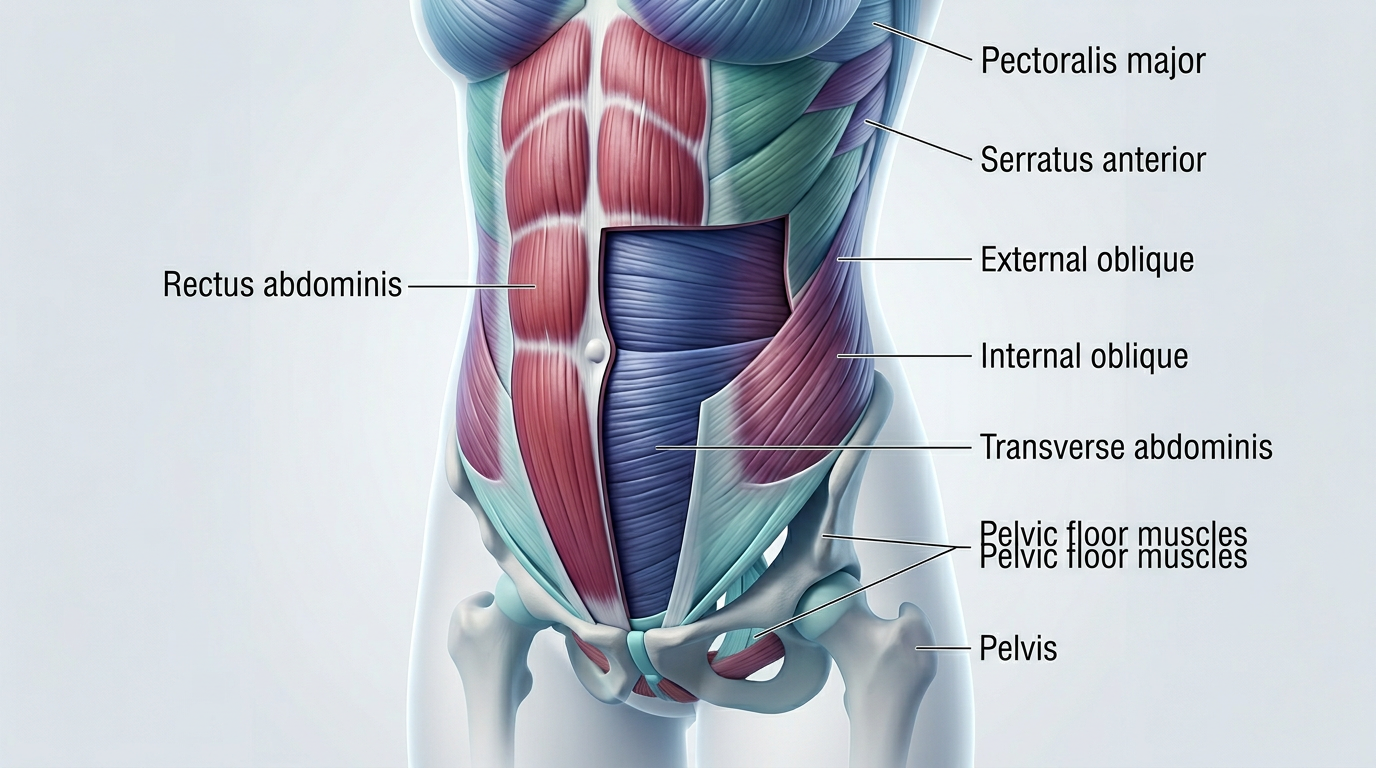
Anatomical illustration showing the layers of core muscles targeted in Pilates including transverse abdominis, obliques, rectus abdominis, and pelvic floor muscles with labels
How to Prepare for Your Pilates Core Workout
Proper preparation maximizes the effectiveness of your Pilates practice and prevents injury. Before beginning any Pilates core workout, spend 5-7 minutes warming up with gentle spinal articulation and breathing exercises to activate your deep core muscles.
Essential Equipment You'll Need
Most Pilates core exercises require minimal equipment, making them perfect for home workouts. A quality exercise mat provides cushioning for your spine during floor-based movements. A small Pilates ball or rolled towel can assist with certain exercises and help you maintain proper alignment.
Resistance bands add challenge to intermediate and advanced variations. A foam roller supports specific exercises and provides feedback for spinal alignment. However, you can begin with just your bodyweight and a mat, adding equipment as you progress.
Mastering Pilates Breathing Technique
Breath work is non-negotiable in Pilates. The lateral breathing pattern used in Pilates involves expanding your ribcage sideways rather than pushing your belly out. This technique maintains core engagement throughout each exercise while providing adequate oxygen to working muscles.
Practice this pattern before adding movement: Inhale through your nose for a count of four, feeling your ribs expand laterally. Exhale through your mouth for a count of six, drawing your navel toward your spine. This exhale is when your deepest core muscles activate most effectively.
1. The Hundred: Foundation of Pilates Core Work
The Hundred serves as the cornerstone exercise in many Pilates core workout routines. This classic movement combines sustained core engagement with controlled breathing and arm pumping to build endurance in your deep abdominal muscles. The exercise gets its name from the 100 arm pulses you perform while holding a challenging core position.
To perform the Hundred, lie on your back with your knees bent in tabletop position or legs extended at a 45-degree angle for more challenge. Lift your head, neck, and shoulders off the mat, curling your upper body forward while keeping your lower back pressed down. Extend your arms alongside your body, hovering a few inches off the floor. Pump your arms up and down with small, controlled movements while breathing in for five counts and out for five counts.
The key to effectiveness lies in maintaining consistent core engagement throughout the full 100 counts without letting your lower back arch off the mat. Your transverse abdominis should feel like it's pulling your navel toward your spine throughout the movement. Beginners should start with bent knees and aim for 50 counts, gradually building to the full 100 as strength improves.
Pros
- Builds core endurance and stamina effectively
- Improves breath control and coordination
- Warms up the entire core system quickly
- Easily modified for different fitness levels
Cons
- Can strain neck if proper form isn't maintained
- May be too intense for beginners without modifications
- Requires significant hip flexor strength
2. Roll-Up: Spinal Articulation and Deep Core Control
The Roll-Up challenges your core through a full range of spinal flexion while teaching segmental control of your vertebrae. This exercise strengthens your entire abdominal wall while improving flexibility in your spine and hamstrings. Unlike a traditional sit-up that relies on momentum, the Roll-Up demands controlled, sequential movement that engages your deepest core stabilizers.
Begin lying flat on your back with legs extended and arms reaching overhead. Inhale to prepare, then exhale as you lift your arms toward the ceiling, curl your chin to your chest, and slowly peel your spine off the mat one vertebra at a time. Continue rolling forward until you're reaching toward your toes with your spine rounded in a C-curve. Inhale at the top, then exhale as you reverse the movement, rolling back down with the same controlled, sequential motion.
The Roll-Up requires significant core strength and spinal mobility. If you can't perform it without using momentum or your legs lifting off the mat, use a resistance band around your feet for assistance or start with a modified Roll-Up from a semi-reclined position. Focus on the quality of movement rather than speed or range.
Pros
- Strengthens the entire abdominal chain from top to bottom
- Improves spinal flexibility and articulation
- Teaches mind-muscle connection and control
- Stretches hamstrings and back muscles
Cons
- Difficult for beginners or those with tight hamstrings
- Not suitable for those with certain back conditions
- Easy to perform incorrectly without proper instruction
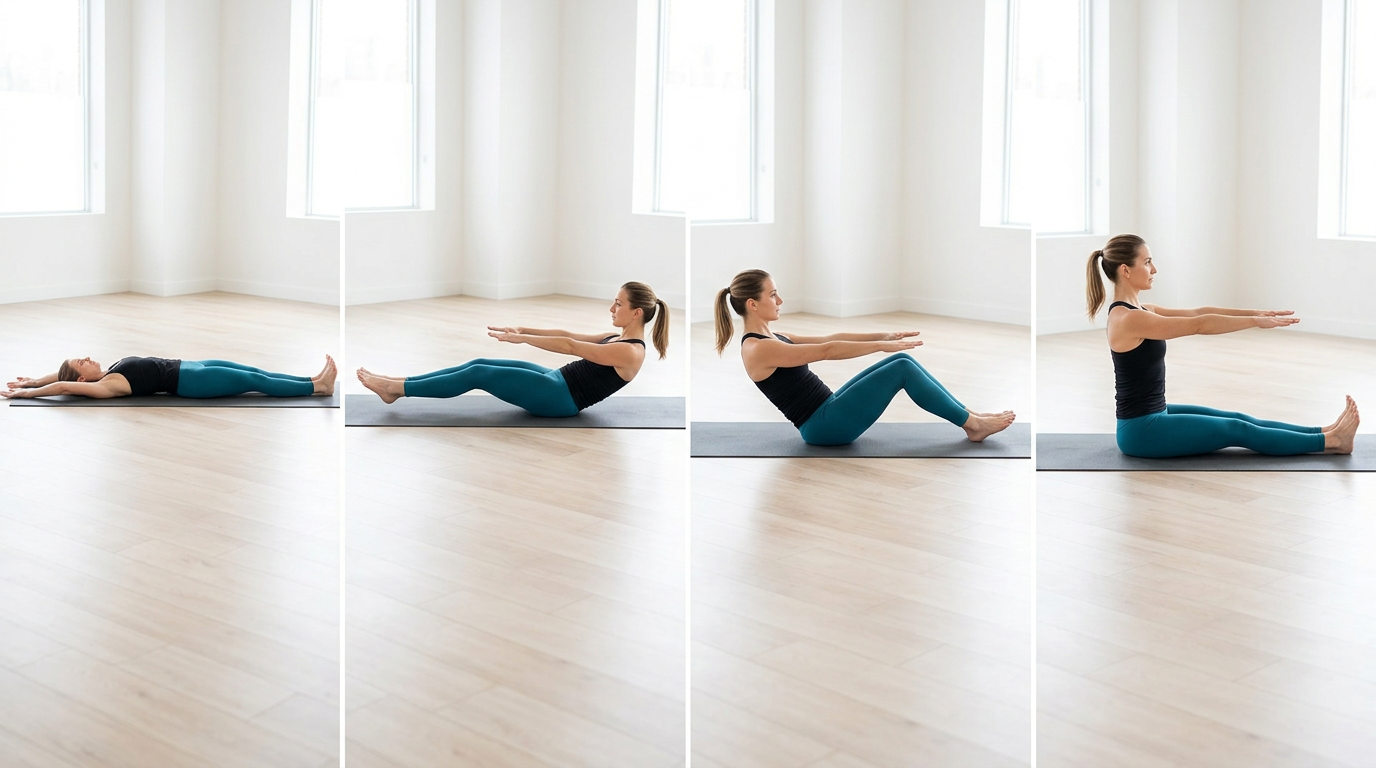
Step-by-step photo sequence showing proper Roll-Up form from lying position through sitting position, demonstrating spinal articulation and hand placement
3. Single Leg Stretch: Dynamic Core Stability
The Single Leg Stretch builds dynamic stability by challenging your core to maintain position while your legs move through space. This exercise mimics functional movement patterns where your core must stabilize while your limbs perform actions, making it incredibly practical for daily activities and athletic performance.
Lie on your back and bring both knees into your chest. Lift your head, neck, and shoulders into a curl, engaging your upper abdominals. Extend your right leg out at a 45-degree angle while pulling your left knee toward your chest, placing your left hand on your left ankle and right hand on your left knee. Switch legs in a fluid motion, extending the left leg while pulling the right knee in and switching hand positions.
The critical element is keeping your torso absolutely still while your legs alternate, which requires intense deep core engagement to prevent rotation or rocking. Your lower back should remain imprinted on the mat throughout the movement. Perform 8-12 repetitions per side, coordinating your breath with the leg changes.
Pros
- Develops core stability during dynamic movement
- Improves coordination and motor control
- Strengthens hip flexors alongside core muscles
- Easily adjustable for intensity by changing leg height
Cons
- Can strain neck if head position isn't supported properly
- May cause lower back discomfort if core isn't strong enough
- Requires coordination that challenges beginners
4. Plank Variations: Isometric Core Strength
Plank variations form the backbone of any effective Pilates core workout guide because they build anti-extension strength—your core's ability to resist unwanted movement. Unlike exercises that involve spinal flexion, planks teach your core to stabilize in a neutral spine position, which is how your core functions most often in daily life.
The basic forearm plank involves supporting your body weight on your forearms and toes with your body forming a straight line from head to heels. Your core muscles work isometrically to prevent your hips from sagging or piking upward. Hold for 30-60 seconds, focusing on drawing your navel toward your spine and maintaining steady breathing.
Progress to side planks to target your obliques and lateral core stability. Lie on your side, prop yourself up on one forearm, and stack your feet. Lift your hips until your body forms a straight line. For added challenge, try plank variations like plank rocks, plank taps, or plank leg lifts that add dynamic movement to the static hold.
Pros
- Builds functional core strength for real-world activities
- Strengthens shoulders, back, and glutes simultaneously
- Infinite variations keep workouts challenging and progressive
- No equipment needed and can be done anywhere
Cons
- Can be too challenging for true beginners
- Easy to perform with improper form that reduces effectiveness
- May cause wrist discomfort in some variations
5. Dead Bug: Core Stability and Coordination
The Dead Bug exercise earned its quirky name from the position you hold—lying on your back with arms and legs in the air like an overturned insect. Don't let the silly name fool you; this exercise is one of the most effective movements for building anti-extension core strength while teaching proper coordination between opposite limbs.
Start on your back with your arms extended straight up toward the ceiling and your knees bent at 90 degrees with shins parallel to the floor. Press your lower back firmly into the mat—this position must be maintained throughout the exercise. Slowly lower your right arm overhead while simultaneously extending your left leg, hovering just above the floor. Return to start and repeat on the opposite side.
The challenge lies in keeping your lower back pressed down as your limbs move away from your center. Any arching indicates your core has lost control, signaling you should reduce your range of motion. Perform 8-10 controlled repetitions per side, coordinating your exhale with the extension phase when core engagement is most critical.
Pros
- Extremely safe for the lower back when performed correctly
- Teaches proper core bracing patterns
- Improves cross-body coordination and motor control
- Easily scalable by adjusting range of motion
Cons
- Requires significant body awareness to perform correctly
- Can feel too easy if form isn't strict enough
- May be frustrating for those with coordination challenges
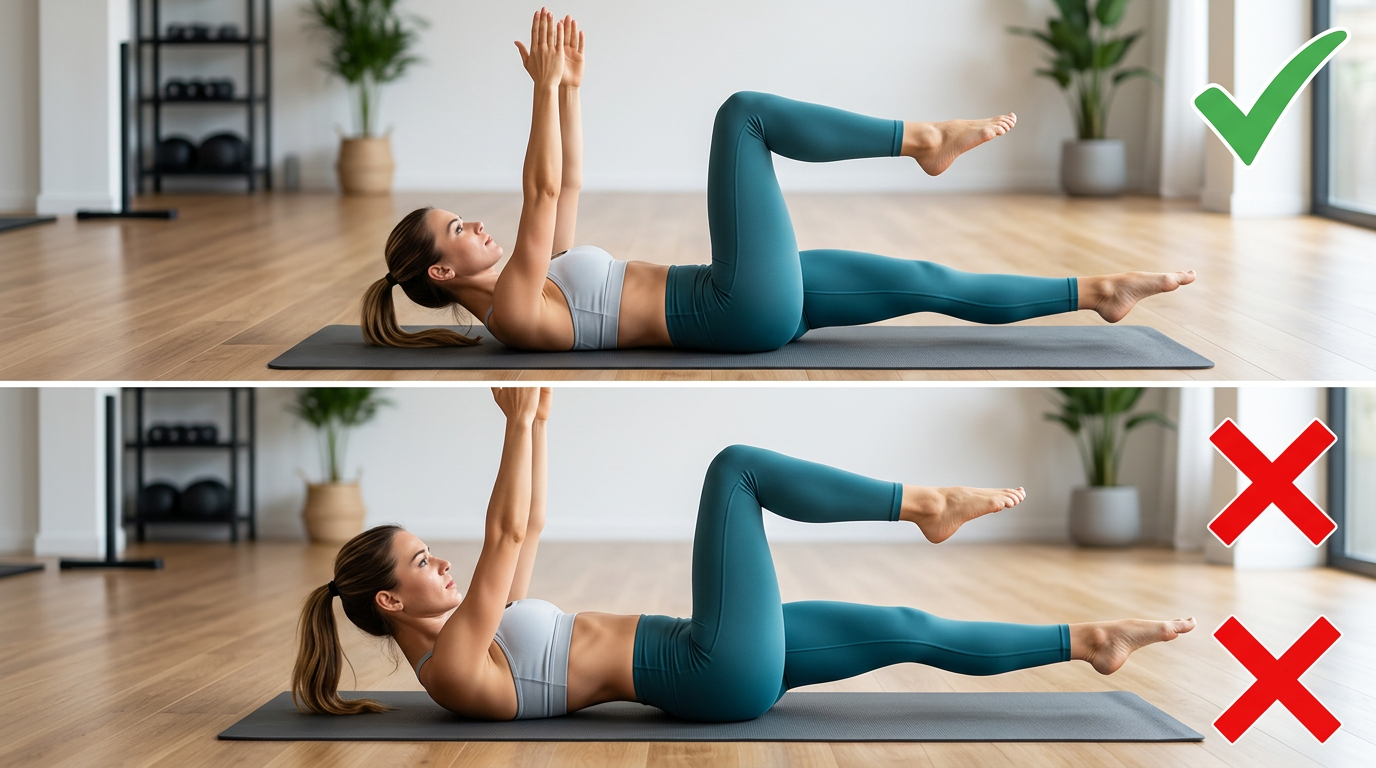
Split image showing correct Dead Bug form with lower back pressed to mat versus incorrect form with arched lower back, with red X and green checkmark indicators
6. Crisscross: Rotational Core Power
The Crisscross exercise targets your obliques through rotational movement while maintaining a stable pelvis. This movement pattern is essential for activities involving twisting, turning, and changing direction. Strong obliques also contribute to a defined waistline and improved posture by supporting lateral spinal stability.
Begin in the same position as the Single Leg Stretch with your head, neck, and shoulders curled up off the mat. Place your hands behind your head with elbows wide. Extend your right leg out while pulling your left knee toward your chest and rotating your torso to bring your right shoulder toward your left knee. Switch sides in a controlled motion, extending the left leg while rotating left.
Focus on rotating from your ribcage rather than just moving your elbows, and keep your pelvis stable without rocking side to side. The rotation should come from your waist, engaging your obliques deeply. Perform 8-12 repetitions per side with controlled, deliberate movements rather than fast, sloppy twists.
Pros
- Effectively targets obliques for waist definition
- Improves rotational power for athletic activities
- Combines core strength with flexibility
- Challenges coordination and balance
Cons
- Can strain neck if hands pull on head
- Easy to use momentum instead of muscle control
- May aggravate existing back issues if performed incorrectly
7. Swimming: Back Extension and Posterior Core
While most Pilates core exercises focus on the anterior core, the Swimming exercise strengthens the often-neglected posterior chain including your erector spinae, glutes, and back extensors. A balanced core includes both front and back strength, and this exercise addresses that crucial posterior component.
Lie face down on your mat with arms extended overhead and legs straight. Engage your core by drawing your navel away from the mat slightly, creating a small space underneath your abdomen. Simultaneously lift your right arm and left leg off the mat, then switch to lift your left arm and right leg in a flutter-kick motion. Continue alternating for 20-30 seconds while maintaining steady breathing.
Keep your neck in neutral alignment by looking down at your mat rather than lifting your head excessively. The movement should be controlled and precise rather than large and wild. Your core engagement prevents excessive arching in your lower back while your back muscles work to lift your limbs.
Pros
- Strengthens posterior chain for balanced core development
- Improves posture by strengthening back extensors
- Enhances coordination between opposite limbs
- Counterbalances forward-flexion exercises
Cons
- Can cause lower back discomfort if performed with excessive arching
- May be challenging for those with limited back strength
- Requires good shoulder mobility
8. Teaser: Advanced Core Integration
The Teaser represents one of the most challenging exercises in the Pilates core workout repertoire, requiring strength, balance, flexibility, and control in equal measure. This exercise integrates your entire core system while demanding precise body awareness and muscular coordination. It's called the Teaser because achieving the V-position is a tantalizing challenge that keeps practitioners coming back.
Begin lying on your back with your legs extended at a 45-degree angle and arms reaching overhead. In one fluid motion, roll up to a V-position, balancing on your sit bones with your legs lifted and arms reaching parallel to your legs. Your body should form a V-shape with your core working intensely to maintain balance. Hold for 3-5 breaths, then roll back down with control.
This exercise should only be attempted after mastering the foundational movements. Modifications include keeping knees bent, using hands for light support behind thighs, or performing a Half Teaser where you roll up with legs already lifted. The Teaser provides an excellent benchmark for measuring core strength progress over time.
Pros
- Integrates all core muscles in one comprehensive movement
- Builds significant core strength and balance
- Improves hip flexor strength and flexibility
- Provides clear progression goal for practitioners
Cons
- Too advanced for beginners and many intermediate practitioners
- High risk of using momentum or poor form
- Can strain lower back if core strength is insufficient
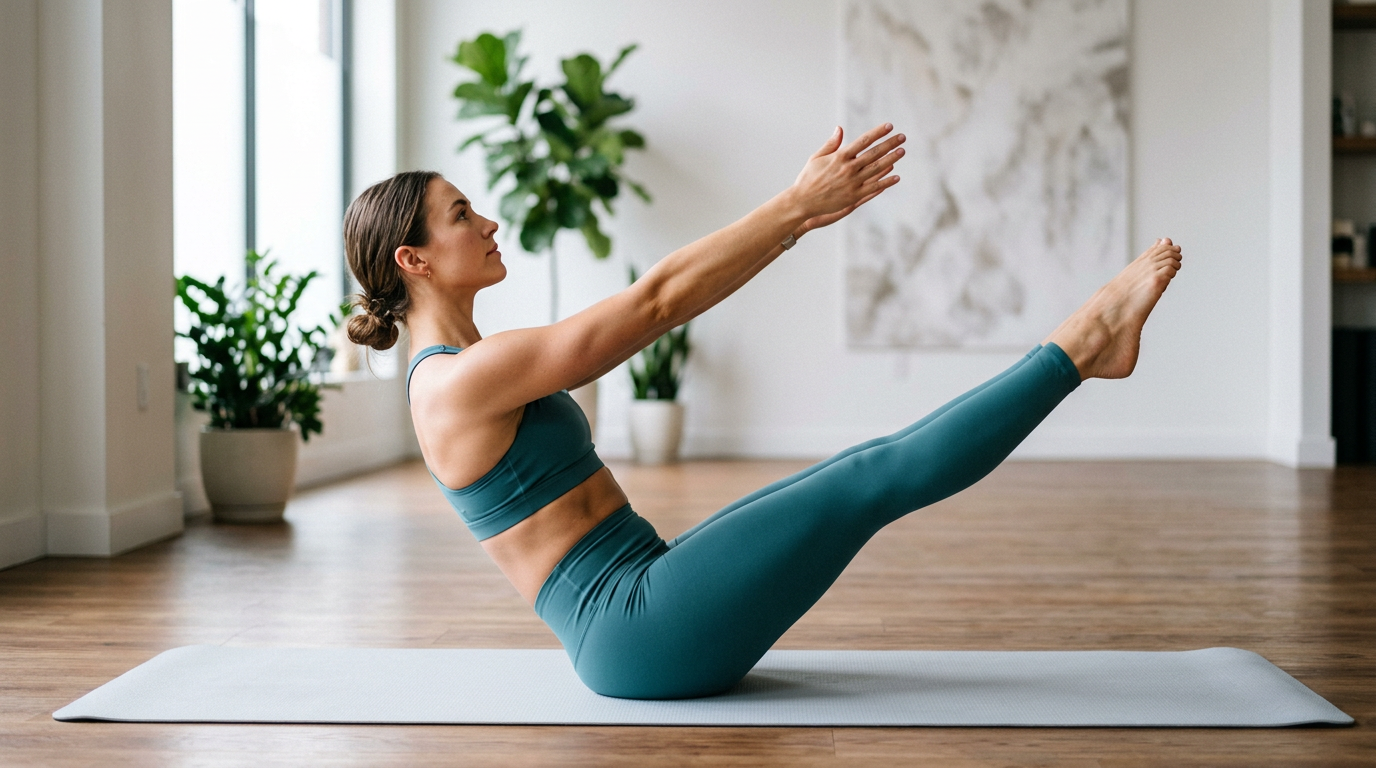
Side-view photo of woman performing Teaser exercise in V-position, showing proper body alignment with straight legs, lifted torso, and arms extended parallel to legs
9. Side Lying Leg Lifts: Lateral Core Stability
Side Lying Leg Lifts target the lateral core muscles including your obliques, quadratus lumborum, and hip abductors. These muscles stabilize your pelvis during single-leg activities like walking, running, and climbing stairs. Strong lateral core muscles also prevent knee injuries by maintaining proper hip alignment during movement.
Lie on your right side with your body in a straight line, propped up on your right forearm or extended arm. Stack your left leg directly on top of your right leg. Engage your core to prevent your waist from sagging toward the floor. Lift your top leg toward the ceiling with control, keeping your hips stacked and your body stable. Lower with the same control and repeat for 10-15 repetitions before switching sides.
Progress this exercise by adding small circles, pulses, or by lifting both legs simultaneously for an intense oblique challenge. You can also perform this from a side plank position for maximum core engagement. The key is maintaining perfect alignment without rolling forward or backward as your leg moves.
Pros
- Strengthens often-neglected lateral core muscles
- Improves hip stability and reduces injury risk
- Targets obliques without spinal flexion or rotation
- Easily progressed with multiple variations
Cons
- Can cause shoulder discomfort in the supporting arm
- May feel too easy without proper form and engagement
- Requires good body awareness to maintain alignment
10. Pelvic Curl: Posterior Core and Glute Activation
The Pelvic Curl bridges the gap between core work and glute training while teaching segmental spinal articulation. This exercise strengthens your posterior chain while improving spinal mobility and control. It's particularly valuable for women who spend long hours sitting, as it counteracts the hip flexor tightness and glute weakness that develops from prolonged sitting.
Lie on your back with knees bent and feet flat on the floor hip-width apart. Arms rest alongside your body. Exhale as you tilt your pelvis, pressing your lower back into the mat. Continue lifting your spine off the mat one vertebra at a time until your body forms a straight line from shoulders to knees. Hold at the top while engaging your glutes and core, then inhale as you roll back down with the same sequential control.
The magic happens in the controlled articulation of your spine rather than simply lifting your hips up and down. Each vertebra should move independently, creating a wave-like motion through your spine. Perform 8-10 repetitions, focusing on the quality of movement and the deep core engagement required to control the descent.
Pros
- Strengthens glutes and hamstrings alongside core muscles
- Improves spinal mobility and articulation
- Gentle enough for beginners and postpartum recovery
- Relieves lower back tension when performed correctly
Cons
- Can cause cramping in hamstrings if they're weak or tight
- May feel too easy for advanced practitioners without modifications
- Easy to perform incorrectly by lifting as one unit
Creating Your Pilates Core Workout Routine
Building an effective routine requires strategic exercise selection and proper progression. A well-designed Pilates core workout balances exercises that target different core functions: flexion, extension, rotation, and anti-movement stability. This comprehensive approach ensures balanced development and reduces injury risk.
Sample Beginner Routine
Start with these foundational exercises performed 2-3 times weekly:
- Pelvic Curl: 8-10 repetitions
- Dead Bug: 8 repetitions per side
- Modified Hundred (knees bent): 50 counts
- Single Leg Stretch: 8 repetitions per side
- Forearm Plank: 20-30 second hold
- Side Lying Leg Lifts: 10 repetitions per side
Complete this circuit once through, focusing on perfect form rather than speed or repetitions. As you build strength over 4-6 weeks, gradually increase repetitions and hold times before progressing to intermediate exercises.
Sample Intermediate to Advanced Routine
Once you've mastered the basics, challenge yourself with this progression:
- Hundred (legs extended): 100 counts
- Roll-Up: 6-8 repetitions
- Single Leg Stretch: 10 repetitions per side
- Crisscross: 10 repetitions per side
- Plank Variations: 45-60 seconds each
- Swimming: 30 seconds
- Side Plank with Leg Lift: 8 repetitions per side
- Teaser (or modified): 4-6 repetitions
Perform this routine 3-4 times weekly for optimal Pilates core workout results. Allow at least one rest day between sessions for recovery. You can integrate these exercises into your existing strength training program or perform them as standalone core sessions.
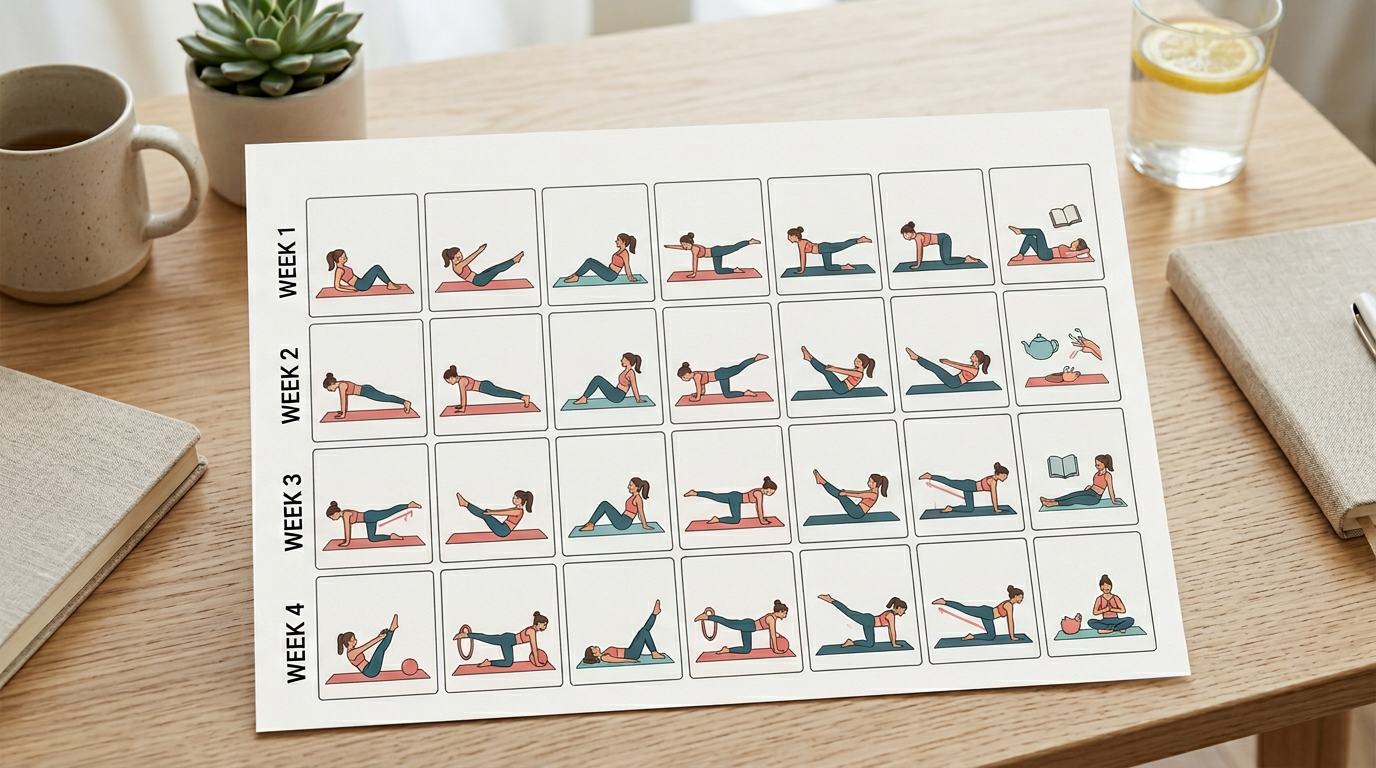
Weekly workout calendar showing recommended Pilates core workout schedule with rest days, beginner routine days, and progression timeline
Common Mistakes to Avoid in Your Pilates Core Workout
Even experienced practitioners can fall into patterns that reduce effectiveness or increase injury risk. The most common mistake is allowing your lower back to arch off the mat during exercises, which shifts the work away from your core and places stress on your spine. Always maintain that connection between your lower back and the mat during supine exercises.
Holding Your Breath
Many women unconsciously hold their breath during challenging movements, which reduces core activation and oxygen delivery to working muscles. The Pilates breathing pattern isn't just for show—it's integral to proper core engagement. If you find yourself holding your breath, reduce the intensity or range of motion until you can maintain steady breathing throughout.
Using Momentum Instead of Muscle Control
Pilates emphasizes quality over quantity. Performing exercises quickly with momentum might make them feel easier, but it defeats the purpose of building controlled strength. Each movement should be deliberate and precise, with your muscles doing the work rather than momentum carrying you through.
Neglecting Proper Progression
Jumping to advanced exercises before mastering foundational movements leads to poor form and potential injury. Your ego might want to attempt the Teaser on day one, but your core needs time to develop the strength and control required. Follow a logical progression, mastering each level before advancing.
Measuring Your Pilates Core Workout Progress
Tracking progress keeps you motivated and helps you identify when to increase difficulty. Unlike traditional strength training where you simply add weight, Pilates progression involves multiple variables including range of motion, hold times, repetitions, and exercise variations.
Strength Indicators to Watch
Notice how long you can hold positions like planks without form breakdown. Track how many repetitions you can complete of exercises like the Hundred while maintaining perfect form. Pay attention to how your lower back feels—improved core strength should reduce lower back discomfort during exercises and daily activities.
Functional improvements matter most: Can you maintain better posture throughout your day? Do you notice improved stability during other workouts? Can you pick up objects or perform daily tasks with better body mechanics? These real-world changes indicate that your Pilates core workout is delivering results.
When to Progress Your Routine
Consider advancing your routine when you can complete your current exercises with perfect form and controlled breathing without excessive fatigue. If you can perform all repetitions while maintaining proper alignment and your muscles don't feel significantly challenged by the end of your session, it's time to progress. This typically occurs every 4-6 weeks for consistent practitioners.
Which Pilates Core Workout Is Best For You?
Your ideal starting point depends on your current fitness level, goals, and any physical limitations. If you're new to exercise or postpartum, begin with the beginner routine focusing on the Pelvic Curl, Dead Bug, and modified Hundred to build foundational strength safely.
For women with back pain or core weakness, prioritize anti-extension exercises like the Dead Bug and Plank variations that strengthen your core without excessive spinal flexion. These movements teach your core to stabilize your spine, which often provides relief from chronic back discomfort.
Athletes and advanced practitioners should incorporate the full range of exercises including rotational movements like the Crisscross and integration exercises like the Teaser. This comprehensive approach builds the multi-directional strength required for sports performance and complex movement patterns.
Women focused on aesthetic goals alongside functional strength will benefit from combining exercises that target all core regions: the Hundred and Roll-Up for upper abs, Dead Bug and Planks for deep core stability, Crisscross for obliques, and Swimming for posterior chain balance. This balanced approach creates visible definition while building genuine strength.
If you're recovering from injury or managing a chronic condition, consult with a physical therapist or certified Pilates instructor who can modify exercises appropriately for your specific needs. Many Pilates exercises can be adapted to accommodate various limitations while still providing effective core strengthening. For additional targeted work, check out our guide to Pilates ab workouts that complement these core exercises perfectly.
Frequently Asked Questions
Does Pilates workout the core?
Yes, Pilates specifically targets core muscles including the transverse abdominis, obliques, pelvic floor, and back stabilizers through controlled movements. Unlike traditional ab exercises, Pilates engages deep core layers that support spinal stability and functional movement patterns, making it exceptionally effective for comprehensive core strengthening.
How often should I do a Pilates core workout?
Perform Pilates core workouts 2-4 times weekly for optimal results, allowing at least one rest day between sessions for muscle recovery. Beginners should start with 2 sessions weekly and gradually increase frequency as strength improves. Consistency matters more than frequency—regular practice yields better results than sporadic intensive sessions.
Can core exercises help scoliosis?
Core exercises can help manage scoliosis symptoms by strengthening muscles that support spinal alignment and improving posture. Pilates exercises focusing on spinal elongation and balanced muscle development may reduce discomfort associated with mild scoliosis. However, always consult a healthcare provider before starting any exercise program for scoliosis management.
Is Pilates good for high cortisol?
Pilates can help manage cortisol levels through its emphasis on controlled breathing and mindful movement, which activate the parasympathetic nervous system. Unlike high-intensity workouts that may spike cortisol, Pilates provides moderate-intensity exercise that builds strength while promoting relaxation, making it beneficial for stress management and hormonal balance.
How long before I see results from Pilates core workouts?
Most women notice improved core strength and body awareness within 2-3 weeks of consistent practice, with visible physical changes appearing after 4-6 weeks. Postural improvements often occur first, followed by increased endurance and muscle definition. Results depend on workout frequency, exercise intensity, and individual factors like nutrition and starting fitness level.
Is yoga or Pilates better for spondylolisthesis?
Pilates is typically better for spondylolisthesis because it emphasizes core stabilization and neutral spine alignment without excessive extension. While certain yoga poses may aggravate this condition through deep backbends, Pilates focuses on controlled movements that strengthen stabilizing muscles. Always consult a physical therapist for personalized exercise recommendations.
Can I do Pilates core workouts during pregnancy?
Modified Pilates core exercises are generally safe during pregnancy and can help maintain core strength and prepare for delivery. Avoid exercises performed lying flat on your back after the first trimester, and skip movements involving deep twisting or excessive abdominal pressure. Always get clearance from your healthcare provider before continuing or starting Pilates during pregnancy.
Conclusion
A well-designed Pilates core workout provides women with a safe, effective method for building genuine functional strength that extends far beyond aesthetic goals. By targeting deep stabilizing muscles through controlled, mindful movement, Pilates creates a strong foundation that supports every activity in your life, from daily tasks to athletic pursuits. The exercises outlined in this guide offer a progressive path from beginner to advanced, ensuring you can build strength safely while respecting your body's current capabilities.
Remember that consistency trumps intensity when it comes to Pilates core workout results. Start with the foundational exercises, master proper form and breathing technique, and progress gradually as your strength improves. Whether you're recovering postpartum, managing back pain, or simply seeking a more functional approach to core training, these Pilates exercises provide the tools you need to build a strong, resilient core that serves you well for years to come.