Leg Muscles Anatomy - Women's Guide to Strength and Function
Leg muscles anatomy encompasses the quadriceps, hamstrings, glutes, adductors, calves, and hip flexors that work together to power movement, stabilize joints, and support daily activities. Understanding these muscle groups helps women build strength, prevent injury, and optimize training for functional fitness and aesthetic goals.
Have you ever wondered why some leg exercises feel more effective than others, or why certain movements challenge you in unexpected ways? The answer lies in understanding your leg muscles anatomy. Your legs contain some of the largest and most powerful muscle groups in your body, and knowing how they function transforms your approach to training.
For women focused on building strength, sculpting their lower body, or simply moving through life with more power and confidence, leg muscle knowledge isn't just academic—it's practical. Whether you're squatting, lunging, climbing stairs, or chasing after kids, these muscles work in coordinated patterns to create movement and stability.
This comprehensive guide breaks down the major leg muscle groups, explains their specific functions, and shows you how to train them effectively. You'll discover which muscles are most prone to injury, how to identify muscular pain, and why certain leg muscles deserve more attention in your training routine. By the end, you'll have the knowledge to build stronger, more resilient legs that support all your fitness and life goals.
Key Takeaways
- The leg contains six major muscle groups: quadriceps, hamstrings, glutes, adductors, calves, and hip flexors that work synergistically for movement and stability
- Understanding leg muscles anatomy helps you select exercises that target specific areas, prevent imbalances, and reduce injury risk
- The hamstrings and hip flexors are commonly neglected in women's training programs, leading to imbalances that affect posture and performance
- Muscular leg pain typically improves with rest and movement, while joint or nerve pain persists or worsens with activity
- Progressive training of all leg muscle groups builds functional strength that translates to everyday activities and athletic performance
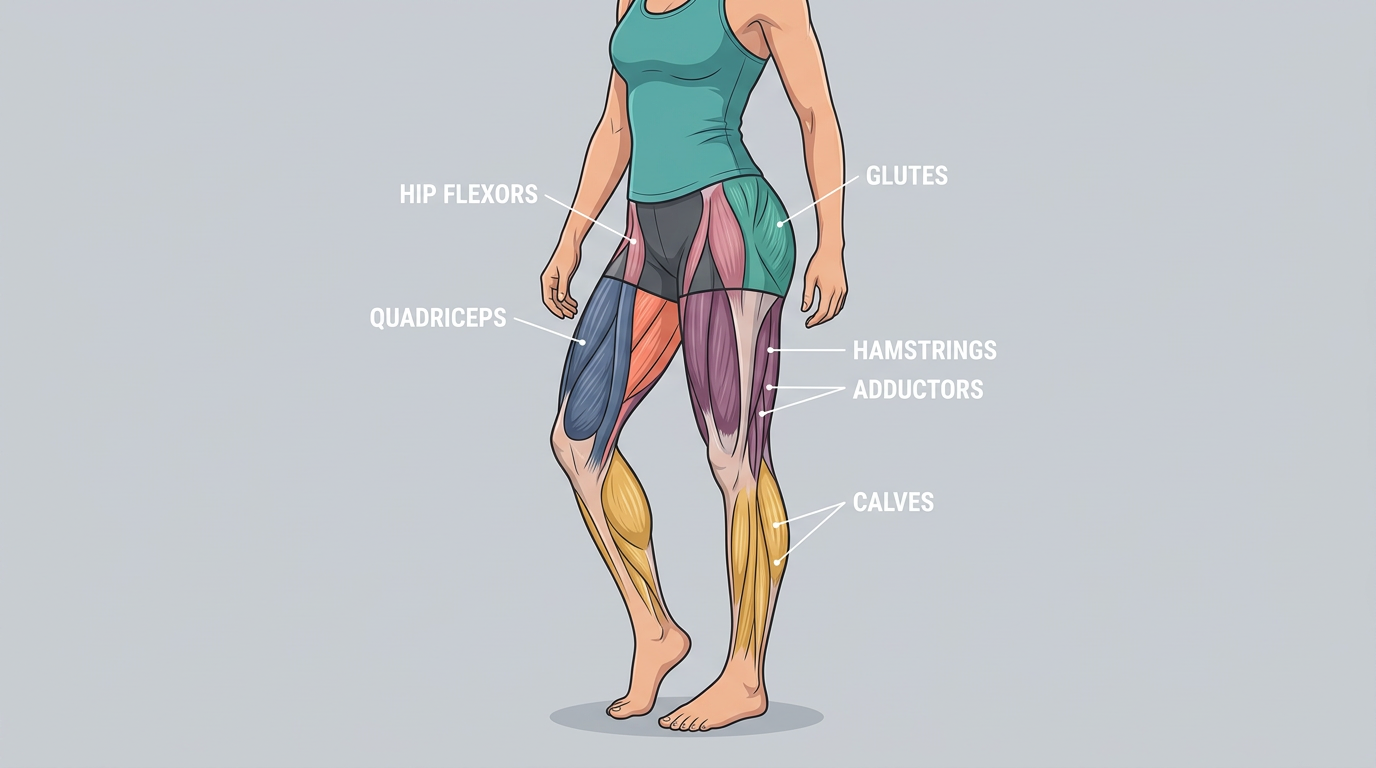
Detailed anatomical illustration of women's leg muscles showing quadriceps, hamstrings, glutes, adductors, calves, and hip flexors with clear labels and different colors for each muscle group
Understanding the Major Leg Muscle Groups
The leg muscles anatomy consists of six primary muscle groups that work in coordination to create movement, provide stability, and generate power. Each group has distinct functions, but they rarely work in isolation. Instead, they form kinetic chains that allow complex movements like walking, running, jumping, and changing direction.
For women building strength and sculpting their lower body, understanding these muscle groups helps you design balanced training programs. You'll know which exercises target which areas, how to correct imbalances, and why certain movement patterns feel more natural than others.
The Quadriceps: Your Front Thigh Powerhouses
The quadriceps consist of four distinct muscles on the front of your thigh: rectus femoris, vastus lateralis, vastus medialis, and vastus intermedius. These muscles work together to extend your knee and, in the case of the rectus femoris, help flex your hip.
Your quadriceps are essential for:
- Standing up from seated positions
- Climbing stairs and hills
- Squatting and lunging movements
- Decelerating when walking or running downhill
- Stabilizing your knee joint during weight-bearing activities
- Jumping and explosive lower body movements
Women often have naturally strong quadriceps relative to their hamstrings, which can create imbalances if not addressed through balanced training. The vastus medialis oblique (VMO), the teardrop-shaped muscle above your inner knee, is particularly important for knee stability and tracking.
The Hamstrings: Posterior Chain Essentials
Located on the back of your thigh, the hamstrings include three muscles: biceps femoris, semitendinosus, and semimembranosus. These muscles cross both the hip and knee joints, giving them dual functions in movement.
Your hamstrings are responsible for:
- Bending your knee (knee flexion)
- Extending your hip (moving your leg behind you)
- Decelerating forward movement and controlling speed
- Stabilizing your pelvis during standing activities
- Protecting your knee from excessive forward movement
The hamstrings are among the most injury-prone leg muscles, especially in women who have quad-dominant movement patterns. Strengthening these muscles through exercises like Romanian deadlifts, Nordic curls, and glute-ham raises helps create balance and reduces injury risk.
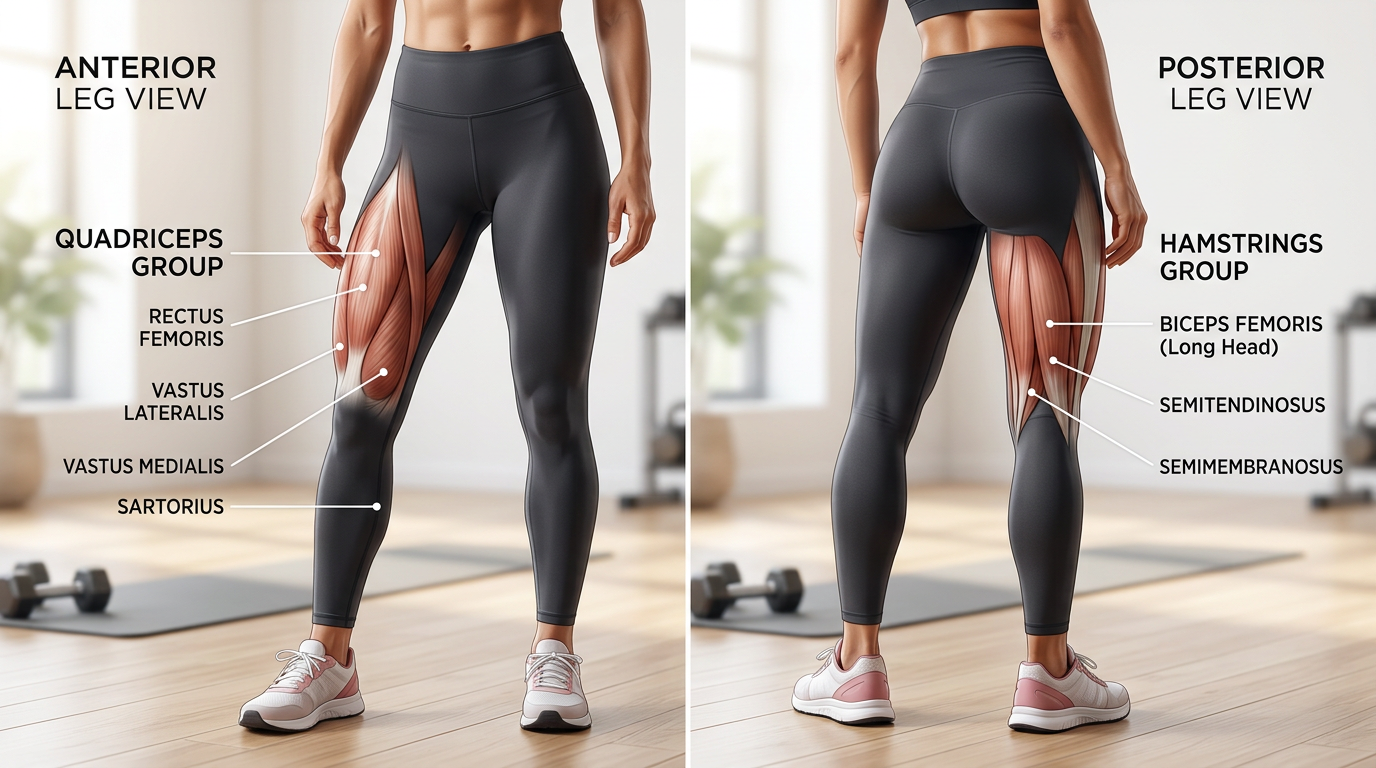
Side-by-side comparison showing quadriceps muscles on anterior leg view and hamstring muscles on posterior leg view with anatomical labels
The Glutes: More Than Just Aesthetics
The gluteal muscles—gluteus maximus, gluteus medius, and gluteus minimus—form the powerhouse of your hip and play crucial roles in nearly every lower body movement. While many women train glutes for aesthetic reasons, their functional importance cannot be overstated.
Your glutes control:
- Hip extension (standing up, climbing, sprinting)
- Hip abduction (moving your leg away from your body)
- Hip external rotation (turning your leg outward)
- Pelvic stability during single-leg activities
- Posture and spinal alignment
- Power generation for athletic movements
The gluteus medius, located on the side of your hip, is particularly important for women because weakness in this muscle contributes to knee valgus (knees caving inward), which increases injury risk. This muscle activates during every step you take, making it essential for walking, running, and maintaining balance.
The Supporting Cast: Adductors, Calves, and Hip Flexors
While the quadriceps, hamstrings, and glutes often receive the most attention, three additional muscle groups play vital roles in leg function and deserve equal consideration in your training program.
The Adductors: Inner Thigh Stabilizers
Your adductor muscles—adductor longus, adductor brevis, adductor magnus, gracilis, and pectineus—run along your inner thigh. These muscles bring your leg toward the midline of your body and provide crucial stability during movement.
Functions of the adductors include:
- Stabilizing your pelvis during walking and running
- Controlling side-to-side movements
- Assisting with hip flexion and extension
- Providing medial knee stability
- Supporting squatting and lunging movements
Many women neglect adductor training, focusing instead on abduction exercises for the outer glutes. This creates imbalances that can lead to groin strains and reduced hip stability. Incorporating exercises like Copenhagen planks, sumo squats, and lateral lunges addresses this gap.
The Calves: Foundation of Every Step
Your calf muscles—the gastrocnemius and soleus—form the posterior lower leg and are essential for ankle movement and stability. The gastrocnemius is the larger, more visible muscle with two heads, while the soleus lies underneath.
Your calves enable:
- Plantar flexion (pointing your toes)
- Pushing off during walking and running
- Absorbing impact when landing from jumps
- Maintaining balance and posture
- Returning blood from your legs to your heart
Strong calves are particularly important for women who wear heels regularly, as this footwear can shorten these muscles over time. Training both muscles requires different exercises: standing calf raises target the gastrocnemius, while seated calf raises emphasize the soleus.
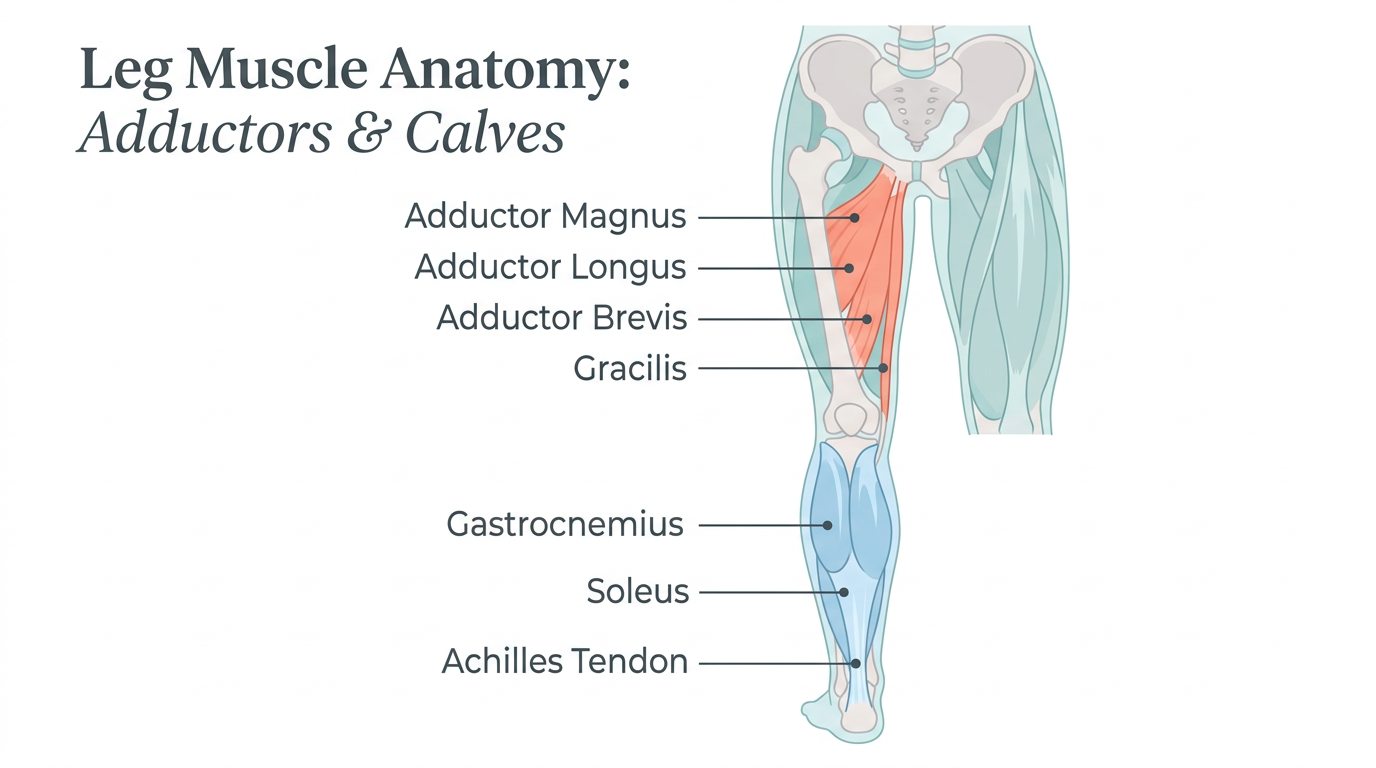
Anatomical diagram showing adductor muscles on inner thigh and calf muscles (gastrocnemius and soleus) on lower leg with clear labels
The Hip Flexors: The Most Neglected Muscle Group
Your hip flexors—primarily the iliopsoas (psoas major and iliacus), rectus femoris, and tensor fasciae latae—lift your knee toward your chest and flex your hip. The hip flexors are often considered the most neglected muscle group, especially in women who sit for extended periods.
These muscles control:
- Lifting your leg during walking and running
- Maintaining upright posture
- Stabilizing your lumbar spine
- Controlling hip extension during backswing movements
- Supporting core stability during standing activities
Prolonged sitting causes hip flexors to shorten and weaken simultaneously, creating a pattern of tightness that limits hip extension. This affects your squat depth, deadlift form, and even your walking gait. Regular stretching combined with strengthening exercises like leg raises and mountain climbers helps restore balance.
How Leg Muscles Work Together: The Kinetic Chain
Understanding individual muscles is important, but recognizing how they work together transforms your training approach. Leg muscles anatomy reveals that no muscle works in isolation—instead, they form kinetic chains that create coordinated movement patterns.
Agonist and Antagonist Relationships
Muscles work in pairs called agonist (prime mover) and antagonist (opposing muscle). When one contracts, the other lengthens to allow smooth movement. For example, when you extend your knee during a squat, your quadriceps contract (agonist) while your hamstrings lengthen (antagonist).
Key agonist-antagonist pairs in the legs include:
- Quadriceps and hamstrings (knee extension and flexion)
- Hip flexors and glutes (hip flexion and extension)
- Adductors and abductors (hip adduction and abduction)
- Dorsiflexors and plantar flexors (ankle movement)
Imbalances in these relationships increase injury risk and reduce performance. Women often develop quad dominance, where the quadriceps overpower the hamstrings, leading to knee stress and hamstring strains. Balanced training addresses both sides of these partnerships.
The Posterior Chain Connection
The posterior chain—hamstrings, glutes, and lower back muscles—works as an integrated unit to extend your hip and stabilize your spine. This chain is crucial for power generation, posture, and injury prevention.
When you perform a deadlift, for instance:
- Your glutes initiate hip extension, driving your hips forward
- Your hamstrings assist with hip extension and stabilize your knee
- Your lower back muscles maintain spinal position
- Your calves and core provide stability throughout the movement
Weakness anywhere in this chain forces other muscles to compensate, leading to inefficient movement and increased injury risk. This is why compound exercises that train the entire posterior chain are so effective for building functional strength.
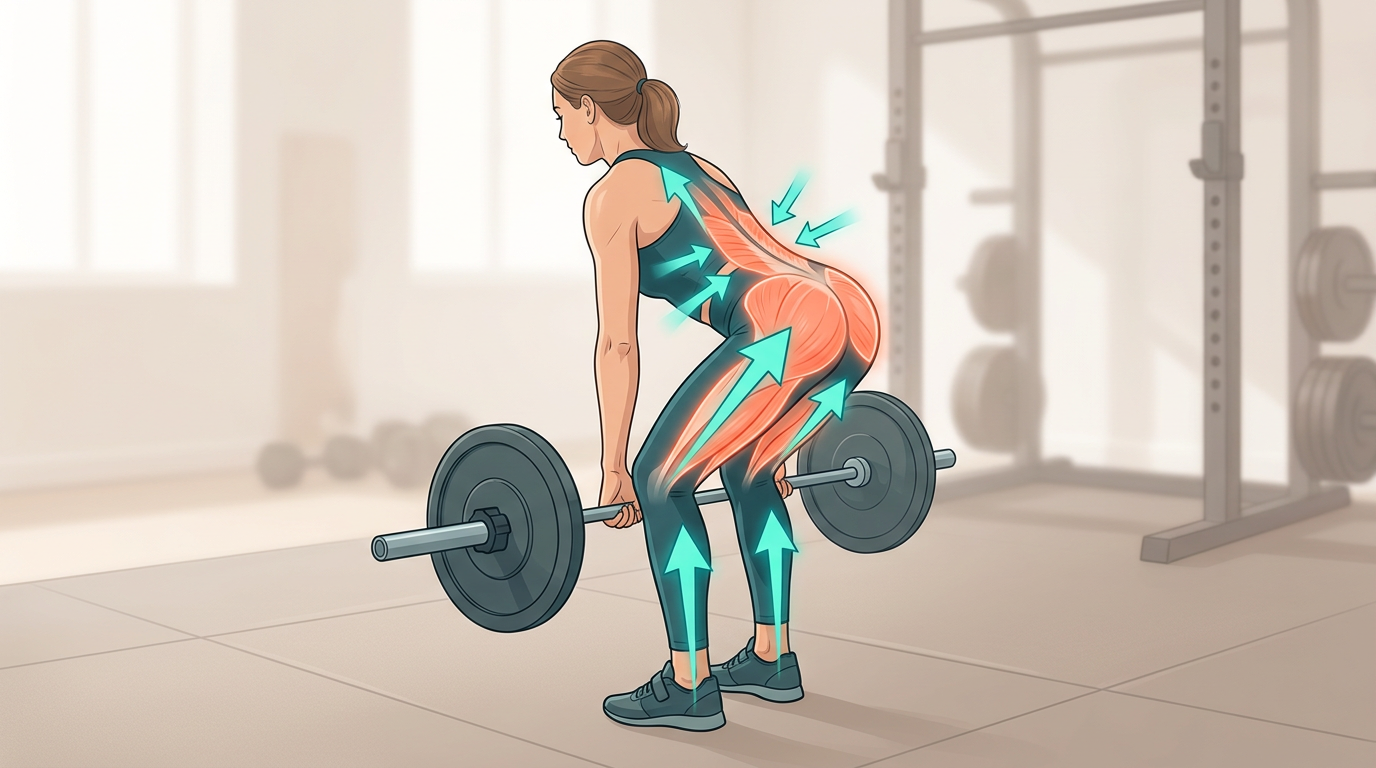
Illustration showing the posterior chain muscles (glutes, hamstrings, lower back) highlighted during a deadlift movement with arrows indicating force direction
Which Leg Muscles Are Most Important for Women?
While all leg muscles contribute to function and strength, certain muscle groups deserve special attention in women's training programs based on their roles in injury prevention, posture, and performance.
The Glutes: Foundation of Lower Body Strength
The gluteal muscles, particularly the gluteus maximus and gluteus medius, are the most important leg muscles for women's functional fitness and injury prevention. These muscles control hip stability, generate power for athletic movements, and maintain proper alignment of the entire lower body.
Strong glutes provide:
- Protection against knee injuries by controlling femur rotation
- Improved posture and reduced lower back pain
- Enhanced athletic performance in running, jumping, and lifting
- Better pelvic floor function and core stability
- Aesthetic improvements in lower body shape
Women are particularly susceptible to weak glutes due to prolonged sitting, wearing heels, and natural biomechanical differences. Prioritizing glute training through hip thrusts, deadlifts, and single-leg exercises addresses these vulnerabilities.
The Hamstrings: Injury Prevention Priority
The hamstrings rank as the second most important muscle group for women, primarily because they're the most prone to injury. Hamstring strains account for a significant portion of lower body injuries in both athletic and everyday activities.
Strengthening your hamstrings:
- Balances quad dominance common in women
- Protects your ACL from excessive strain
- Improves deceleration control during running and jumping
- Supports proper pelvic alignment
- Enhances posterior chain strength for lifting movements
Eccentric hamstring training—where you emphasize the lengthening phase of exercises—has been shown to significantly reduce injury rates. Nordic curls, Romanian deadlifts, and single-leg deadlifts are particularly effective.
The Gluteus Medius: The Unsung Hero
While smaller than the gluteus maximus, the gluteus medius deserves special mention as a critical muscle for women's lower body health. This hip abductor prevents your knee from collapsing inward during single-leg activities, a movement pattern that increases ACL injury risk.
Women have wider pelvises and greater Q-angles (the angle between your hip and knee), which increases stress on the knee joint. A strong gluteus medius counteracts this biomechanical disadvantage by maintaining proper knee alignment during movement.
Common Leg Muscle Injuries and How to Prevent Them
Understanding which leg muscles are most vulnerable helps you take proactive steps to prevent injuries and recognize warning signs early.
Which Leg Muscle Is Most Prone to Injury?
The hamstrings are the most injury-prone leg muscles, particularly the biceps femoris at the musculotendinous junction where muscle meets tendon. Hamstring strains occur during rapid acceleration, deceleration, or when the muscle is stretched under load.
Hamstring injuries are common because:
- The muscles cross two joints (hip and knee), increasing complexity
- They work eccentrically during high-speed movements
- Many women have strength imbalances favoring the quadriceps
- Flexibility limitations increase strain during lengthening
- Previous hamstring injuries increase reinjury risk
Prevention strategies include progressive eccentric training, maintaining hamstring-to-quadriceps strength ratios of at least 60%, adequate warm-up before intense activity, and addressing flexibility limitations through dynamic stretching.
Other Common Leg Muscle Injuries
Beyond hamstring strains, several other leg muscle injuries affect women regularly:
- Quadriceps strains: Often occur during kicking or sprinting movements
- Calf strains: Common in runners and women returning to exercise after time off
- Adductor strains: Frequent in activities involving side-to-side movement or overstretching
- Hip flexor strains: Result from sudden acceleration or excessive hip flexion under load
Most muscle strains are classified by severity: Grade 1 (mild strain with minimal damage), Grade 2 (moderate strain with partial tearing), and Grade 3 (complete rupture requiring medical intervention).
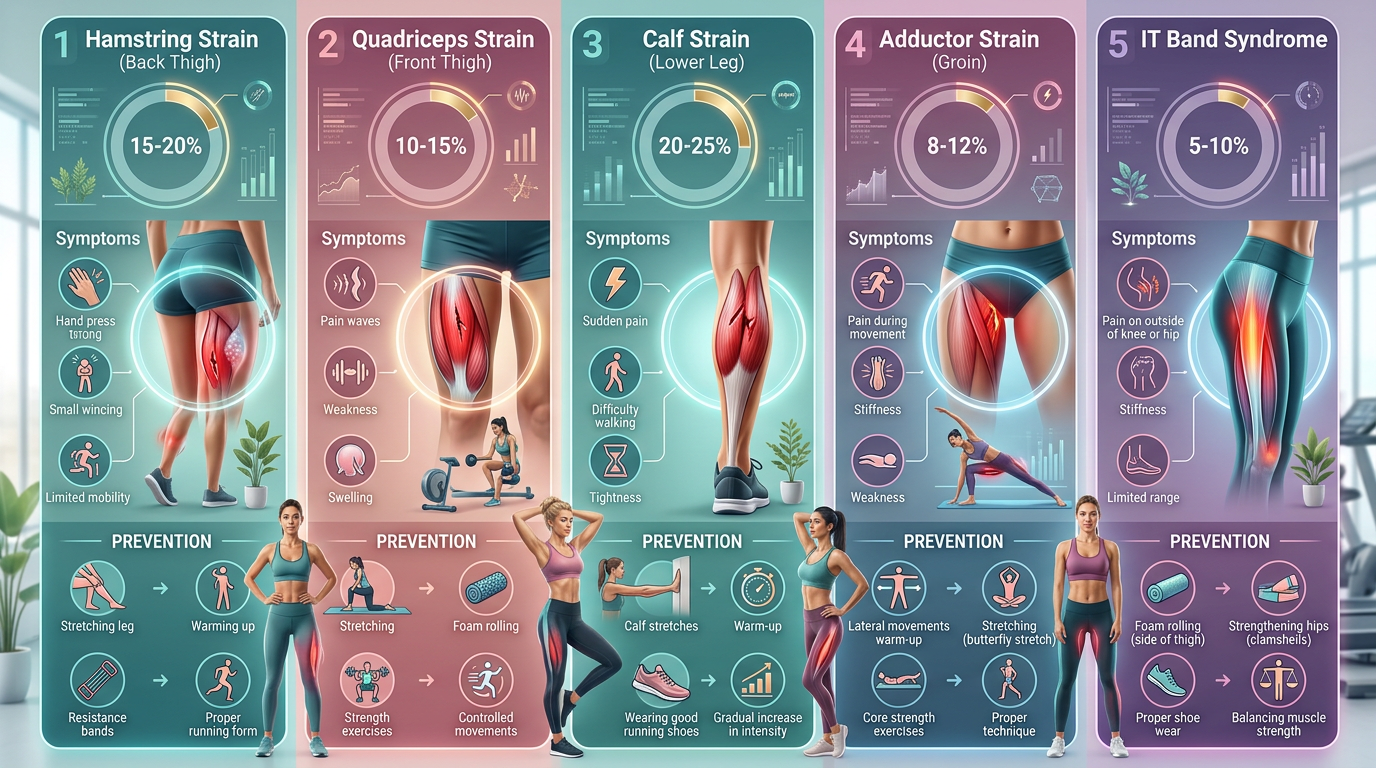
Infographic showing the five most common leg muscle injuries in women with percentage of occurrence, symptoms, and prevention tips for each
How to Know If Leg Pain Is Muscular
Muscular leg pain typically presents as a dull ache or sharp pain that worsens with muscle contraction, improves with rest, and responds well to stretching and gentle movement. The pain is usually localized to a specific muscle or area and may be accompanied by tenderness, swelling, or bruising.
Signs that leg pain is muscular include:
- Pain that increases when you contract or stretch the affected muscle
- Tenderness when you press on the specific muscle
- Improvement with rest, ice, and gentle stretching
- Recent increase in activity or new exercise
- Visible swelling or bruising in the area
- Pain that feels better after warming up the muscle
In contrast, joint pain typically occurs at specific points (knee, hip, ankle), feels worse with weight-bearing, and may include clicking, popping, or locking sensations. Nerve pain often radiates, causes numbness or tingling, and may feel like burning or shooting sensations.
If leg pain persists beyond a few days, worsens despite rest, or is accompanied by severe swelling, inability to bear weight, or numbness, consult a healthcare provider to rule out more serious conditions.
Training Your Leg Muscles: A Functional Approach
Understanding leg muscles anatomy becomes practical when you apply it to your training. A functional approach emphasizes exercises that train muscles in coordinated patterns rather than isolation.
Compound Movements for Complete Development
Compound exercises train multiple muscle groups simultaneously, creating functional strength that translates to real-world activities. These movements form the foundation of effective leg training:
- Squats: Train quadriceps, glutes, hamstrings, adductors, and core in a coordinated pattern that mimics everyday movements
- Deadlifts: Emphasize the entire posterior chain while building hip hinge mechanics essential for lifting objects safely
- Lunges: Develop single-leg strength, balance, and stability while targeting all major leg muscle groups
- Hip thrusts: Isolate and strengthen the glutes more effectively than most other exercises
- Step-ups: Build unilateral strength and power while improving balance and coordination
These exercises should form the core of your leg training, with variations and progressions added based on your goals and experience level.
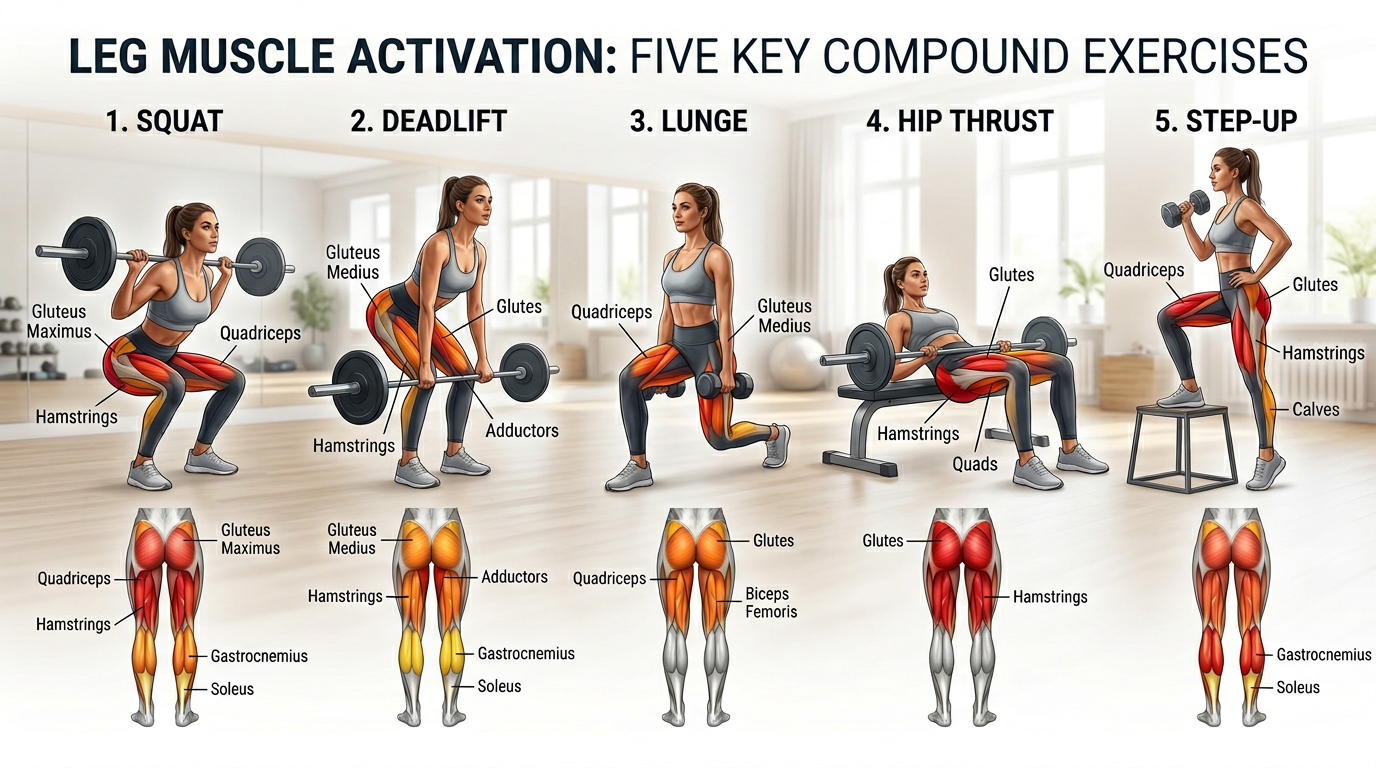
Diagram showing which leg muscles are activated during five key compound exercises (squat, deadlift, lunge, hip thrust, step-up) with color-coded muscle activation levels
Addressing Muscle Imbalances
Most women develop predictable imbalances in their leg muscles anatomy based on lifestyle factors and training history. Common patterns include:
- Quad dominance: Quadriceps overpower hamstrings, leading to knee stress
- Weak gluteus medius: Results in knee valgus and hip instability
- Tight hip flexors: Limit hip extension and contribute to anterior pelvic tilt
- Neglected adductors: Reduce hip stability and increase groin strain risk
- Underdeveloped calves: Limit ankle stability and power transfer
Correcting these imbalances requires targeted exercises, strategic exercise selection, and attention to movement quality. For example, if you're quad-dominant, emphasize posterior chain exercises like Romanian deadlifts and Nordic curls while ensuring you feel your glutes and hamstrings working during squats.
Progressive Overload for Continued Growth
Your leg muscles adapt to training stress by becoming stronger and more resilient. To continue making progress, you must progressively increase the demands you place on them through:
- Increased weight: Adding load to exercises over time
- More volume: Performing additional sets or repetitions
- Greater frequency: Training legs more often per week
- Enhanced intensity: Using techniques like tempo training or pauses
- Improved range of motion: Gradually increasing depth or stretch
- Exercise progression: Moving to more challenging variations
Track your workouts to ensure you're applying progressive overload consistently. Small, incremental increases over time produce better results than sporadic jumps in difficulty.
Flexibility and Mobility for Leg Muscle Health
Strong muscles need adequate flexibility and mobility to function optimally. Understanding how your leg muscles anatomy affects your range of motion helps you address limitations effectively.
The Difference Between Flexibility and Mobility
Flexibility refers to a muscle's ability to lengthen passively, while mobility describes your ability to actively move a joint through its full range of motion. Both are important, but mobility—which requires strength, coordination, and control—is more functional.
For example, you might have the flexibility to touch your toes in a seated forward fold, but if you can't perform a deep squat with control, you have a mobility limitation. This distinction matters because it guides your approach to improving movement quality.
Essential Stretches for Major Leg Muscles
Incorporate these stretches to maintain healthy leg muscle length and reduce injury risk:
- Hip flexor stretch: Addresses tightness from prolonged sitting
- Hamstring stretch: Improves posterior chain flexibility
- Quadriceps stretch: Balances anterior thigh tension
- Calf stretch: Maintains ankle mobility and Achilles health
- Glute stretch: Releases tension in hip extensors
- Adductor stretch: Opens inner thigh and improves squat depth
Hold static stretches for 30-60 seconds after workouts when muscles are warm. Before training, use dynamic stretches and mobility drills that take joints through their full range of motion without prolonged holds.
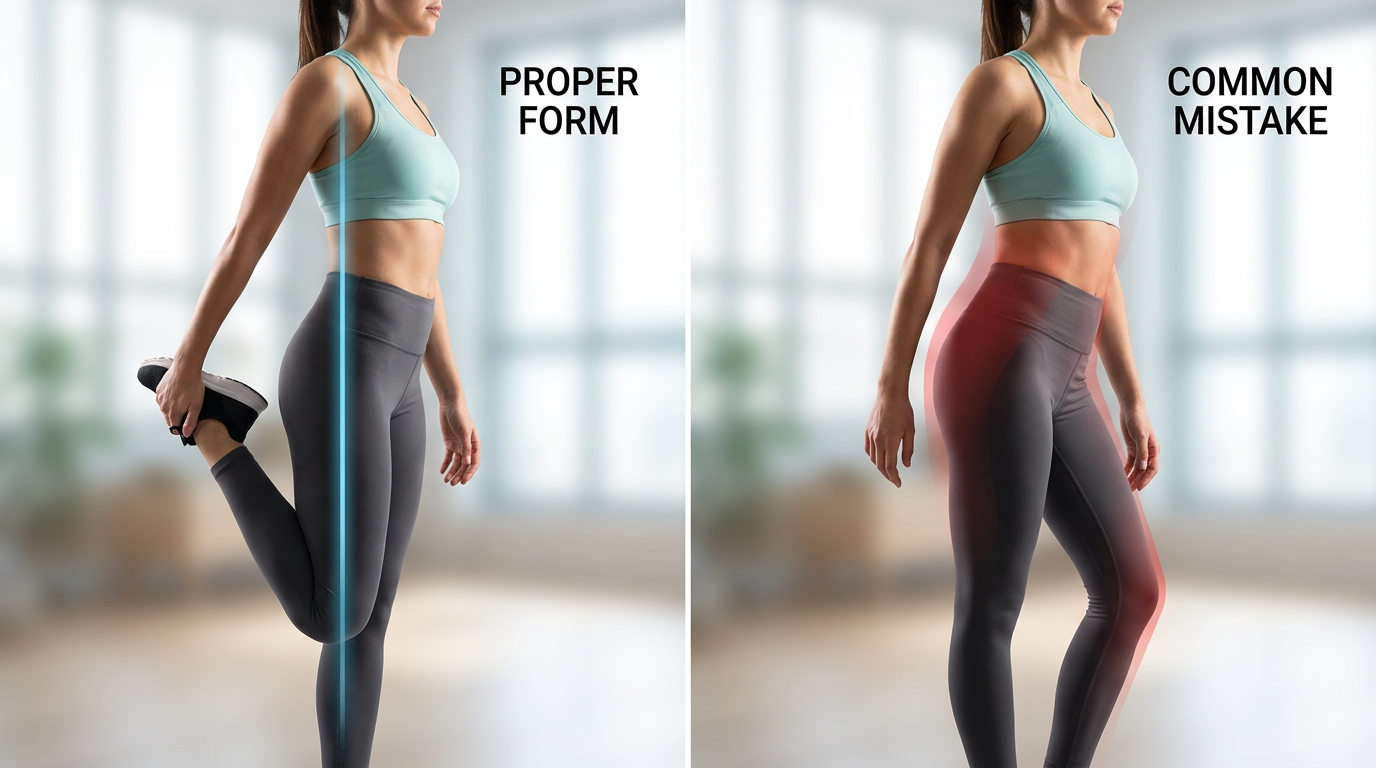
Step-by-step visual guide showing proper form for six essential leg muscle stretches with alignment cues and common mistakes to avoid
Mobility Drills for Better Movement
Mobility work prepares your legs for training and improves movement patterns. Effective drills include:
- 90/90 hip rotations: Improve internal and external hip rotation
- World's greatest stretch: Addresses multiple muscle groups in one flowing movement
- Cossack squats: Build lateral mobility and adductor strength
- Ankle circles and dorsiflexion drills: Maintain ankle mobility for proper squat mechanics
- Leg swings: Dynamically warm up hip flexors, extensors, and abductors
Perform mobility work before training sessions and on rest days to maintain and improve your movement capacity over time.
Leg Muscles Anatomy and Women's Biomechanics
Women's leg muscles anatomy functions within a unique biomechanical context that affects training considerations, injury risk, and movement patterns.
Structural Differences That Matter
Several anatomical differences between men and women influence how leg muscles function:
- Wider pelvis: Creates a larger Q-angle, increasing knee stress during movement
- Greater joint laxity: Provides more flexibility but reduces joint stability
- Different muscle fiber composition: Women typically have higher proportions of Type I (endurance) muscle fibers
- Lower relative strength: Women have less absolute strength but similar strength relative to muscle mass
- Hormonal influences: Estrogen affects ligament laxity and injury risk throughout the menstrual cycle
These differences aren't limitations—they're characteristics that inform smart training decisions. For instance, the wider Q-angle makes gluteus medius strengthening particularly important for maintaining proper knee tracking.
Training Considerations for Women
Understanding your biomechanics helps you optimize your training approach:
- Emphasize glute and hamstring development to protect knees from valgus stress
- Include single-leg exercises to address side-to-side imbalances
- Focus on movement quality before adding significant load
- Incorporate hip abduction and external rotation work to strengthen stabilizers
- Use higher training volumes to capitalize on greater endurance capacity
- Monitor training during different menstrual cycle phases when joint laxity changes
These adjustments don't mean women need fundamentally different training—the same exercises and principles apply. Rather, they highlight areas that deserve extra attention for optimal results and injury prevention.
Frequently Asked Questions
What is the most neglected muscle in leg training?
The hip flexors are the most neglected muscle group in leg training, particularly the iliopsoas complex. Prolonged sitting weakens these muscles while simultaneously creating tightness, limiting hip extension during squats and deadlifts. Incorporating exercises like leg raises, mountain climbers, and hip flexor stretches addresses this common weakness and improves overall leg function.
Which leg muscle is most prone to injury?
The hamstrings are the most injury-prone leg muscles, particularly during rapid acceleration, deceleration, or eccentric loading. The biceps femoris at the musculotendinous junction is especially vulnerable. Prevention includes eccentric training like Nordic curls, maintaining proper hamstring-to-quadriceps strength ratios, and adequate warm-up before intense activities.
How to know if leg pain is muscular?
Muscular leg pain worsens with muscle contraction or stretching, improves with rest, and feels localized to a specific muscle area. It typically presents as a dull ache or sharp pain with tenderness when pressed. Joint pain occurs at specific points and worsens with weight-bearing, while nerve pain radiates and causes numbness or tingling sensations.
Which leg muscles are most important for women?
The glutes, particularly the gluteus maximus and gluteus medius, are the most important leg muscles for women's functional fitness and injury prevention. They control hip stability, generate power, and maintain proper lower body alignment. Strong glutes protect against knee injuries, improve posture, reduce lower back pain, and enhance athletic performance across all activities.
How often should women train leg muscles?
Women should train leg muscles 2-3 times per week for optimal strength and development, allowing 48-72 hours between sessions for recovery. This frequency provides adequate stimulus for muscle growth while preventing overtraining. Beginners may start with twice weekly, while advanced lifters can handle three sessions with varied intensities and exercise selections.
Can you target specific areas within leg muscles?
While you cannot completely isolate specific areas within a muscle, exercise selection and technique can emphasize different regions. For example, high-bar squats emphasize quadriceps more than low-bar squats, and Romanian deadlifts target hamstrings differently than leg curls. Varying exercises, foot positions, and ranges of motion creates more complete development.
Why do women often have quad dominance?
Women often develop quad dominance due to biomechanical factors like wider pelvises and larger Q-angles, combined with lifestyle factors like prolonged sitting and heel-wearing. Many exercise programs also emphasize anterior chain exercises over posterior chain work. Correcting this imbalance requires targeted hamstring and glute training, proper hip hinge technique, and attention to movement patterns.
Conclusion: Building Strong, Resilient Legs Through Anatomical Understanding
Understanding leg muscles anatomy transforms your approach to training, injury prevention, and functional movement. The six major muscle groups—quadriceps, hamstrings, glutes, adductors, calves, and hip flexors—work together in coordinated patterns to create strength, stability, and power. By recognizing how these muscles function individually and as part of kinetic chains, you can design balanced training programs that address weaknesses, correct imbalances, and build comprehensive lower body strength.
The most important takeaway is that no muscle works in isolation. Your glutes, hamstrings, and quadriceps form partnerships that require balanced development. Prioritizing posterior chain strength, addressing common weaknesses like underdeveloped hip flexors and gluteus medius, and training through full ranges of motion creates legs that are not only strong but also resilient and functional. Whether your goal is lifting heavier weights, moving through daily activities with ease, or building confidence through physical capability, understanding your leg muscles anatomy provides the foundation for sustainable progress.
Apply progressive overload principles, maintain flexibility and mobility, and listen to your body's signals to build the strong, capable legs that support all your fitness and life goals.