The Best Inner Thigh Workout to Tone Fast
Inner thigh workouts target the adductor muscles through exercises like sumo squats, lateral lunges, and side-lying leg lifts. The most effective routines combine compound movements with isolation exercises, performed 2-3 times weekly with progressive resistance for visible toning results within 4-6 weeks.
If you've ever struggled to find exercises that truly target your inner thighs, you're not alone. Over 70% of women report difficulty toning their inner thigh area, making it one of the most challenging muscle groups to strengthen and sculpt. The good news? With the right inner thigh workout approach, you can build strength, improve muscle definition, and feel more confident in your body.
The inner thighs, or adductor muscles, play a crucial role in stabilizing your hips, supporting your knees, and enabling lateral movements. Yet many traditional workout routines overlook these important muscles entirely. This comprehensive guide will walk you through the best inner thigh exercises, proper form techniques, and a complete workout plan designed specifically for women who want real results.
Created by certified trainer Shelley Darlington with 15+ years experience, this science-backed approach has helped thousands of women develop stronger, more toned legs. Whether you're working out at home or in the gym, you'll discover exercises that fit your fitness level and lifestyle.
Key Takeaways
- Inner thigh workouts should target all five adductor muscles through varied movement patterns
- Combining compound exercises with isolation movements produces the fastest toning results
- Progressive overload with proper form is more effective than high reps with poor technique
- Consistency matters more than intensity—train inner thighs 2-3 times weekly for optimal results
- Nutrition and overall body fat reduction complement targeted strengthening for visible definition
Understanding Your Inner Thigh Muscles
Before diving into the best inner thigh workout routines, it's essential to understand what you're actually training. Your inner thighs consist of five adductor muscles: the adductor longus, adductor brevis, adductor magnus, gracilis, and pectineus. These muscles work together to bring your legs toward your body's midline, stabilize your pelvis, and support hip rotation.
Why Inner Thighs Are Challenging to Tone
The adductor muscles are often undertrained because most popular exercises focus on the quads, hamstrings, and glutes. Additionally, women naturally store more subcutaneous fat in the thigh area due to hormonal factors, which can make muscle definition less visible even when the muscles are strong.
Many women over 35 focused on strength training and body recomposition find that traditional leg exercises don't adequately challenge the inner thighs. This is where targeted adductor work becomes essential for balanced lower body development.
The Role of Inner Thighs in Functional Fitness
Strong adductors aren't just about aesthetics. These muscles are critical for:
- Preventing knee injuries by stabilizing the joint during movement
- Improving balance and coordination in daily activities
- Supporting proper squat and lunge mechanics
- Enhancing athletic performance in sports requiring lateral movement
- Reducing hip and lower back pain through better pelvic stability
The Strong Curves glute-focused approach to functional fitness emphasizes the connection between strong adductors and overall lower body power, making inner thigh training an integral part of any comprehensive program.
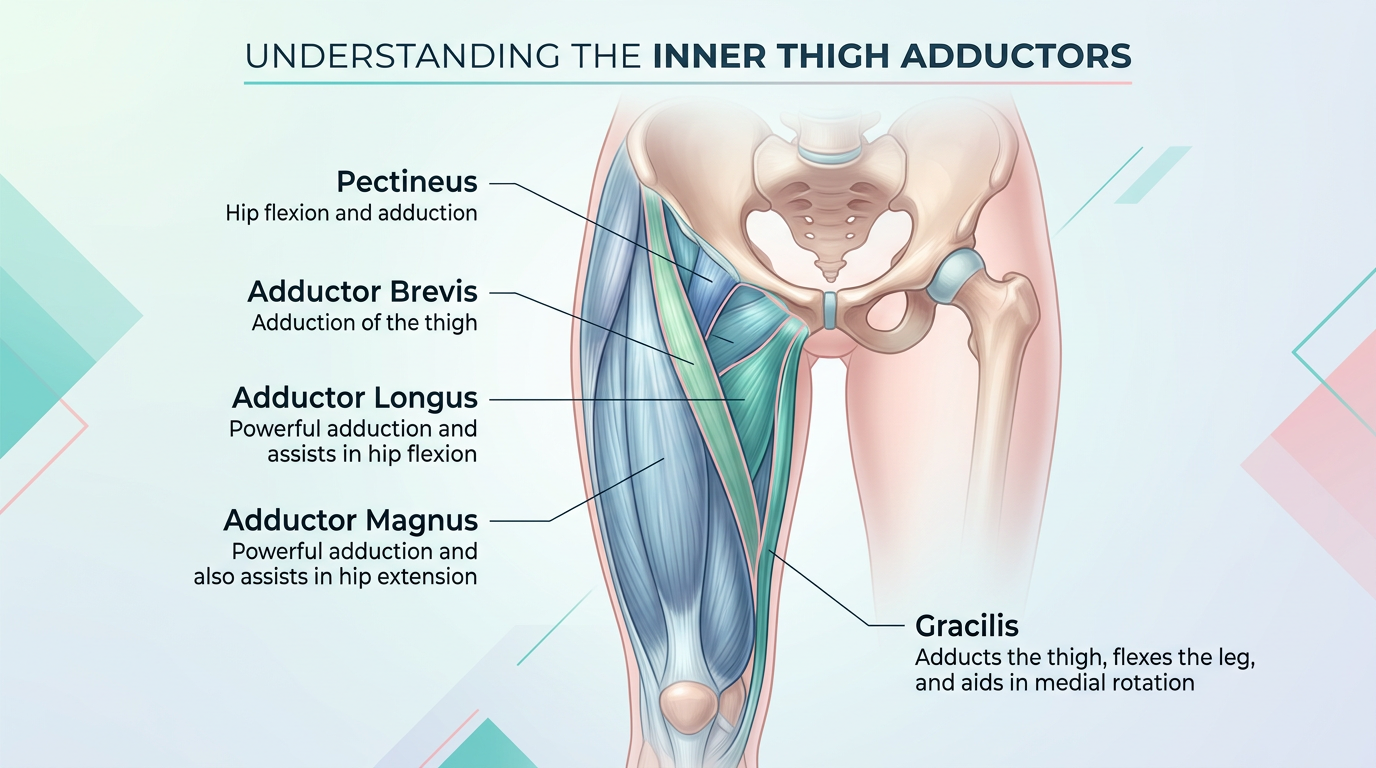
Anatomical diagram showing the five inner thigh adductor muscles (adductor longus, brevis, magnus, gracilis, and pectineus) with labels highlighting their location and function in the leg
Comparison of the Best Inner Thigh Exercises
Exercise
Difficulty Level
Equipment Needed
Primary Benefit
Sumo Squats
Beginner
Optional weights
Compound strength building
Lateral Lunges
Beginner-Intermediate
None or dumbbells
Functional mobility
Copenhagen Planks
Advanced
Bench or chair
Maximum adductor activation
Side-Lying Leg Lifts
Beginner
None
Isolation and control
Curtsy Lunges
Intermediate
Optional weights
Multi-plane movement
Banded Lateral Walks
Beginner-Intermediate
Resistance band
Hip stability
Glute Bridges with Squeeze
Beginner
Pilates ball or block
Posterior chain integration
Cable Adductions
Intermediate
Cable machine
Isolated resistance training
Scissor Kicks
Beginner-Intermediate
None
Core and adductor endurance
Slider Side Lunges
Intermediate-Advanced
Sliders or towels
Eccentric strength
1. Sumo Squats
Sumo squats are the foundation of any effective inner thigh workout. By taking a wider stance with toes pointed outward, you shift emphasis from the quads to the adductors and glutes. This compound movement builds functional strength while targeting multiple muscle groups simultaneously.
To perform sumo squats correctly, stand with feet 1.5 to 2 times shoulder-width apart, toes angled 30-45 degrees outward. Keep your chest lifted, core engaged, and lower down by pushing your hips back and bending your knees. Drive through your heels to return to standing, squeezing your inner thighs at the top.
Start with bodyweight to master the form, then progress to holding a dumbbell or kettlebell at chest height. Aim for 3-4 sets of 12-15 repetitions. Based on feedback from thousands of Strong Curves app users, adding a 2-second pause at the bottom significantly increases adductor activation.
Pros
- Excellent compound exercise that works multiple muscle groups
- Easy to progress by adding weight
- Functional movement pattern for daily activities
- Can be performed anywhere with minimal equipment
Cons
- Requires good hip mobility for proper depth
- Form breaks down easily when fatigued
- May cause knee discomfort if stance is too wide
2. Lateral Lunges
Lateral lunges train your inner thighs through their full range of motion while improving hip mobility and balance. This side-to-side movement pattern is often neglected in traditional workout routines, making it especially valuable for comprehensive leg development.
Begin standing with feet hip-width apart. Step your right foot out to the side approximately 2-3 feet, keeping your left leg straight. Bend your right knee and push your hips back, lowering into a lunge position while keeping your chest up. Push through your right heel to return to the starting position, feeling the inner thigh of your straight leg engage throughout the movement.
Perform 10-12 reps on each side for 3 sets. You can hold dumbbells at your sides or a single weight at chest height for added resistance. This exercise particularly benefits women seeking to improve lateral stability and reduce knee injury risk.
Pros
- Develops lateral movement strength often missing in workouts
- Improves hip and ankle mobility
- Unilateral training helps correct muscle imbalances
- Low impact on joints when performed correctly
Cons
- Requires significant hip flexibility
- Balance can be challenging initially
- Takes practice to maintain proper alignment
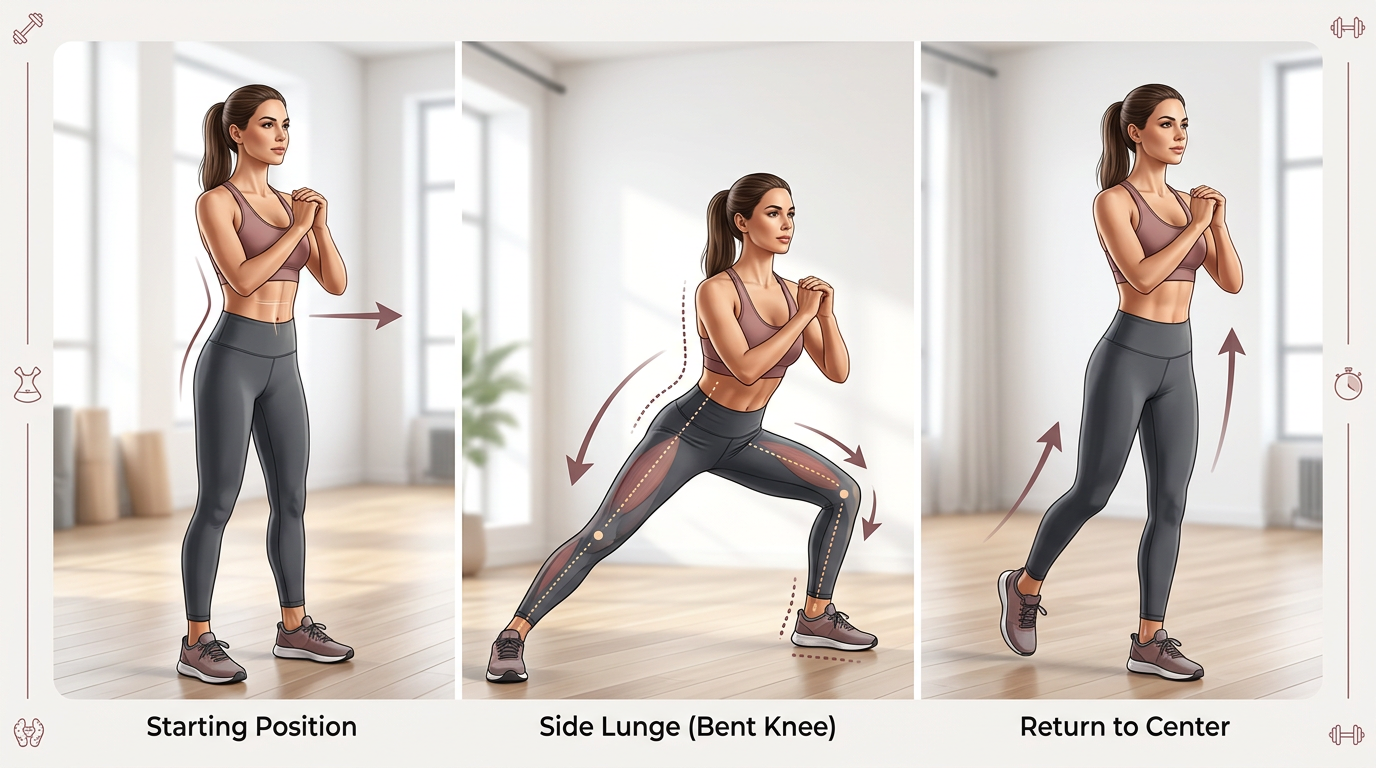
Step-by-step demonstration of lateral lunge form showing starting position, side lunge with bent knee, and return to center, with arrows indicating proper movement direction and form cues
3. Copenhagen Planks
Copenhagen planks are the most advanced inner thigh exercise on this list, delivering intense adductor activation that research shows can be up to 4 times greater than traditional exercises. This exercise originated from injury prevention programs for soccer players and has become a gold standard for adductor strengthening.
Position yourself sideways next to a bench or sturdy chair. Place your top foot on the elevated surface and lift your body into a side plank position, with your bottom leg either bent (easier) or straight (harder). Your body should form a straight line from head to heels. Hold this position for 15-30 seconds, focusing on keeping your hips elevated and preventing any sagging.
Start with 2-3 sets per side, resting 60-90 seconds between sets. This exercise is particularly effective for women who have mastered basic inner thigh movements and want to take their training to the next level.
Pros
- Highest level of adductor muscle activation
- Builds exceptional hip stability and core strength
- Proven effective for injury prevention
- Time-efficient isometric exercise
Cons
- Very challenging for beginners
- Requires elevated surface and space
- Can strain groin if progressed too quickly
- Difficult to maintain proper form when fatigued
4. Side-Lying Leg Lifts
Side-lying leg lifts provide excellent isolation work for the inner thighs, allowing you to focus purely on adductor contraction without the complexity of compound movements. This exercise is perfect for beginners or as a finishing movement after more demanding exercises.
Lie on your right side with your body in a straight line. Bend your top (left) leg and place that foot flat on the floor in front of your bottom leg. Keep your bottom (right) leg straight and lift it toward the ceiling as high as comfortable. Lower with control and repeat for 15-20 reps before switching sides.
For added resistance, wear ankle weights or use a resistance band around your thighs. Focus on controlled movements rather than speed—quality always trumps quantity for muscle toning. Many women find this exercise particularly effective when performed slowly with a 1-second hold at the top.
Pros
- Perfect for beginners and all fitness levels
- Excellent mind-muscle connection with adductors
- No equipment required
- Low impact and joint-friendly
- Easy to add progressive resistance
Cons
- Limited resistance without added weight
- Can become monotonous
- Less functional than compound movements
5. Curtsy Lunges
Curtsy lunges add a rotational component to traditional lunges, creating a unique challenge for your inner thighs, glutes, and core. This multi-plane movement builds strength that translates directly to real-world activities requiring balance and coordination.
Stand with feet hip-width apart. Step your right leg diagonally behind and to the left of your left leg, as if performing a curtsy. Lower your hips until your left thigh is parallel to the ground, keeping your torso upright. Push through your left heel to return to standing. Alternate legs or complete all reps on one side before switching, performing 10-12 reps per leg for 3 sets.
Hold dumbbells at your sides or at shoulder height for increased difficulty. This exercise works exceptionally well in a glute-focused leg workout routine when paired with hip thrusts and deadlifts.
Pros
- Targets inner thighs, glutes, and quads simultaneously
- Improves balance and coordination
- Adds variety to traditional lunge patterns
- Easily scalable with added weight
Cons
- Requires good balance and coordination
- Can stress knees if form is incorrect
- More complex movement pattern to learn
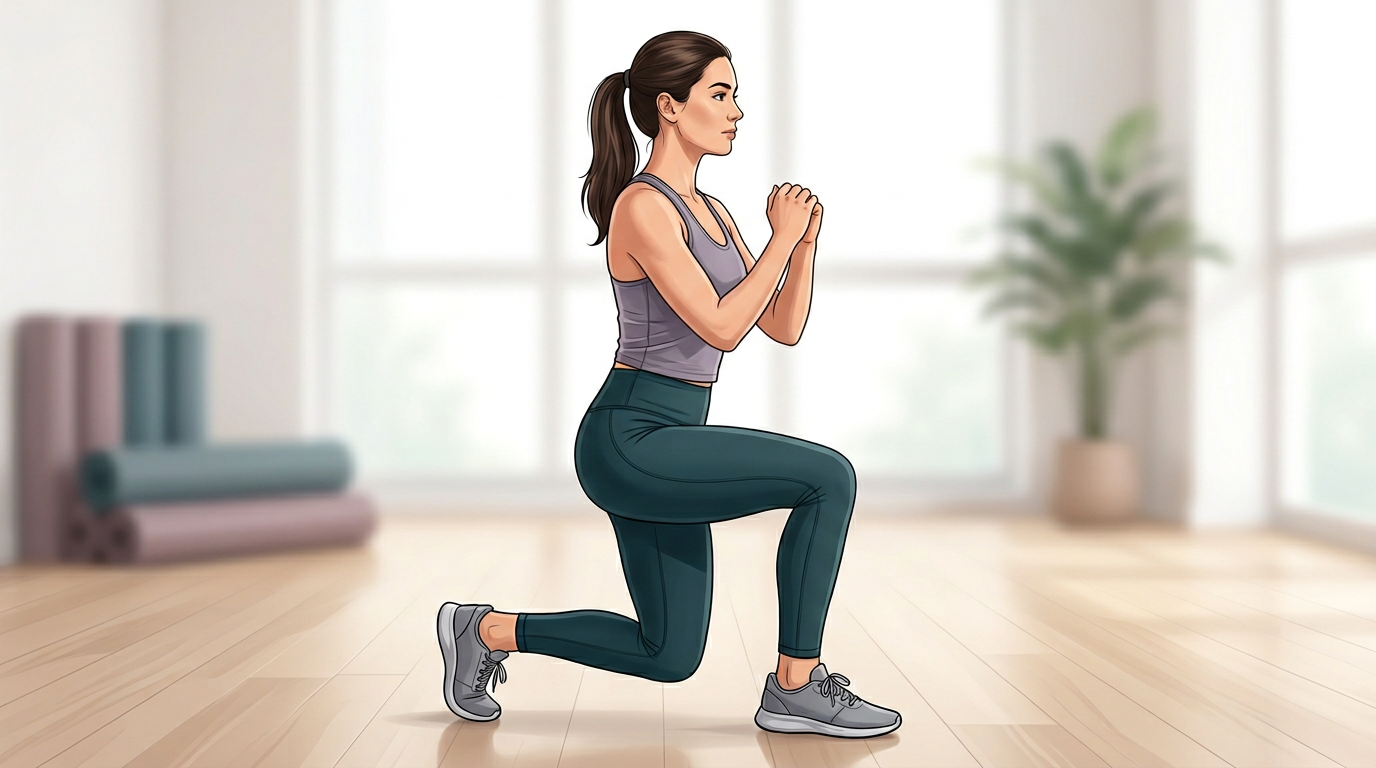
Woman demonstrating curtsy lunge exercise showing proper form from side angle, with one leg crossed behind the other in curtsy position, highlighting knee alignment and upright torso position
6. Banded Lateral Walks
Banded lateral walks are a staple in physical therapy and athletic training programs because they effectively strengthen the hip abductors and adductors while improving lateral stability. This exercise is particularly valuable for women who experience knee pain or want to prevent future injuries.
Place a resistance band around your legs, either above your knees or around your ankles (ankle placement is more challenging). Stand with feet hip-width apart, creating tension in the band. Bend your knees slightly into a quarter-squat position. Step sideways with your right foot, then follow with your left foot, maintaining constant tension in the band. Take 10-15 steps in one direction, then reverse for 10-15 steps back.
Complete 3 sets in each direction. Keep your core engaged and avoid letting your knees cave inward. This exercise works beautifully as a warm-up before heavier leg training or as part of your main inner thigh workout.
Pros
- Excellent for hip stability and injury prevention
- Minimal equipment required
- Can be performed anywhere
- Great warm-up or activation exercise
- Easy to adjust resistance by changing band tension
Cons
- Requires resistance band
- Can feel awkward initially
- Limited strength-building potential compared to weighted exercises
7. Glute Bridges with Squeeze
Adding an inner thigh squeeze to traditional glute bridges creates a powerful combination exercise that targets your posterior chain while intensely activating your adductors. This modification transforms a standard glute exercise into one of the best inner thigh workout movements.
Lie on your back with knees bent and feet flat on the floor, hip-width apart. Place a small Pilates ball, yoga block, or even a rolled towel between your knees. Squeeze the object between your knees as you lift your hips toward the ceiling, creating a straight line from shoulders to knees. Hold for 2 seconds at the top, maintaining the squeeze, then lower with control.
Perform 15-20 reps for 3-4 sets. You can progress this exercise by adding a barbell or placing a weight plate on your hips. The constant isometric contraction of your inner thighs throughout the movement creates significant muscle activation and endurance.
Pros
- Targets glutes and inner thighs simultaneously
- Minimal equipment needed
- Safe for all fitness levels
- Excellent for posterior chain development
- Can be easily progressed with added weight
Cons
- Requires small ball or block for optimal effect
- May cause lower back strain if form is poor
- Limited range of motion compared to other exercises
8. Cable Adductions
Cable adductions provide smooth, constant tension throughout the entire range of motion, making them ideal for building muscle definition and strength. This gym-based exercise allows for precise resistance adjustments and excellent muscle isolation.
Attach an ankle cuff to a low cable pulley and secure it around your right ankle. Stand perpendicular to the machine with your right leg furthest from the cable. Support yourself on a stable surface if needed. Keeping your leg straight, pull your right leg across your body past your standing leg, then return with control to the starting position.
Complete 12-15 reps on each leg for 3 sets. Focus on controlled movements rather than swinging the leg. The constant tension from the cable creates a unique stimulus that bodyweight exercises can't replicate, making this valuable for breaking through plateaus.
Pros
- Constant tension throughout the movement
- Precise resistance control
- Excellent for muscle isolation
- Easy to track progressive overload
Cons
- Requires gym access and cable machine
- Can be intimidating for beginners
- Less functional than compound movements
- Equipment may not be available during busy gym times
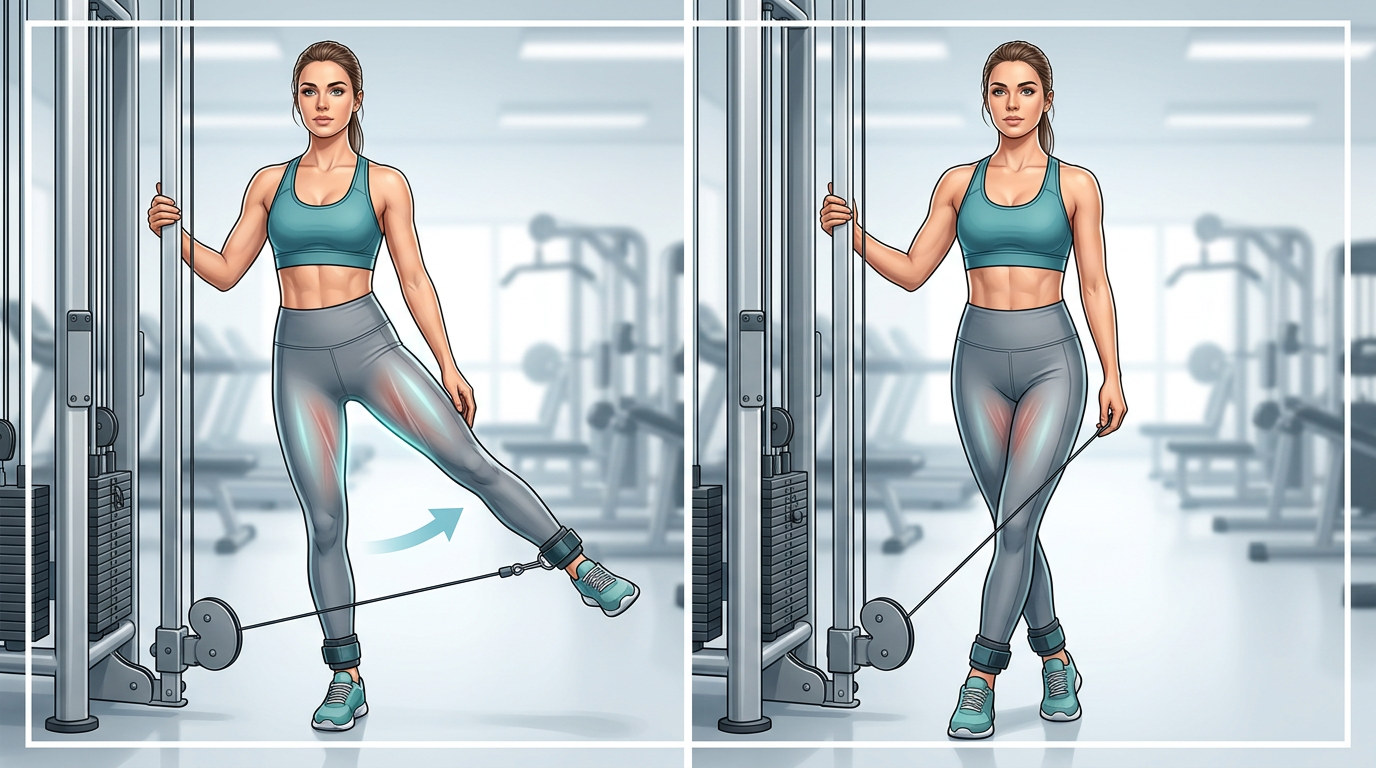
Woman performing cable adduction exercise at cable machine, showing starting position with leg extended to side and ending position with leg crossed in front of body, with proper posture and form cues
9. Scissor Kicks
Scissor kicks combine core strengthening with inner thigh work, making them an efficient two-for-one exercise. This movement challenges your adductors through dynamic motion while building endurance and control.
Lie on your back with legs extended and hands placed under your glutes for lower back support. Lift both legs approximately 6 inches off the ground. Cross your right leg over your left, then switch so your left leg crosses over your right in a scissoring motion, maintaining constant tension in your inner thighs.
Continue alternating for 30-60 seconds or 20-30 total crosses. Keep your lower back pressed to the floor and core engaged throughout. If you experience lower back discomfort, elevate your legs higher or place your hands directly under your sacrum for additional support.
Pros
- Works core and inner thighs simultaneously
- No equipment required
- Builds muscular endurance
- Can be performed anywhere
- Time-efficient exercise
Cons
- Can strain lower back if core is weak
- Challenging to maintain proper form when fatigued
- Limited strength-building potential
10. Slider Side Lunges
Slider side lunges create intense eccentric loading on your inner thighs, which research shows is particularly effective for building muscle strength and definition. The sliding motion forces your adductors to work hard to control the movement, creating significant muscle activation.
Place a slider, paper plate, or small towel under your right foot. Stand with feet together and hands at your hips or chest. Slide your right foot out to the side while bending your left knee and pushing your hips back, keeping your right leg straight. Use your inner thigh strength to pull your right foot back to the starting position.
Perform 10-12 reps per side for 3 sets. The eccentric (lengthening) phase is where the magic happens, so focus on controlling the slide out and powerfully contracting to return. This exercise fits perfectly into an advanced home leg workout routine when gym access is limited.
Pros
- Intense eccentric loading for muscle growth
- Minimal equipment needed
- Highly effective for strength building
- Challenges balance and coordination
Cons
- Requires sliders or smooth flooring
- Very challenging for beginners
- Can cause muscle soreness initially
- Requires good hip mobility and control
Creating Your Complete Inner Thigh Workout Plan
Now that you understand the best exercises, let's discuss how to structure an effective inner thigh workout that delivers results. The key is combining compound movements with isolation exercises while allowing adequate recovery.
Sample Workout Routine for Beginners
If you're new to targeted inner thigh training, start with this foundational routine 2 times per week:
- Warm-up: 5 minutes of light cardio plus dynamic leg swings
- Sumo Squats: 3 sets of 12-15 reps
- Lateral Lunges: 3 sets of 10 reps per side
- Side-Lying Leg Lifts: 3 sets of 15-20 reps per side
- Glute Bridges with Squeeze: 3 sets of 15 reps
- Cool-down: 5 minutes of stretching focusing on inner thighs and hips
Rest 60-90 seconds between sets and focus on perfect form rather than rushing through repetitions. As you build strength over 4-6 weeks, gradually increase resistance or reps.
Advanced Inner Thigh Workout
For women with established training experience, this advanced routine can be performed 2-3 times weekly:
- Banded Lateral Walks: 3 sets of 15 steps each direction (warm-up)
- Sumo Squats with Weight: 4 sets of 10-12 reps
- Copenhagen Planks: 3 sets of 20-30 seconds per side
- Curtsy Lunges with Dumbbells: 3 sets of 12 reps per leg
- Slider Side Lunges: 3 sets of 10 reps per side
- Cable Adductions: 3 sets of 12-15 reps per leg
- Scissor Kicks: 3 sets of 30 seconds
This comprehensive routine targets your inner thighs from multiple angles while building functional strength. Trusted by over 50,000 women worldwide, this progressive approach delivers visible results when combined with proper nutrition.
Progressive Overload Principles
To continue seeing results, you must progressively challenge your muscles. Apply these strategies:
- Increase weight by 5-10% when you can complete all sets with perfect form
- Add 1-2 reps per set every 2 weeks
- Decrease rest periods between sets by 15 seconds
- Increase time under tension by slowing down the eccentric phase
- Add an additional set to each exercise
- Progress to more challenging exercise variations
Remember that progressive overload for women looks different than for men due to hormonal differences, so be patient with strength gains and celebrate all progress.
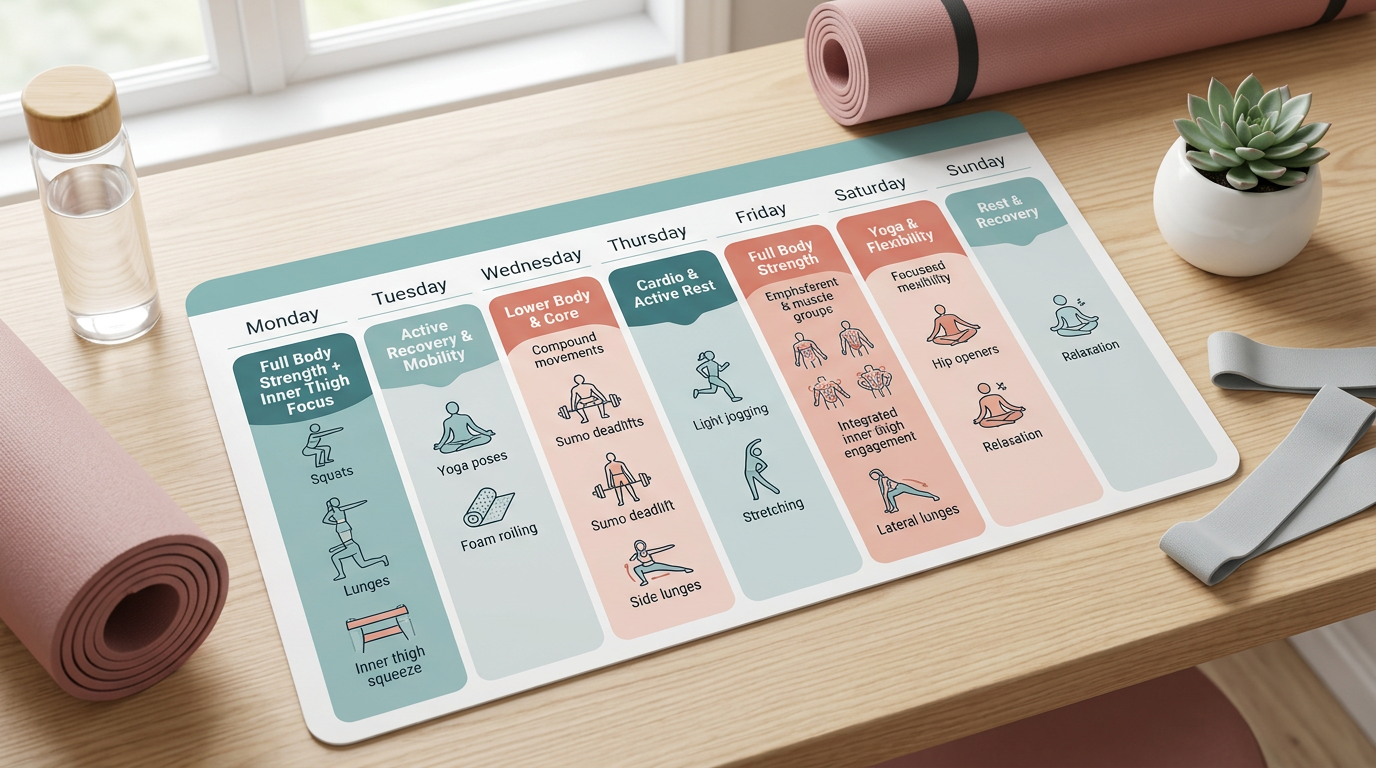
Weekly workout schedule calendar showing optimal inner thigh training frequency, rest days, and how to integrate inner thigh exercises with full-body training programs
Nutrition and Recovery for Inner Thigh Toning
Exercise alone won't deliver the toned inner thighs you're working toward. Your nutrition and recovery practices play equally important roles in achieving visible muscle definition.
Protein Requirements for Muscle Development
Adequate protein intake is essential for muscle repair and growth. Aim for 0.7-1.0 gram of protein per pound of body weight daily, distributed across 3-4 meals. This ensures your muscles have the building blocks needed to recover from training and develop the toned appearance you desire.
Quality protein sources include lean meats, fish, eggs, Greek yogurt, legumes, and plant-based proteins. Consuming 20-30 grams of protein within 2 hours after your inner thigh workout optimizes muscle protein synthesis.
Managing Body Fat for Visible Definition
While you can't spot-reduce fat from your inner thighs, creating a moderate caloric deficit (250-500 calories below maintenance) while maintaining high protein intake helps reduce overall body fat. This reveals the muscle definition you're building through your training efforts.
Focus on whole foods, adequate hydration (half your body weight in ounces daily), and consistent meal timing. Avoid extreme diets that promise rapid fat loss, as these typically result in muscle loss alongside fat loss.
Recovery and Rest Days
Your muscles grow stronger during recovery, not during workouts. Allow at least 48 hours between inner thigh training sessions. Use rest days for active recovery like walking, yoga, or light stretching to promote blood flow without adding training stress.
Prioritize 7-9 hours of quality sleep nightly, as this is when your body releases growth hormone and repairs muscle tissue. Poor sleep significantly impairs recovery and can prevent you from seeing the results your hard work deserves.
Common Mistakes to Avoid
Even with the best inner thigh workout plan, certain mistakes can sabotage your progress. Here's what to watch out for:
Neglecting Other Muscle Groups
While focusing on inner thighs is valuable, neglecting other leg muscles creates imbalances that can lead to injury. Always include exercises for quads, hamstrings, glutes, and calves in your overall training program. A balanced approach produces better aesthetic results and functional strength.
Using Momentum Instead of Control
Swinging through repetitions or using momentum reduces muscle activation and increases injury risk. Slow, controlled movements with a 2-second lowering phase and 1-second lifting phase maximize muscle fiber recruitment and produce superior results.
Expecting Spot Reduction
No amount of inner thigh exercises will eliminate fat from that specific area. Fat loss occurs systemically across your entire body based on genetics and hormones. Focus on building muscle through strength training while managing overall body composition through nutrition.
Progressing Too Quickly
Adding too much weight or volume too soon leads to injury and setbacks. Increase training variables gradually—no more than 10% per week. Master bodyweight exercises before adding significant resistance.
Which Inner Thigh Workout Is Best For You?
Choosing the right exercises depends on your fitness level, available equipment, and specific goals. Here's how to match exercises to your situation:
If you're a complete beginner: Start with sumo squats, side-lying leg lifts, and glute bridges with squeeze. These foundational movements teach proper form while building baseline strength. Perform 2 sessions weekly for 4-6 weeks before progressing.
If you're working out at home: Focus on lateral lunges, banded lateral walks, curtsy lunges, scissor kicks, and slider side lunges. These exercises require minimal equipment but deliver excellent results. Invest in a quality resistance band set for progressive overload.
If you have gym access: Incorporate cable adductions, weighted sumo squats, and Copenhagen planks using gym equipment. The variety of resistance options allows for precise progressive overload and continued adaptation.
If you're recovering from injury: Start with low-impact movements like side-lying leg lifts and glute bridges with squeeze. Avoid exercises that cause pain or discomfort. Consult with a physical therapist to ensure exercises are appropriate for your specific condition.
If you want maximum results in minimum time: Prioritize compound movements like sumo squats, lateral lunges, and curtsy lunges that work multiple muscle groups simultaneously. Add one isolation exercise like cable adductions or side-lying leg lifts at the end of your workout.
If you're an experienced lifter: Challenge yourself with Copenhagen planks, slider side lunges, and heavily weighted sumo squats. Focus on progressive overload by consistently increasing resistance or volume. Consider incorporating tempo training with 3-4 second eccentric phases.
Frequently Asked Questions
How do I tone my inner thighs fast?
Combine targeted strength exercises like sumo squats and lateral lunges 2-3 times weekly with a moderate caloric deficit to reduce body fat. Focus on progressive overload and consistency rather than extreme measures. Visible results typically appear within 4-6 weeks with proper nutrition and training.
How to fix saggy inner thighs?
Build muscle through resistance training exercises like Copenhagen planks, weighted sumo squats, and cable adductions while reducing overall body fat through nutrition. Skin elasticity improves with hydration, adequate protein intake, and time. Strength training provides the most significant improvement in inner thigh appearance and firmness.
Why is it so hard to tone inner thighs?
Inner thighs are challenging because women naturally store more fat in this area due to hormones, and adductor muscles are often undertrained in traditional workouts. Additionally, you cannot spot-reduce fat from specific areas. Success requires combining targeted strength training with overall body fat reduction through nutrition.
How do you work out inner thighs?
Work inner thighs through exercises that bring your legs toward your body's midline, such as sumo squats, lateral lunges, side-lying leg lifts, and cable adductions. Perform these movements 2-3 times weekly with progressive resistance. Combine compound exercises with isolation movements for comprehensive adductor development.
How many times per week should I train inner thighs?
Train inner thighs 2-3 times weekly with at least 48 hours between sessions for optimal recovery. Beginners should start with 2 sessions weekly, while advanced lifters can handle 3 sessions. Adequate recovery is essential for muscle growth and strength gains.
Can I do inner thigh exercises every day?
Daily inner thigh training is not recommended as muscles need 48 hours to recover and grow stronger. Overtraining leads to diminished results, increased injury risk, and burnout. Focus on quality training sessions 2-3 times weekly with proper recovery between workouts.
What equipment do I need for inner thigh workouts?
Basic inner thigh training requires no equipment, as bodyweight exercises like lateral lunges and side-lying leg lifts are highly effective. Adding resistance bands, dumbbells, a Pilates ball, and sliders expands exercise options and enables progressive overload for continued results.
Conclusion
Building strong, toned inner thighs requires a strategic approach that combines targeted exercises, progressive overload, proper nutrition, and adequate recovery. The inner thigh workout exercises outlined in this guide provide a comprehensive toolkit for women at every fitness level.
Remember these key principles for success:
- Consistency trumps intensity—show up 2-3 times weekly with focused effort
- Master proper form before adding significant resistance
- Combine compound movements with isolation exercises for complete development
- Support your training with adequate protein and a balanced nutrition approach
- Be patient with results—visible changes typically appear within 4-8 weeks
- Focus on building strength rather than obsessing over aesthetics
Your inner thighs play a crucial role in overall lower body strength, stability, and injury prevention. By dedicating time to properly training these often-neglected muscles, you're investing in both your appearance and long-term functional fitness.
Ready to take your leg training to the next level? The Strong Curves app provides structured workout programs, form videos, and progressive training plans designed specifically for women who want real results. Download the app today and join thousands of women building stronger, more confident bodies through science-backed training methods.