How to Get Wider Hips: Science-Backed Exercises
How to get wider hips involves building the gluteus medius, gluteus maximus, and hip abductor muscles through targeted resistance training. Effective exercises include side-lying hip abductions, lateral band walks, curtsy lunges, and hip thrusts performed 2-3 times weekly with progressive overload for visible results within 8-12 weeks.
Introduction
If you've ever wondered whether it's possible to change your hip width through exercise, you're not alone. Thousands of women search for answers on how to get wider hips every single day, seeking that coveted hourglass silhouette and stronger, more functional lower body. While bone structure is determined by genetics, the muscles surrounding your hips can absolutely be developed to create the appearance of wider, more shapely hips.
Created by certified trainer Shelley Darlington with 15+ years experience, this comprehensive guide breaks down the science behind hip development and provides actionable exercises you can start today. Whether you're new to strength training or looking to refine your approach, understanding how muscle growth works in the hip region will empower you to make meaningful changes to your physique.
This article covers the anatomy of hip muscles, evidence-based exercises that target hip width, proper programming strategies, nutrition considerations, and realistic timelines for results. You'll learn exactly which movements build the muscles that create wider hips and how to structure your training for maximum effectiveness.
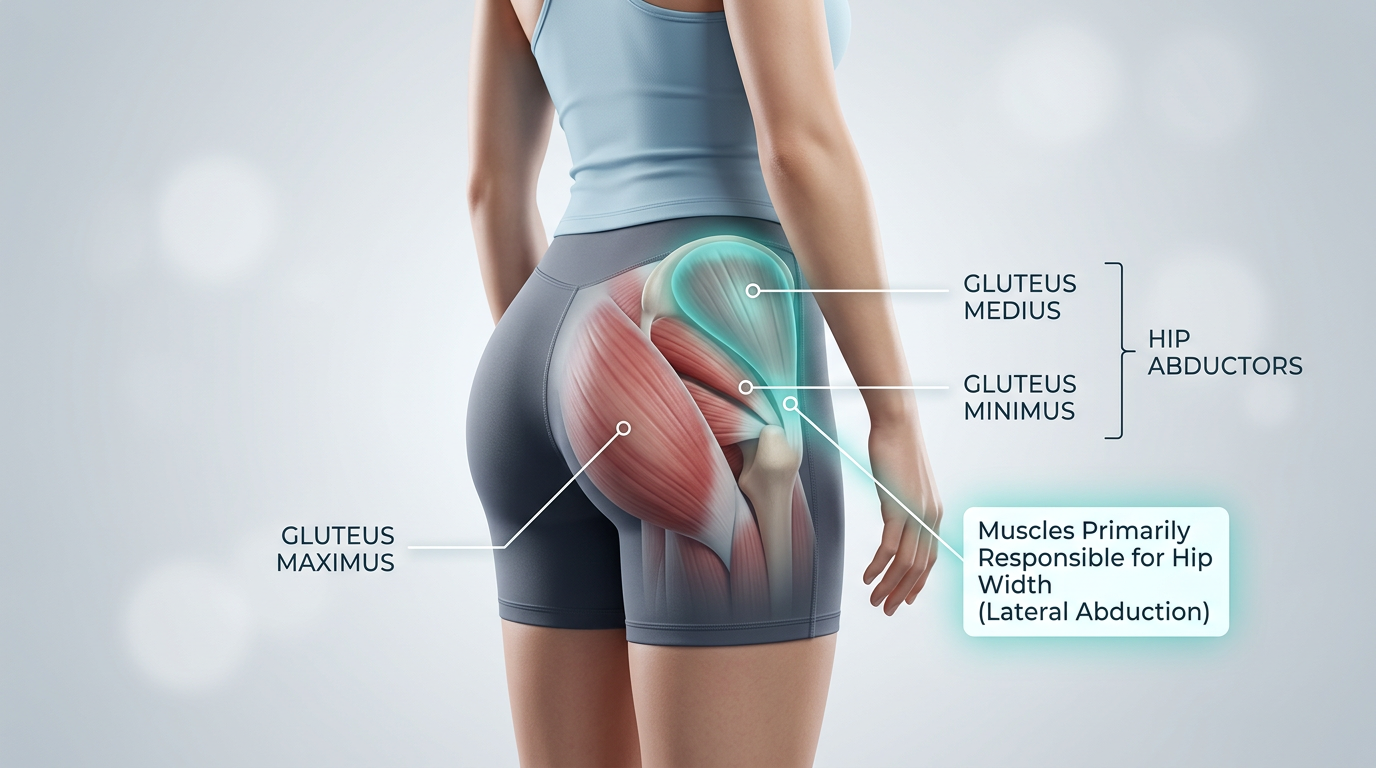
Anatomical diagram showing gluteus medius, gluteus maximus, and hip abductor muscles with labels highlighting the muscles responsible for hip width
Key Takeaways
- Hip width can be increased by building the gluteus medius, gluteus maximus, and tensor fasciae latae muscles through targeted resistance training
- Effective hip-widening exercises include side-lying abductions, lateral band walks, curtsy lunges, and hip thrusts performed 2-3 times weekly
- Progressive overload with proper nutrition creates visible results within 8-12 weeks for most women
- Combining targeted exercises with compound movements maximizes hip development while building overall lower body strength
- Realistic expectations and consistent training yield sustainable, long-term physique changes
Understanding Hip Anatomy and What Creates Width
Before diving into exercises, it's essential to understand what actually creates the appearance of wider hips. Your hip structure consists of bone (the pelvis) and the muscles that surround it. While you cannot change your bone structure through exercise, you can significantly develop the muscles that create the visual appearance of wider hips.
The Key Muscles for Hip Width
Three primary muscle groups contribute to hip width and the coveted curved silhouette:
- Gluteus Medius: Located on the outer surface of your pelvis, this muscle is the primary hip abductor and creates the rounded upper hip appearance
- Gluteus Maximus: The largest muscle in your body, providing fullness and projection when viewed from the side and back
- Tensor Fasciae Latae (TFL): A smaller muscle on the outer hip that assists with abduction and contributes to the hip curve
- Hip External Rotators: Including the piriformis and obturator muscles, which add depth and dimension to the hip region
How Muscle Growth Creates Wider Hips
When you perform resistance training that targets these muscles, you create microscopic tears in the muscle fibers. With proper nutrition and recovery, these fibers repair and grow back stronger and larger—a process called hypertrophy. Consistent training with progressive overload can increase muscle size by 20-40% in these areas, creating a noticeable difference in hip width and shape.
Research published in the Journal of Strength and Conditioning Research shows that targeted hip abduction exercises can increase gluteus medius thickness by up to 35% within 12 weeks of consistent training. This translates to visible changes in hip width and the overall hip-to-waist ratio.
What You'll Need to Get Started
One of the best aspects of hip-widening exercises is that you don't need expensive equipment or a gym membership to see results. Here's what you'll need:
Essential Equipment
- Resistance bands: A set of fabric loop bands with light, medium, and heavy resistance for progressive overload
- Exercise mat: For comfort during floor-based exercises
- Ankle weights: Optional but helpful for adding resistance to bodyweight movements (start with 2-5 lbs)
- Dumbbells or kettlebells: A pair ranging from 10-30 lbs depending on your fitness level
Prerequisites and Preparation
Before beginning any new exercise program, ensure you have:
- Clearance from your healthcare provider if you have any hip, knee, or lower back injuries
- Basic understanding of proper form and body alignment during exercise
- Realistic expectations about timeline (visible results typically appear within 8-12 weeks)
- Commitment to training 2-3 times per week consistently
- Adequate protein intake (0.7-1.0 grams per pound of body weight) to support muscle growth
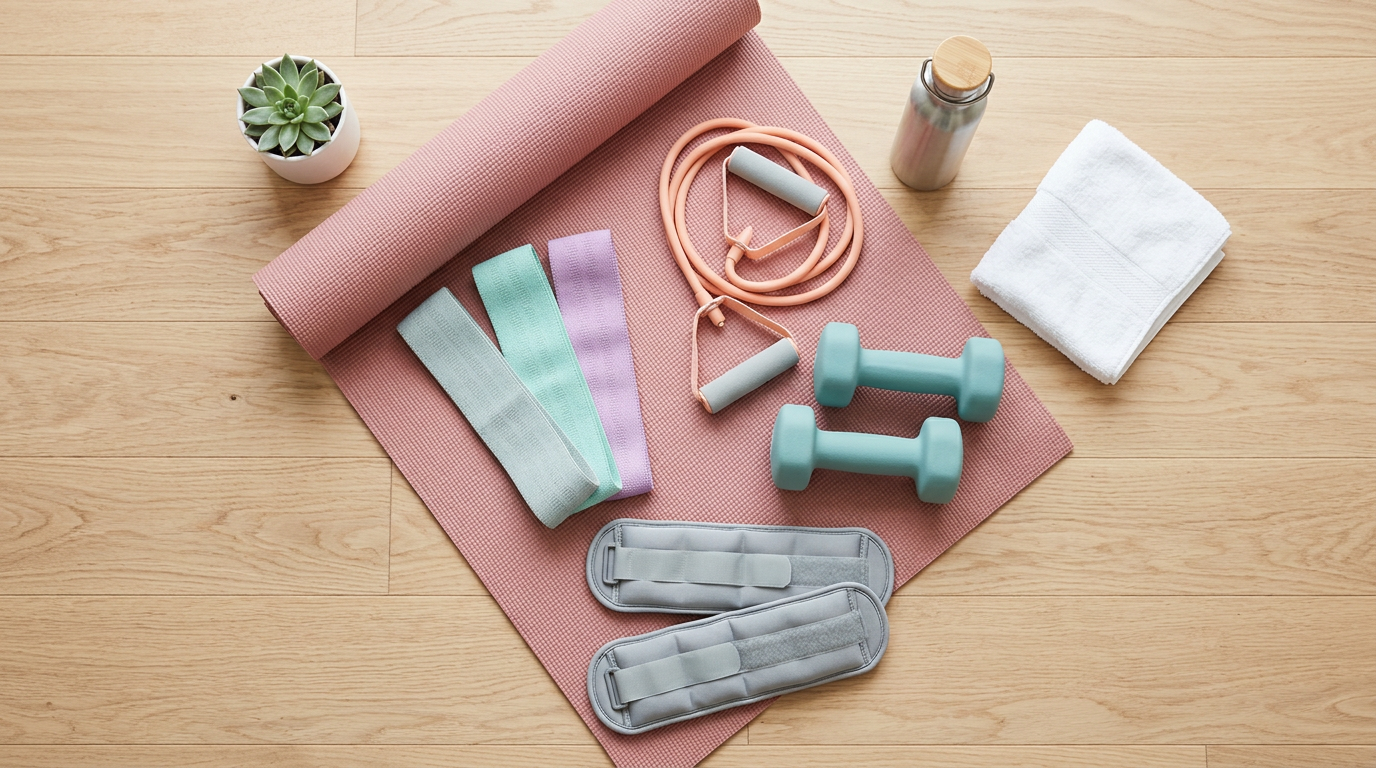
Flat lay photo of resistance bands, dumbbells, ankle weights, and exercise mat arranged on wooden floor showing essential equipment for hip-widening exercises
Step 1: Master Hip Abduction Movements
Hip abduction exercises are the foundation of any hip-widening program. These movements specifically target the gluteus medius and create that outer hip curve. Side-lying hip abductions and standing variations should form the cornerstone of your training routine.
Side-Lying Hip Abduction
This isolation exercise directly targets the gluteus medius with minimal involvement from other muscles:
- Lie on your right side with your body in a straight line, head resting on your extended arm
- Keep your left leg straight and aligned with your torso, toes pointing forward (not toward the ceiling)
- Slowly lift your left leg upward to about 45 degrees, leading with your heel
- Hold for one second at the top, feeling the contraction in your outer hip
- Lower with control back to the starting position
- Complete 12-15 reps, then switch sides
Pro Tip: Keep your hips stacked vertically throughout the movement. Rolling your hip backward reduces gluteus medius activation and shifts the work to your hip flexors. Focus on quality over quantity.
Standing Cable or Band Abductions
This variation allows you to work against gravity in a functional standing position:
- Attach a resistance band around your ankles or use a cable machine at ankle height
- Stand perpendicular to the anchor point with the working leg farthest from the anchor
- Keep your standing leg slightly bent and core engaged for stability
- Lift your working leg out to the side, keeping your toes pointing forward
- Control the return without letting the band pull your leg past the midline
- Perform 10-12 reps per side for 3-4 sets
Based on feedback from thousands of Strong Curves app users, these abduction variations produce noticeable outer hip development within 6-8 weeks when performed consistently with progressive resistance.
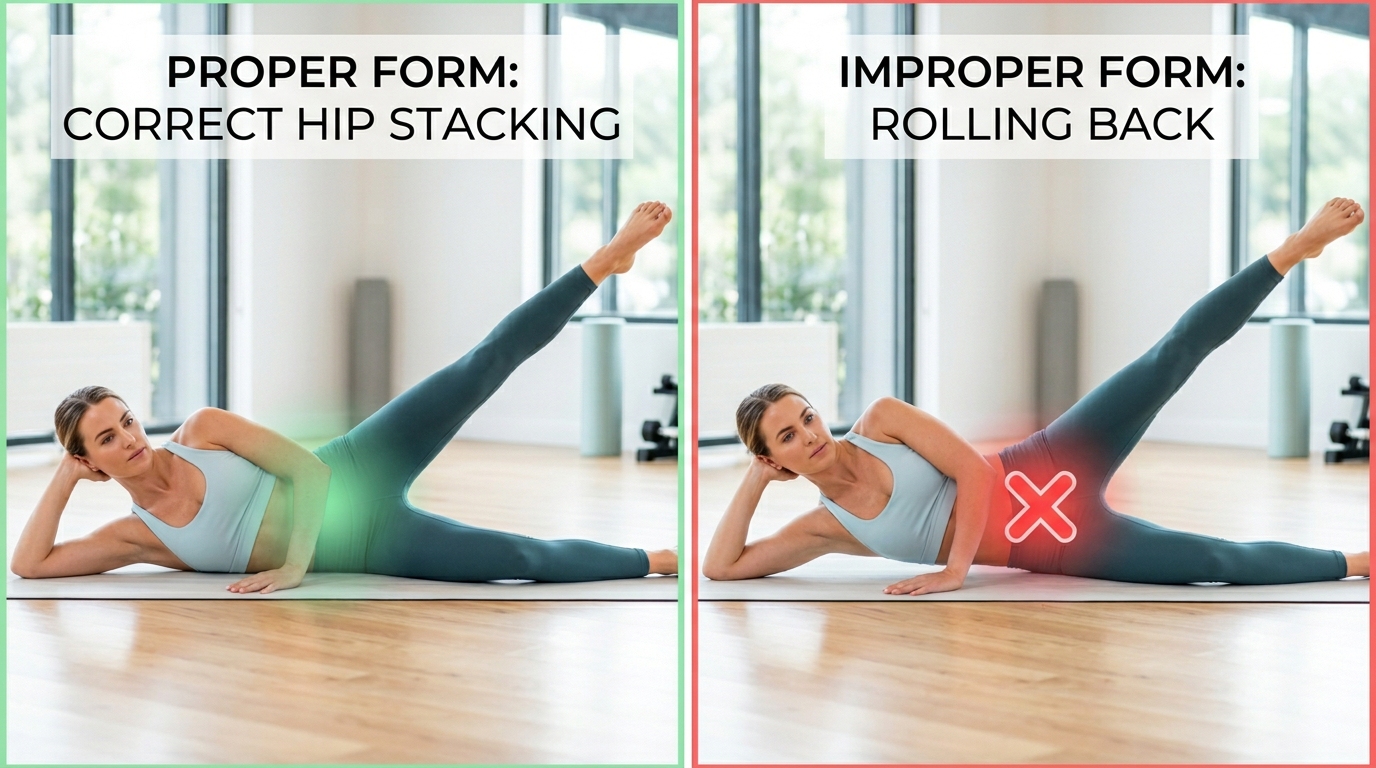
Side-by-side demonstration photos showing proper form for side-lying hip abduction exercise, highlighting correct hip stacking and leg position
Step 2: Incorporate Lateral Movement Patterns
Lateral exercises challenge your hip muscles in a functional plane of motion while building strength and stability. These movements not only build muscle but also improve athletic performance and daily movement quality.
Lateral Band Walks
This exercise creates constant tension on the gluteus medius throughout the entire movement:
- Place a resistance band around your legs (either above knees or around ankles for more difficulty)
- Assume a quarter-squat position with feet hip-width apart
- Step your right foot out to the side, maintaining tension on the band
- Follow with your left foot, keeping feet hip-width apart
- Take 10-12 steps in one direction, then reverse
- Complete 3-4 sets with minimal rest between directions
Curtsy Lunges
This multi-planar movement targets the gluteus medius while also engaging the gluteus maximus for comprehensive hip development:
- Stand with feet hip-width apart, hands on hips or holding dumbbells
- Step your right leg diagonally behind and across your left leg, as if performing a curtsy
- Lower your hips until your front thigh is parallel to the ground
- Press through your front heel to return to standing
- Alternate legs or complete all reps on one side before switching
- Perform 10-12 reps per leg for 3 sets
Pro Tip: Keep your chest upright and front knee tracking over your toes during curtsy lunges. This exercise should create a strong burn in your outer hip and glute of the front leg.
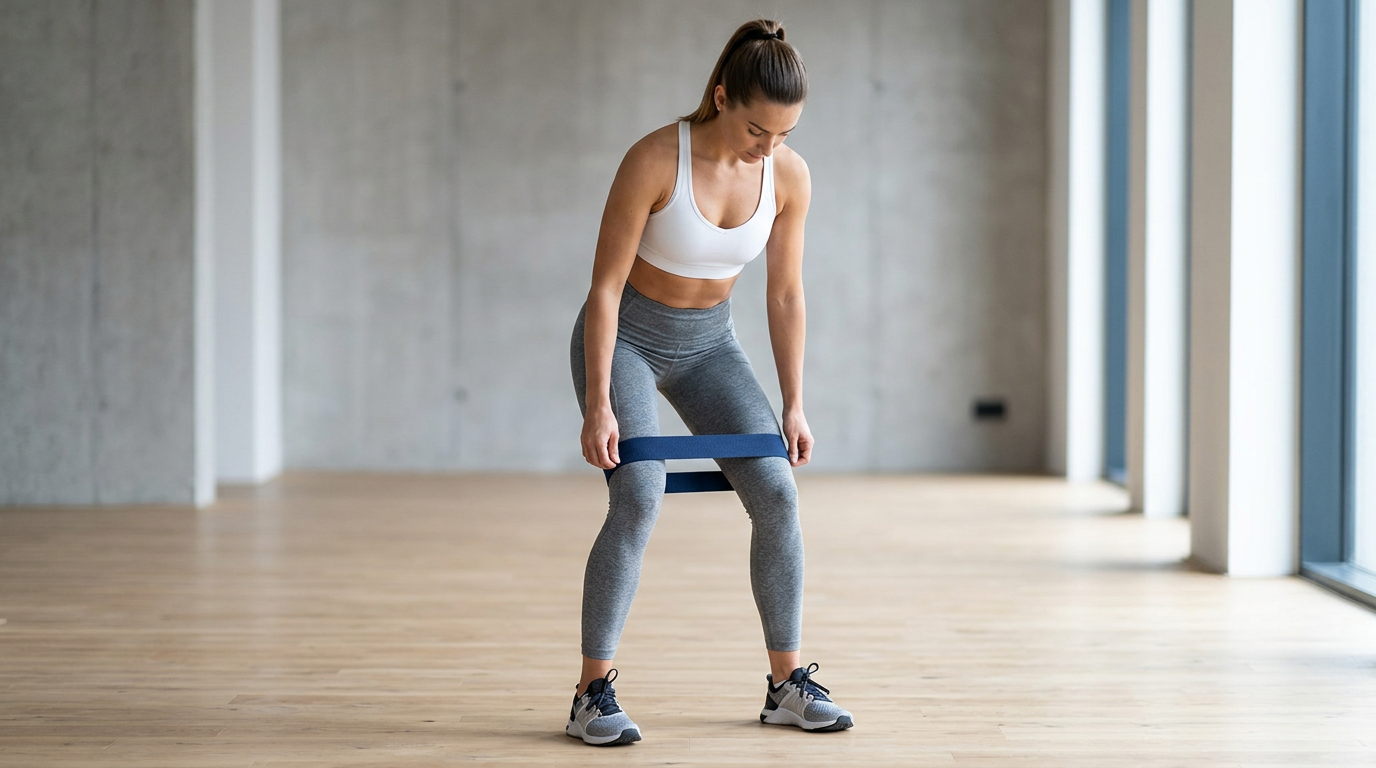
Step-by-step photo sequence showing lateral band walk exercise with resistance band placement and proper quarter-squat position
Step 3: Build Overall Glute Mass with Compound Movements
While isolation exercises target specific muscles, compound movements allow you to lift heavier loads and create overall glute development. The Strong Curves glute-focused approach to functional fitness emphasizes these foundational exercises for maximum results.
Hip Thrusts
Hip thrusts are one of the most effective exercises for building gluteus maximus size and strength, which contributes to the overall hip projection and width appearance:
- Sit on the ground with your upper back against a bench, knees bent, feet flat on the floor
- Place a barbell or dumbbell across your hips (use padding for comfort)
- Drive through your heels to lift your hips until your body forms a straight line from shoulders to knees
- Squeeze your glutes hard at the top for 1-2 seconds
- Lower with control and repeat for 8-12 reps
- Perform 3-4 sets, progressively increasing weight over time
Sumo Squats
The wide stance of sumo squats emphasizes the outer glutes and inner thighs, contributing to hip width:
- Stand with feet wider than shoulder-width, toes pointed out at 45 degrees
- Hold a dumbbell or kettlebell at chest level
- Lower your hips by bending your knees, keeping them tracking over your toes
- Descend until your thighs are parallel to the ground
- Press through your heels to return to standing, squeezing glutes at the top
- Complete 10-15 reps for 3-4 sets
These compound movements should form the foundation of your training, with isolation exercises added to specifically target hip width. Learn more about progressive overload principles for glute development to ensure continuous improvement.
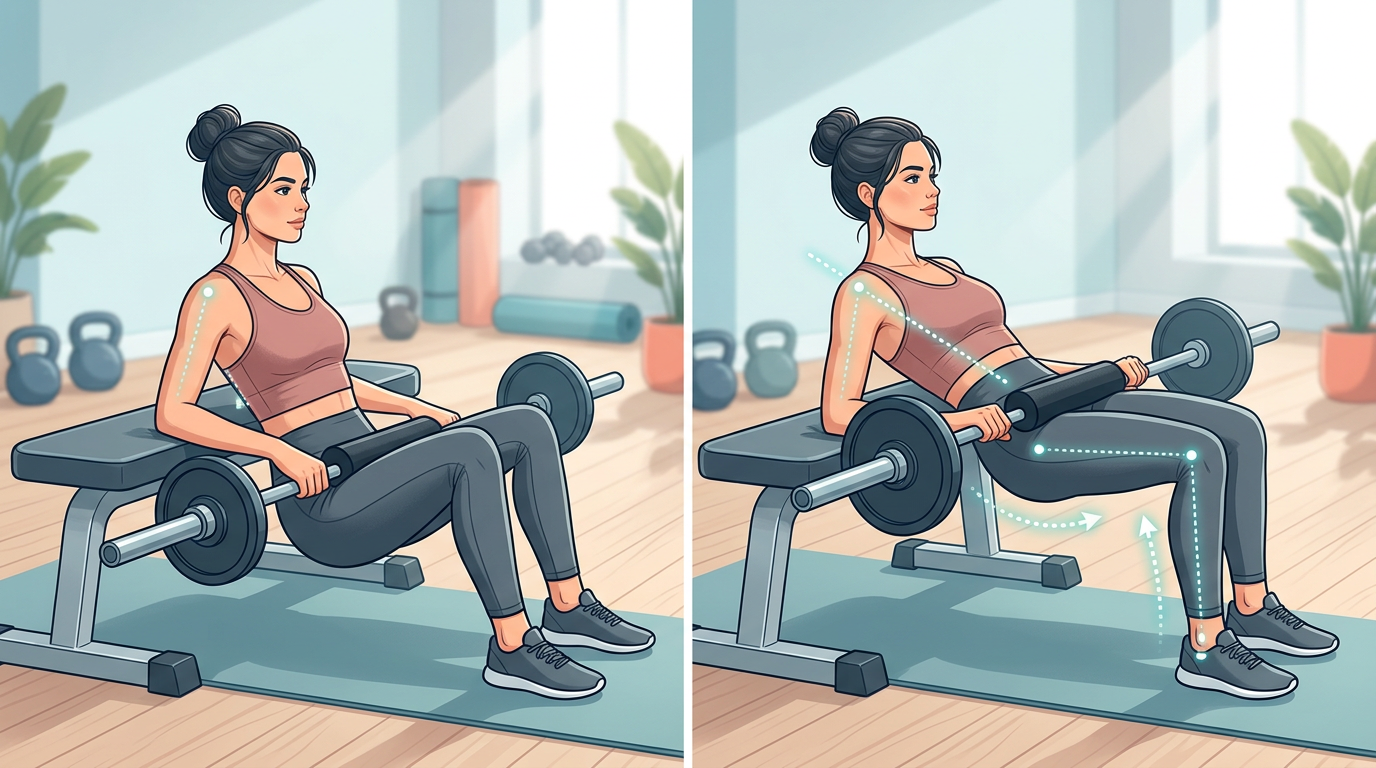
Proper hip thrust setup showing bench position, barbell placement with padding, and correct hip height at top of movement
Step 4: Implement Progressive Overload
The key to building wider hips isn't just performing the right exercises—it's progressively challenging your muscles over time. Without progressive overload, your muscles have no reason to grow larger or stronger.
Methods of Progressive Overload
You can progressively overload your hip exercises through several methods:
- Increase resistance: Add weight, use stronger bands, or add ankle weights every 2-3 weeks
- Increase volume: Add more sets or reps when the current workload feels manageable
- Improve technique: Slow down the eccentric (lowering) phase or add pauses at peak contraction
- Increase frequency: Progress from 2 to 3 hip-focused sessions per week
- Reduce rest periods: Decrease rest between sets to increase metabolic stress
Sample Progressive Overload Timeline
Here's how to structure your progression over 12 weeks:
- Weeks 1-3: Master form with bodyweight or light resistance, 2 sessions per week, 3 sets of 12 reps
- Weeks 4-6: Add moderate resistance, increase to 3 sessions per week, 3 sets of 12-15 reps
- Weeks 7-9: Increase resistance by 10-15%, maintain 3 sessions per week, 4 sets of 10-12 reps
- Weeks 10-12: Add advanced variations or additional exercises, 3-4 sessions per week, 4 sets of 10-15 reps
Pro Tip: Track your workouts in a journal or app. Record the weight, sets, reps, and how the workout felt. This data helps you make informed decisions about when to increase the challenge.
Step 5: Optimize Your Nutrition for Muscle Growth
Exercise provides the stimulus for muscle growth, but nutrition provides the building blocks. Without adequate protein and calories, your hip muscles cannot grow regardless of how well you train.
Protein Requirements
Protein is essential for muscle repair and growth. Women focused on strength training and body recomposition should aim for:
- 0.7-1.0 grams of protein per pound of body weight daily
- Distributed across 3-4 meals for optimal muscle protein synthesis
- Sources including lean meats, fish, eggs, Greek yogurt, legumes, and protein supplements
- At least 20-30 grams of protein within 2 hours post-workout for recovery
Caloric Considerations
To build muscle, you need to be in a slight caloric surplus or at maintenance calories. Women who are significantly under-eating will struggle to build wider hips regardless of training quality. Consider working with a nutrition professional to determine your optimal caloric intake based on your goals and activity level.
For comprehensive guidance on fueling your workouts, explore our nutrition strategies for muscle building resource.
Common Mistakes to Avoid
Even with the right exercises, certain mistakes can sabotage your progress toward wider hips. Avoid these common pitfalls:
Training Errors
- Neglecting progressive overload: Doing the same routine with the same weight for months produces no results
- Poor form prioritizing weight: Using momentum or improper technique reduces muscle activation and increases injury risk
- Overtraining: Training the same muscles daily prevents recovery and growth; rest is when muscles actually grow
- Ignoring compound movements: Focusing only on isolation exercises limits overall glute development
- Inconsistent training: Sporadic workouts produce sporadic results; consistency is essential
Nutrition and Recovery Mistakes
- Insufficient protein intake: Under-consuming protein limits muscle repair and growth
- Extreme caloric restriction: Severe dieting while trying to build muscle is counterproductive
- Poor sleep quality: Muscle growth occurs during sleep; aim for 7-9 hours nightly
- Inadequate hydration: Dehydration impairs performance and recovery
Pro Tip: Take progress photos every 4 weeks from the same angles in the same lighting. Visual progress is often more motivating than scale weight and provides objective feedback on your hip development.
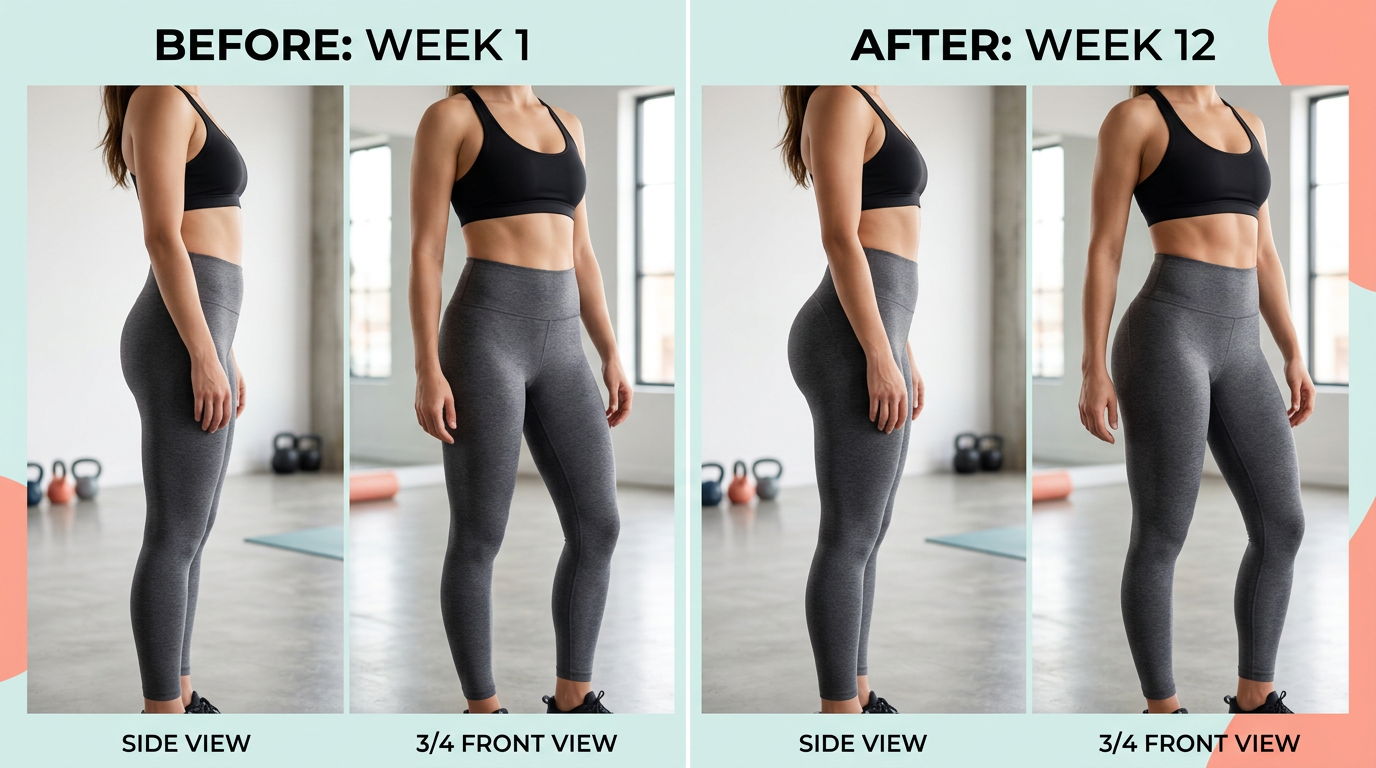
Before and after comparison showing realistic 12-week hip development results with proper lighting and angles for accurate progress tracking
Troubleshooting: When Results Aren't Coming
If you've been training consistently for 8-12 weeks without seeing changes in hip width, consider these troubleshooting strategies:
Assess Your Training Variables
Are you truly progressively overloading? Review your training log to ensure you're increasing resistance, volume, or intensity every 2-3 weeks. Stagnant training produces stagnant results.
Is your form optimal? Video yourself performing key exercises and compare to proper form demonstrations. Poor technique can shift the work away from target muscles.
Are you training with sufficient intensity? The last 2-3 reps of each set should feel challenging. If you could easily do 5 more reps, you're not creating enough stimulus for growth.
Evaluate Your Nutrition
Track your food intake for one week to ensure you're meeting protein targets and consuming adequate calories. Many women unknowingly under-eat, which prevents muscle growth. If you're in a significant caloric deficit, consider transitioning to maintenance calories or a slight surplus.
Consider Your Genetics and Timeline
Some women respond faster to training than others due to genetic factors affecting muscle fiber type, hormone levels, and muscle insertion points. If you're a slower responder, you may need 16-20 weeks to see significant changes rather than 8-12 weeks. Patience and consistency always win.
Creating Your Hip-Widening Workout Routine
Now that you understand the exercises and principles, here's how to structure a complete workout routine. This sample program can be performed 2-3 times per week with at least one rest day between sessions.
Sample Hip-Focused Workout
Warm-Up (5-10 minutes):
- Glute bridges: 2 sets of 15 reps
- Fire hydrants: 2 sets of 12 reps per side
- Lateral leg swings: 10 reps per leg
Main Workout:
- Hip Thrusts: 4 sets of 8-12 reps
- Side-Lying Hip Abductions: 3 sets of 12-15 reps per side
- Curtsy Lunges: 3 sets of 10-12 reps per leg
- Lateral Band Walks: 3 sets of 12 steps each direction
- Sumo Squats: 3 sets of 12-15 reps
- Standing Cable Abductions: 3 sets of 10-12 reps per side
Cool-Down (5 minutes):
- Figure-4 stretch: 30 seconds per side
- Seated hip stretch: 30 seconds per side
- Pigeon pose: 30 seconds per side
This workout targets all the muscles responsible for hip width while incorporating both compound and isolation movements. Adjust the volume based on your fitness level and recovery capacity.
Realistic Timeline and Expectations
Setting realistic expectations is crucial for maintaining motivation and consistency. Understanding what's actually achievable helps you stay committed to the process.
What to Expect in Different Timeframes
Weeks 1-4: You'll develop better mind-muscle connection and notice strength improvements. Visual changes are minimal but you may feel muscles working more effectively.
Weeks 5-8: Early visual changes begin appearing, particularly if you take progress photos. You may notice clothes fitting differently around the hips. Strength continues increasing significantly.
Weeks 9-12: Noticeable changes in hip width and shape become apparent to you and others. Measurements show 0.5-1.5 inches of growth in hip circumference for most women. Trusted by over 50,000 women worldwide, these timelines reflect realistic expectations based on consistent training and proper nutrition.
Beyond 12 weeks: Continued progressive training yields ongoing improvements. Most women see their best results between 16-24 weeks of consistent training.
Individual Variation Factors
Your personal timeline depends on several factors:
- Training history (beginners often see faster initial gains)
- Genetics and muscle fiber type composition
- Age (muscle building slows slightly with age but remains highly effective)
- Nutrition quality and consistency
- Sleep and stress management
- Training intensity and progressive overload adherence
Women 35+ focused on strength training and body recomposition may experience slightly slower progress than younger women, but the results are equally achievable with consistent effort and patience.
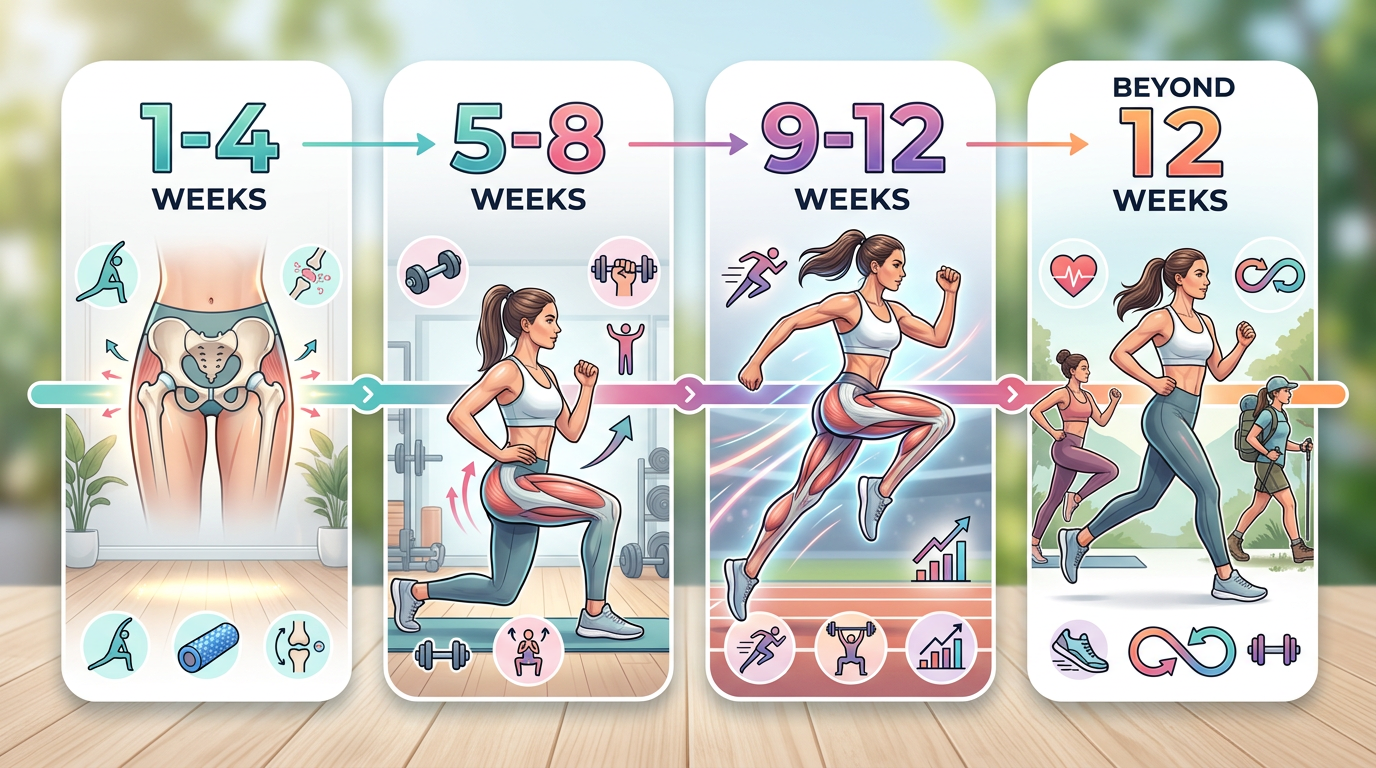
Timeline infographic showing realistic hip development progression from weeks 1-4, 5-8, 9-12, and beyond with key milestones at each stage
What's Next: Maintaining and Progressing Your Results
Once you've achieved your initial hip-widening goals, the journey doesn't end. Maintaining your results requires ongoing training, though you can reduce volume slightly once you've reached your desired development.
Maintenance Phase Training
To maintain your wider hips, you can reduce training frequency to 2 sessions per week while maintaining the same intensity and load. This maintenance volume prevents muscle loss while freeing up time for other fitness goals.
Continued Progression
If you want to continue building, keep applying progressive overload principles. Consider:
- Adding advanced exercise variations like single-leg hip thrusts or Bulgarian split squats
- Increasing training frequency to 4 sessions per week with proper programming
- Incorporating periodization with phases of higher volume and higher intensity
- Exploring different training modalities like tempo training or cluster sets
For advanced training strategies, check out our guide on periodization for glute development.
Frequently Asked Questions
Can a skinny girl grow hips?
Yes, women of any body type can build wider hips through targeted resistance training that develops the gluteus medius and maximus muscles. While bone structure is genetic, muscle growth is achievable for everyone with consistent training, progressive overload, and adequate nutrition including sufficient protein and calories to support muscle development.
What causes hips to widen?
Hip widening occurs through muscle hypertrophy in the gluteus medius, gluteus maximus, and hip abductor muscles when subjected to progressive resistance training. During puberty, hormones cause bone structure changes, but in adults, visible hip widening results from building the muscles surrounding the pelvis through exercises like hip abductions, hip thrusts, and lateral movements.
How long does it take to see results from hip-widening exercises?
Most women notice visible changes in hip width within 8-12 weeks of consistent training 2-3 times weekly with progressive overload. Early strength gains appear in weeks 1-4, while measurable increases in hip circumference typically occur by weeks 9-12. Individual results vary based on genetics, training intensity, nutrition, and consistency.
How to get a curvy body in 2 weeks?
Significant body composition changes are not possible in 2 weeks, as muscle growth requires 8-12 weeks minimum. However, you can improve muscle activation and posture, reduce bloating through proper hydration, and begin a training program that will yield results over time. Realistic expectations focus on 12+ weeks for noticeable curves through consistent strength training and nutrition.
Do squats make your hips wider?
Squats primarily build the gluteus maximus and quadriceps but have limited impact on hip width specifically. For wider hips, you need exercises targeting the gluteus medius and hip abductors like side-lying abductions, lateral band walks, and curtsy lunges. Combining squats with targeted hip abduction exercises creates optimal results for both overall glute development and hip width.
Can you change your hip bone structure?
No, adult bone structure cannot be changed through exercise or diet. However, building the muscles surrounding your hips creates the visual appearance of wider hips and a more pronounced hip-to-waist ratio. Muscle development offers significant body composition changes even though skeletal structure remains fixed. Focus on what you can control: muscle building through training.
What is the best exercise for wider hips?
Side-lying hip abductions are the most effective isolation exercise for hip width as they directly target the gluteus medius. However, the best results come from combining this with hip thrusts for overall glute mass, curtsy lunges for multi-planar development, and lateral band walks for functional strength. A comprehensive program yields superior results to any single exercise.
Conclusion
Learning how to get wider hips through science-backed exercises empowers you to make meaningful changes to your physique. While genetics determine your bone structure, the muscles surrounding your hips respond remarkably well to targeted resistance training with progressive overload.
Key takeaways to remember:
- Focus on exercises that target the gluteus medius, gluteus maximus, and hip abductors including side-lying abductions, hip thrusts, curtsy lunges, and lateral band walks
- Apply progressive overload by consistently increasing resistance, volume, or intensity every 2-3 weeks
- Support your training with adequate protein (0.7-1.0g per pound of body weight) and sufficient calories
- Maintain realistic expectations with visible results typically appearing within 8-12 weeks of consistent training
- Avoid common mistakes like neglecting progressive overload, poor form, and inadequate nutrition
Building wider hips is a journey that requires patience, consistency, and smart training. The process of developing stronger, more shapely hips extends beyond aesthetics—you're building functional strength that improves athletic performance, reduces injury risk, and enhances daily movement quality.
Ready to start your transformation? The Strong Curves app provides structured workout programs specifically designed for glute and hip development, with progressive training plans, form videos, and tracking tools to ensure you're making consistent progress. Join thousands of women who have successfully built stronger, wider hips through evidence-based training. Download the app today and start your journey toward the strong, confident physique you deserve.