How Many Squats a Day for Women: Science-Backed Guide
How many squats a day women should perform depends on fitness level and goals. Beginners should start with 15-25 bodyweight squats daily, intermediate lifters can perform 30-50 squats with added resistance, and advanced athletes may complete 50-100+ squats across multiple sets for strength and conditioning.
You've decided to add squats to your daily routine—excellent choice! But scrolling through fitness advice online leaves you more confused than motivated. One influencer swears by 100 squats daily, while another warns against overtraining. So what's the truth about how many squats a day you actually need?
The answer isn't one-size-fits-all, and that's actually good news. Your ideal squat volume depends on your current fitness level, training goals, recovery capacity, and whether you're using just bodyweight or adding resistance. This guide breaks down the science-backed recommendations for women at every fitness stage, so you can build strength, sculpt your lower body, and avoid the pitfalls of doing too much too soon.
Whether you're just starting your fitness journey or you're an experienced lifter looking to optimize your training, you'll discover exactly how to structure your daily squat routine for maximum results without burnout.
Key Takeaways
- Beginners should start with 15-25 bodyweight squats daily, focusing on form over volume
- Intermediate lifters can perform 30-50 squats per day with progressive resistance for continued gains
- Advanced athletes may complete 50-100+ squats across multiple sets, incorporating variations and heavy loads
- Rest days are essential—training squats 3-5 days per week allows proper recovery and muscle growth
- Quality always trumps quantity; perfect form prevents injury and maximizes muscle engagement
Understanding Your Squat Starting Point
Before determining how many squats a day suits your needs, you must honestly assess your current fitness level. This isn't about ego—it's about building a sustainable foundation that leads to real progress.
Beginner Level: Building Your Foundation
If you're new to strength training or haven't exercised consistently in six months, you're starting at the beginner level. Your primary goal should be mastering proper squat form with 15-25 bodyweight squats daily. This volume allows your muscles, joints, and connective tissues to adapt without overwhelming your system.
At this stage, focus on these fundamentals:
- Feet positioned shoulder-width apart with toes slightly turned out
- Chest lifted and core engaged throughout the movement
- Knees tracking over toes without caving inward
- Descending until thighs are parallel to the ground or slightly below
- Driving through your heels to return to standing
- Maintaining a neutral spine without excessive forward lean
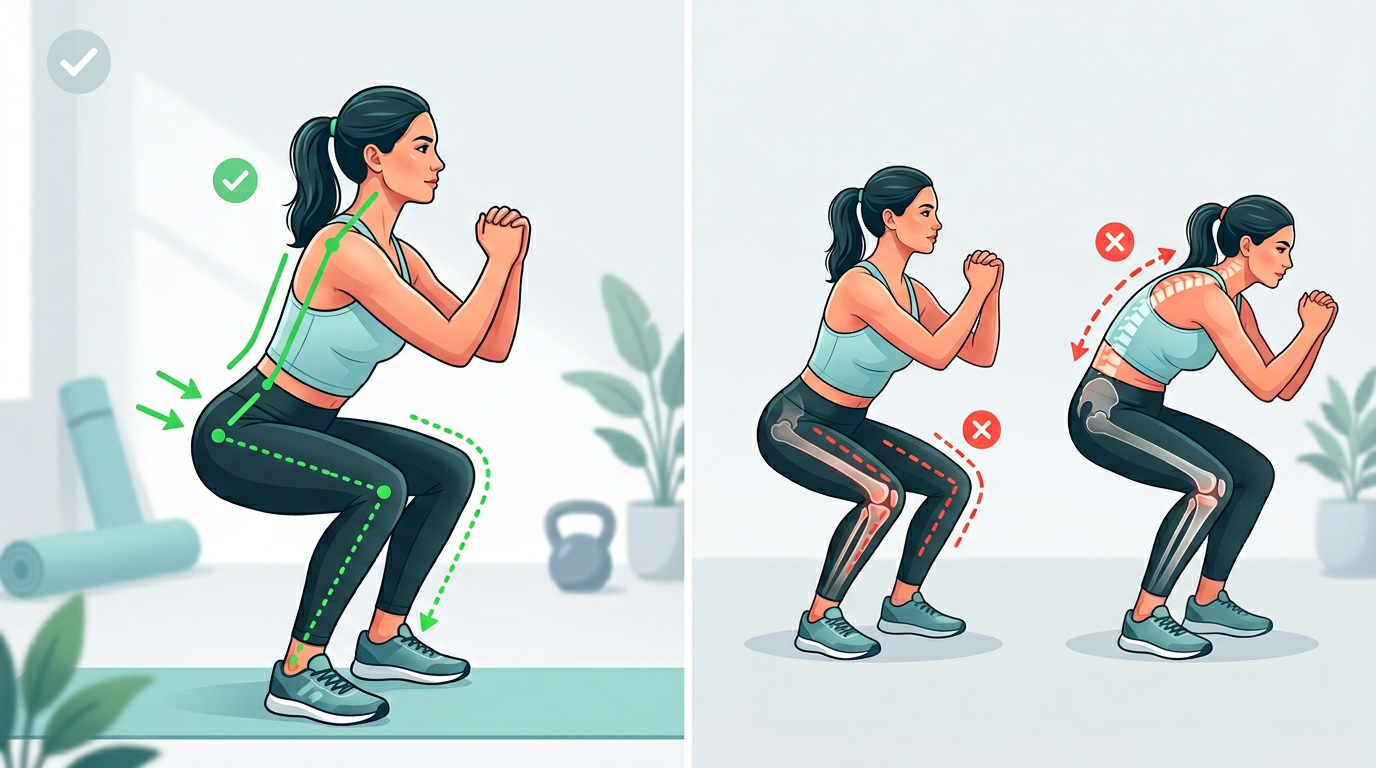
Side-by-side comparison showing correct squat form versus common mistakes for women, with alignment markers highlighting proper knee, hip, and spine positioning
Intermediate Level: Progressive Overload
After 2-3 months of consistent training, you'll notice squats feeling easier. This signals readiness for the intermediate level, where you can perform 30-50 squats per day. At this stage, simply adding more reps isn't enough for continued progress.
Intermediate lifters should incorporate resistance through dumbbells, kettlebells, or barbells to maintain progressive overload. This principle—gradually increasing the challenge to your muscles—drives continued strength gains and body composition changes.
Advanced Level: Optimizing Performance
Advanced lifters with 6+ months of consistent training can handle 50-100+ squats daily across multiple sets. At this level, you're likely working with significant resistance and incorporating various squat variations to target different muscle groups and movement patterns.
Your training becomes more sophisticated, including:
- Periodized programming with varying intensity and volume
- Advanced variations like Bulgarian split squats and pistol squats
- Heavier loads requiring longer rest periods between sets
- Strategic deload weeks to prevent overtraining
Science-Backed Squat Recommendations by Goal
Your training objectives significantly influence how many squats you should perform daily. Let's break down the optimal approach for different fitness goals.
For General Health and Mobility
If you're squatting primarily for overall wellness, joint health, and functional fitness, performing 2-3 sets of 10-15 bodyweight squats 3-4 times per week provides substantial benefits. This translates to roughly 20-45 squats on training days, with rest days in between.
This moderate volume supports cardiovascular health, maintains lower body strength, and preserves the mobility needed for daily activities like climbing stairs and lifting objects from the ground.
For Muscle Building and Glute Development
Building noticeable muscle requires greater training volume and progressive resistance. Aim for 3-5 sets of 8-12 squats with challenging resistance, performed 3-4 days weekly. This equals 24-60 weighted squats per training session.
The key factors for muscle growth include:
- Training close to muscular failure (leaving 1-2 reps in reserve)
- Using weights that make the last 2-3 reps genuinely challenging
- Allowing 48-72 hours between heavy squat sessions for recovery
- Consuming adequate protein (0.7-1 gram per pound of body weight daily)
- Progressively increasing weight, reps, or sets every 2-3 weeks
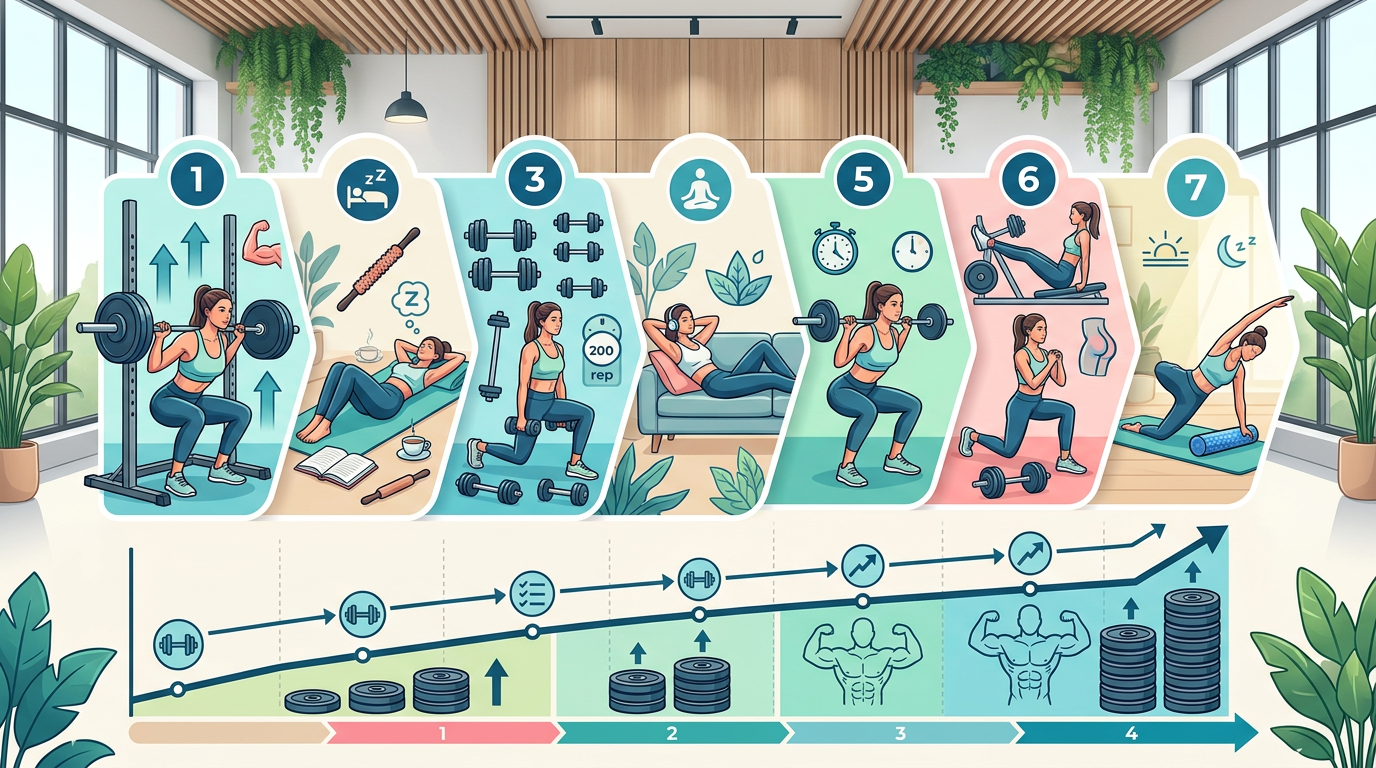
Infographic showing the weekly squat training split for muscle building, with daily volume, rest days, and progressive overload timeline
For Strength and Performance
If your goal is maximizing strength—lifting the heaviest weight possible—your approach shifts toward lower reps with heavier loads. Perform 4-6 sets of 3-6 squats at 80-90% of your one-rep max, 2-3 times weekly. This totals 12-36 heavy squats per session.
Strength training requires longer rest periods (3-5 minutes between sets) and meticulous attention to form under heavy loads. This approach builds neural adaptations that allow you to recruit more muscle fibers simultaneously.
For Fat Loss and Body Composition
Squats alone won't create a calorie deficit, but they're valuable for preserving muscle while losing fat. Combine 3-4 sets of 10-15 squats with other compound movements 3-5 days weekly. Focus on maintaining training intensity even while in a calorie deficit.
The metabolic benefits of squats include increased calorie burn during and after exercise, preservation of lean muscle mass, and improved insulin sensitivity—all supportive of fat loss efforts.
What Happens When You Do 100 Squats Daily
The "100 squats a day" challenge has gained popularity across social media, but is it effective? The answer depends entirely on your starting point and how you structure those 100 reps.
The Benefits of High-Volume Bodyweight Squats
Performing 100 bodyweight squats daily can improve muscular endurance, enhance cardiovascular conditioning, and build the habit of consistent movement. For beginners, this volume distributed across multiple sets throughout the day provides a solid introduction to lower body training.
Breaking 100 squats into manageable sets—like 5 sets of 20 or 10 sets of 10—makes the challenge more approachable and maintains better form quality than attempting all 100 consecutively.
The Limitations and Risks
However, 100 daily bodyweight squats have significant limitations. Without progressive overload, your body adapts within 4-6 weeks, and further improvements plateau. Continuously repeating the same workout without increasing difficulty leads to diminishing returns.
Potential drawbacks include:
- Overuse injuries from repetitive movement patterns without adequate recovery
- Muscle imbalances if squats are your only lower body exercise
- Lack of strength gains once your body adapts to bodyweight resistance
- Neglect of other important movement patterns like hip hinges and lunges
- Form breakdown when fatigue sets in, increasing injury risk
A Better Approach to High-Volume Training
If you enjoy high-repetition training, structure it intelligently. Perform 100 squats 3-4 days weekly rather than daily, allowing recovery days. Gradually add resistance through a weighted vest, dumbbells, or resistance bands. Incorporate squat variations to challenge your muscles differently and prevent adaptation.
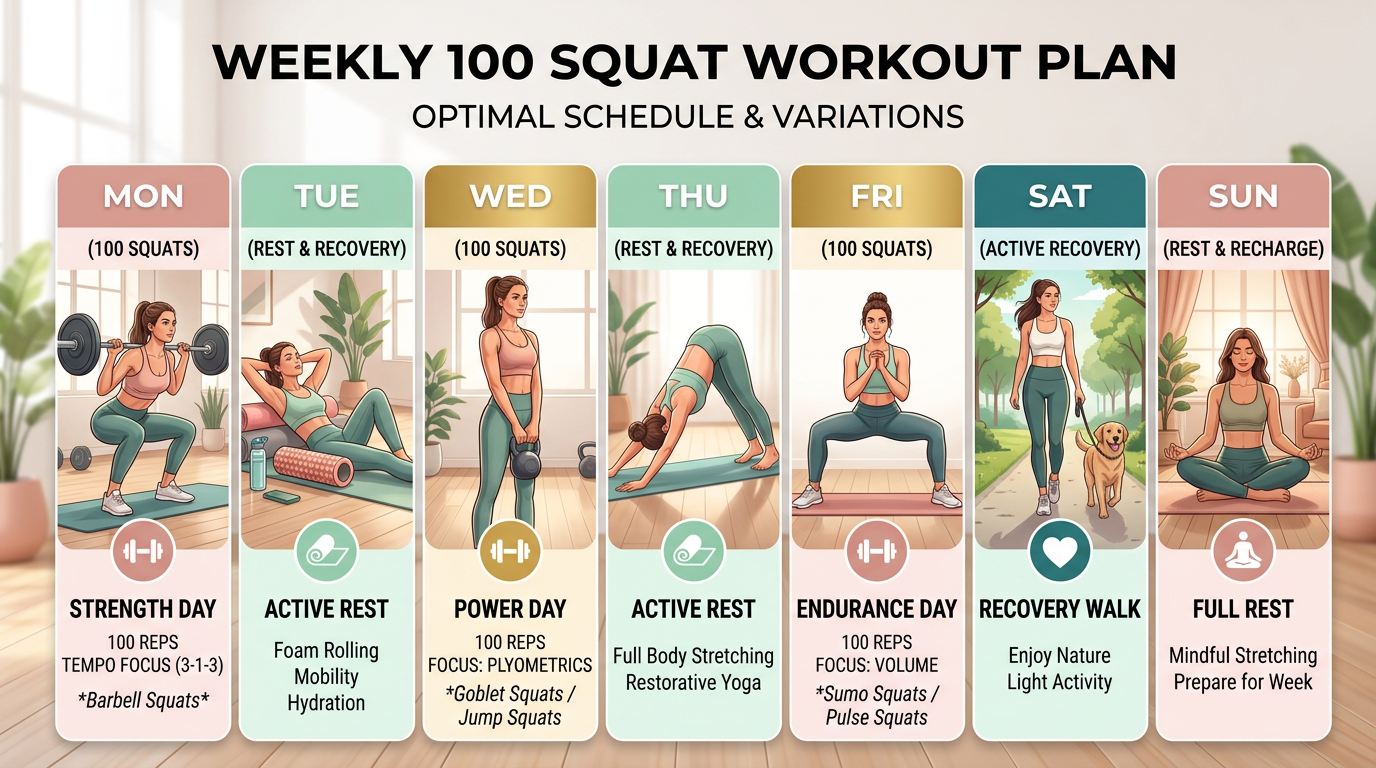
Weekly calendar showing optimal distribution of 100-squat workout days with rest days and variation suggestions for each training session
The Importance of Rest and Recovery
One of the biggest mistakes women make when asking how many squats a day they should do is overlooking the critical role of recovery. Your muscles don't grow during workouts—they grow during rest.
Why Rest Days Matter
Muscle protein synthesis—the process of building new muscle tissue—peaks 24-48 hours after training and requires adequate rest to complete. Training the same muscle groups daily without recovery impairs this process, leading to stagnation or even regression in your results.
During rest days, your body:
- Repairs microscopic muscle damage from training
- Replenishes glycogen stores for energy
- Reduces inflammation and clears metabolic waste
- Strengthens connective tissues and bones
- Rebalances stress hormones like cortisol
Structuring Your Weekly Squat Schedule
For optimal results, train squats 3-5 days per week with at least one full rest day between heavy sessions. This might look like squatting Monday, Wednesday, and Friday with active recovery or different exercises on other days.
If you prefer training six days weekly, alternate between heavy squat days and lighter, higher-rep sessions. This approach, called Daily Undulating Periodization, allows frequent training while managing fatigue.
Signs You Need More Recovery
Your body provides clear signals when you're not recovering adequately. Watch for persistent muscle soreness lasting beyond 72 hours, decreased performance or strength, disrupted sleep patterns, increased resting heart rate, or loss of motivation for training.
If you experience these symptoms, reduce your squat volume by 30-50% for one week to allow full recovery. This strategic deload prevents burnout and often leads to strength gains when you resume normal training.
Squat Variations to Maximize Results
Performing the same squat pattern daily creates adaptation and potential imbalances. Incorporating variations challenges your muscles from different angles and prevents plateaus.
Essential Squat Variations for Women
Goblet squats hold a dumbbell or kettlebell at chest height, promoting upright torso positioning and engaging your core. This variation is excellent for learning proper depth and knee tracking.
Sumo squats use a wider stance with toes turned out significantly, emphasizing inner thighs and glutes. This variation is particularly effective for women wanting to target the gluteus medius.
Bulgarian split squats elevate your rear foot on a bench, creating a unilateral movement that addresses strength imbalances and intensely targets each leg individually. This variation requires fewer total reps for equivalent stimulus.
Jump squats add a plyometric component, building explosive power and increasing calorie burn. These are best performed fresh, at the beginning of workouts.
Programming Variations Effectively
Rather than randomly mixing variations, structure them purposefully. Dedicate specific training days to different squat patterns based on your weekly split. For example, perform barbell back squats on Monday, goblet squats on Wednesday, and Bulgarian split squats on Friday.
This approach provides adequate recovery for each movement pattern while maintaining high training frequency for overall lower body development.
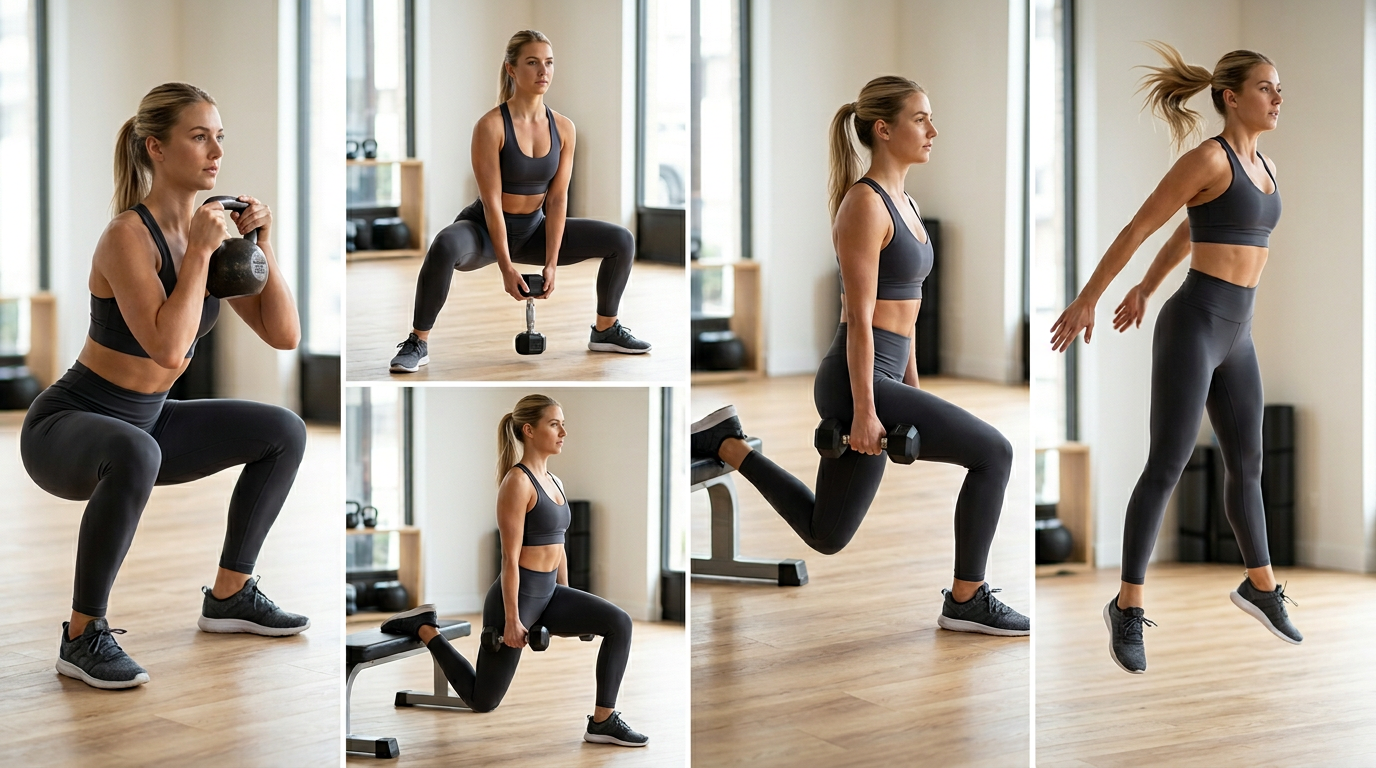
Demonstration grid showing four squat variations (goblet squat, sumo squat, Bulgarian split squat, jump squat) with key form cues for each
Additional Health Benefits Beyond Muscle Building
Squats offer remarkable benefits that extend far beyond aesthetic changes to your legs and glutes. Understanding these advantages reinforces why squats deserve a place in your routine.
Bone Density and Osteoporosis Prevention
Squats with progressive resistance create mechanical stress on bones that stimulates increased bone mineral density. This is particularly important for women, who face higher osteoporosis risk after menopause due to declining estrogen levels.
Weight-bearing exercises like squats signal your body to deposit more calcium and other minerals into bone tissue, making them denser and more resistant to fractures. Starting strength training in your 20s and 30s builds peak bone mass, while continuing through your 40s and beyond helps preserve it.
Blood Sugar Regulation and Metabolic Health
Your quadriceps, glutes, and hamstrings—the primary muscles worked during squats—are among the largest in your body. When these muscles contract during exercise, they pull glucose from your bloodstream for fuel, improving insulin sensitivity and blood sugar control.
Regular squat training enhances your muscles' ability to store and utilize glucose, reducing blood sugar spikes after meals. This metabolic benefit extends beyond your workout, with improved insulin sensitivity lasting 24-48 hours after training.
Functional Strength for Daily Life
The squat pattern mirrors countless daily movements—sitting down and standing up, picking up children or pets, lifting groceries, and gardening. Building strength through squats directly translates to easier, safer performance of these essential activities.
As you age, maintaining the ability to squat independently is one of the strongest predictors of overall quality of life and independence. Women who can perform a full squat in their 60s, 70s, and beyond maintain greater mobility and require less assistance with daily tasks.
Core Strength and Spinal Support
Proper squat execution requires intense core engagement to maintain spinal stability under load. Your abdominals, obliques, and erector spinae muscles work together to prevent your torso from collapsing forward or your lower back from hyperextending.
This core strengthening effect protects your spine during both exercise and everyday activities, reducing lower back pain risk. Many women discover that consistent squat training alleviates chronic back discomfort by building the muscular support their spine needs.
Common Mistakes That Limit Your Progress
Even with the right squat volume, certain errors can undermine your results or increase injury risk. Recognizing and correcting these mistakes accelerates your progress.
Prioritizing Quantity Over Quality
The most common mistake is rushing through high rep counts with compromised form. Ten perfect squats build more strength and create less injury risk than fifty sloppy ones. Every rep should demonstrate controlled descent, full depth (appropriate for your mobility), and powerful ascent.
If you can't maintain proper form for your target rep count, reduce the number or decrease the resistance. Your ego might prefer higher numbers, but your body responds to quality stimulus.
Neglecting Progressive Overload
Your body is remarkably efficient at adaptation. Once you can comfortably complete your target reps and sets, you must increase the challenge to continue progressing. This might mean adding weight, increasing reps, performing more challenging variations, or reducing rest periods.
Track your workouts in a training journal or app. When you successfully complete all prescribed sets and reps for two consecutive sessions, increase the difficulty by 5-10%.
Ignoring Mobility Limitations
Some women force themselves into squat depths their current mobility doesn't support, compensating with excessive forward lean, lifted heels, or rounded lower backs. These compensations shift stress to your spine and knees, creating injury risk.
If you can't achieve parallel depth with neutral spine and heels down, address your mobility limitations through targeted stretching and mobility work for your ankles, hips, and thoracic spine. Meanwhile, squat to the depth you can achieve with proper form.
Training Through Pain
Distinguish between the discomfort of muscular effort and the sharp or persistent pain that signals potential injury. Joint pain, sharp stabbing sensations, or pain that worsens during the movement should never be pushed through.
If you experience pain during squats, reduce the range of motion, decrease the load, or substitute a different exercise. Persistent pain warrants evaluation by a qualified healthcare provider or physical therapist.
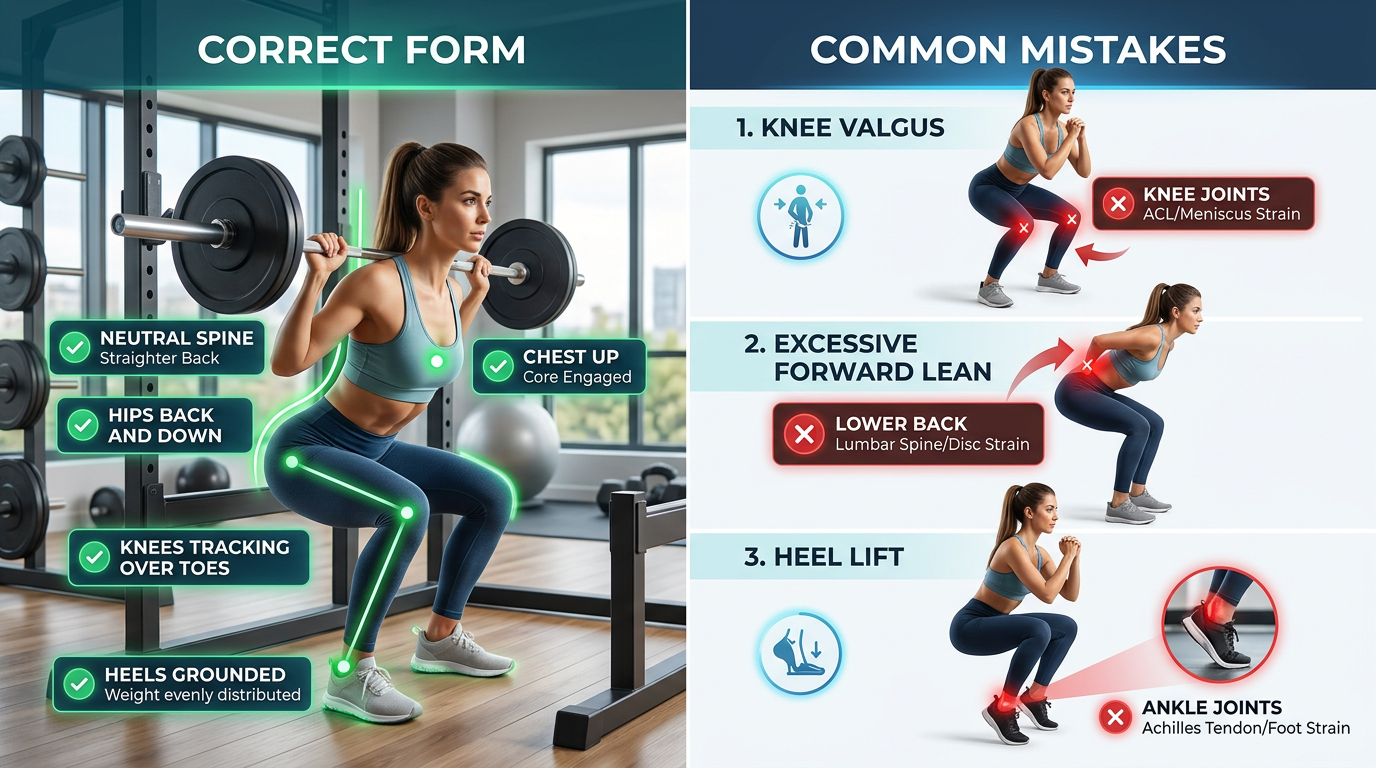
Comparison infographic showing three common squat mistakes (knee valgus, excessive forward lean, heel lift) versus correct form, with injury risk areas highlighted
Creating Your Personalized Squat Plan
Now that you understand the principles, let's create your specific action plan based on your current level and goals.
Your First 30 Days: Beginner Protocol
Weeks 1-2: Perform 3 sets of 8-10 bodyweight squats, 3 days per week (Monday, Wednesday, Friday). Focus entirely on form. Rest 60-90 seconds between sets. Total: 24-30 squats per training day.
Weeks 3-4: Increase to 3 sets of 12-15 bodyweight squats, maintaining the same 3-day schedule. If this feels easy, hold a light dumbbell at chest height (goblet position). Total: 36-45 squats per training day.
Months 2-3: Intermediate Progression
Add resistance progressively. Start with goblet squats using a weight that makes the last 2-3 reps of each set challenging. Perform 4 sets of 10-12 reps, 3-4 days weekly. Total: 40-48 squats per training day.
Introduce variation by alternating between goblet squats one day and bodyweight sumo squats the next. This prevents adaptation while allowing different muscle emphasis.
Month 4+: Advanced Programming
Structure your week with varying intensities and rep ranges. Heavy day (4 sets of 6-8 reps with barbell or heavy dumbbells), moderate day (3 sets of 10-12 reps with moderate weight), and high-rep day (2-3 sets of 15-20 reps with lighter weight or bodyweight).
This varied approach targets different muscle fiber types and energy systems, maximizing overall development while managing fatigue. Total weekly volume: 100-150 squats across 3-4 training sessions.
Adjusting Based on Response
Your body's response guides necessary adjustments. If you're consistently sore for 3+ days after squats, reduce volume by 20-30%. If you're not experiencing any challenge or muscle fatigue, increase resistance or volume by 10-15%.
Progress isn't always linear. Some weeks you'll feel strong and add weight or reps easily. Other weeks, life stress, sleep quality, or hormonal fluctuations may reduce your capacity. Listen to your body and adjust accordingly without judgment.
Frequently Asked Questions
How many squats should you do a day?
Beginners should perform 15-25 bodyweight squats daily across 2-3 sets, while intermediate lifters can do 30-50 squats with added resistance. Advanced athletes may complete 50-100+ squats per session, 3-5 days weekly with rest days between heavy training sessions for optimal recovery.
Do squats regulate blood sugar?
Squats help regulate blood sugar by engaging large muscle groups that pull glucose from your bloodstream for fuel. Regular squat training improves insulin sensitivity, allowing your muscles to utilize glucose more efficiently and reducing blood sugar spikes after meals for 24-48 hours post-exercise.
Can squats help with bone density?
Squats with progressive resistance significantly improve bone density by creating mechanical stress that signals your body to deposit more minerals into bone tissue. This weight-bearing exercise is particularly beneficial for women in preventing osteoporosis, especially when started early and maintained consistently throughout life.
What does doing 100 squats a day do?
Performing 100 bodyweight squats daily improves muscular endurance and cardiovascular conditioning, especially for beginners. However, without progressive overload, your body adapts within 4-6 weeks and improvements plateau. Adding resistance or variations prevents adaptation and produces better long-term strength and muscle-building results.
Should I do squats every day or take rest days?
Rest days are essential for muscle growth and recovery. Train squats 3-5 days per week with at least one full rest day between heavy sessions. Muscle protein synthesis peaks 24-48 hours after training and requires adequate recovery to build new tissue and increase strength effectively.
How long before I see results from daily squats?
You'll notice improved strength and endurance within 2-3 weeks of consistent squat training. Visible muscle development typically appears after 6-8 weeks with proper progressive overload and nutrition. Significant body composition changes require 12+ weeks of dedicated training combined with appropriate calorie and protein intake.
Can squats alone give me a toned lower body?
Squats are excellent for building lower body strength and muscle, but a complete program includes hip hinges, lunges, and isolation exercises for balanced development. Combining squats with other movement patterns prevents imbalances and creates more comprehensive results than squats alone, especially for glute development.
Conclusion
The question of how many squats a day you should perform has no universal answer—and that's precisely why individualized programming matters. Beginners thrive with 15-25 daily bodyweight squats focusing on form mastery, intermediate lifters progress with 30-50 squats incorporating progressive resistance, and advanced athletes can handle 50-100+ squats across varied intensities and rep ranges.
Remember that quality always trumps quantity, rest days are non-negotiable for muscle growth, and progressive overload drives continued results. Squats offer remarkable benefits beyond aesthetics, including improved bone density, better blood sugar regulation, and enhanced functional strength for daily life.
Start where you are, focus on perfect form, progressively challenge yourself, and trust the process—your stronger, more capable body is built one quality rep at a time.