Hip Flexor Exercises: Relieve Tightness and Build Strength
Hip flexor exercises are targeted movements that strengthen and stretch the iliopsoas, rectus femoris, and surrounding muscles connecting your thighs to your pelvis. The most effective include kneeling hip flexor stretches, standing knee drives, leg raises, and mountain climbers, performed 2-3 times weekly to reduce tightness, improve mobility, and prevent lower back pain.
Introduction
Do you feel a nagging tightness in the front of your hips after sitting at your desk all day? Does climbing stairs feel harder than it should, or do you experience lower back discomfort during workouts? You're not alone. Tight, weak hip flexors affect millions of women, especially those juggling desk jobs with fitness goals. The good news? Incorporating targeted hip flexor exercises into your routine can transform how your body moves and feels.
Your hip flexors are the unsung heroes of everyday movement—from walking and running to squatting and lunging. When they're tight or weak, your entire kinetic chain suffers, leading to compensations that can derail your fitness progress. Created by certified trainer Shelley Darlington with 15+ years experience, this comprehensive guide will show you exactly how to strengthen, stretch, and mobilize these crucial muscles for better performance and pain-free movement.
Whether you're a seasoned lifter or just starting your fitness journey, understanding hip flexor exercises is essential for building a strong, functional body. This article covers everything from anatomy basics to specific exercises, programming strategies, and common mistakes to avoid—all backed by science and real-world results.
Key Takeaways
- Hip flexors are essential for lifting your knees, bending at the waist, and stabilizing your pelvis during movement
- Tight hip flexors often result from prolonged sitting and can lead to lower back pain, poor posture, and limited mobility
- A balanced approach combining strengthening and stretching exercises 2-3 times weekly delivers optimal results
- Proper form and progressive overload are critical for building hip flexor strength without injury
- Addressing hip flexor dysfunction improves squat depth, running efficiency, and overall athletic performance
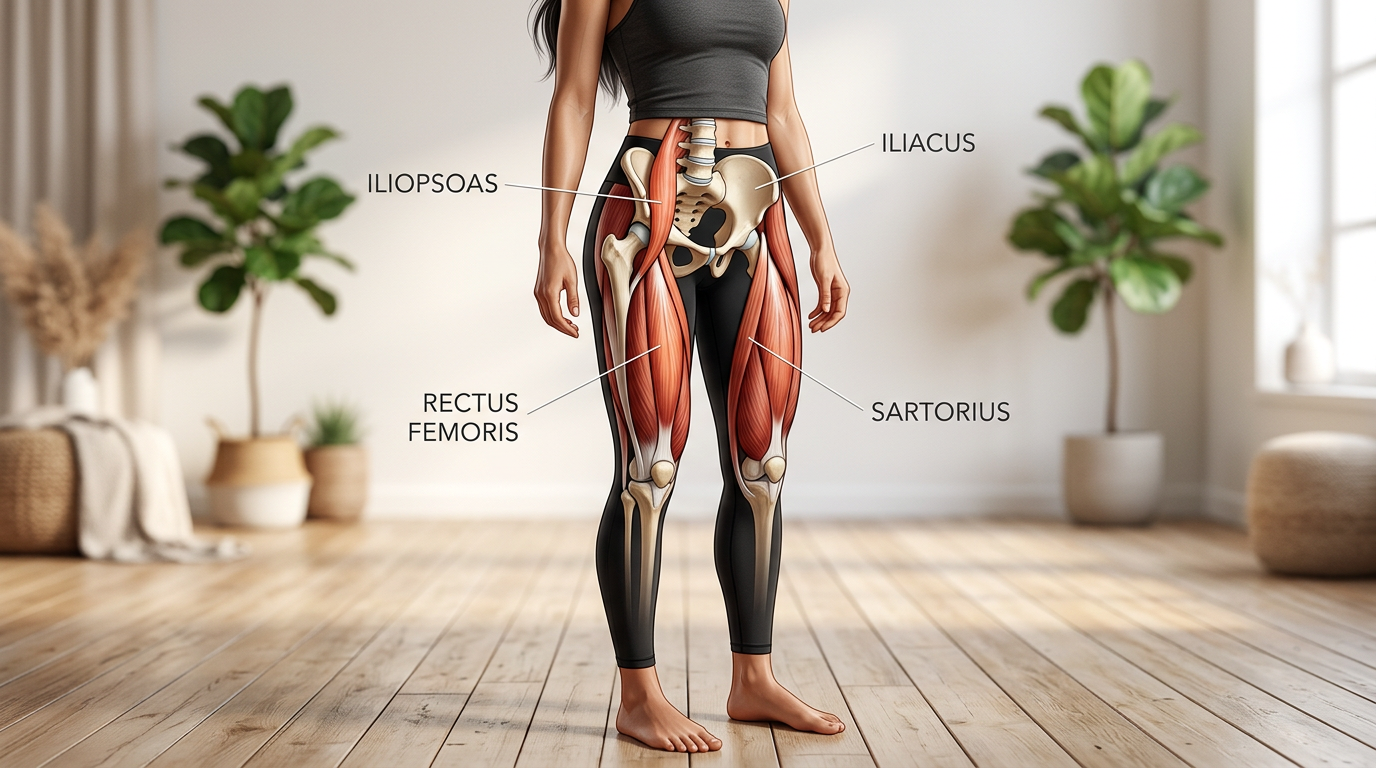
Anatomical illustration showing the hip flexor muscle group including iliopsoas, rectus femoris, and sartorius muscles with labels on a female figure
Understanding Your Hip Flexors: Anatomy and Function
Before diving into the best hip flexor exercises, it's crucial to understand what these muscles actually do. Your hip flexors aren't just one muscle—they're a group of muscles working together to create movement at your hip joint.
The Primary Hip Flexor Muscles
The hip flexor group includes several key players:
- Iliopsoas: The powerhouse combination of your psoas major and iliacus muscles, responsible for the majority of hip flexion strength
- Rectus femoris: The only quadriceps muscle that crosses the hip joint, assisting with both hip flexion and knee extension
- Sartorius: The longest muscle in your body, helping with hip flexion, abduction, and external rotation
- Tensor fasciae latae (TFL): A small but mighty muscle that assists with hip flexion and stabilization
- Pectineus and adductor muscles: While primarily adductors, these muscles also contribute to hip flexion
Why Hip Flexor Health Matters for Women
Strong, flexible hip flexors are fundamental to every lower body movement pattern you perform. They're essential for activities like sprinting, jumping, squatting deep, and even maintaining proper posture while standing. Women 35+ focused on strength training and body recomposition particularly benefit from addressing hip flexor health, as hormonal changes and lifestyle factors can accelerate muscle tightness and weakness.
When your hip flexors are functioning optimally, you'll notice improved performance in compound lifts like squats and deadlifts, better running economy, and reduced risk of compensatory injuries. Conversely, dysfunctional hip flexors create a cascade of problems throughout your kinetic chain, often manifesting as lower back pain, anterior pelvic tilt, or difficulty activating your glutes during workouts.
The Sitting Epidemic and Your Hips
Modern life keeps most of us in a flexed hip position for 8-12 hours daily. This prolonged sitting causes your hip flexors to remain in a shortened position, leading to adaptive shortening—a process where muscles literally lose sarcomeres (contractile units) and become chronically tight. The solution isn't just stretching; you need a comprehensive approach that includes both mobility work and targeted strengthening.
Signs You Need to Focus on Hip Flexor Exercises
How do you know if your hip flexors need attention? Several telltale signs indicate it's time to prioritize these muscles in your training program.
Common Symptoms of Tight Hip Flexors
Watch for these warning signs:
- Lower back pain or discomfort, especially when standing after prolonged sitting
- Difficulty achieving proper depth in squats without your lower back rounding
- A visible anterior pelvic tilt (your lower back arches excessively and your belly protrudes forward)
- Hip pain or pinching sensation in the front of your hip during leg raises or high knees
- Tight sensation in the front of your thighs and hips after workouts or long periods of inactivity
- Reduced stride length when running or walking
Indicators of Weak Hip Flexors
Weakness in your hip flexors manifests differently than tightness and requires specific strengthening protocols. You might notice difficulty lifting your knee to hip height, struggling with exercises like mountain climbers or high knees, or feeling your hip flexors fatigue quickly during ab work. Many women discover their hip flexors are the limiting factor in exercises like hanging leg raises or V-ups, where the abs are strong enough but the hips can't maintain the position.
Based on feedback from thousands of Strong Curves app users, the combination of tightness and weakness is most common—your hip flexors are short and stiff but lack the strength to move through a full range of motion under load. This is why a balanced approach to hip flexor exercises is essential.
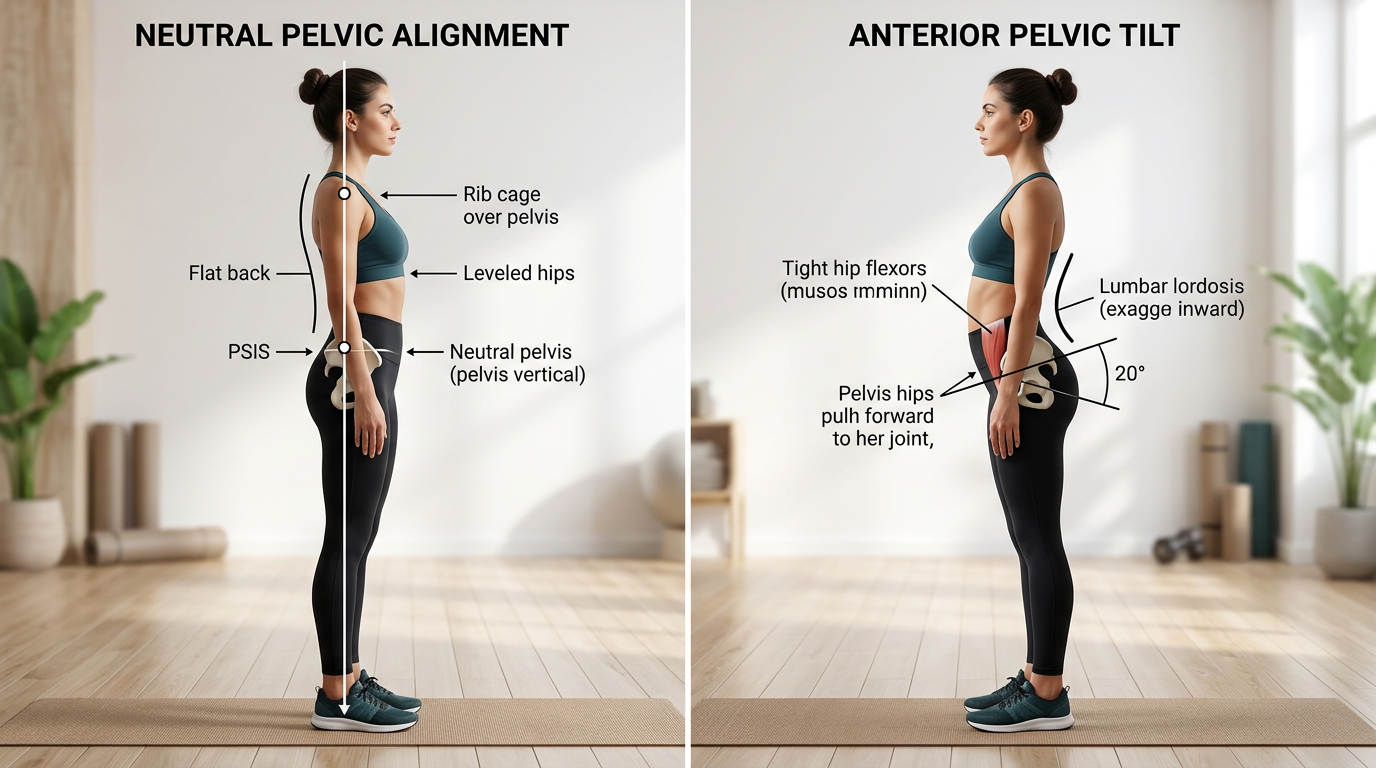
Side-by-side comparison showing proper neutral pelvic alignment versus anterior pelvic tilt caused by tight hip flexors on female figures
Best Hip Flexor Exercises for Strength
Building strong hip flexors improves your performance in virtually every lower body movement. These exercises target the hip flexor group through various angles and movement patterns.
1. Standing Banded Knee Drives
This exercise is perfect for beginners and provides immediate feedback about hip flexor strength. Loop a resistance band around a sturdy anchor point at floor level, then around one ankle. Stand facing away from the anchor point and drive your knee forward and up toward your chest against the band's resistance. Perform 3 sets of 12-15 reps per leg, focusing on controlled movement rather than speed.
The band creates accommodating resistance—it's easier at the bottom and harder at the top, which matches your strength curve perfectly. This makes it an ideal exercise for building both strength and endurance in your hip flexors.
2. Hanging Knee Raises
Hang from a pull-up bar with your arms fully extended and shoulders engaged. Keeping your core tight, flex your hips to bring your knees up toward your chest. Lower with control and repeat. This exercise not only strengthens your hip flexors but also challenges your grip strength and core stability simultaneously.
Start with bent-knee raises and progress to straight-leg raises as you build strength. Aim for 3 sets of 8-12 reps, resting 60-90 seconds between sets.
3. Mountain Climbers
Begin in a high plank position with your hands directly under your shoulders. Drive one knee toward your chest, then quickly switch legs in a running motion. This dynamic exercise builds hip flexor strength and endurance while elevating your heart rate. Perform 3-4 sets of 30-45 seconds, maintaining proper plank form throughout.
4. Psoas March
Lie on your back with your knees bent and feet flat on the floor. Engage your core to press your lower back into the ground, then slowly lift one knee toward your chest while keeping your shin parallel to the floor. Hold for 2-3 seconds, lower with control, and repeat on the other side. This controlled movement isolates the hip flexors and teaches proper pelvic stability.
Perform 3 sets of 10-12 reps per leg. To increase difficulty, add ankle weights or extend the hovering leg straight rather than keeping it bent.
5. Bulgarian Split Squat (Hip Flexor Emphasis)
While typically considered a quad and glute exercise, the Bulgarian split squat provides an excellent stretch and strengthening stimulus for the hip flexor of your rear leg. Place one foot on a bench behind you and lower into a split squat position. The deeper you descend, the greater the stretch on your rear hip flexor.
Perform 3 sets of 8-12 reps per leg. This exercise bridges the gap between isolated hip flexor work and functional strength training, making it invaluable for overall lower body development.
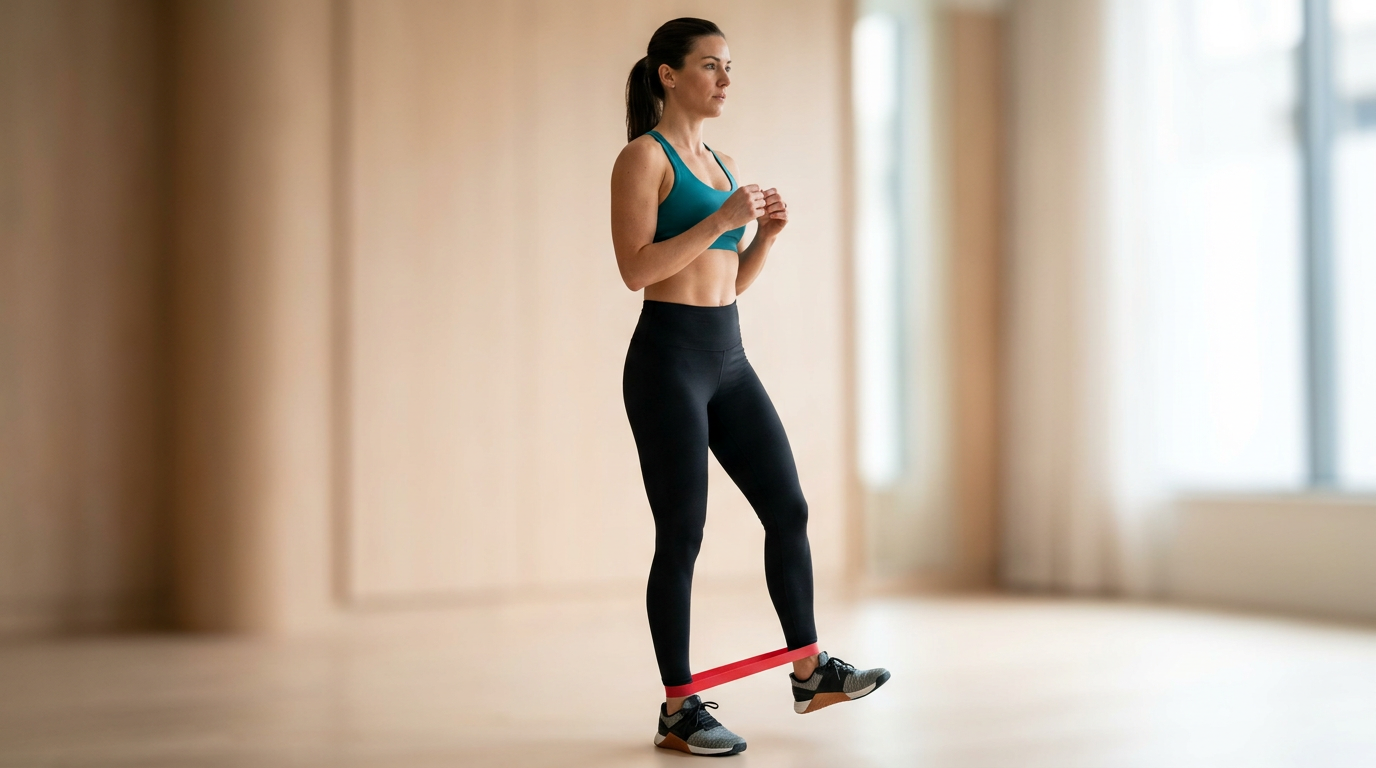
Step-by-step demonstration photos showing proper form for standing banded knee drives performed by a woman, with four progressive images showing the starting position and knee drive motion
Essential Hip Flexor Stretches to Relieve Tightness
Stretching tight hip flexors is crucial for restoring optimal length-tension relationships and reducing compensatory movement patterns. These stretches should be held for 30-60 seconds and performed when your muscles are warm.
1. Kneeling Hip Flexor Stretch
The kneeling hip flexor stretch is the gold standard for releasing chronically tight hip flexors. Kneel on one knee with your other foot planted in front, forming a 90-degree angle at both knees. Gently push your hips forward while keeping your torso upright and core engaged. You should feel a deep stretch in the front of your hip and thigh on the kneeling side.
To intensify the stretch, raise the arm on the same side as your kneeling leg overhead and lean slightly to the opposite side. This adds a lateral component that targets the psoas more effectively. Hold for 45-60 seconds per side, performing 2-3 rounds.
2. Low Lunge (Anjaneyasana)
Similar to the kneeling stretch but with your hands on the ground for support, the low lunge allows you to control the intensity more precisely. From a kneeling position, step one foot forward and lower your hips toward the ground. Keep your front knee tracking over your ankle and your back leg extended behind you.
For an enhanced stretch, try to straighten your back leg and lift your back knee off the ground while maintaining the hip flexor stretch. This variation also engages your core and improves balance.
3. Couch Stretch
This intense stretch targets the rectus femoris specifically. Position yourself facing away from a couch or wall. Place one shin vertically against the couch with your knee on the ground, and step your other foot forward into a lunge position. Slowly bring your torso upright, which will intensify the stretch dramatically.
The couch stretch is advanced and can be uncomfortable initially. Start with 20-30 seconds per side and gradually work up to 60-90 seconds as your mobility improves. The Strong Curves glute-focused approach to functional fitness emphasizes this stretch for women looking to improve squat depth and reduce anterior pelvic tilt.
4. Standing Hip Flexor Stretch
When you don't have floor space available, the standing version works well. Stand with feet hip-width apart, then take a large step backward with one leg. Bend your front knee slightly and tuck your pelvis under (posterior pelvic tilt) while keeping your back leg straight. You should feel the stretch in the front of your back hip.
Hold for 30-45 seconds per side. This stretch is perfect for office breaks or post-workout when you're short on time.
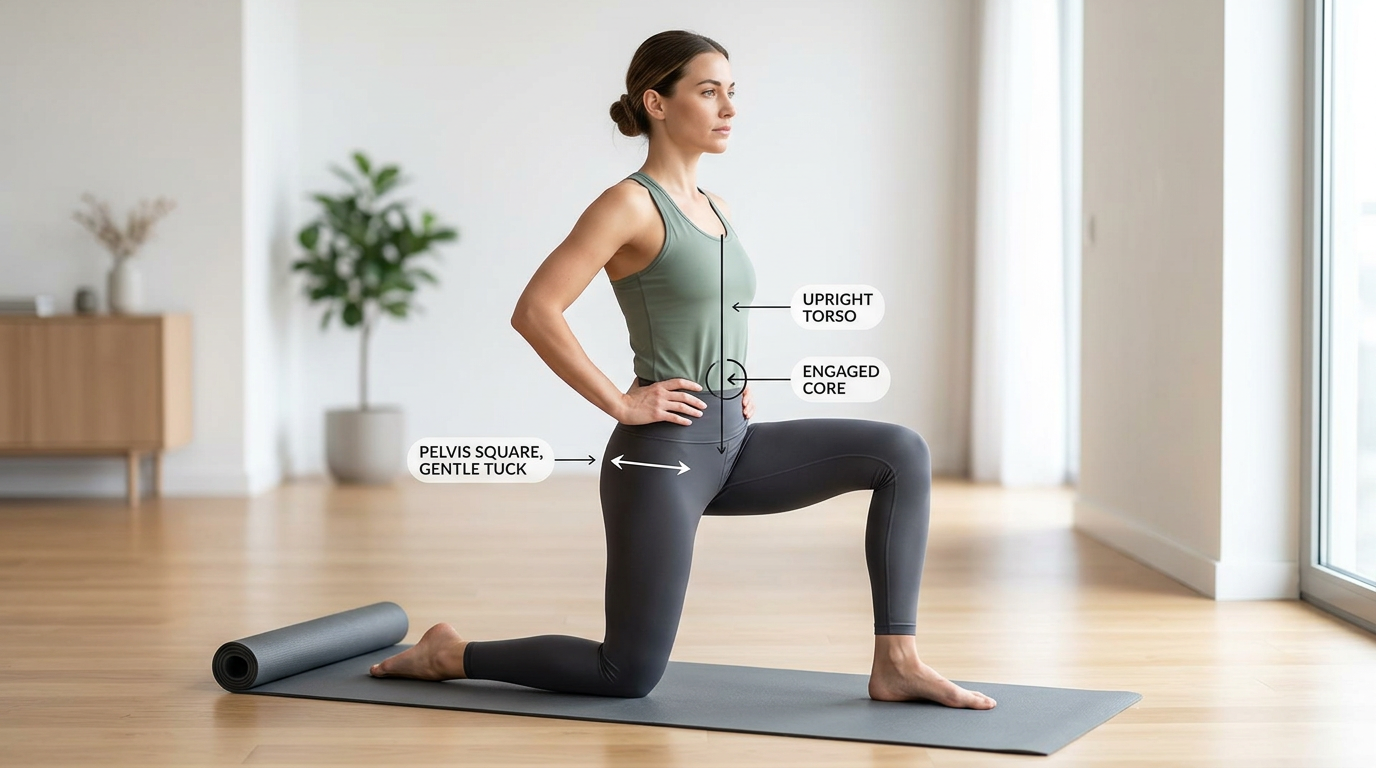
Detailed form demonstration of kneeling hip flexor stretch showing proper alignment, with annotation arrows indicating hip position, upright torso, and engaged core on a woman
How to Program Hip Flexor Exercises Into Your Routine
Knowing the exercises is only half the battle—programming them effectively ensures you see results without overtraining or creating imbalances.
Weekly Training Frequency
For optimal results, incorporate hip flexor exercises 2-3 times per week with at least one rest day between sessions. Your hip flexors are involved in most lower body movements, so they get indirect work during squats, lunges, and running. Adding dedicated hip flexor training provides the targeted stimulus needed for improvement without excessive volume.
A sample weekly structure might look like this:
- Monday: Lower body strength training with 2 hip flexor strengthening exercises (knee raises, banded drives)
- Wednesday: Hip flexor stretching routine post-cardio or as standalone mobility work
- Friday: Lower body strength training with 1-2 different hip flexor exercises (mountain climbers, psoas march)
- Sunday: Active recovery with gentle hip flexor stretches and foam rolling
Sets, Reps, and Progression
For strengthening exercises, start with 2-3 sets of 10-12 reps per exercise. As you build strength, progress by increasing reps to 15-20, adding resistance (bands, ankle weights), or advancing to more challenging variations. The principle of progressive overload applies to hip flexors just as it does to any other muscle group.
For stretches, hold each position for 30-60 seconds and perform 2-3 rounds per stretch. Unlike strengthening work, stretching benefits from daily practice if you're dealing with significant tightness. Consider adding 5-10 minutes of hip flexor stretching to your morning or evening routine for accelerated results.
Integrating With Your Current Program
Hip flexor exercises fit seamlessly into most training programs. Add strengthening movements to your leg day or core training sessions. Include stretches in your warm-up (dynamic stretches) or cool-down (static stretches). If you're following a structured program focused on glute development and lower body strength, hip flexor work enhances your results by improving squat depth and reducing compensations that limit glute activation.
Common Mistakes to Avoid
Even with the best intentions, several common errors can limit your progress or lead to injury when performing hip flexor exercises.
Mistake #1: Overarching Your Lower Back
During strengthening exercises like leg raises or knee drives, many women compensate for weak hip flexors by hyperextending their lower back. This not only reduces the effectiveness of the exercise but also increases injury risk. Always maintain a neutral spine or slight posterior pelvic tilt during hip flexor strengthening movements.
Focus on engaging your core throughout the movement. If you can't maintain proper spinal alignment, regress the exercise to an easier variation until you build sufficient strength.
Mistake #2: Stretching Without Activation
Stretching tight hip flexors provides temporary relief, but without addressing the weakness and poor motor control that often accompany tightness, the problem returns quickly. Always pair stretching with strengthening exercises for lasting results. Additionally, activate antagonist muscles (glutes and hamstrings) before and after hip flexor work to restore proper muscle balance.
Mistake #3: Ignoring the Root Cause
If you spend 10 hours sitting and do 10 minutes of hip flexor stretches, you're fighting a losing battle. Address lifestyle factors by taking standing breaks every 30-60 minutes, using a standing desk for part of your workday, and incorporating more general movement throughout your day. Learn more about improving posture and movement quality for comprehensive solutions.
Mistake #4: Rushing Through Movements
Hip flexor exercises require control and intention. Rushing through reps reduces time under tension and limits the neuromuscular benefits. Slow down, focus on the muscle contraction, and prioritize quality over quantity. A controlled tempo (2 seconds up, 1 second hold, 2 seconds down) maximizes results.
The Hip Flexor-Glute Connection
Understanding the relationship between your hip flexors and glutes is crucial for balanced lower body development and injury prevention.
Reciprocal Inhibition Explained
Your body operates on a principle called reciprocal inhibition—when one muscle group contracts, its antagonist relaxes. Chronically tight hip flexors send constant signals that inhibit glute activation, making it harder to fully engage your glutes during exercises like squats, deadlifts, and hip thrusts. This is one reason why women often struggle to "feel" their glutes working despite performing glute-focused exercises.
Releasing hip flexor tightness through targeted stretching and mobility work can immediately improve glute activation and performance. Many women report better glute engagement and increased strength in their lifts after just 2-3 weeks of consistent hip flexor work.
Creating Balance for Optimal Function
The goal isn't to have weak hip flexors—it's to have strong, mobile hip flexors that work in harmony with equally strong glutes and hamstrings. This balance allows for optimal force production, reduces compensation patterns, and minimizes injury risk. Include both hip flexor exercises and glute activation work in your training for comprehensive hip health. Trusted by over 50,000 women worldwide, this balanced approach to lower body training delivers superior results compared to focusing on one muscle group in isolation.
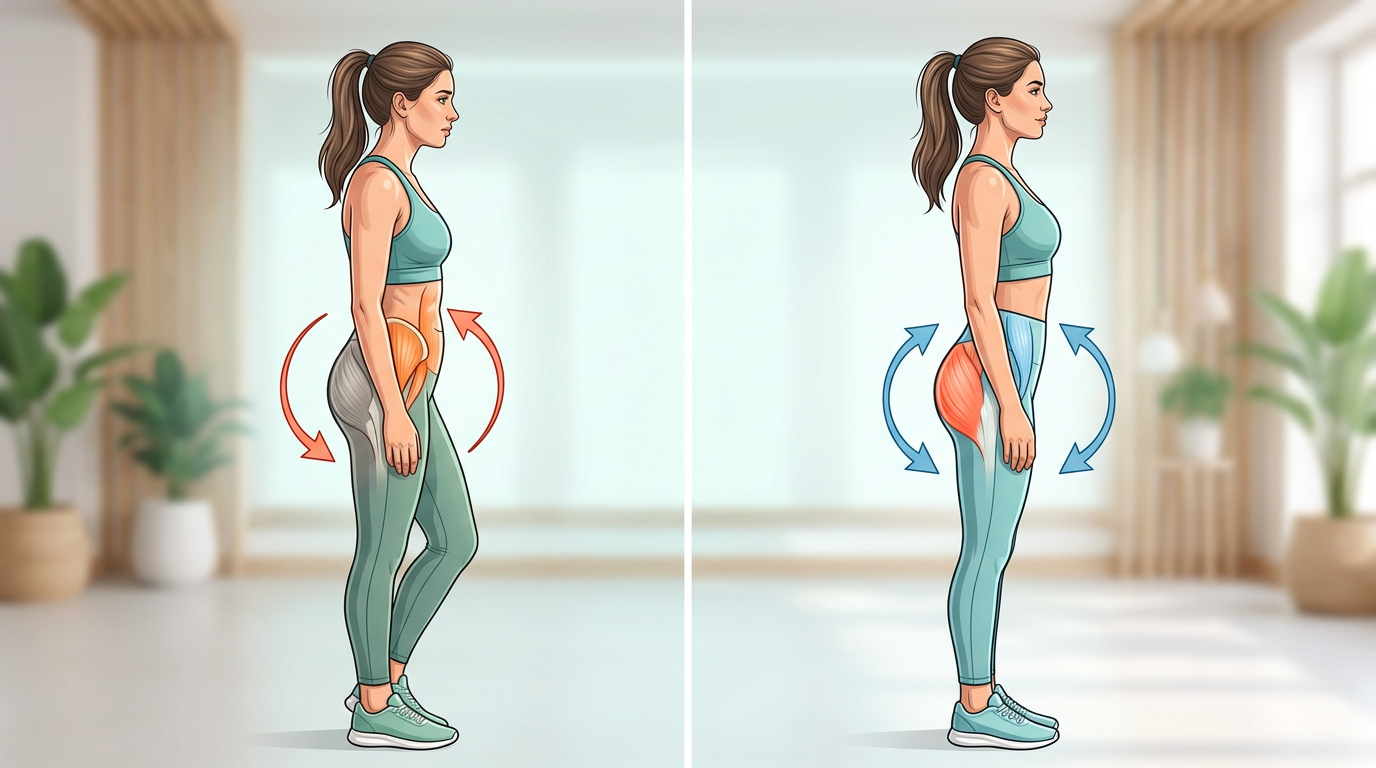
Infographic showing the reciprocal relationship between hip flexors and glutes, with arrows indicating how tight hip flexors inhibit glute activation
Addressing Special Considerations
Certain situations require modified approaches to hip flexor training. Here's how to adapt your program for specific circumstances.
Hip Flexor Exercises for Runners
Runners place enormous demands on their hip flexors with every stride. The repetitive nature of running can lead to both tightness and overuse injuries if hip flexor health isn't maintained. Runners should prioritize dynamic hip flexor stretches before runs (leg swings, walking lunges) and static stretches post-run. Additionally, strengthening exercises like knee drives and mountain climbers improve running economy by enhancing the power of your hip flexion during the swing phase of your gait.
During Pregnancy and Postpartum
Pregnancy changes your center of gravity and often exacerbates anterior pelvic tilt due to the growing baby and hormonal changes affecting ligament laxity. Gentle hip flexor stretches can provide relief, but avoid aggressive stretching during pregnancy. Focus on maintaining strength through modified exercises like standing knee lifts and seated marches. Postpartum, gradually reintroduce hip flexor work as part of your recovery process, always listening to your body and consulting with healthcare providers.
For Desk Workers
If you sit for extended periods, implement a proactive approach. Set hourly reminders to stand and perform 2-3 minutes of hip flexor stretches or mobility work. Consider a standing desk for part of your day, and use a foam roller on your hip flexors during lunch breaks. Evening training sessions should include dedicated hip flexor stretching to counteract the day's accumulated tightness. Explore desk-friendly mobility routines for more strategies to combat sitting-related issues.
Working Around Hip Pain
If you're experiencing hip pain, differentiate between productive discomfort (stretching sensation) and pain that indicates injury. Sharp, pinching pain in the front of your hip during flexion may indicate hip impingement or labral issues requiring professional assessment. Dull, achy tightness typically responds well to the exercises in this guide. When in doubt, consult a physical therapist or sports medicine professional for personalized guidance.
Frequently Asked Questions
How do I strengthen my hip flexor?
Strengthen hip flexors through exercises like hanging knee raises, standing banded knee drives, mountain climbers, and psoas marches. Perform 2-3 sets of 10-15 reps per exercise, 2-3 times weekly. Progress by adding resistance, increasing reps, or advancing to more challenging variations while maintaining proper form and core engagement throughout each movement.
What are the symptoms of a weak hip flexor?
Weak hip flexors cause difficulty lifting your knee to hip height, struggling with exercises like leg raises or high knees, and rapid fatigue during ab work. You may notice reduced stride length when running, difficulty maintaining proper form in compound lifts, and compensatory movements where your lower back arches excessively during hip flexion exercises.
Can tight hip flexors be reversed?
Yes, tight hip flexors can be reversed through consistent stretching, strengthening, and lifestyle modifications. Perform hip flexor stretches for 30-60 seconds, 2-3 times daily, combined with strengthening exercises 2-3 times weekly. Address prolonged sitting by taking movement breaks every hour. Most people notice significant improvement within 2-4 weeks of dedicated practice.
Do adductors help hip flexors?
Adductors assist with hip flexion, particularly the pectineus and adductor brevis muscles. While their primary function is bringing your leg toward your midline, they contribute to hip flexion when your hip is externally rotated. Strong adductors support overall hip stability and function, complementing dedicated hip flexor work for comprehensive hip health and performance.
How long should I hold hip flexor stretches?
Hold hip flexor stretches for 30-60 seconds per side to achieve optimal lengthening. Perform 2-3 rounds of each stretch for maximum benefit. Static stretches should be done when muscles are warm, ideally post-workout or after light cardio. For severe tightness, daily stretching sessions accelerate progress more effectively than less frequent longer sessions.
Should I stretch hip flexors before or after workouts?
Perform dynamic hip flexor stretches before workouts to prepare muscles for movement without reducing power output. Save static stretches for after training when muscles are warm and more receptive to lengthening. Pre-workout, use leg swings and walking lunges. Post-workout, hold static stretches like the kneeling hip flexor stretch to improve flexibility and reduce tightness.
Can weak hip flexors cause knee pain?
Yes, weak hip flexors can contribute to knee pain through altered movement mechanics. When hip flexors are weak, your body compensates by overusing the quadriceps and changing knee tracking patterns. This increases stress on knee structures and can lead to patellofemoral pain syndrome. Strengthening hip flexors often reduces knee pain by restoring proper movement patterns.
Conclusion
Your hip flexors are fundamental to every lower body movement you perform, from walking and running to squatting and climbing stairs. Addressing tightness and building strength in these often-neglected muscles transforms your movement quality, reduces pain, and unlocks new levels of performance in your training.
The most effective approach to hip flexor exercises combines targeted strengthening movements like knee raises and banded drives with dedicated stretching protocols including the kneeling hip flexor stretch and couch stretch. Implement this balanced strategy 2-3 times weekly, and you'll notice improvements in squat depth, reduced lower back discomfort, and better glute activation within just a few weeks.
Key takeaways for hip flexor success:
- Balance strengthening and stretching for comprehensive hip flexor health
- Address lifestyle factors like prolonged sitting that contribute to dysfunction
- Focus on quality movement and proper form rather than rushing through exercises
- Pair hip flexor work with glute activation to restore muscle balance
- Be consistent with 2-3 weekly sessions for lasting results
Ready to take your training to the next level? The Strong Curves app provides structured hip flexor exercises, glute-focused workouts, and progressive programming designed specifically for women's bodies. Join thousands of women who've transformed their strength, mobility, and confidence through science-backed training methods. Download the Strong Curves app today and experience the difference that proper hip flexor training makes in your fitness journey.
Have questions about incorporating hip flexor exercises into your routine? Share your experience in the comments below, and let's build stronger, more functional bodies together!