The Best Butt Workouts With Weights for Women
Butt workouts with weights are resistance training exercises targeting the gluteal muscles using dumbbells, barbells, or kettlebells. The most effective include hip thrusts, Romanian deadlifts, Bulgarian split squats, sumo squats, and weighted glute bridges, performed with progressive overload for maximum muscle growth and strength.
If you've been searching for ways to build stronger, more sculpted glutes, you've come to the right place. Butt workouts with weights are the gold standard for developing powerful glutes that not only look amazing but also support your entire body through daily activities and athletic performance. While bodyweight exercises have their place, adding resistance through weights creates the progressive overload your muscles need to grow and strengthen.
Whether you're new to strength training or looking to level up your glute routine, weighted exercises offer unmatched benefits. They help you build muscle more efficiently, increase metabolic rate, improve bone density, and enhance functional strength for everything from climbing stairs to running faster. This comprehensive guide covers the best butt workouts with weights, breaking down proper form, benefits, and how to incorporate them into your training program.
Get ready to discover exercises that will transform your glute training and help you build the strong, powerful lower body you deserve.
Key Takeaways
- Weighted glute exercises create progressive overload essential for muscle growth and strength gains
- Hip thrusts, Romanian deadlifts, and Bulgarian split squats are among the most effective weighted movements for glute development
- Proper form and gradual weight progression prevent injury while maximizing results
- Training glutes 2-3 times per week with adequate recovery optimizes muscle building
- Strong glutes improve posture, reduce lower back pain, and enhance athletic performance
Quick Comparison: Best Weighted Butt Exercises
Exercise
Difficulty Level
Equipment Needed
Primary Benefit
Barbell Hip Thrust
Intermediate
Barbell, bench
Maximum glute activation
Romanian Deadlift
Intermediate
Barbell or dumbbells
Hamstring and glute strength
Bulgarian Split Squat
Advanced
Dumbbells, bench
Unilateral strength and balance
Dumbbell Sumo Squat
Beginner
Dumbbell
Inner thigh and glute targeting
Weighted Glute Bridge
Beginner
Barbell or dumbbell
Glute isolation and activation
Kettlebell Swing
Intermediate
Kettlebell
Power and explosive strength
Walking Lunges
Beginner-Intermediate
Dumbbells
Functional strength and coordination
Cable Pull-Through
Beginner
Cable machine
Hip hinge pattern mastery
Single-Leg RDL
Advanced
Dumbbell or kettlebell
Balance and unilateral development
Goblet Squat
Beginner
Dumbbell or kettlebell
Squat pattern foundation
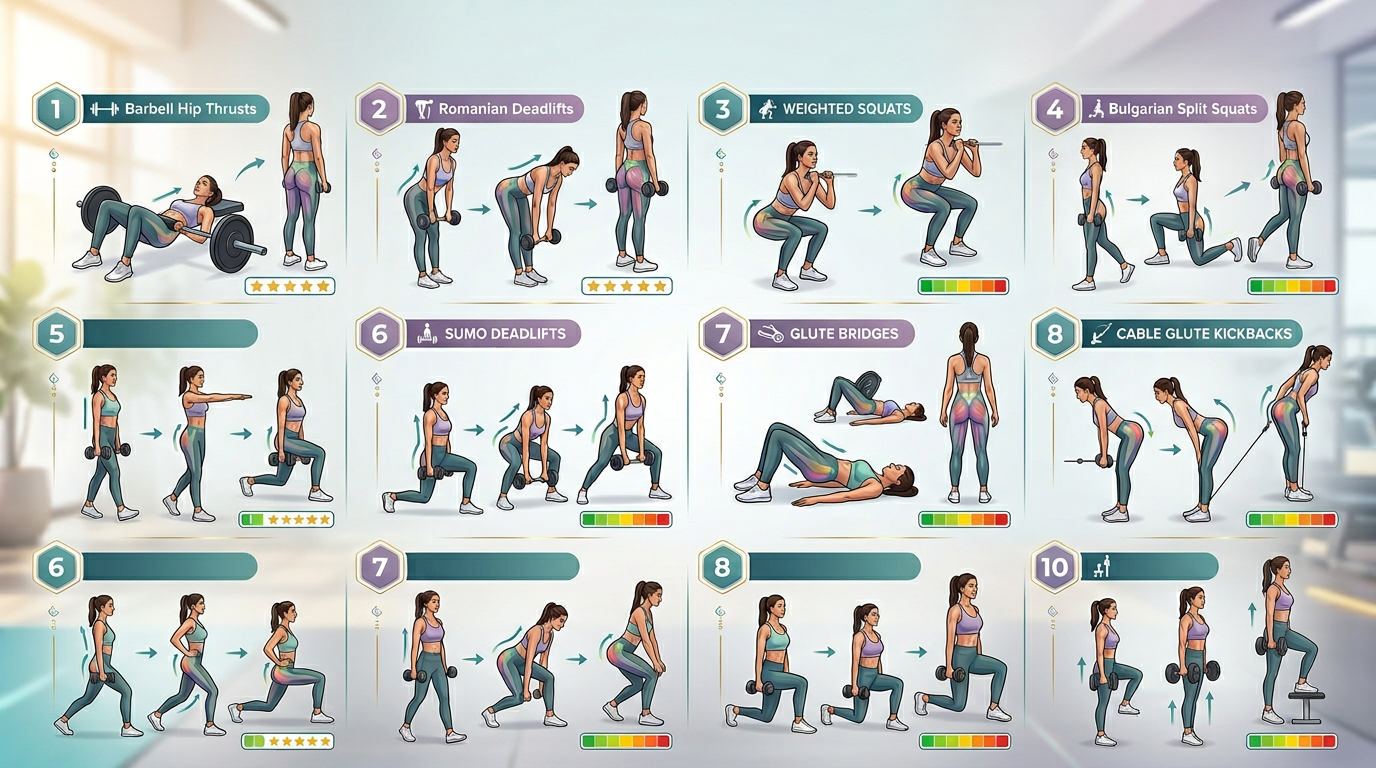
Comparison infographic showing proper form for the top 10 weighted butt exercises with difficulty ratings and muscle activation zones highlighted
1. Barbell Hip Thrust
The barbell hip thrust reigns supreme as one of the most effective butt workouts with weights for glute development. Research consistently shows that hip thrusts produce the highest glute activation of any lower body exercise, making them essential for anyone serious about building stronger glutes.
To perform a hip thrust, position your upper back against a bench with a barbell across your hips. Plant your feet flat on the floor, hip-width apart. Drive through your heels to lift your hips until your body forms a straight line from shoulders to knees. Squeeze your glutes hard at the top before lowering with control.
The beauty of hip thrusts lies in their ability to load the glutes in their shortened position, where they're fully contracted. This creates maximum tension and metabolic stress, two key drivers of muscle growth. Start with just the barbell to master form, then progressively add weight plates as you get stronger.
Pros
- Highest glute activation of any weighted exercise
- Allows for heavy loading and progressive overload
- Minimal stress on lower back compared to squats
- Easy to feel the mind-muscle connection
Cons
- Requires specialized setup with bench and barbell
- Can be uncomfortable on hip bones without padding
- May feel awkward or intimidating for beginners
2. Romanian Deadlift (RDL)
The Romanian deadlift is a hip-hinge movement that targets your glutes and hamstrings simultaneously. Unlike conventional deadlifts that start from the floor, RDLs begin from a standing position, emphasizing the eccentric (lowering) phase that's crucial for muscle development.
Hold a barbell or dumbbells in front of your thighs with a slight bend in your knees. Hinge at your hips, pushing them back while maintaining a neutral spine. Lower the weight along your legs until you feel a stretch in your hamstrings, typically just below the knees. Drive your hips forward to return to standing, squeezing your glutes at the top.
The RDL teaches proper hip hinge mechanics while building serious posterior chain strength. This movement pattern translates directly to daily activities like picking up objects and athletic movements like sprinting. The constant tension on your glutes and hamstrings throughout the movement creates exceptional muscle-building stimulus.
Pros
- Develops both glutes and hamstrings effectively
- Teaches essential hip hinge pattern for injury prevention
- Can be performed with barbells or dumbbells
- Improves posterior chain strength and posture
Cons
- Requires good hamstring flexibility
- Easy to compensate with lower back if form breaks down
- Learning curve for proper hip hinge mechanics
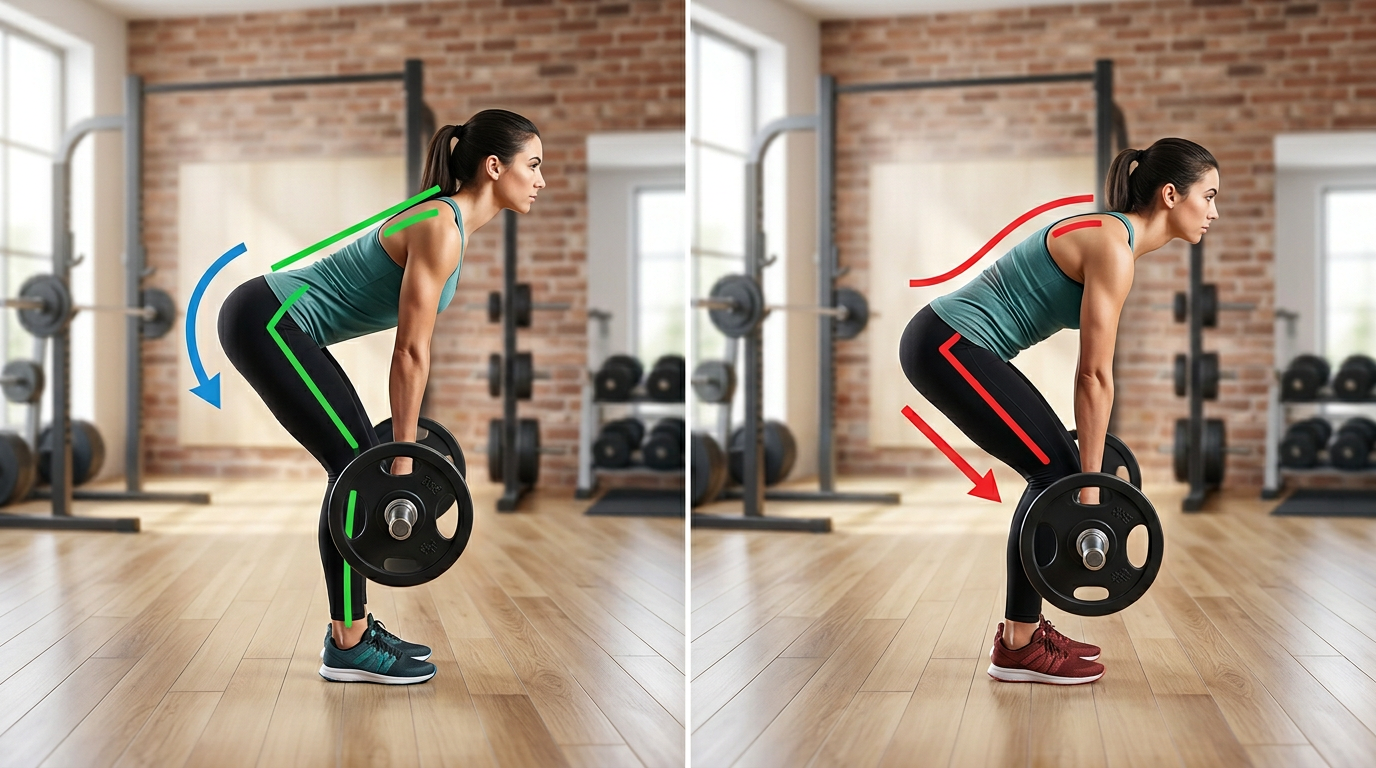
Side-by-side comparison showing proper Romanian deadlift form versus common mistakes, with arrows indicating hip hinge movement and spine position
3. Bulgarian Split Squat
Bulgarian split squats are unilateral powerhouses that challenge your glutes, quads, and balance simultaneously. By training one leg at a time, you address muscle imbalances and build functional strength that carries over to real-world movement.
Position your rear foot on a bench behind you, holding dumbbells at your sides. Stand far enough forward that when you lower down, your front knee stays behind your toes. Descend until your rear knee nearly touches the floor, then drive through your front heel to return to standing. Keep your torso upright throughout the movement.
The elevated rear foot increases the range of motion and places greater demand on your working glute. Bulgarian split squats reveal and correct strength imbalances between legs while building serious single-leg strength. Many women find they can feel their glutes working more intensely in this exercise compared to bilateral squats.
Pros
- Identifies and corrects left-right strength imbalances
- Excellent glute activation with lighter weights
- Improves balance and unilateral stability
- Reduces spinal loading compared to back squats
Cons
- Challenging balance requirements for beginners
- Takes longer to complete working both legs separately
- Can cause knee discomfort if stance is incorrect
4. Dumbbell Sumo Squat
The sumo squat variation uses a wider stance to shift emphasis toward your glutes and inner thighs. This makes it an excellent choice for targeting your glutes from a different angle than conventional squats.
Stand with feet wider than shoulder-width, toes pointed outward at 45 degrees. Hold a single dumbbell vertically with both hands at arm's length. Squat down by pushing your knees out in line with your toes, keeping your chest up and core engaged. Descend until your thighs are parallel to the floor, then drive through your heels to stand.
The wide stance of sumo squats allows for deeper hip flexion and greater glute stretch at the bottom position. This increased range of motion contributes to better muscle development. The exercise is also beginner-friendly since holding one dumbbell is less intimidating than a barbell across your back.
Pros
- Beginner-friendly with simple dumbbell setup
- Targets glutes and inner thighs effectively
- Allows for deep range of motion
- Minimal equipment requirements
Cons
- Limited by grip strength with heavy dumbbells
- May cause hip discomfort if mobility is limited
- Less loading potential than barbell variations
5. Weighted Glute Bridge
The weighted glute bridge is the foundational movement for hip thrusts and an excellent exercise for learning to activate your glutes properly. Performed on the floor rather than with an elevated back, bridges are accessible for all fitness levels.
Lie on your back with knees bent and feet flat on the floor, hip-width apart. Place a barbell or dumbbell across your hips. Drive through your heels to lift your hips until your body forms a straight line from knees to shoulders. Hold the top position briefly, squeezing your glutes maximally, then lower with control.
Glute bridges teach you to posteriorly tilt your pelvis and fully contract your glutes, skills that transfer to all other glute exercises. The floor-based position provides stability that helps beginners master the glute squeeze without worrying about balance. This makes bridges perfect for activation work before heavier exercises or as a primary movement for those new to weighted training.
Pros
- Perfect for beginners learning glute activation
- Requires minimal equipment and setup
- Excellent mind-muscle connection development
- Can be performed anywhere with floor space
Cons
- Shorter range of motion than hip thrusts
- May feel less challenging for advanced lifters
- Weight can roll or shift during the movement
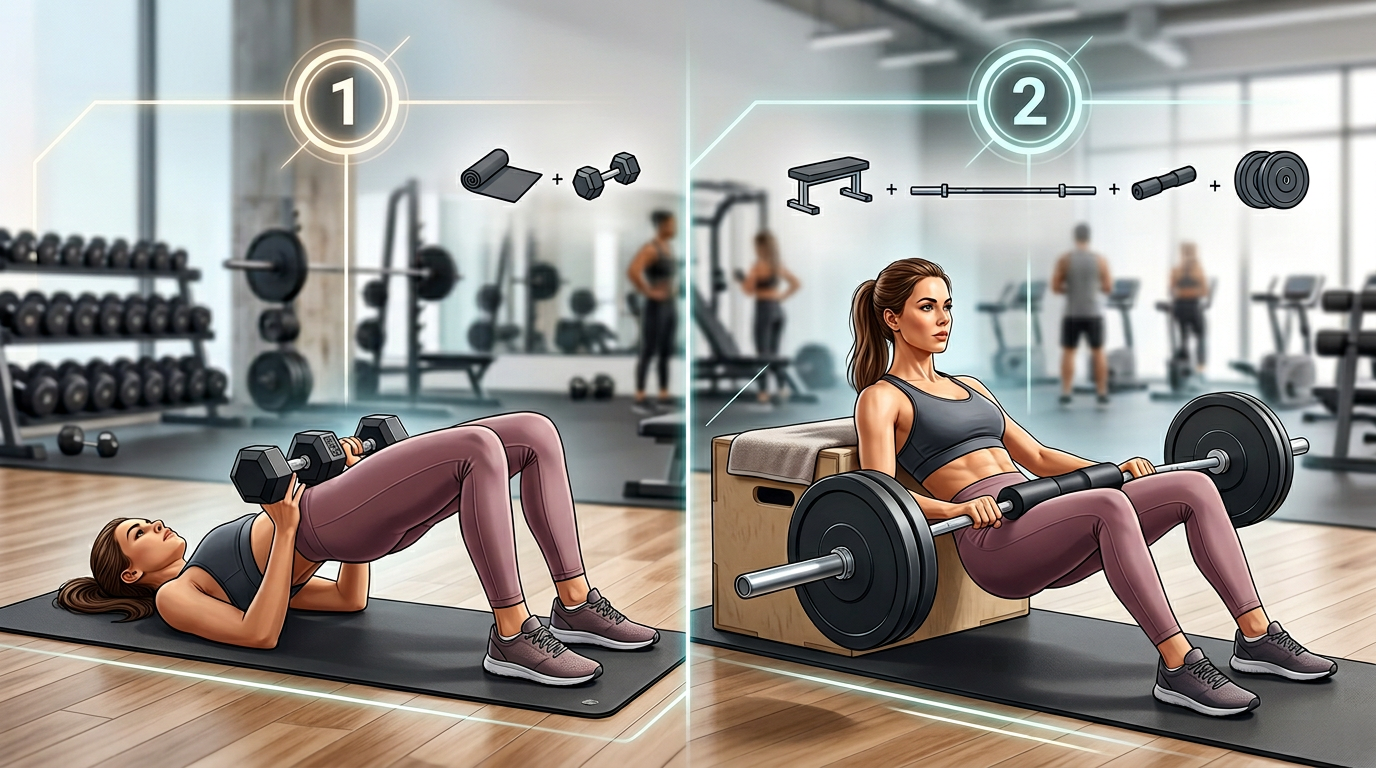
Progression chart showing weighted glute bridge advancing to barbell hip thrust, with setup differences and weight recommendations for each level
6. Kettlebell Swing
Kettlebell swings are a dynamic, explosive movement that builds power in your glutes and posterior chain. Unlike the slow, controlled movements of most butt workouts with weights, swings train your glutes to generate force rapidly.
Stand with feet shoulder-width apart, kettlebell on the floor slightly in front of you. Hinge at your hips to grab the kettlebell with both hands. Hike it back between your legs, then explosively drive your hips forward to swing the kettlebell to chest height. Let momentum carry the weight, not your arms. Control the descent and immediately flow into the next rep.
The ballistic nature of swings develops explosive hip extension power that improves athletic performance and daily function. They also provide cardiovascular benefits while building strength, making them time-efficient. The key is understanding that swings are a hip hinge movement powered by your glutes, not a squat or arm exercise.
Pros
- Develops explosive power and strength simultaneously
- Provides cardiovascular conditioning benefits
- Time-efficient full posterior chain workout
- Improves hip hinge mechanics
Cons
- Requires proper technique to avoid lower back strain
- Learning curve for the explosive hip snap
- Can be intimidating with heavy kettlebells
7. Walking Lunges with Dumbbells
Walking lunges combine unilateral leg training with dynamic movement, challenging your glutes, quads, and balance while improving coordination. The forward momentum adds a functional element that translates to real-world activities.
Hold dumbbells at your sides and step forward into a lunge, lowering your back knee toward the floor. Your front knee should stay behind your toes, and your torso should remain upright. Push through your front heel to bring your back leg forward into the next lunge, continuing to walk forward.
The continuous forward motion prevents you from resting between reps, increasing time under tension for your glutes. Walking lunges develop single-leg strength, balance, and coordination while providing a significant metabolic challenge. They're also highly functional, mimicking movement patterns you use when walking up hills or stairs.
Pros
- Functional movement pattern for daily activities
- Addresses muscle imbalances between legs
- Requires minimal equipment
- Combines strength and coordination training
Cons
- Requires adequate space to walk forward
- Balance challenges may limit weight used initially
- Can cause knee discomfort with improper form
8. Cable Pull-Through
The cable pull-through is an underrated gem for learning and perfecting the hip hinge pattern. The constant cable tension provides feedback that helps you feel the proper movement, making it excellent for beginners before progressing to RDLs.
Stand facing away from a cable machine with the rope attachment between your legs. Hold the rope with both hands and walk forward to create tension. With a slight knee bend, hinge at your hips and let the weight pull your hips back. Feel the stretch in your hamstrings and glutes, then drive your hips forward explosively to return to standing.
The anterior load from the cable teaches proper weight distribution and prevents the lower back compensation common in deadlift variations. Many women find pull-throughs help them finally understand what a proper hip hinge should feel like, making this exercise invaluable for technique development.
Pros
- Excellent for learning hip hinge mechanics
- Constant tension throughout the movement
- Anterior loading reduces lower back stress
- Easy to adjust weight for different rep ranges
Cons
- Requires access to cable machine
- May not provide enough resistance for advanced lifters
- Setup can feel awkward initially
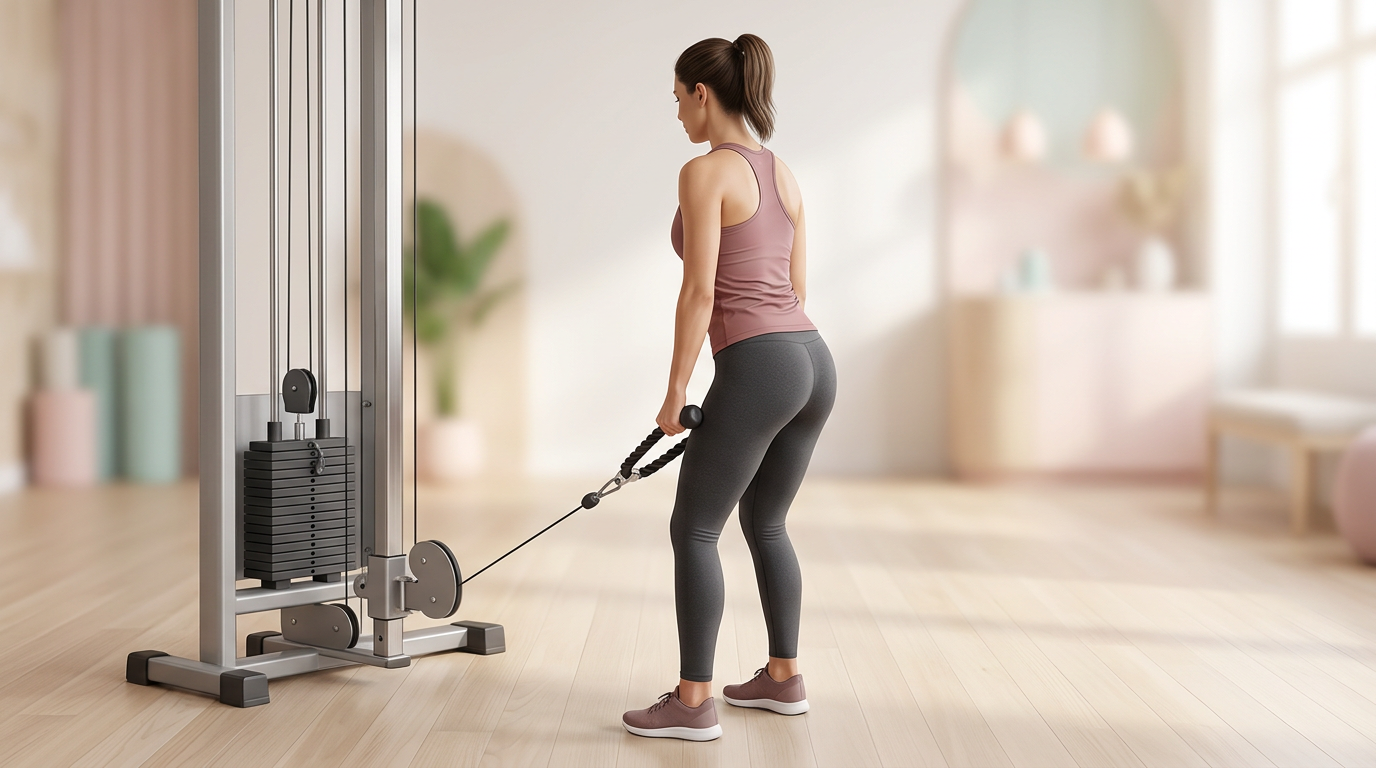
Step-by-step visual guide for cable pull-through setup and execution, showing proper hip hinge angle and common form corrections
9. Single-Leg Romanian Deadlift
The single-leg RDL is an advanced unilateral exercise that challenges your balance, stability, and glute strength simultaneously. By working one leg at a time, you build functional strength while identifying and addressing asymmetries.
Hold a dumbbell or kettlebell in one hand. Stand on the opposite leg with a slight knee bend. Hinge at your hip, extending your free leg behind you for balance as you lower the weight toward the floor. Keep your back neutral and your hips square to the floor. Return to standing by driving your hip forward and squeezing your glute.
Single-leg RDLs develop exceptional balance and proprioception while building unilateral glute and hamstring strength. The stability demands force your core and hip stabilizers to work overtime, creating a comprehensive lower body and core workout in one movement. This exercise is particularly valuable for runners and athletes who need single-leg strength and stability.
Pros
- Develops balance, stability, and strength together
- Identifies and corrects muscle imbalances
- Activates core and hip stabilizers intensely
- Requires minimal weight for challenging workout
Cons
- Steep learning curve for balance requirements
- May be frustrating for beginners
- Requires good ankle and hip mobility
10. Goblet Squat
The goblet squat is a foundational movement that teaches proper squat mechanics while effectively targeting your glutes and quads. Holding the weight in front of your chest helps maintain an upright torso and encourages proper depth.
Hold a dumbbell or kettlebell vertically at chest height, cupping the top with both hands. Stand with feet shoulder-width apart, toes slightly turned out. Squat down by pushing your knees out and sitting back, keeping your chest up. Descend until your elbows touch the inside of your knees, then drive through your heels to stand.
The front-loaded position of goblet squats naturally encourages proper squat form by counterbalancing your weight and keeping your torso upright. This makes them perfect for beginners learning to squat or for anyone working on squat depth and technique. The exercise also serves as an excellent warm-up before heavier squat variations.
Pros
- Teaches proper squat mechanics naturally
- Beginner-friendly with minimal equipment
- Front loading improves squat depth
- Versatile for warm-ups or primary work
Cons
- Limited by how heavy a dumbbell you can hold
- May cause shoulder fatigue before glutes are challenged
- Less glute emphasis than hip-dominant movements
Why Weighted Glute Training Matters
Understanding why butt workouts with weights are superior to bodyweight training helps you stay motivated and consistent with your program. The benefits extend far beyond aesthetics, impacting your overall health, function, and quality of life.
Progressive Overload for Muscle Growth
Your muscles adapt to stress by growing stronger and larger, but they need progressively increasing challenges to continue developing. Bodyweight exercises eventually become too easy, limiting further progress. Weighted exercises allow you to continually increase resistance, ensuring ongoing muscle growth and strength gains.
Adding just five pounds to your hip thrust every few weeks creates the stimulus your glutes need to keep adapting. This principle of progressive overload is fundamental to all strength training success.
Functional Strength for Daily Life
Strong glutes aren't just about appearance. They're essential for virtually every lower body movement you perform daily. Walking, climbing stairs, standing from a seated position, and lifting objects all require glute strength.
Weak glutes force other muscles to compensate, often leading to lower back pain, knee issues, and poor posture. By strengthening your glutes with weights, you build resilience against injury and improve your movement quality in everything you do.
Metabolic and Bone Health Benefits
Resistance training with weights provides benefits that extend to your entire body. Building muscle increases your resting metabolic rate, helping you maintain a healthy body composition. Weight-bearing exercises also stimulate bone formation, crucial for preventing osteoporosis as you age.
Your glutes are the largest muscle group in your body, meaning training them burns significant calories and creates substantial metabolic benefits. Weighted glute training offers one of the best returns on investment for your time and effort.
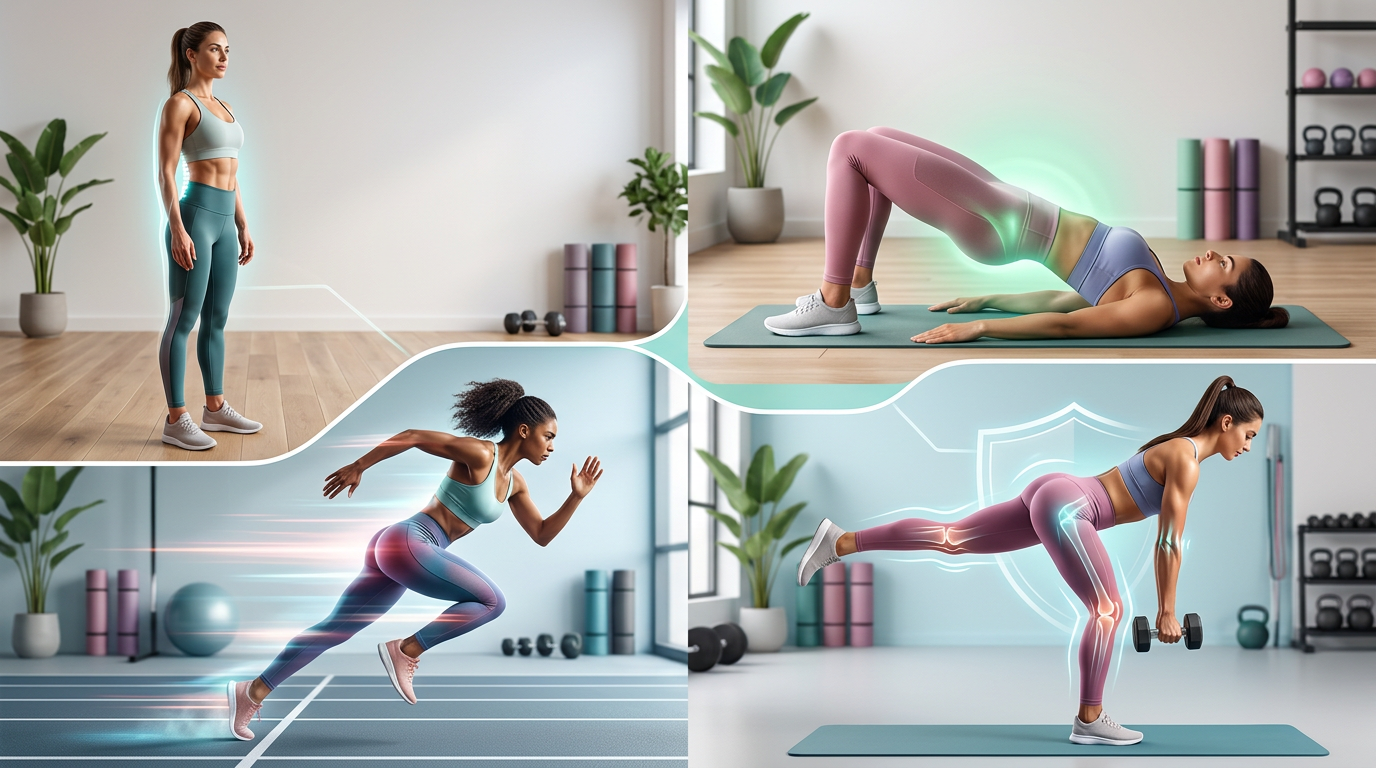
Educational infographic showing the functional benefits of strong glutes, including improved posture, reduced back pain, better athletic performance, and injury prevention
How to Structure Your Weighted Glute Workout
Knowing the best exercises is only part of the equation. How you organize them into an effective workout determines your results. Follow these guidelines to create a program that builds strength while allowing adequate recovery.
Training Frequency and Volume
Train your glutes 2-3 times per week with at least one rest day between sessions. This frequency allows enough stimulus for growth while providing recovery time. Your muscles grow during rest, not during workouts, so recovery is crucial.
For each session, perform 3-5 different glute exercises with 3-4 sets per exercise. Aim for 8-12 repetitions per set for muscle building, or 4-6 reps with heavier weights for strength development. Vary your rep ranges across different training days to target different aspects of muscle development.
Exercise Selection and Order
Start your workout with compound movements that allow the heaviest loading, such as hip thrusts or Romanian deadlifts. These exercises require the most energy and concentration, so perform them when you're fresh. Progress to unilateral exercises like Bulgarian split squats, then finish with isolation movements like glute bridges.
Include a mix of hip extension exercises (hip thrusts, bridges), hip hinge movements (RDLs, swings), and squat patterns (goblet squats, lunges) to target your glutes from multiple angles and functions.
Progressive Overload Strategies
Increase the challenge in your workouts systematically over time. You can add weight, increase reps, add sets, decrease rest periods, or improve exercise execution. Track your workouts to ensure you're progressing.
A simple progression: once you can complete all prescribed sets and reps with good form, increase the weight by 5-10 pounds for upper body exercises or 10-20 pounds for lower body movements. This steady progression builds strength safely and effectively.
Form Tips for Maximum Results and Safety
Perfect form ensures you're targeting the right muscles while minimizing injury risk. These universal principles apply across all butt workouts with weights.
Mind-Muscle Connection
Focus on feeling your glutes work during every repetition rather than just moving weight from point A to point B. This conscious muscle engagement, called the mind-muscle connection, significantly improves muscle activation and growth.
Before adding weight, practice each movement pattern with just your bodyweight, concentrating on squeezing your glutes at the top of each rep. This neural pathway becomes stronger with practice, allowing you to recruit more muscle fibers during weighted exercises.
Common Form Mistakes to Avoid
- Arching your lower back excessively: This compensates for weak glutes and can cause back pain. Keep your core engaged and maintain a neutral spine
- Letting knees cave inward: This stresses your knee joints and reduces glute activation. Actively push your knees out in line with your toes
- Rushing through reps: Momentum reduces time under tension. Control both the lifting and lowering phases of each exercise
- Not achieving full range of motion: Partial reps limit muscle development. Move through the complete range unless mobility restrictions require modifications
- Ignoring the eccentric phase: The lowering portion builds as much strength as the lifting phase. Take 2-3 seconds to lower the weight with control
When to Increase Weight
Progress to heavier weights when you can complete all prescribed sets and reps with excellent form and the last 2-3 reps feel challenging but achievable. If you're breezing through workouts, you're not creating enough stimulus for adaptation.
Conversely, if your form breaks down before completing your sets, reduce the weight. Building strength with proper form takes time, and rushing the process increases injury risk while reducing effectiveness.
Which Weighted Butt Workout Is Best for You?
The ideal exercise selection depends on your experience level, goals, available equipment, and any physical limitations. Here's how to match exercises to your situation.
For Complete Beginners
Start with weighted glute bridges, goblet squats, and cable pull-throughs. These exercises teach fundamental movement patterns with manageable balance requirements. Focus on mastering form with lighter weights before progressing to more complex movements.
Perform 2-3 exercises per workout, 2 times per week. This frequency allows your nervous system to adapt to the new movement patterns while building foundational strength.
For Intermediate Lifters
Progress to barbell hip thrusts, Romanian deadlifts, and walking lunges. These movements allow heavier loading and provide greater stimulus for muscle growth. Add Bulgarian split squats to address any left-right imbalances.
Train 3 times per week with 4-5 exercises per session. Vary your rep ranges across workouts: one heavy day (4-6 reps), one moderate day (8-12 reps), and one higher rep day (15-20 reps).
For Advanced Athletes
Incorporate single-leg RDLs, heavy barbell hip thrusts, and kettlebell swings for power development. Focus on progressive overload with challenging weights while maintaining perfect form. Consider periodizing your training with strength phases, hypertrophy phases, and power phases.
Advanced lifters benefit from higher training volumes and frequencies, potentially training glutes 3-4 times per week with varied intensities and exercise selections.
For Home Gym Training
If you have limited equipment, prioritize dumbbell exercises: dumbbell RDLs, goblet squats, Bulgarian split squats, and weighted glute bridges. These movements require minimal equipment while providing excellent results.
A single pair of adjustable dumbbells or a set of resistance bands can provide everything you need for effective glute training at home.
For Those with Lower Back Sensitivity
Focus on hip thrusts, glute bridges, and cable pull-throughs, which minimize spinal loading. Avoid heavy conventional deadlifts and back squats if they aggravate your back. Single-leg exercises often feel better for people with back issues since they require less total load.
Always prioritize pain-free movement. If an exercise causes discomfort beyond normal muscle fatigue, modify it or choose an alternative that works for your body.
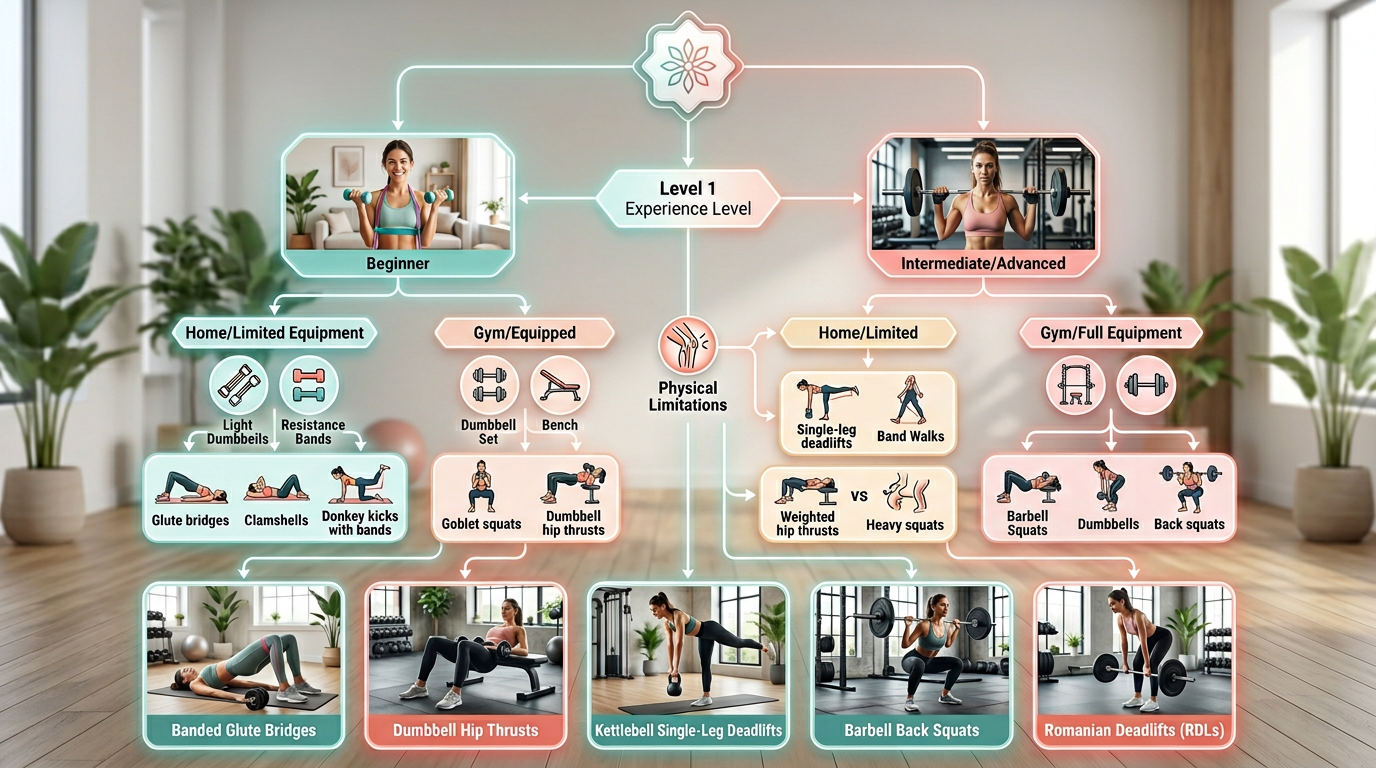
Decision tree flowchart helping readers choose the right weighted glute exercises based on experience level, equipment availability, and any physical limitations
Frequently Asked Questions
What is the best workout for buttocks with weights?
The barbell hip thrust is the best workout for buttocks with weights, producing the highest glute activation of any exercise. Combine it with Romanian deadlifts and Bulgarian split squats for comprehensive glute development. Train 2-3 times weekly with progressive overload for optimal results.
Do glutes help your knees?
Strong glutes stabilize your pelvis and control hip rotation, reducing stress on your knee joints during movement. Weak glutes allow your knees to cave inward during activities like squatting and walking, increasing injury risk. Strengthening your glutes through weighted exercises improves knee health and reduces pain.
What is the 8 8 8 rule for glutes?
The 8 8 8 rule suggests performing 8 reps, 8 sets, and 8 exercises for glutes in one workout. However, this approach provides excessive volume that most women don't need and may hinder recovery. A more effective approach is 3-5 exercises, 3-4 sets each, 8-12 reps per set, 2-3 times weekly.
Do glute exercises help hip pain?
Strengthening your glutes often reduces hip pain by improving hip stability and correcting movement patterns that stress the joint. Weak glutes force surrounding muscles to compensate, causing pain. Start with low-impact exercises like glute bridges and clamshells before progressing to weighted movements.
How heavy should weights be for glute exercises?
Choose weights that make the last 2-3 reps of each set challenging while maintaining perfect form. Beginners might start with 10-20 pound dumbbells, while advanced lifters may hip thrust over 200 pounds. Progressive overload matters more than specific weight, so gradually increase resistance as you get stronger.
Can you build glutes with dumbbells only?
You can absolutely build strong, developed glutes using only dumbbells. Romanian deadlifts, Bulgarian split squats, goblet squats, and weighted glute bridges all work excellently with dumbbells. Focus on progressive overload by gradually increasing weight, and consider single-leg exercises when dumbbells feel too light.
How long does it take to see results from weighted glute workouts?
Most women notice strength improvements within 2-3 weeks and visible muscle changes within 6-8 weeks of consistent training. Significant glute development typically requires 3-6 months of progressive weighted training combined with adequate nutrition. Results vary based on genetics, training consistency, and nutrition habits.
Conclusion
Building strong, sculpted glutes requires consistent effort with the right exercises and progressive resistance. The best butt workouts with weights combine hip thrusts, Romanian deadlifts, split squats, and other compound movements that challenge your glutes from multiple angles. By training 2-3 times per week with proper form and gradually increasing weight, you'll develop the powerful lower body strength that enhances both your appearance and functional capacity.
Remember that sustainable progress comes from consistency, not perfection. Start with exercises that match your current fitness level, focus on mastering proper form, and trust the process of progressive overload. Your glutes will respond to the challenge, becoming stronger and more developed with each training session.
Strong glutes support better posture, reduce injury risk, improve athletic performance, and boost confidence in how you move through the world. The Strong Curves app provides structured workout programs designed specifically for women's glute development, with progressive plans that take the guesswork out of training.