Best stretches before workout are dynamic movements that prepare muscles and joints for exercise. The most effective include leg swings, arm circles, walking lunges, hip circles, and cat-cow stretches, performed for 5-10 minutes to increase blood flow, improve range of motion, and reduce injury risk for women.
Best Stretches Before Workout: A Woman's Guide
Have you ever jumped straight into a workout only to feel stiff, sluggish, or worse—sidelined by an injury? Proper pre-workout stretching is the foundation of safe, effective training that helps you build strength while protecting your body. For women pursuing fitness goals—whether you're focused on strength training, glute development, or body sculpting—the right warm-up routine makes all the difference between a mediocre session and one that delivers real results.
The best stretches before workout aren't the static holds you might remember from gym class. Modern exercise science shows that dynamic stretches—movements that take your joints and muscles through their full range of motion—are far more effective for preparing your body to perform. These active movements increase blood flow, elevate your heart rate gradually, and activate the neuromuscular pathways you'll use during your training session.
This comprehensive guide walks you through the most effective pre-workout stretches specifically designed for women's fitness goals. You'll learn exactly which movements to perform, how to execute them properly, and how to build a warm-up routine that enhances your performance while reducing injury risk. Whether you're training at home or in the gym, these stretches will help you move better, lift heavier, and make consistent progress toward your goals.
Key Takeaways
- Dynamic stretches are superior to static stretching before workouts, preparing muscles through movement rather than holds
- A proper pre-workout stretch routine takes 5-10 minutes and includes movements targeting all major muscle groups
- Pre-workout stretching increases blood flow, improves range of motion, activates neuromuscular pathways, and reduces injury risk
- The best stretches mimic the movement patterns you'll perform during your workout for optimal preparation
- Consistency with pre-workout stretching leads to better performance, faster progress, and more sustainable fitness results
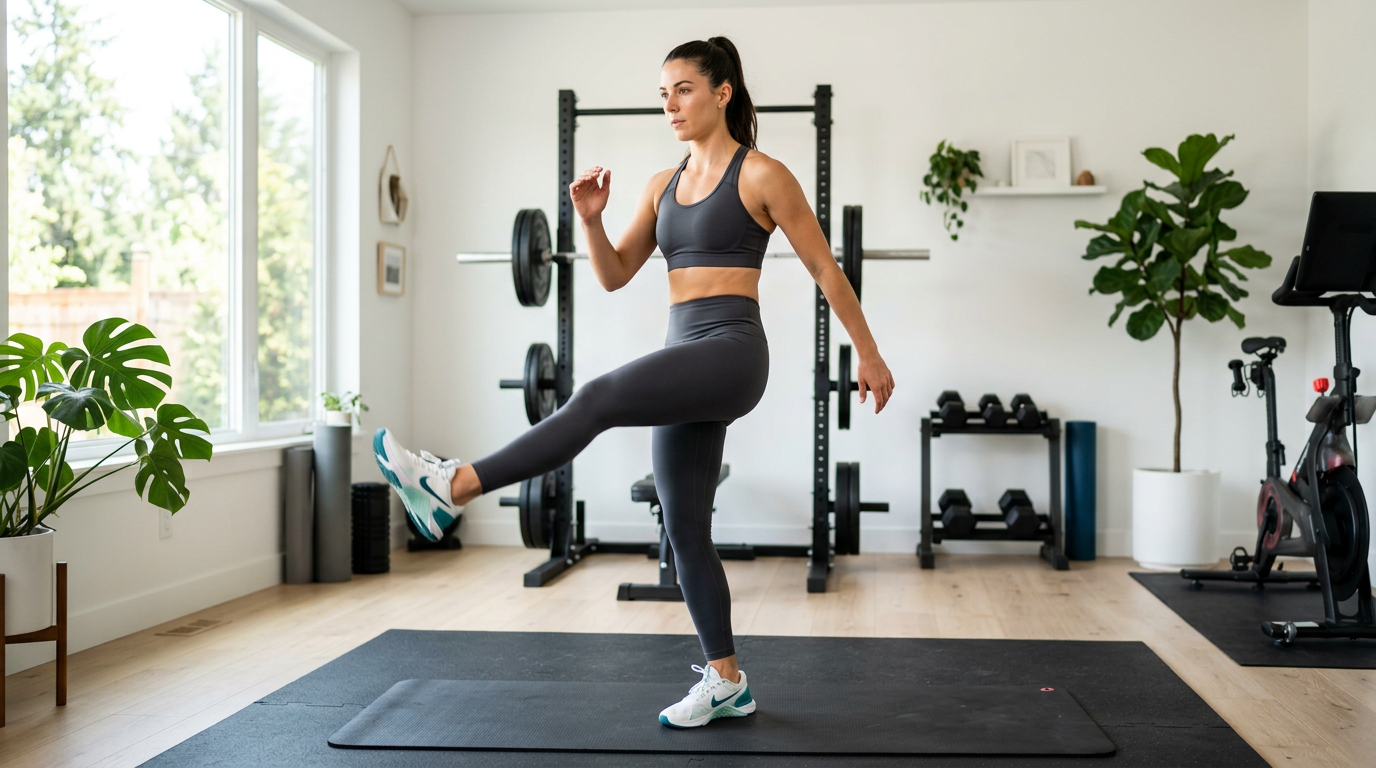
Woman in athletic wear performing dynamic stretches in a bright home gym, showing proper form for pre-workout warm-up movements
Understanding Pre-Workout Stretching for Women
Pre-workout stretching serves as the bridge between rest and intense physical activity, preparing your body systematically for the demands of training. Unlike static stretching (holding a position for 30-60 seconds), dynamic stretching involves controlled movements that gradually increase your range of motion and muscle temperature.
Why Dynamic Stretching Works Better
Research consistently shows that dynamic stretching before workouts improves performance more effectively than static stretching. When you perform dynamic movements, you're essentially rehearsing the motor patterns your body will use during exercise. This activates the nervous system, primes the muscles, and lubricates the joints—all critical factors for optimal performance.
For women focused on strength training and body sculpting, this preparation phase is especially important. Dynamic stretches help you achieve better depth in squats, maintain proper form during lunges, and generate more power during lifts. They also reduce the risk of common injuries like pulled hamstrings or strained hip flexors.
The Science Behind Warm Muscles
When you begin moving dynamically, your body temperature rises and blood flow to working muscles increases. This physiological response has several benefits:
- Increased oxygen delivery to muscle tissue, improving energy production
- Enhanced elasticity of muscle fibers, allowing greater range of motion
- Improved nerve signal transmission, leading to better coordination and control
- Elevated metabolic rate, helping you burn more calories during your workout
- Reduced muscle viscosity, making movements feel smoother and more fluid
Timing Your Pre-Workout Routine
The ideal pre-workout stretching routine takes 5-10 minutes. This duration provides enough time to adequately prepare your body without causing fatigue before your main workout. Start with gentler, smaller movements and progressively increase the intensity and range of motion. By the end of your warm-up, you should feel energized, mobile, and ready to tackle your training session.
1. Leg Swings (Front to Back)
Leg swings are a fundamental dynamic stretch that prepares your hip flexors, hamstrings, and glutes for lower body training. This movement is particularly valuable for women focusing on glute development and leg workouts. Stand next to a wall or sturdy surface for balance, then swing one leg forward and backward in a controlled, rhythmic motion.
The key to effective leg swings is maintaining an upright torso while allowing your leg to move through its full natural range of motion. Start with smaller swings and gradually increase the amplitude as your muscles warm up. Perform 10-15 swings per leg, focusing on smooth, controlled movement rather than momentum.
This stretch directly prepares you for exercises like squats, lunges, deadlifts, and leg presses. It mobilizes the hip joint in the sagittal plane (forward and backward), which is the primary movement pattern for most lower body exercises. The rhythmic swinging motion also activates the stabilizing muscles around your hips and core.
Pros
- Effectively mobilizes hip flexors and hamstrings simultaneously
- Requires minimal space and no equipment
- Easy to modify intensity by adjusting swing amplitude
- Directly translates to better squat and lunge depth
Cons
- Requires balance support for some beginners
- Can feel awkward initially if hip mobility is limited
2. Leg Swings (Side to Side)
Lateral leg swings complement front-to-back swings by mobilizing your hips in the frontal plane (side to side). This movement targets your hip abductors and adductors—the muscles responsible for moving your legs away from and toward your body's centerline. Stand facing a wall or support, then swing one leg across your body and out to the side.
For women working on glute development and hip strength, lateral leg swings are essential. They activate the gluteus medius and minimus, which are crucial for hip stability during single-leg movements and compound exercises. These smaller glute muscles often need extra attention to prevent imbalances and knee issues.
Perform 10-15 swings per leg, maintaining an engaged core and stable standing leg throughout the movement. Avoid leaning your torso excessively to the side—the movement should come from your hip joint, not your spine. As you warm up, you can gradually increase the range of motion.
Pros
- Activates often-neglected hip abductors and adductors
- Improves lateral stability for functional movements
- Helps prevent knee valgus (knee caving) during squats
- Enhances hip mobility in multiple planes of motion
Cons
- Requires good balance and coordination
- May feel uncomfortable if you have tight hip adductors
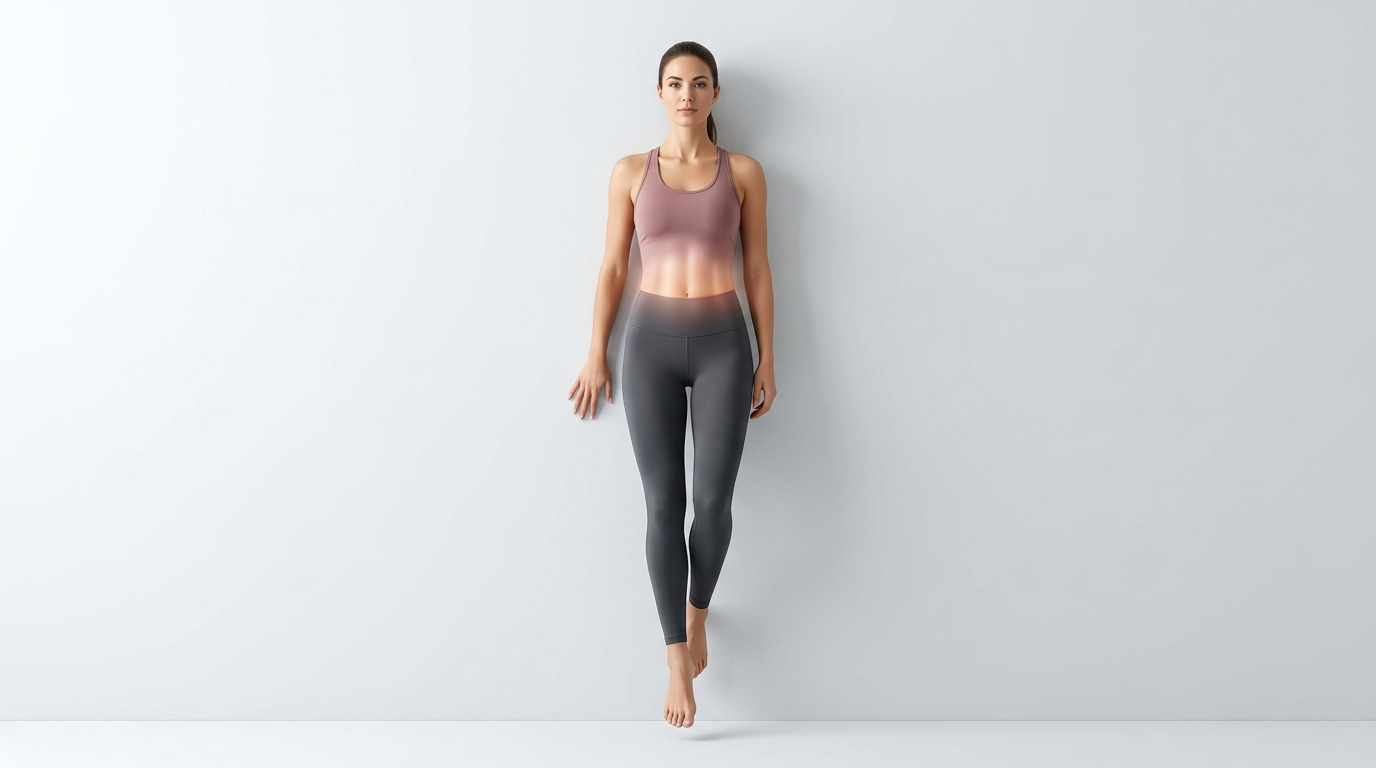
Step-by-step demonstration of proper leg swing technique, showing both front-to-back and side-to-side variations with form cues
3. Walking Lunges with Rotation
Walking lunges with rotation combine lower body mobility with core activation and upper body movement. This compound dynamic stretch prepares multiple muscle groups simultaneously, making it one of the most efficient pre-workout movements. Step forward into a lunge position, then rotate your torso toward your front leg.
This movement pattern is particularly valuable because it mimics the multi-planar demands of real-world movement and athletic performance. The lunge component activates your quads, glutes, and hamstrings, while the rotation engages your obliques and improves thoracic spine mobility. For women focused on functional strength and body sculpting, this exercise provides comprehensive preparation for complex training movements.
Perform 8-10 walking lunges with rotation (4-5 per side), focusing on maintaining proper lunge mechanics: front knee aligned over ankle, back knee dropping toward the floor, and torso upright. Add the rotation only after establishing a stable lunge position. This ensures you're building mobility on a foundation of strength and control.
Pros
- Warms up multiple muscle groups in a single movement
- Improves coordination and body awareness
- Enhances thoracic spine mobility for better posture
- Directly prepares you for compound lower body exercises
Cons
- Requires more space than stationary stretches
- More technically demanding for beginners
4. Arm Circles
Arm circles are a simple yet effective dynamic stretch for preparing your shoulders, upper back, and chest for upper body training. Stand with feet shoulder-width apart and extend your arms out to the sides. Make circular motions with your arms, starting small and gradually increasing the diameter of the circles.
Perform both forward and backward circles for 15-20 repetitions in each direction. This bidirectional movement ensures balanced preparation of all the muscles surrounding your shoulder joint. Arm circles are especially important for women who perform pressing movements, rows, or any overhead exercises, as they help prevent shoulder impingement and improve range of motion.
The shoulder joint has the greatest range of motion of any joint in your body, which also makes it vulnerable to injury. Proper warm-up through movements like arm circles helps ensure the rotator cuff muscles are activated and the joint capsule is lubricated before you load it with weight.
Pros
- Extremely simple and requires no equipment
- Mobilizes shoulders in multiple directions
- Can be performed anywhere with minimal space
- Activates rotator cuff muscles for shoulder stability
Cons
- May feel too easy for some individuals
- Limited lower body engagement
5. Hip Circles
Hip circles directly mobilize the hip joint through its full range of motion, preparing it for the demands of lower body training. Stand on one leg (use a wall for balance if needed) and lift the other knee to hip height. Make circular motions with your lifted knee, as if drawing circles in the air.
Perform 8-10 circles in each direction (clockwise and counterclockwise) before switching legs. This movement pattern activates all the muscles surrounding your hip joint while improving joint lubrication and range of motion. Hip circles are particularly beneficial for women who experience hip tightness from prolonged sitting or who want to improve their squat depth and glute activation.
The circular motion takes your hip through flexion, extension, abduction, and adduction—all the primary movement patterns of the hip joint. This comprehensive mobilization ensures you're prepared for any lower body exercise in your workout. Focus on making the circles as large as your current mobility allows, without forcing the range of motion.
Pros
- Mobilizes hips in all planes of motion
- Improves hip joint lubrication and flexibility
- Activates stabilizing muscles around the hip
- Helps identify and address mobility limitations
Cons
- Requires balance and coordination
- May be challenging for those with very tight hips
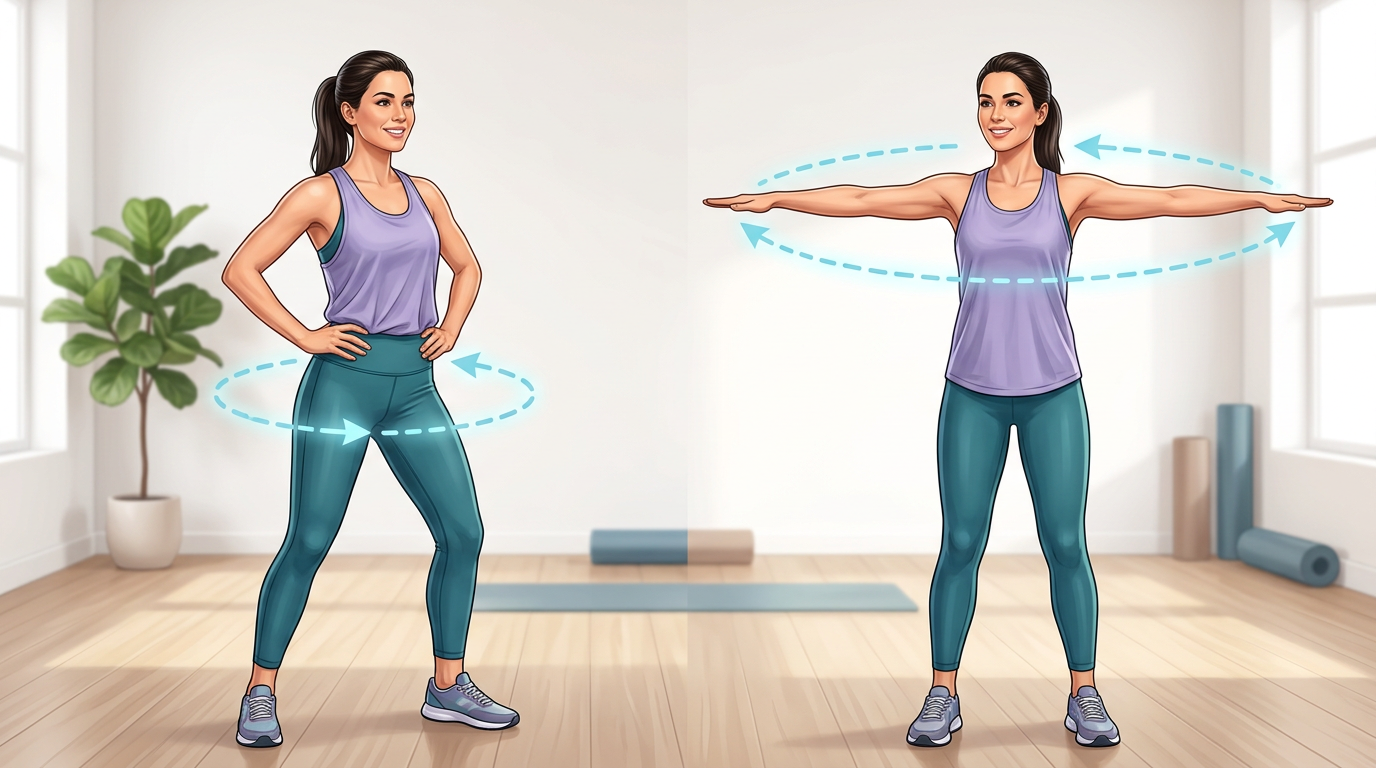
Woman demonstrating hip circles and arm circles with proper form, showing the circular motion path and body positioning
6. Cat-Cow Stretch
The cat-cow stretch is a dynamic spinal mobility exercise that prepares your entire back for training. Start on your hands and knees in a tabletop position. Alternate between arching your back (cow position) and rounding your spine (cat position), coordinating the movement with your breath.
Inhale as you drop your belly and lift your chest and tailbone (cow), then exhale as you round your spine and tuck your chin and tailbone (cat). This rhythmic movement mobilizes every segment of your spine, from your neck to your lower back, making it essential preparation for exercises that load the spine like squats, deadlifts, and overhead presses.
Perform 8-10 slow, controlled repetitions, focusing on moving through your entire spine rather than just your lower back. Many women carry tension in their upper back and shoulders, and the cat-cow stretch helps release this tension while improving awareness of spinal positioning—a crucial skill for maintaining proper form during strength training.
Pros
- Mobilizes the entire spine segment by segment
- Reduces back tension and improves posture awareness
- Coordinates movement with breathing for relaxation
- Gentle enough for all fitness levels
Cons
- Requires floor space and getting down on hands and knees
- May be uncomfortable for those with wrist or knee sensitivity
7. Inchworms
Inchworms are a dynamic full-body stretch that combines hamstring mobility with core stability and shoulder activation. Stand with feet hip-width apart, hinge at your hips to place your hands on the floor, then walk your hands forward into a plank position. Walk your hands back toward your feet and return to standing.
This movement provides a comprehensive warm-up by taking you through multiple positions and engaging nearly every major muscle group. The forward fold stretches your hamstrings and calves, the plank position activates your core and shoulders, and the transition between positions challenges your coordination and body control.
Inchworms are particularly effective for women preparing for total-body workouts or circuit training, as they elevate your heart rate while simultaneously improving mobility and activating stabilizing muscles. Perform 5-8 repetitions, focusing on controlled movement rather than speed. If you can't reach the floor with straight legs, it's perfectly fine to bend your knees slightly.
Pros
- Warms up the entire body in one movement
- Elevates heart rate for cardiovascular preparation
- Improves hamstring flexibility and core strength
- Requires no equipment and minimal space
Cons
- More challenging than isolated stretches
- May be difficult for those with limited hamstring flexibility
8. Bodyweight Squats
Bodyweight squats serve as both a dynamic stretch and a movement rehearsal for loaded squat variations. Stand with feet slightly wider than hip-width, toes pointed slightly outward. Lower your hips back and down as if sitting into a chair, keeping your chest up and knees tracking over your toes.
Performing 10-15 bodyweight squats before your workout prepares your ankles, knees, hips, and spine for the demands of lower body training. This movement pattern is fundamental to many exercises women perform for glute development and leg strength, making it an essential component of any pre-workout routine.
Bodyweight squats allow you to assess your mobility and identify any restrictions or imbalances before adding load, which is crucial for injury prevention and long-term progress. Focus on achieving the deepest squat position you can maintain with good form—chest up, knees stable, weight distributed through your full foot. As you warm up, you'll likely notice your range of motion improving.
Pros
- Directly rehearses the squat pattern before loaded variations
- Identifies mobility restrictions and movement compensations
- Activates all major lower body muscle groups
- Progressively increases range of motion with repetition
Cons
- May be too challenging for complete beginners
- Requires adequate ankle and hip mobility for proper depth
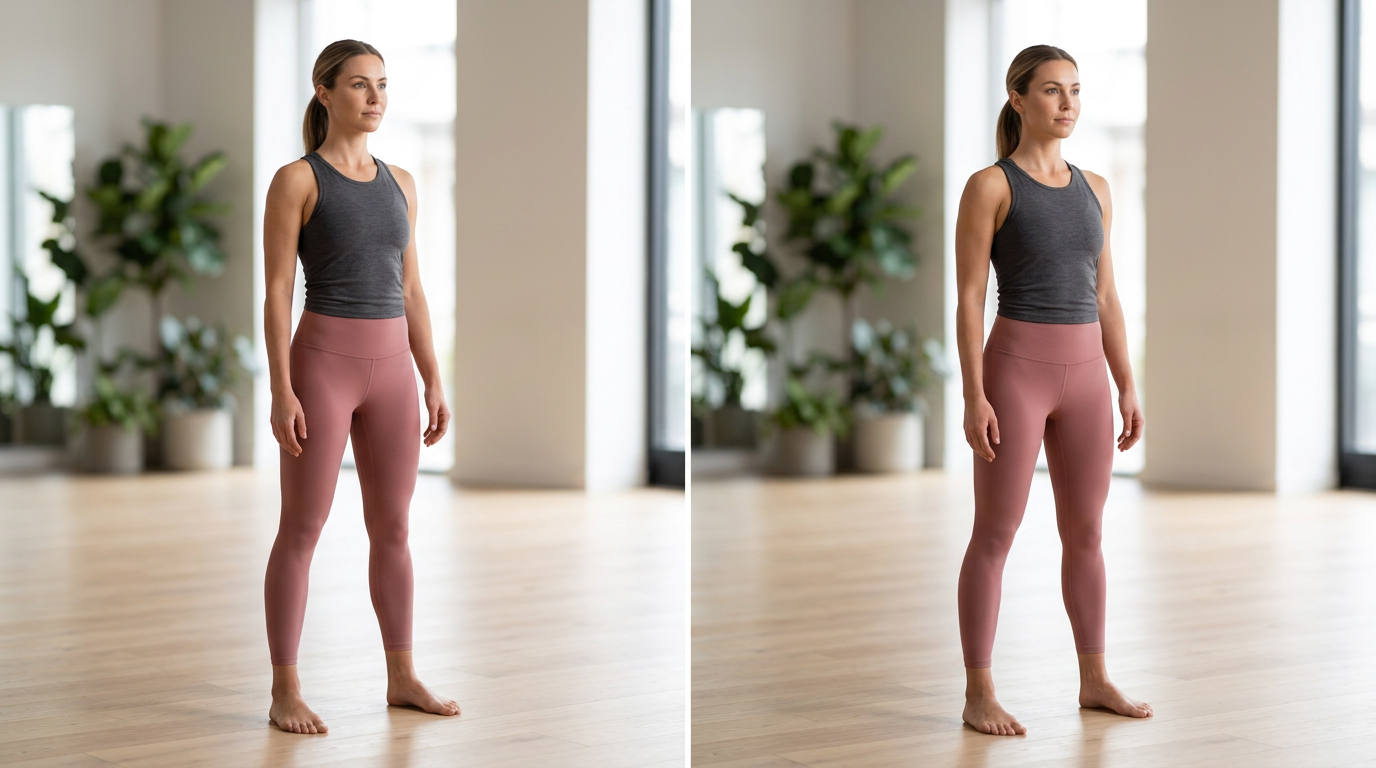
Sequence showing proper inchworm and bodyweight squat form with alignment cues and common mistakes to avoid
9. High Knees
High knees are a dynamic cardiovascular movement that elevates your heart rate while activating your hip flexors, core, and improving lower body coordination. Stand in place and alternately drive your knees up toward your chest in a running motion, pumping your arms in coordination with your legs.
This movement prepares your body for high-intensity training by transitioning you from a resting state to an active one. The rapid leg movement increases blood flow throughout your lower body, while the arm action engages your shoulders and upper back. High knees are particularly effective for women who include plyometric exercises, running, or high-intensity interval training in their workouts.
Perform high knees for 30-45 seconds, focusing on bringing your knees as high as comfortably possible while maintaining an upright posture. Land softly on the balls of your feet to minimize impact on your joints. This exercise should feel energizing and get your breathing rate up without causing exhaustion.
Pros
- Rapidly elevates heart rate for cardiovascular preparation
- Activates hip flexors and improves lower body coordination
- Requires no equipment and minimal space
- Easily modifiable by adjusting speed and knee height
Cons
- Higher impact than other dynamic stretches
- May be too intense for some beginners
10. Thoracic Rotations
Thoracic rotations target the middle and upper back, an area where many women experience stiffness from desk work and daily activities. Start in a quadruped position (hands and knees), place one hand behind your head, and rotate your torso to bring your elbow toward the floor, then rotate upward to point your elbow toward the ceiling.
This movement specifically mobilizes your thoracic spine—the section of your spine between your neck and lower back. Thoracic mobility is essential for maintaining proper posture during upper body exercises and preventing compensation patterns that can lead to shoulder or lower back issues. Improving thoracic rotation helps women achieve better form in exercises like rows, presses, and even squats, where upper back positioning affects the entire movement chain.
Perform 8-10 rotations per side, moving slowly and deliberately through the full range of motion. Focus on rotating from your mid-back rather than your lower back or shoulders. You should feel a gentle stretch through your chest and upper back as you rotate upward.
Pros
- Specifically targets often-neglected thoracic spine mobility
- Improves posture and upper body movement quality
- Reduces compensation patterns that lead to injury
- Gentle and accessible for all fitness levels
Cons
- Requires getting down on the floor
- May feel subtle compared to larger movements
Creating Your Pre-Workout Stretching Routine
Now that you understand the best stretches before workout, it's time to organize them into an effective routine. Your pre-workout stretching session should be systematic, progressive, and tailored to your specific training session.
The 3-3-3 Rule for Workout Preparation
The 3-3-3 rule is a simple framework for structuring your warm-up: spend 3 minutes on light cardiovascular activity (like brisk walking or light jogging), 3 minutes on dynamic stretches targeting major muscle groups, and 3 minutes on movement-specific preparation (lighter versions of exercises you'll perform). This 9-minute protocol ensures comprehensive preparation without excessive time investment or fatigue.
Matching Stretches to Your Workout
Customize your pre-workout stretching based on your training focus:
- Lower Body Days: Prioritize leg swings (both directions), hip circles, walking lunges, bodyweight squats, and cat-cow stretches
- Upper Body Days: Focus on arm circles, thoracic rotations, cat-cow stretches, and inchworms
- Full Body or HIIT Sessions: Include a balanced mix with emphasis on inchworms, high knees, and walking lunges with rotation
- Glute-Focused Training: Emphasize hip circles, lateral leg swings, and bodyweight squats to activate and prepare glute muscles
Progressive Warm-Up Structure
Structure your warm-up to gradually increase intensity:
- Start with gentler, smaller movements (arm circles, hip circles)
- Progress to larger range of motion exercises (leg swings, walking lunges)
- Include more dynamic, cardiovascular movements (high knees, inchworms)
- Finish with movement rehearsal (bodyweight squats or lighter versions of your main exercises)
This progressive approach ensures your body temperature, heart rate, and neural activation all increase gradually, preparing you optimally for intense training without causing premature fatigue.
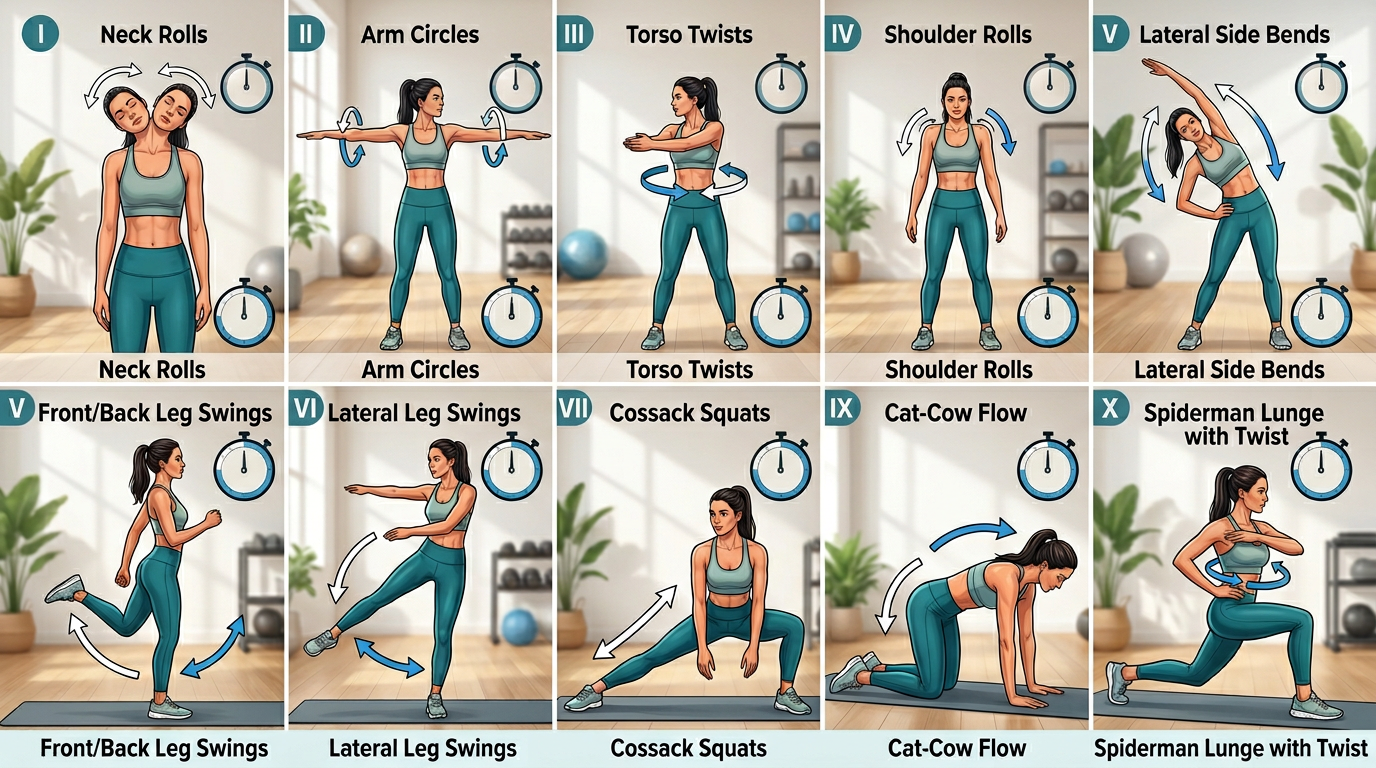
Visual chart showing a complete 10-minute pre-workout stretching routine with timing for each stretch and progression order
Common Pre-Workout Stretching Mistakes to Avoid
Even with the best stretches before workout, improper execution can limit benefits or increase injury risk. Avoid these common mistakes to maximize your warm-up effectiveness.
Static Stretching Before Training
Holding static stretches for extended periods before your workout can temporarily reduce muscle power and performance. Save static stretching for your cool-down routine. Before training, your muscles need activation and movement preparation, not prolonged passive stretching that can decrease neural drive to the muscles.
Rushing Through Your Warm-Up
Skipping or rushing your pre-workout stretches to save time is counterproductive. A proper warm-up enhances performance, allowing you to lift heavier, move better, and get more from your training time. Those 5-10 minutes of preparation translate to better results and reduced injury risk over the long term.
Ignoring Individual Needs
Your warm-up should address your specific mobility limitations and training goals. If you have particularly tight hips, spend extra time on hip mobility exercises. If shoulder mobility is your limitation, prioritize thoracic rotations and arm circles. Generic warm-ups are better than nothing, but personalized preparation is ideal.
Performing Stretches Without Purpose
Each stretch in your warm-up should have a purpose related to your upcoming workout. Going through the motions without intention reduces effectiveness. Focus on the muscles you're activating, the joints you're mobilizing, and how each movement prepares you for your training session.
Which Pre-Workout Stretches Are Best For You?
The best stretches before workout depend on your fitness level, training goals, and time availability. Use this guide to select the most appropriate stretches for your situation.
For Beginners
If you're new to structured exercise, start with these foundational stretches: arm circles, hip circles, bodyweight squats, and cat-cow stretches. These movements are technically simple, low-risk, and provide comprehensive preparation for basic strength training. As you build confidence and body awareness, gradually add more complex movements like walking lunges and inchworms.
For Glute and Lower Body Focus
Women prioritizing glute development and lower body strength should emphasize leg swings (both directions), hip circles, walking lunges with rotation, and bodyweight squats. These movements specifically activate and prepare the glutes, hamstrings, and hip stabilizers for optimal performance during squats, deadlifts, lunges, and hip thrusts.
For Upper Body Training
When training upper body, prioritize arm circles, thoracic rotations, cat-cow stretches, and inchworms. These stretches mobilize your shoulders, upper back, and spine while activating the stabilizing muscles crucial for pressing and pulling movements. Don't neglect lower body mobility entirely—include a few bodyweight squats to maintain full-body engagement.
For Time-Constrained Workouts
When time is limited, choose multi-joint movements that prepare multiple muscle groups simultaneously. Inchworms, walking lunges with rotation, and high knees provide the most comprehensive warm-up in the shortest time. Pair these with 2-3 minutes of light cardio for a complete 5-minute warm-up.
For Mobility-Limited Individuals
If you have significant mobility restrictions, start with smaller ranges of motion and gentler movements. Modified versions of these stretches—like smaller leg swings, quarter squats, or wall-supported movements—are perfectly appropriate. Consistency matters more than perfection. Regular practice of even modified stretches will improve your mobility over time.
Frequently Asked Questions
What stretch is best before a workout?
The best stretch before a workout is the walking lunge with rotation, as it combines lower body mobility, core activation, and thoracic spine movement in one dynamic exercise. This compound movement prepares multiple muscle groups simultaneously and mimics the multi-planar demands of most training sessions.
What is the 3-3-3 rule for workout?
The 3-3-3 rule for workout preparation involves 3 minutes of light cardiovascular activity, 3 minutes of dynamic stretching, and 3 minutes of movement-specific warm-up exercises. This 9-minute protocol progressively prepares your cardiovascular system, mobilizes joints, and rehearses movement patterns for optimal performance.
Should I do static or dynamic stretches before working out?
You should perform dynamic stretches before working out, as they prepare muscles through active movement while maintaining power output. Static stretching before exercise can temporarily reduce muscle strength and performance. Save static stretches for your post-workout cool-down when they effectively improve flexibility.
How long should I stretch before a workout?
You should stretch for 5-10 minutes before a workout, depending on the intensity and complexity of your training session. This duration provides adequate time to mobilize major joints, activate key muscle groups, and elevate your body temperature without causing fatigue before your main workout.
Does stretching help with neuropathy?
Stretching may help manage neuropathy symptoms by improving circulation and reducing muscle tension, though it does not treat the underlying nerve condition. Gentle dynamic stretches can enhance blood flow to affected areas, potentially reducing discomfort. Consult your healthcare provider for neuropathy-specific exercise recommendations.
Does stretching help lower cholesterol?
Stretching alone does not significantly lower cholesterol levels. Cardiovascular exercise, strength training, and dietary changes are the primary methods for improving cholesterol profiles. However, stretching as part of a comprehensive exercise routine contributes to overall cardiovascular health and supports consistent physical activity habits.
Can I skip stretching if I'm short on time?
You should not skip stretching entirely, but you can condense your warm-up to 5 minutes when time-constrained. Focus on dynamic movements that prepare multiple muscle groups simultaneously, like inchworms and walking lunges. A brief warm-up is always better than jumping straight into intense exercise.
Conclusion
The best stretches before workout are dynamic movements that prepare your body systematically for the demands of training. By incorporating leg swings, arm circles, walking lunges, hip circles, cat-cow stretches, inchworms, bodyweight squats, high knees, and thoracic rotations into your pre-workout routine, you'll move better, perform stronger, and reduce injury risk. These movements increase blood flow, improve range of motion, activate neuromuscular pathways, and rehearse the patterns you'll use during your training session.
Consistency with your pre-workout stretching routine is just as important as consistency with your training itself. Those 5-10 minutes of preparation make the difference between workouts that drain you and sessions that build you up. Whether you're focused on strength training, glute development, or overall fitness, proper warm-up helps you make sustainable progress toward your goals.
Start implementing these stretches before your next workout and pay attention to how your body responds. You'll likely notice improved mobility, better exercise execution, and enhanced performance. Make pre-workout stretching a non-negotiable part of your fitness routine, and your body will reward you with better results and fewer setbacks.