Best ab workouts for women are exercises that target all core muscles through varied movement patterns. The most effective include dead bugs for core stability, planks for anti-extension strength, bicycle crunches for oblique engagement, and bird dogs for functional coordination, performed 2-4 times weekly with progressive resistance for optimal results.
You've committed to building a stronger core, but scrolling through endless ab workout videos leaves you confused about which exercises actually deliver results. Between conflicting advice and exercises that strain your neck more than your abs, finding the best ab workouts for women can feel overwhelming.
The truth is, effective ab training goes far beyond endless crunches. Your core includes multiple muscle groups that require varied movement patterns to develop balanced strength, stability, and definition. Whether you're returning to fitness after pregnancy, working to reduce lower belly bloat, or simply want a stronger midsection for daily activities, the right exercises make all the difference.
This comprehensive guide breaks down the most effective ab exercises specifically for women's bodies and goals. Created by certified trainer Shelley Darlington with 15+ years experience, you'll discover science-backed movements that target every core function, proper form cues to prevent injury, and how to structure your routine for maximum results. Trusted by over 50,000 women worldwide, these proven strategies will help you build the strong, functional core you deserve.
Key Takeaways
- Effective ab training requires exercises targeting all core functions: flexion, anti-extension, rotation, and anti-rotation
- Women benefit most from progressive overload with proper form rather than high-rep, low-quality movements
- Core strength supports posture, reduces back pain, and enhances performance in daily activities and other exercises
- Consistency with 2-4 weekly sessions produces better results than sporadic intense workouts
- Combining targeted ab work with overall strength training and nutrition creates visible definition
Understanding Core Anatomy and Function for Women
Before diving into specific exercises, understanding your core anatomy helps you select the best ab workouts for women and execute them with proper intention.
The Four Core Muscle Groups
Your core consists of multiple layers working together. The rectus abdominis (the "six-pack" muscle) runs vertically along your front torso, responsible for spinal flexion. Your internal and external obliques wrap around your sides, controlling rotation and lateral flexion.
The transverse abdominis acts as your body's natural weight belt, providing deep stability and protecting your spine during movement. This deepest layer is particularly important for women, especially post-pregnancy, as it supports pelvic floor function and maintains intra-abdominal pressure.
Why Women Need Different Core Training Approaches
Women's bodies respond differently to core training due to hormonal influences, body composition patterns, and biomechanical factors. Estrogen affects connective tissue elasticity, making proper form and controlled movements essential for injury prevention.
Women also tend to store more subcutaneous fat in the abdominal region, which means building core strength and reducing overall body fat both contribute to visible results. The Strong Curves glute-focused approach to functional fitness emphasizes compound movements that engage the core while building overall strength, creating better hormonal responses for body composition changes.
Core Functions Beyond Crunches
Your core performs four primary functions that effective training must address:
- Spinal flexion: Bringing your ribcage toward your pelvis (crunches, sit-ups)
- Anti-extension: Resisting spinal extension under load (planks, dead bugs)
- Rotation: Twisting movements (Russian twists, wood chops)
- Anti-rotation: Resisting rotational forces (Pallof press, side planks)
A balanced routine includes exercises from all four categories. Many women focus exclusively on flexion exercises, missing the stability and functional strength that anti-extension and anti-rotation movements provide.
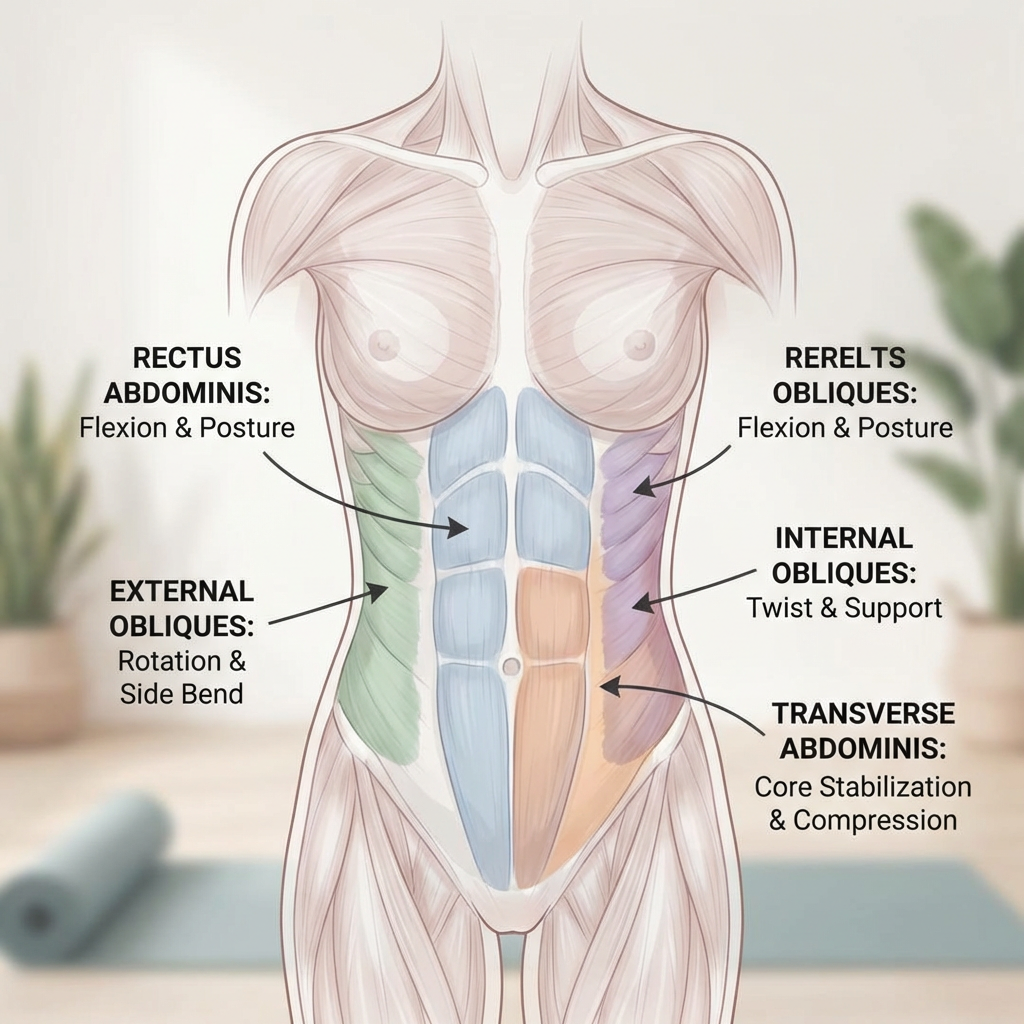
Anatomical diagram showing the four core muscle layers (rectus abdominis, external obliques, internal obliques, and transverse abdominis) with labels indicating their functions in women's bodies
Quick Comparison: Top 10 Ab Exercises for Women
Exercise
Primary Target
Difficulty Level
Equipment Needed
Best For
Dead Bug
Transverse Abdominis
Beginner
None
Core stability, back pain
Plank
Full Core
Beginner-Intermediate
None
Anti-extension strength
Bird Dog
Transverse Abdominis
Beginner
None
Balance, coordination
Bicycle Crunch
Obliques, Rectus Abdominis
Intermediate
None
Oblique definition
Pallof Press
Anti-rotation
Intermediate
Resistance band
Functional strength
Mountain Climber
Full Core
Intermediate
None
Cardio + core
Russian Twist
Obliques
Intermediate
Optional weight
Rotational strength
Reverse Crunch
Lower Rectus Abdominis
Beginner-Intermediate
None
Lower belly targeting
Side Plank
Obliques, Anti-rotation
Intermediate
None
Lateral stability
Hollow Body Hold
Full Core
Advanced
None
Advanced strength
1. Dead Bug: The Foundation Exercise
The dead bug is arguably the most important core exercise for women, especially those dealing with back pain or returning to fitness post-pregnancy. This deceptively simple movement teaches your core to stabilize your spine while your limbs move independently.
Lie on your back with arms extended toward the ceiling and knees bent at 90 degrees. Slowly lower your right arm overhead while extending your left leg, keeping your lower back pressed to the floor. Return to start and repeat on the opposite side.
The key is maintaining a neutral spine throughout the movement. If your back arches off the floor, you've gone too far. This exercise directly targets the transverse abdominis, teaching the deep core activation that transfers to every other movement.
Progress by adding ankle weights, holding dumbbells, or slowing the tempo to 5 seconds per repetition. Perform 3 sets of 8-12 reps per side, focusing on quality over quantity.
Pros
- Extremely safe for beginners and post-pregnancy recovery
- Teaches proper core bracing for other exercises
- Can be modified for any fitness level
- Reduces lower back pain when performed correctly
Cons
- Requires concentration and mind-muscle connection
- Easy to perform incorrectly without proper cues
- May feel too easy for advanced exercisers without progression
2. Plank: The Ultimate Anti-Extension Exercise
Planks build the anti-extension strength that protects your spine during daily activities and other exercises. This isometric hold strengthens your entire core while teaching proper neutral spine positioning.
Start in a forearm plank position with elbows directly under shoulders, body forming a straight line from head to heels. Engage your core by pulling your belly button toward your spine and squeeze your glutes to prevent your hips from sagging.
Common mistakes include hiking your hips too high (which reduces core engagement) or letting them drop (which stresses your lower back). Your body should maintain a neutral alignment throughout the hold.
Begin with 20-30 second holds for 3 sets, gradually increasing to 60 seconds. Once you can hold a solid plank for 60 seconds, progress to variations like shoulder taps, plank walks, or weighted planks rather than simply holding longer.
Pros
- Builds functional core strength for daily activities
- Improves posture and reduces back pain
- Countless variations for continued progression
- Engages shoulders, glutes, and legs simultaneously
Cons
- Can cause wrist or shoulder discomfort for some
- Easy to hold with poor form, reducing effectiveness
- May be too challenging for complete beginners
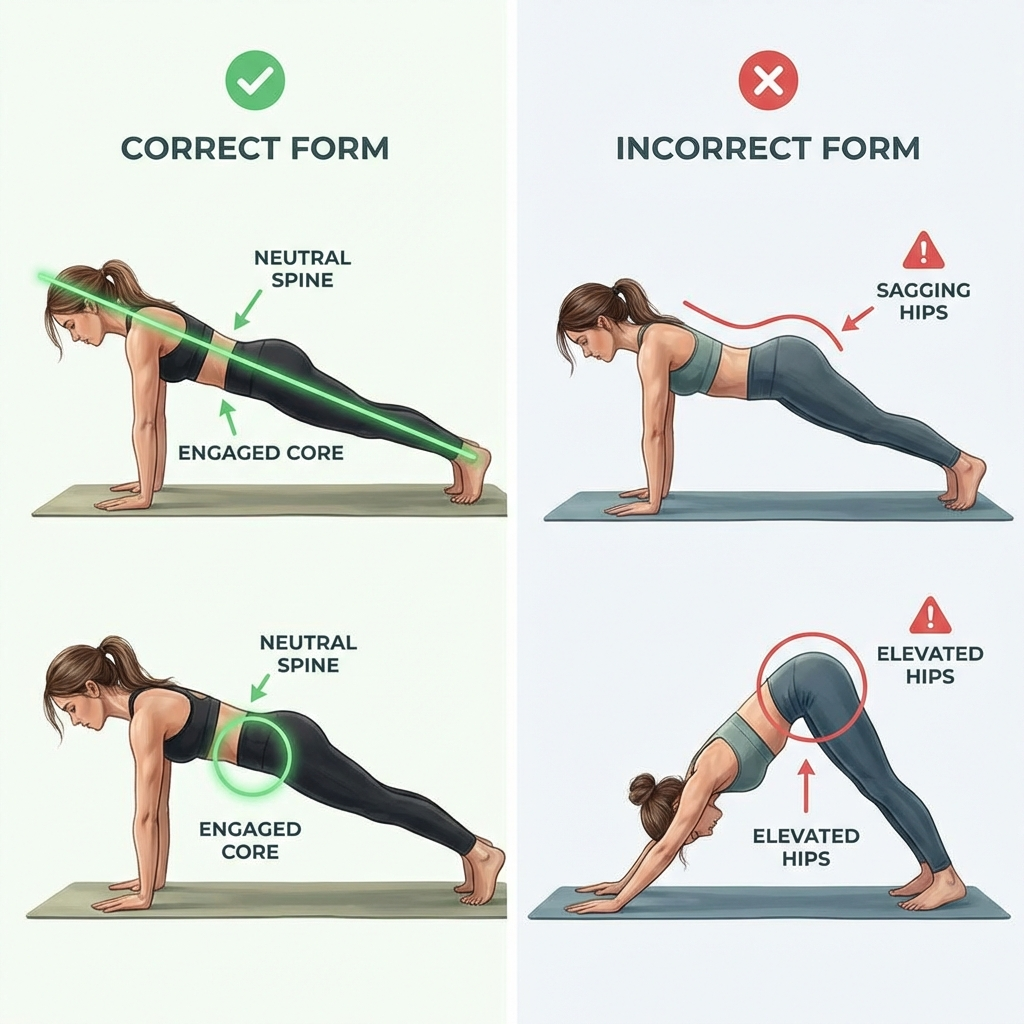
Side-by-side comparison showing correct plank form (neutral spine, engaged core) versus incorrect form (sagging hips, elevated hips) with form cue annotations
3. Bird Dog: Balance and Coordination
The bird dog combines core stability with balance and coordination, making it one of the best ab workouts for women seeking functional fitness improvements. This exercise particularly benefits those who sit for extended periods.
Start on hands and knees with wrists under shoulders and knees under hips. Simultaneously extend your right arm forward and left leg back, creating a straight line from fingertips to toes. Hold for 2-3 seconds, then return to start and switch sides.
The goal is maintaining a completely stable torso without rotating or tilting your hips. Your core works to prevent movement, building the anti-rotation strength essential for spinal health.
Progress by increasing hold times, adding ankle or wrist weights, or performing the movement from a plank position. Aim for 3 sets of 10-12 reps per side with controlled, deliberate movements.
Pros
- Low impact and joint-friendly
- Improves balance and proprioception
- Strengthens lower back and glutes alongside core
- Excellent for beginners and rehabilitation
Cons
- Requires coordination that may frustrate beginners initially
- Can cause knee discomfort on hard surfaces
- Limited resistance options for advanced progression
4. Bicycle Crunch: Oblique Engagement
Bicycle crunches effectively target your obliques while engaging your rectus abdominis, making them excellent for building definition along your waistline. Research consistently ranks this exercise among the most effective for overall core activation.
Lie on your back with hands behind your head and legs lifted in tabletop position. Bring your right elbow toward your left knee while extending your right leg, then switch sides in a pedaling motion.
Focus on rotating from your torso rather than pulling on your neck, and fully extend each leg rather than keeping both knees bent. The twisting motion engages your obliques while the leg extension challenges your lower abs.
Perform 3 sets of 15-20 reps per side, maintaining controlled movement throughout. Slow the tempo to increase difficulty rather than rushing through repetitions.
Pros
- Highly effective for oblique development
- No equipment needed
- Combines rotation and flexion for comprehensive engagement
- Can be modified for different fitness levels
Cons
- Easy to strain neck with improper form
- Momentum can reduce effectiveness if performed too quickly
- May be challenging for those with hip flexor tightness
5. Pallof Press: Anti-Rotation Strength
The Pallof press builds anti-rotation strength that directly translates to injury prevention and improved performance in sports and daily activities. This exercise teaches your core to resist unwanted movement, which is how your core functions most often in real life.
Attach a resistance band to a stable anchor at chest height. Stand perpendicular to the anchor, holding the band with both hands at your chest. Press your hands straight out from your chest, resisting the band's pull to rotate your torso, then return to start.
Your hips and shoulders should remain square throughout the movement, with your core working intensely to prevent rotation. This exercise particularly benefits women 35+ focused on strength training and body recomposition, as it builds the stability needed for heavy compound lifts.
Perform 3 sets of 10-15 reps per side, choosing a band resistance that challenges you while maintaining perfect form. Progress by using heavier resistance or standing farther from the anchor point.
Pros
- Builds functional, real-world core strength
- Easily scalable with different band resistances
- Low injury risk with proper setup
- Improves performance in rotational sports and activities
Cons
- Requires resistance band or cable machine
- Proper setup and anchor point essential for safety
- May feel awkward initially for those new to anti-rotation work
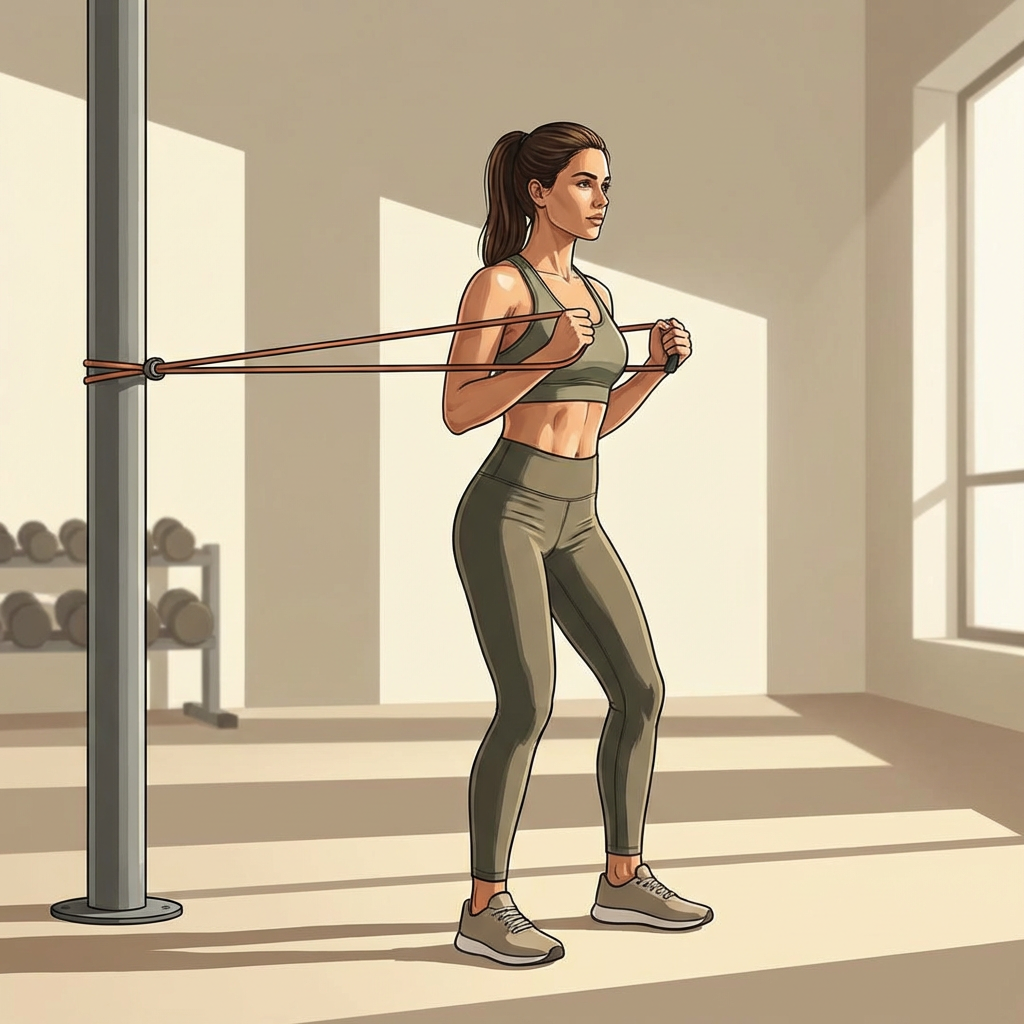
Step-by-step demonstration of Pallof press showing starting position, extended position, and common form errors with resistance band setup
6. Mountain Climber: Dynamic Core and Cardio
Mountain climbers combine core strengthening with cardiovascular conditioning, making them efficient for women with limited workout time. This dynamic movement elevates your heart rate while challenging core stability.
Start in a high plank position with hands under shoulders. Drive your right knee toward your chest, then quickly switch legs in a running motion while maintaining a stable plank position.
Keep your hips level and core engaged throughout the movement rather than letting your hips pike up or sag down. The faster you move, the more cardiovascular challenge you add, but never sacrifice form for speed.
Perform 3 sets of 20-30 seconds, or include mountain climbers in circuit training for metabolic conditioning. Based on feedback from thousands of Strong Curves app users, combining mountain climbers with strength-focused core exercises creates balanced results.
Pros
- Combines cardio and core training efficiently
- Burns more calories than static core exercises
- Improves coordination and agility
- No equipment needed
Cons
- Higher impact than other core exercises
- Can stress wrists and shoulders
- Form often deteriorates with fatigue
- May be too intense for beginners
7. Russian Twist: Rotational Power
Russian twists build rotational strength and oblique definition through dynamic twisting movements. This exercise particularly benefits women looking to create waistline definition and improve functional rotation strength.
Sit on the floor with knees bent and feet lifted, leaning back to create a V-shape with your torso and thighs. Hold a weight at your chest and rotate your torso to tap the weight on the floor beside your hip, alternating sides.
Maintain the V-position throughout the movement, rotating from your core rather than just moving your arms side to side. Keep your chest lifted and avoid rounding your spine forward.
Start with bodyweight or a light weight (5-10 pounds) for 3 sets of 20-30 total reps. Progress by increasing weight, slowing tempo, or fully extending your arms to increase the lever length. Learn more about progressive overload principles for strength training to continue advancing.
Pros
- Effectively targets obliques for definition
- Easily progressed with added weight
- Builds rotational power for sports
- Can be modified by keeping feet on ground
Cons
- Can stress lower back if performed with poor form
- Momentum often reduces effectiveness
- May be challenging to maintain proper position initially
8. Reverse Crunch: Lower Belly Focus
Reverse crunches specifically target the lower portion of your rectus abdominis, addressing the common concern of lower belly pooch. This exercise moves your pelvis toward your ribcage rather than the traditional crunch pattern.
Lie on your back with hands by your sides or under your hips for support. Lift your legs with knees bent at 90 degrees. Curl your hips off the floor, bringing your knees toward your chest, then lower with control.
The movement should be small and controlled, focusing on tilting your pelvis rather than swinging your legs. Your lower back should press into the floor at the top of the movement, fully engaging your lower abs.
Perform 3 sets of 12-15 reps with a 2-second pause at the top of each rep. Progress by straightening your legs or adding ankle weights for increased resistance.
Pros
- Specifically targets lower abdominal region
- Minimal neck strain compared to traditional crunches
- Can be performed anywhere without equipment
- Effective for building mind-muscle connection
Cons
- Easy to use momentum instead of muscle control
- Range of motion is small, requiring focus
- May cause lower back discomfort if core is weak
9. Side Plank: Lateral Stability
Side planks build lateral core strength and oblique endurance while improving hip stability. This exercise is particularly valuable for women, as it strengthens the muscles that support pelvic alignment and reduce lower back strain.
Lie on your side with your forearm on the ground, elbow under shoulder. Stack your feet or stagger them for more stability. Lift your hips to create a straight line from head to feet.
Engage your obliques to prevent your hips from sagging, and avoid rotating your shoulders forward or backward. Your body should form a straight plank from the side view.
Hold for 20-45 seconds per side for 3 sets. Progress to side plank with hip dips, leg lifts, or reduced base of support (top foot in front of bottom foot). Discover how proper core stability improves compound lift performance in your strength training routine.
Pros
- Builds lateral stability often neglected in other exercises
- Strengthens obliques and hip abductors simultaneously
- Numerous progressions for continued challenge
- Improves posture and reduces side-to-side imbalances
Cons
- Can stress shoulder joint for some individuals
- Requires significant core strength for proper execution
- May cause wrist or elbow discomfort
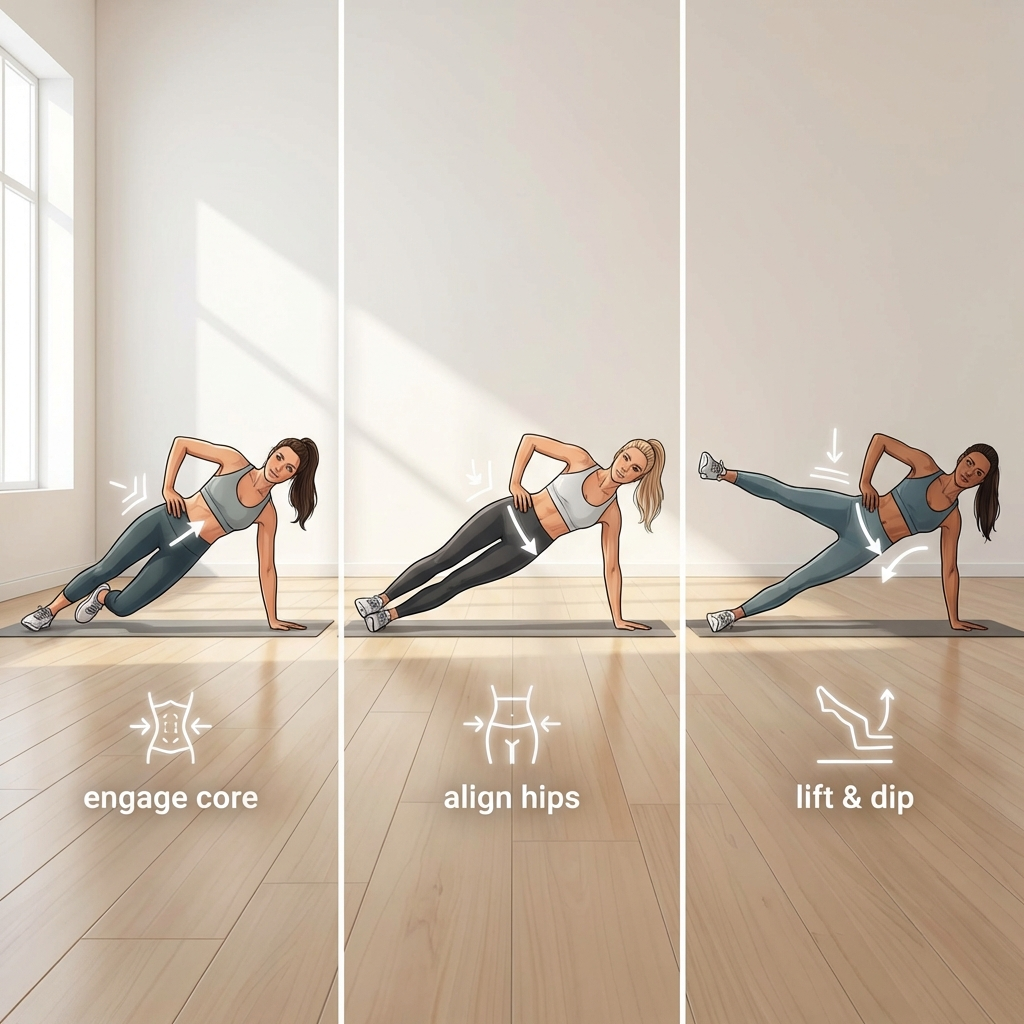
Progression chart showing side plank variations from beginner (bent knee) to advanced (with leg lift and hip dip) with proper form cues
10. Hollow Body Hold: Advanced Full-Core Challenge
The hollow body hold represents the pinnacle of core control, requiring your entire core to work as an integrated unit. This gymnastics-inspired exercise builds the foundation for advanced movements and creates exceptional core strength.
Lie on your back with arms extended overhead. Press your lower back into the floor and lift your shoulders and legs off the ground, creating a "hollow" body position. Your body should form a slight curve, like a banana.
The key is maintaining lower back contact with the floor while keeping your arms and legs as straight as possible. If your back arches, bend your knees or raise your arms higher until you can maintain proper position.
Start with 15-20 second holds for 3 sets, gradually building to 45-60 seconds. This exercise requires significant core strength, so master the previous nine exercises before progressing to hollow body holds.
Pros
- Builds exceptional full-core integration and strength
- Transfers to advanced gymnastics and calisthenics movements
- No equipment needed
- Highly effective for developing core control
Cons
- Too challenging for beginners and intermediates
- Easy to perform incorrectly, reducing effectiveness
- Can cause neck strain if not properly positioned
- Limited progression options once mastered
Creating Your Ab Workout Routine
Understanding individual exercises is just the beginning. Structuring an effective routine ensures you target all core functions while allowing adequate recovery.
Weekly Training Frequency
Train your abs 2-4 times per week with at least one rest day between focused core sessions. Your abs are muscles like any other and require recovery time to grow stronger. Many women overtrain their core, thinking daily ab work produces faster results, but this approach often leads to diminished returns.
You can perform lighter core activation work (like dead bugs or planks) on other training days as part of your warm-up without hindering recovery. Reserve intense, high-volume ab training for dedicated sessions.
Exercise Selection and Order
Each workout should include 4-6 exercises covering different core functions. A balanced session might include:
- One anti-extension exercise (plank variation)
- One anti-rotation exercise (Pallof press or side plank)
- One rotation exercise (bicycle crunch or Russian twist)
- One flexion exercise (reverse crunch)
- Optional dynamic exercise (mountain climbers)
Perform exercises requiring the most stability and control first when you're fresh, saving higher-rep or cardio-focused movements for later in the session.
Sets, Reps, and Progression
For strength-focused exercises, perform 3-4 sets of 8-15 reps or 20-60 second holds. For endurance or cardio-focused movements, perform 3 sets of 15-30 reps or 30-60 seconds of work.
Progressive overload is essential for continued results. Increase difficulty by adding resistance, slowing tempo, increasing hold times, or progressing to more challenging variations. Track your workouts to ensure you're consistently challenging your muscles beyond their current capacity.
Common Mistakes to Avoid
Neglecting Anti-Extension and Anti-Rotation Work
Many women focus exclusively on crunches and sit-ups, neglecting the stability functions that comprise most real-world core demands. This imbalanced approach can actually increase injury risk while limiting functional strength development.
Prioritize exercises that teach your core to resist movement, as these build the foundation for all other core functions and transfer most effectively to daily activities and other exercises.
Using Momentum Instead of Muscle Control
Quality always trumps quantity in ab training. Rushing through 100 sloppy crunches provides less benefit than 15 controlled, properly executed reps. Focus on feeling your core muscles working throughout each repetition.
If you can't maintain proper form, reduce the difficulty, decrease reps, or rest longer between sets. Compensation patterns and momentum reduce effectiveness and increase injury risk.
Expecting Spot Reduction
No amount of ab exercises will specifically burn belly fat. Fat loss occurs systemically based on your overall calorie balance and individual genetics. Core exercises build muscle and strength, but visible abs require reducing overall body fat through nutrition and comprehensive training.
Combine your ab training with full-body strength training and proper nutrition strategies for optimal body composition results. Core exercises are one piece of the puzzle, not the complete solution.
Ignoring Breathing Patterns
Proper breathing enhances core engagement and prevents unnecessary strain. Generally, exhale during the exertion phase (when your core contracts most) and inhale during the easier phase.
Never hold your breath during core exercises, as this increases intra-abdominal pressure excessively and can cause dizziness or blood pressure spikes. Controlled breathing also helps maintain rhythm and focus throughout your sets.
Nutrition Considerations for Visible Abs
While this guide focuses on the best ab workouts for women, nutrition plays an equally important role in achieving visible core definition. You can build incredibly strong abs that remain hidden under a layer of subcutaneous fat.
Women typically need to reach approximately 16-20% body fat to see clear ab definition, though this varies based on individual fat distribution patterns and genetics. This requires a modest calorie deficit, adequate protein intake (0.7-1.0 grams per pound of body weight), and patience with the process.
Crash dieting and extreme calorie restriction often backfire, slowing your metabolism and causing muscle loss that makes achieving visible abs even harder. Instead, focus on sustainable nutrition habits that support your training while creating a small calorie deficit.
Prioritize whole foods, adequate protein at each meal, plenty of vegetables, and sufficient healthy fats to support hormone production. Consistency over months, not perfection over days, produces lasting results.
Which Ab Workout Is Best For You?
The ideal exercises and routine structure depend on your current fitness level, goals, and any physical limitations.
For Complete Beginners
Start with dead bugs, bird dogs, and basic planks (on knees if needed). Focus on learning proper core bracing and building the mind-muscle connection before progressing to more complex movements. Perform 2 sessions weekly with 2-3 exercises per session, 2-3 sets of 8-12 reps or 20-30 second holds.
For Post-Pregnancy Recovery
Prioritize deep core reconnection with dead bugs and bird dogs after receiving medical clearance. Avoid crunches and sit-ups initially, as these can worsen diastasis recti. Work with a pelvic floor physical therapist if you experience any incontinence, pelvic pain, or significant abdominal separation.
For Intermediate Exercisers
Include exercises from all four core functions: bicycle crunches for rotation, Pallof press for anti-rotation, planks with variations for anti-extension, and reverse crunches for flexion. Train 3 times weekly with 4-5 exercises per session, progressively adding resistance or difficulty.
For Advanced Athletes
Focus on weighted variations, longer holds, and complex movements like hollow body holds and advanced plank progressions. Integrate core training with your sport-specific or strength training goals, emphasizing the core functions most relevant to your activities.
For Those with Lower Back Pain
Emphasize anti-extension and anti-rotation exercises that teach spinal stability. Dead bugs, bird dogs, and Pallof presses typically feel better than flexion-based movements. Always consult with a healthcare provider for persistent back pain, and avoid any exercises that cause pain beyond normal muscle fatigue.
Frequently Asked Questions
What is the most effective ab workout for women?
The most effective ab workout combines planks, dead bugs, Pallof presses, and bicycle crunches to target all core functions. Perform 3-4 sets of 8-15 reps or 30-60 second holds, 2-4 times weekly with progressive overload for optimal results.
What exercise burns the most belly fat for females?
No single exercise specifically burns belly fat, as fat loss occurs systemically through calorie deficit. Compound exercises like squats, deadlifts, and rows burn the most calories while building muscle, which increases metabolic rate and supports overall fat loss including the abdominal area.
How can women tone abs fast?
Combine consistent core training 3-4 times weekly with a modest calorie deficit and adequate protein intake. Focus on progressive overload with exercises targeting all core functions, maintain proper form, and allow adequate recovery. Visible results typically require 8-12 weeks of consistent effort.
What is the best exercise for lower belly pooch?
Reverse crunches and dead bugs effectively target the lower abdominal region, but reducing lower belly fat requires overall body fat reduction through nutrition and training. Combine targeted core exercises with full-body strength training and a sustainable calorie deficit for best results.
How long should I hold a plank for ab results?
Hold planks for 30-60 seconds with perfect form rather than longer holds with compromised technique. Once you achieve 60-second holds easily, progress to more challenging variations like shoulder taps or single-leg planks rather than simply extending hold time beyond 60 seconds.
Can I train abs every day?
Training abs 2-4 times weekly produces better results than daily training, as muscles require recovery time to grow stronger. You can perform light core activation exercises daily as part of warm-ups, but reserve intense, high-volume ab training for dedicated sessions with rest days between.
Do I need equipment for effective ab workouts?
Bodyweight exercises like planks, dead bugs, and bicycle crunches provide highly effective ab training without equipment. Adding resistance bands or weights enables progressive overload for continued results, but beginners and intermediates can build significant core strength using only bodyweight movements.
Conclusion
Building a strong, functional core requires more than endless crunches. The best ab workouts for women incorporate exercises targeting all core functions—flexion, anti-extension, rotation, and anti-rotation—performed with proper form and progressive overload.
Key takeaways for effective ab training:
- Prioritize quality over quantity with controlled movements and proper form
- Include exercises from all four core functions for balanced development
- Train consistently 2-4 times weekly with adequate recovery between sessions
- Progress systematically by adding resistance, slowing tempo, or advancing to harder variations
- Combine core training with proper nutrition and full-body strength work for visible results
Remember that core strength supports every aspect of your fitness journey, from improving posture and reducing back pain to enhancing performance in other exercises and daily activities. The confidence that comes from building genuine strength extends far beyond aesthetics.
Ready to start building the strong core you deserve? The Strong Curves app provides structured ab workouts designed specifically for women, complete with video demonstrations, progressive programming, and tracking tools to ensure consistent results. Download the app today and join thousands of women transforming their core strength and overall fitness with science-backed training methods.