A 30 day squat challenge is a progressive workout program where you perform increasing squat repetitions daily over 30 days to build lower body strength. Results vary based on fitness level, nutrition, and consistency, with most women experiencing improved muscle endurance, glute activation, and leg strength rather than dramatic physique changes alone.
Scroll through social media and you'll see countless before-and-after photos from women claiming a 30 day squat challenge transformed their bodies. But does cramming hundreds of squats into a month actually deliver results, or is it just another fitness fad that promises more than it can deliver?
The truth is more nuanced than the viral posts suggest. While squat challenges can kickstart your fitness journey and build foundational strength, understanding what they can and cannot achieve is crucial before you commit to 30 days of daily squats.
This comprehensive guide breaks down everything you need to know about the 30 day squat challenge—from realistic results you can expect to potential risks, proper form, and whether this approach aligns with science-backed training principles. Whether you're a complete beginner or looking to add variety to your routine, you'll discover if this challenge is worth your time and effort.
Key Takeaways
- 30 day squat challenges build muscular endurance and improve squat form, but won't dramatically transform your physique without proper nutrition and progressive overload
- Daily squatting without adequate recovery can lead to overuse injuries, especially for beginners who haven't mastered proper form
- The best results come from combining squat challenges with varied lower body exercises, rest days, and a balanced training program
- Realistic expectations include improved leg strength, better glute activation, and enhanced workout consistency rather than dramatic body composition changes
- Modified versions with rest days and varied squat types are more sustainable and effective than high-rep daily challenges
What Is a 30 Day Squat Challenge?
A 30 day squat challenge is a structured exercise program where participants perform an increasing number of squats each day over the course of a month. Most challenges start with 50 squats on day one and progressively increase to 250-300 squats by day 30, with rest days typically scheduled every 3-4 days.
The concept gained popularity on social media platforms as an accessible way for women to target their glutes, thighs, and core without equipment or gym memberships. The progressive structure appeals to beginners because it provides clear daily goals and builds momentum through small, incremental increases.
Common Challenge Formats
Different versions of the 30 day squat challenge exist, each with unique approaches:
- Basic bodyweight challenge: Increasing reps of standard squats only
- Varied squat challenge: Different squat types each day (sumo, jump, pulse squats)
- Timed challenge: Performing as many squats as possible within set time periods
- Weighted progression: Adding resistance as reps or days progress
Most challenges provide a calendar or chart showing exactly how many squats to complete each day, making it easy to follow without planning. The simplicity and clear progression are major reasons these challenges go viral, but simplicity doesn't always equal effectiveness.
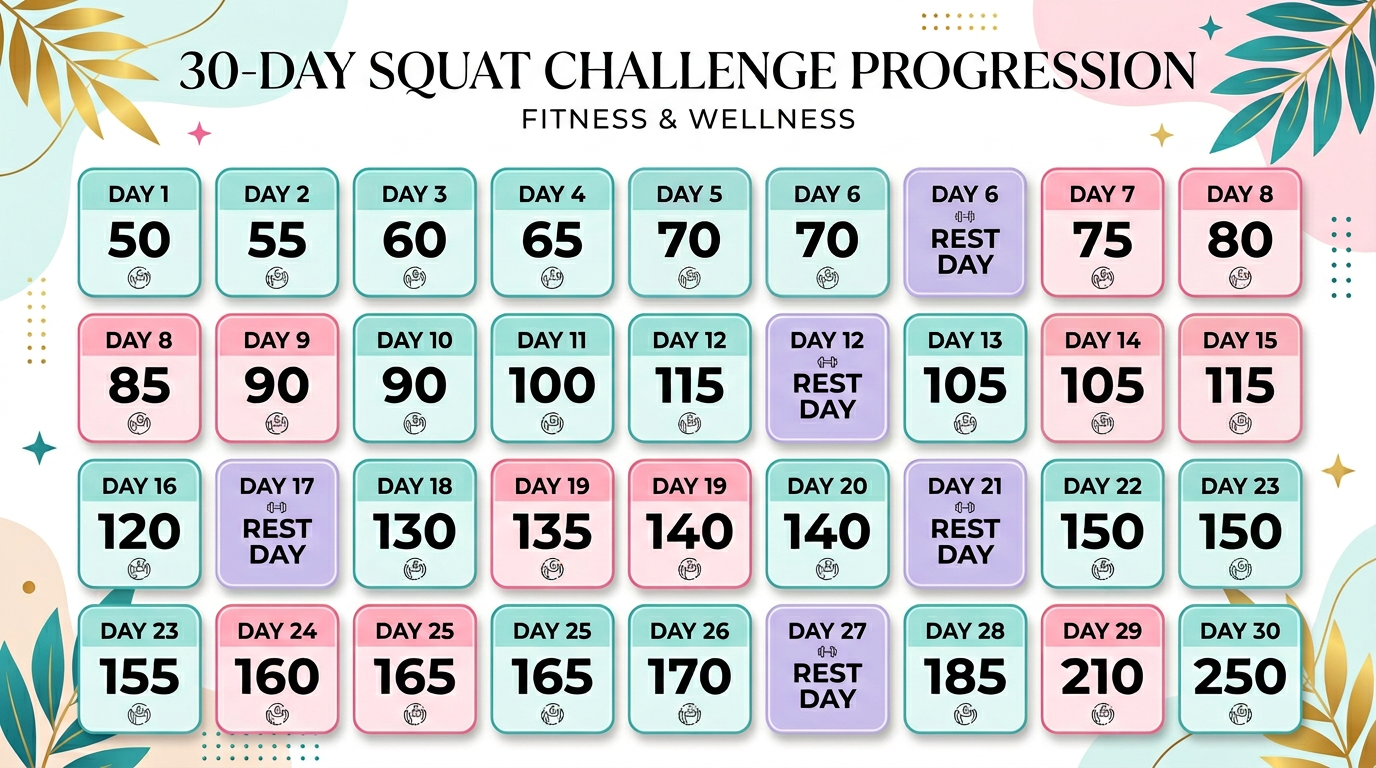
Calendar-style infographic showing a 30 day squat challenge progression chart with rep counts for each day, rest days highlighted in different color, starting at 50 reps and ending at 250 reps
Does the 30 Day Squat Challenge Actually Work?
The effectiveness of a 30 day squat challenge depends entirely on your definition of "work" and your starting fitness level. Research shows that beginners will experience neuromuscular adaptations and improved muscular endurance within 30 days, but significant muscle growth or body composition changes require longer timeframes and progressive resistance.
What You Can Realistically Expect
After completing a 30 day squat challenge, most women experience:
- Improved squat form and technique: Daily practice reinforces proper movement patterns
- Enhanced muscular endurance: Your legs will handle high-rep sets more easily
- Better mind-muscle connection: Increased awareness of glute and quad activation
- Established exercise habit: Building a 30-day streak creates behavioral momentum
- Modest strength gains: Especially noticeable if you were previously sedentary
What You Shouldn't Expect
Despite viral transformation photos, the challenge alone won't deliver:
- Dramatic physique changes: Visible muscle growth requires months of progressive overload
- Significant fat loss: Spot reduction is a myth; overall calorie deficit matters most
- Balanced lower body development: Squats alone don't target hamstrings or glute medius adequately
- Optimal strength gains: Progressive resistance training is more effective than high-rep bodyweight work
The bottom line: squat challenges work as a gateway to fitness consistency and can improve your baseline strength, but they're not a complete training program. Think of them as a starting point rather than a comprehensive solution.
The Science Behind Daily Squatting
Understanding the physiological principles behind squat challenges helps set realistic expectations and optimize your approach.
Muscle Adaptation Timeline
Muscle growth (hypertrophy) requires consistent progressive overload over 8-12 weeks minimum, not just 30 days. During the first month of training, most strength gains come from neuromuscular adaptations—your nervous system becoming more efficient at recruiting muscle fibers—rather than actual muscle tissue growth.
This explains why you'll feel stronger and more capable after 30 days, even if your legs don't look dramatically different. Your body is learning to perform the movement more efficiently, which is valuable progress but different from building substantial muscle mass.
Recovery and Overtraining Concerns
Muscles grow during rest, not during workouts. When you squat, you create microscopic tears in muscle fibers that need 48-72 hours to repair and adapt. Daily squatting without adequate recovery can lead to overuse injuries, chronic fatigue, and diminished results.
This is particularly concerning for beginners whose connective tissues haven't adapted to regular loading. Tendons and ligaments strengthen more slowly than muscles, making them vulnerable when training volume increases too rapidly.
The Role of Progressive Overload
Progressive overload—gradually increasing training stimulus—is the fundamental principle of strength building. While squat challenges increase reps over 30 days, high-rep bodyweight squats eventually provide insufficient stimulus for continued adaptation.
For optimal results, you need to increase resistance (add weight), not just repetitions. After a certain point, doing more bodyweight squats trains endurance rather than strength or muscle growth.
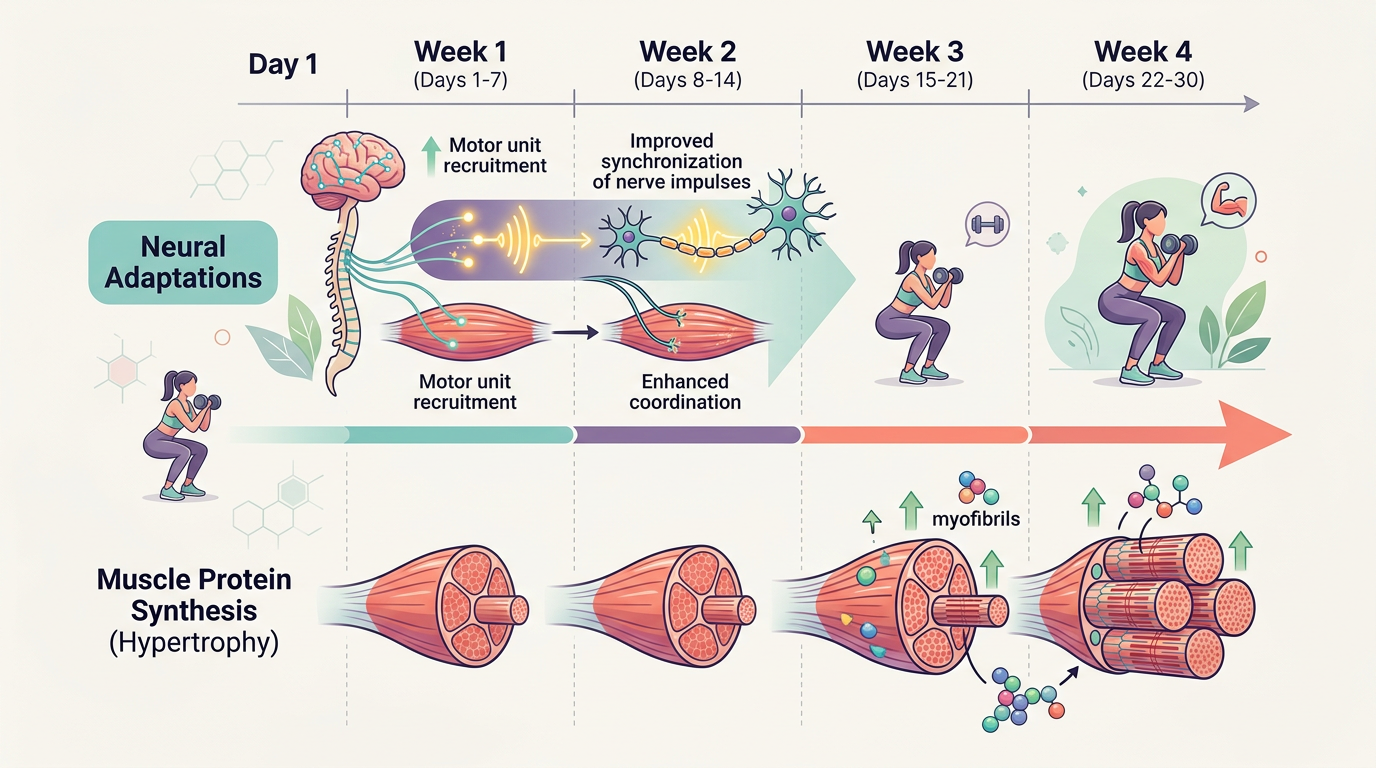
Scientific diagram showing muscle adaptation timeline over 30 days, with neural adaptations in weeks 1-2 and beginning muscle protein synthesis in weeks 3-4, illustrated with simple graphics
Benefits of the 30 Day Squat Challenge
Despite limitations, squat challenges offer legitimate benefits, especially for specific populations and goals.
Accessibility and Simplicity
The challenge requires no equipment, minimal space, and clear daily instructions, removing common barriers to starting a fitness routine. For women intimidated by gym environments or complex programs, this simplicity is genuinely valuable.
The structured format eliminates decision fatigue—you don't need to plan workouts or wonder if you're doing enough. You simply follow the prescribed reps each day.
Building Exercise Habits
Research on habit formation shows that consistency matters more than intensity when establishing new behaviors. Committing to daily movement for 30 consecutive days can create neural pathways that make exercise feel automatic rather than requiring constant willpower.
Many women report that completing a squat challenge gave them confidence to pursue more comprehensive training programs. The psychological win of finishing what you started shouldn't be underestimated.
Functional Strength Development
Squats are a fundamental movement pattern used in daily life—sitting, standing, lifting objects from the ground. Improving your squat strength translates to easier everyday activities and reduced injury risk during routine tasks.
For older women or those recovering from sedentary periods, this functional benefit can significantly improve quality of life.
Community and Accountability
Many women participate in squat challenges with friends or online communities, creating social accountability that increases adherence. The shared experience and mutual encouragement can make exercise feel less isolating and more enjoyable.
Potential Risks and Drawbacks
Before starting any challenge, understanding potential downsides helps you make informed decisions and implement necessary modifications.
Overuse Injuries
Daily high-rep squatting without rest days increases risk of knee pain, hip impingement, lower back strain, and Achilles tendinitis. These overuse injuries develop gradually and can sideline you for weeks or months if ignored.
Women with existing joint issues, previous injuries, or biomechanical imbalances face higher risk. Poor form amplified over hundreds of daily reps compounds these problems exponentially.
Muscle Imbalances
Focusing exclusively on squats for 30 days can create or worsen muscle imbalances. Squats primarily target quadriceps and glutes but provide minimal hamstring activation and don't address glute medius (important for hip stability).
This imbalanced development can alter movement patterns and increase injury risk in other activities. A comprehensive program should include posterior chain exercises like deadlifts, hip thrusts, and hamstring curls.
Unrealistic Expectations
The gap between viral transformation photos and realistic results can lead to disappointment and abandonment of fitness efforts altogether. Many dramatic before-and-after images involve favorable lighting, angles, and sometimes completely different individuals.
When women don't see Instagram-worthy results after 30 days, they may conclude that exercise doesn't work for them rather than recognizing the challenge's limitations.
Neglecting Other Training Components
Fitness requires balanced development of strength, cardiovascular health, flexibility, and mobility. Dedicating all your exercise time to squats means neglecting upper body strength, core stability, and cardiovascular conditioning.
A well-rounded program yields better overall health outcomes than any single-exercise focus.
Proper Squat Form Essentials
Form quality matters infinitely more than quantity. Performing 300 squats with poor technique causes more harm than good.
The Perfect Bodyweight Squat
- Starting position: Stand with feet shoulder-width apart, toes slightly turned out (5-15 degrees)
- The descent: Initiate by pushing hips back as if sitting into a chair, keeping chest proud and core braced
- Depth: Lower until thighs are parallel to ground or slightly below, maintaining neutral spine
- Knee tracking: Knees should track over toes, not caving inward or pushing excessively forward
- The ascent: Drive through entire foot (not just toes), squeezing glutes at the top
- Breathing: Inhale during descent, exhale during ascent
Common Form Mistakes
The most frequent squat errors include knees collapsing inward (valgus collapse), excessive forward lean, heels lifting off the ground, and insufficient depth. Each of these compensations indicates mobility restrictions or weak stabilizers that need addressing.
Recording yourself from the side and front angles helps identify form issues. Consider working with a qualified trainer for at least one session to establish proper technique before attempting high-volume challenges.
Mobility Requirements
Proper squat form requires adequate ankle dorsiflexion, hip flexion, and thoracic spine extension. Limited mobility in these areas forces compensatory movements that stress joints inappropriately.
If you can't achieve proper depth with good form, address mobility restrictions through targeted stretching and mobility work rather than forcing poor-quality reps.
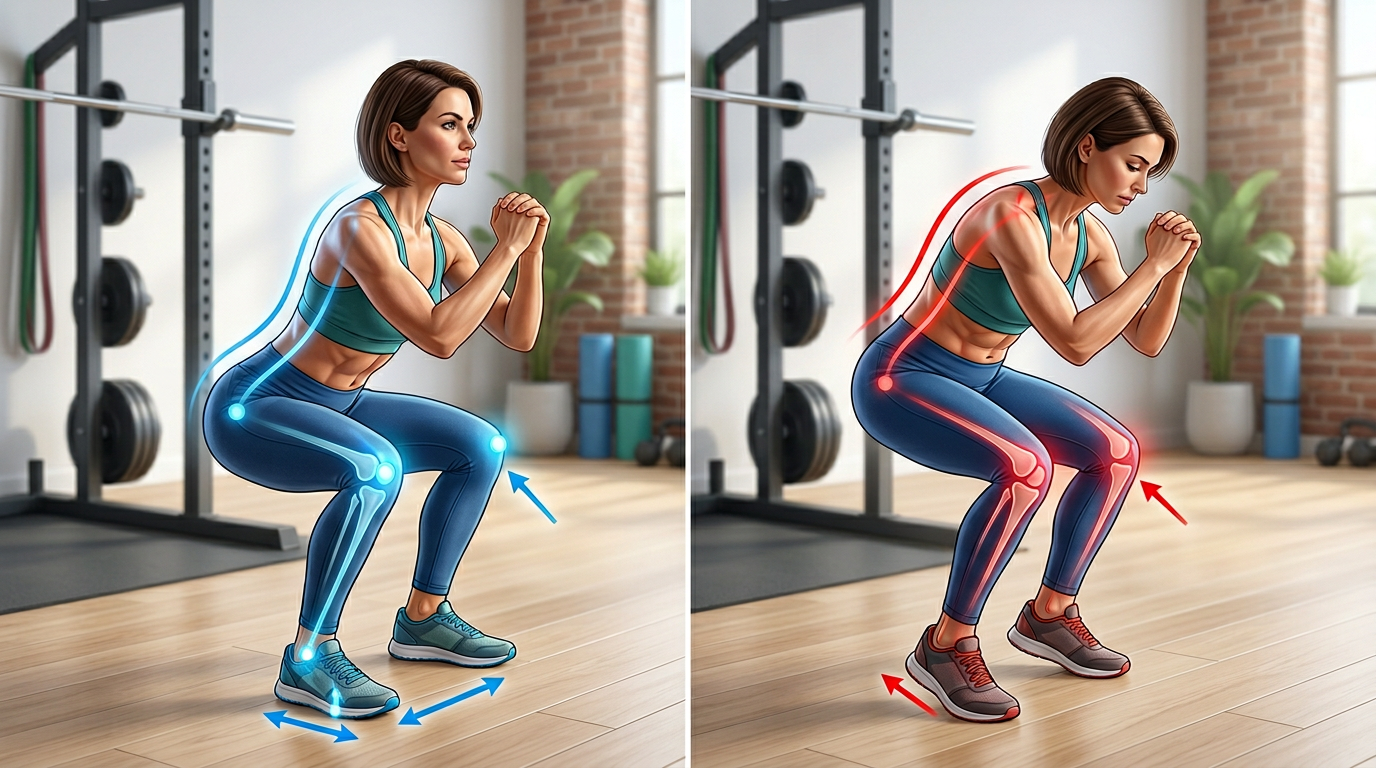
Side-by-side comparison illustration showing proper squat form versus common mistakes, with anatomical markers highlighting correct knee tracking, spine position, and foot placement
How to Modify the Challenge for Better Results
Strategic modifications transform a basic squat challenge into a more effective and sustainable program.
Incorporate Rest Days
Instead of 30 consecutive days, schedule rest or active recovery days every 3-4 training days. This allows tissue repair and prevents overuse injuries while maintaining consistency. A modified schedule might include 4-5 squat days per week rather than seven.
Add Exercise Variety
Rotate through different squat variations to target muscles from multiple angles and prevent repetitive strain:
- Sumo squats: Wider stance emphasizes inner thighs and glutes
- Bulgarian split squats: Single-leg variation improves balance and addresses asymmetries
- Goblet squats: Holding weight at chest encourages upright torso position
- Jump squats: Plyometric variation builds power (use sparingly to prevent joint stress)
- Pulse squats: Small movements at bottom position increase time under tension
Implement Progressive Resistance
Adding resistance through dumbbells, kettlebells, or resistance bands provides continued stimulus as you adapt, making the challenge effective beyond just the first week. Start with bodyweight to master form, then gradually add load.
Even light weights (10-20 pounds) significantly increase training stimulus compared to endless bodyweight reps.
Combine with Complementary Exercises
Balance your squat-focused training with exercises targeting neglected muscle groups:
- Hamstrings: Romanian deadlifts, leg curls
- Glute medius: Lateral band walks, clamshells
- Core stability: Planks, dead bugs, bird dogs
- Upper body: Push-ups, rows, shoulder presses
This creates a more balanced program that delivers better overall results.
Nutrition Considerations for Optimal Results
Exercise alone won't transform your physique—nutrition plays an equally important role in achieving visible results.
Protein for Muscle Recovery
Adequate protein intake (0.7-1.0 grams per pound of body weight) provides the building blocks for muscle repair and growth. Without sufficient protein, your body can't effectively recover from daily training stimulus.
Distribute protein throughout the day rather than consuming it all in one meal for optimal muscle protein synthesis.
Caloric Balance Matters
To build muscle, you need adequate calories (slight surplus or maintenance); to lose fat, you need a caloric deficit. You cannot simultaneously maximize both goals, so clarify your primary objective.
Many women expect squat challenges to dramatically reduce body fat while building muscle—physiologically contradictory goals that lead to disappointment.
Hydration and Recovery
Proper hydration supports joint lubrication, nutrient transport, and waste removal. Dehydration impairs recovery and performance, making each day's squats progressively more difficult.
Aim for at least half your body weight in ounces of water daily, more if you're sweating heavily.
Alternative Approaches to Consider
If the traditional 30 day squat challenge doesn't align with your goals or circumstances, consider these evidence-based alternatives.
Structured Strength Training Programs
Progressive strength programs like Strong Curves, Starting Strength, or StrongLifts provide systematic progression, balanced muscle development, and built-in recovery. These programs deliver superior long-term results compared to single-exercise challenges.
While less trendy than viral challenges, structured programs align with exercise science principles and produce consistent, measurable progress.
The 5-4-3-2-1 Squat Program
This alternative approach involves performing 5 sets with decreasing reps (5-4-3-2-1) while increasing weight each set. The 5-4-3-2-1 method emphasizes progressive resistance and strength building rather than high-rep endurance, making it more effective for muscle development.
This pyramid structure allows you to work across different rep ranges in a single session, targeting both strength and hypertrophy adaptations.
Periodized Lower Body Training
Rather than daily squats, periodized training alternates between different training focuses throughout the week: strength days (heavy weight, low reps), hypertrophy days (moderate weight, moderate reps), and metabolic days (lighter weight, high reps or circuits).
This variation prevents adaptation plateaus and reduces overuse injury risk while providing comprehensive stimulus.
What Will Happen If I Do Squats Every Day for 30 Days?
The realistic outcomes of daily squatting depend on your starting point, form quality, and recovery capacity.
Week 1: Neural Adaptations Begin
Your nervous system starts learning the movement pattern more efficiently. You'll likely experience significant muscle soreness (DOMS) as your body adapts to the new stimulus. Squats that felt challenging on day one become noticeably easier by day seven.
Week 2-3: Endurance Improvements
Muscular endurance increases substantially—you can complete higher rep sets with less fatigue. Soreness decreases as your muscles adapt. However, you may notice knee discomfort or hip tightness if recovery is insufficient or form deteriorates with fatigue.
Week 4: Plateau and Fatigue
Many women hit a wall during the final week as cumulative fatigue accumulates. Without adequate rest, performance may decline rather than improve. The very high rep counts (200+ squats) become more of a mental endurance test than a productive training stimulus.
Visible physique changes remain minimal for most people—you might notice slightly better muscle tone and improved posture, but dramatic transformation requires longer timeframes and more comprehensive programming.
Bone Density Benefits
Can squats help with bone density? Yes, weight-bearing exercises like squats create mechanical stress that stimulates bone remodeling and increased mineral density. However, significant bone density improvements require consistent resistance training over months to years, not just 30 days.
For optimal bone health, combine squats with other compound movements and ensure adequate calcium and vitamin D intake.
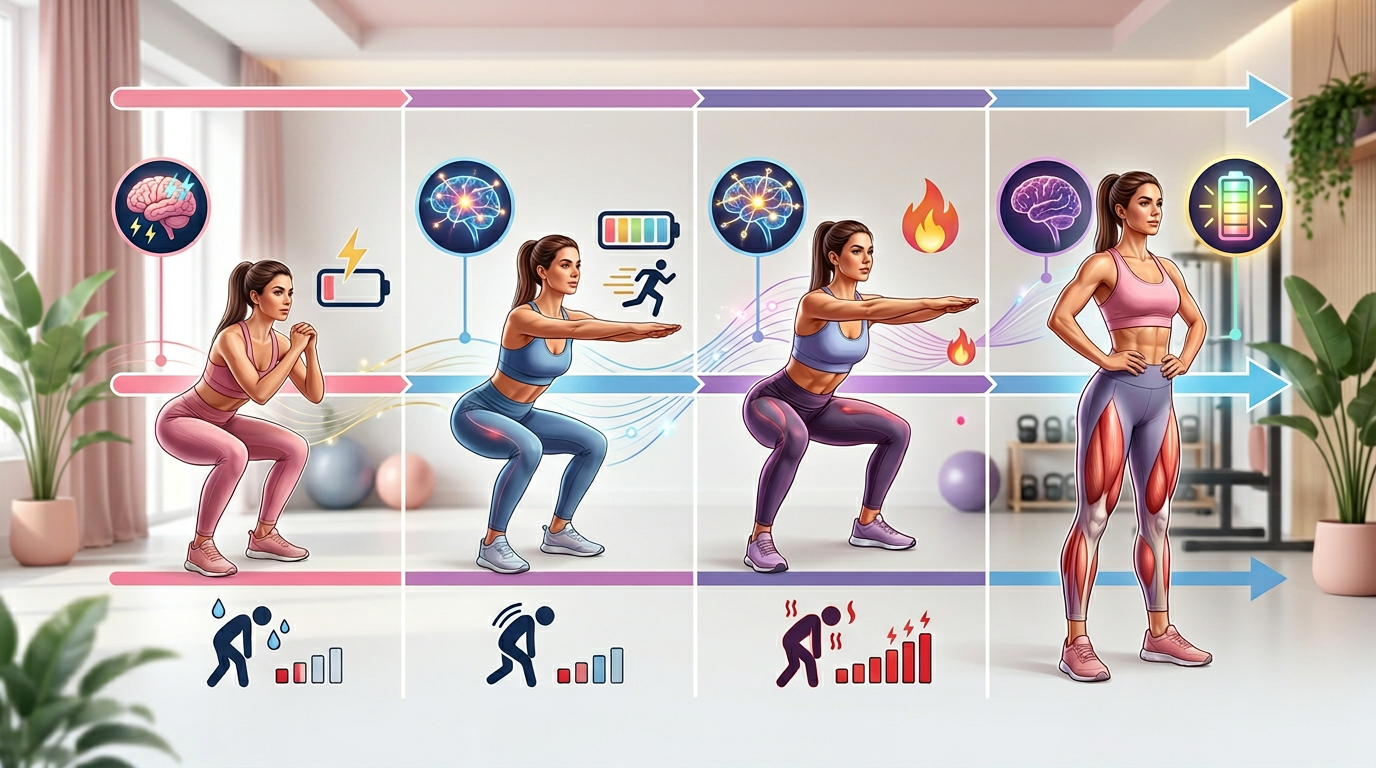
Timeline infographic showing what happens to your body during each week of a 30 day squat challenge, with icons representing neural adaptations, muscle endurance, and fatigue accumulation
Who Should (and Shouldn't) Try This Challenge
Squat challenges aren't universally appropriate—certain populations benefit while others face unnecessary risks.
Good Candidates
- Complete beginners: Establishing an exercise habit and building baseline strength
- Those returning after long breaks: Regaining movement patterns and confidence
- Women seeking accountability: The structured format provides clear daily goals
- People with limited equipment: Bodyweight training accessible anywhere
Who Should Modify or Skip
- Those with existing knee or hip issues: Daily loading may exacerbate problems
- Advanced trainees: Bodyweight squats provide insufficient stimulus for continued progress
- Anyone with poor squat form: Master technique before high-volume training
- Women with overtraining symptoms: Adding daily squats to already intense training invites injury
Listen to your body—persistent pain (different from muscle soreness) signals the need to rest or modify the approach.
Success Strategies for Completing the Challenge
If you decide to attempt a 30 day squat challenge, these strategies increase your chances of success and positive outcomes.
Start Conservative
Choose a challenge version that matches your current fitness level. It's better to complete a moderate challenge successfully than abandon an overly ambitious one after two weeks. You can always repeat with higher volume later.
Prioritize Form Over Numbers
If fatigue causes form breakdown, stop the set regardless of target reps. Poor-quality reps accumulate injury risk without training benefits. It's perfectly acceptable to split daily totals into multiple sets throughout the day.
Track Your Progress
Beyond checking off daily reps, track qualitative factors like how the movement feels, energy levels, and any discomfort. This data helps you identify patterns and make informed adjustments.
Take photos and measurements at the beginning and end—scale weight alone doesn't reflect body composition changes.
Address Mobility Limitations
Dedicate 5-10 minutes daily to mobility work targeting ankles, hips, and thoracic spine. Improved mobility allows better form, which translates to better results and reduced injury risk.
Build in Recovery Practices
Support your training with adequate sleep (7-9 hours), proper nutrition, foam rolling, and active recovery activities like walking or yoga. Recovery isn't passive—it requires intentional effort.
After the Challenge: Maintaining Your Progress
Completing 30 days is an accomplishment, but sustaining results requires ongoing commitment.
Transition to Balanced Programming
Use the momentum from completing your challenge to start a comprehensive strength training program that develops your entire body. This prevents the detraining that occurs when you stop the challenge abruptly.
Continue Progressive Overload
Keep challenging your muscles by adding resistance, trying advanced variations, or manipulating tempo and rest periods. Stagnant training yields stagnant results.
Set New Goals
Define your next fitness objective—whether that's mastering pistol squats, increasing your barbell squat weight, or completing a different challenge. Clear goals maintain motivation and direction.
Frequently Asked Questions
Does the 30 day squat challenge actually work?
The 30 day squat challenge improves muscular endurance, squat form, and baseline leg strength, especially for beginners. However, dramatic physique transformation requires longer timeframes, progressive resistance, proper nutrition, and comprehensive programming beyond squats alone. Set realistic expectations focused on habit-building and foundational strength rather than dramatic body composition changes.
Can squats help with bone density?
Yes, squats create mechanical stress that stimulates bone remodeling and increased mineral density over time. Weight-bearing exercises are essential for bone health, particularly for women concerned about osteoporosis. However, significant bone density improvements require consistent resistance training over months to years, combined with adequate calcium and vitamin D intake, not just 30 days of squatting.
What is the 5 4 3 2 1 squat program?
The 5-4-3-2-1 squat program involves performing five sets with decreasing reps (5, 4, 3, 2, 1) while increasing weight each set. This pyramid structure targets both strength and muscle growth by working across different rep ranges in one session. It emphasizes progressive resistance rather than high-rep endurance, making it more effective for building strength and muscle mass than traditional bodyweight challenges.
What will happen if I do squats every day for 30 days?
Daily squatting for 30 days improves muscular endurance, squat technique, and mind-muscle connection, with most strength gains coming from neural adaptations rather than muscle growth. You may experience initial soreness, followed by improved performance, but risk overuse injuries without adequate recovery. Visible physique changes remain minimal for most women—expect better muscle tone and posture rather than dramatic transformation in just one month.
How many squats should a beginner start with?
Beginners should start with 25-50 bodyweight squats per day, focusing on perfect form rather than high volume. Split this total into 2-3 sets throughout the day if needed. Master proper technique with lower reps before progressing to higher volumes. Starting too aggressively increases injury risk and makes the challenge unsustainable, while conservative progression builds confidence and allows connective tissues to adapt safely.
Should I do squats every day or take rest days?
Include rest days every 3-4 training days to allow muscle recovery and prevent overuse injuries. Muscles grow during rest periods, not during workouts. A modified schedule with 4-5 squat days per week delivers better results than seven consecutive days while reducing injury risk. On rest days, focus on upper body training, mobility work, or active recovery activities like walking or yoga.
Can I lose weight doing a 30 day squat challenge?
Squat challenges alone won't cause significant weight loss without a caloric deficit through nutrition. While squats burn calories and build muscle (which slightly increases metabolism), exercise accounts for a smaller portion of daily energy expenditure than most people assume. For fat loss, combine strength training with balanced nutrition, adequate protein intake, and a moderate caloric deficit. Squats support but don't replace proper nutrition strategies.
Conclusion
The 30 day squat challenge can serve as an effective gateway to fitness consistency and build foundational lower body strength, particularly for beginners establishing exercise habits. However, realistic expectations are essential—you'll develop better squat form, improved muscular endurance, and increased confidence, but dramatic physique transformation requires comprehensive programming, progressive resistance, proper nutrition, and longer timeframes.
For optimal results, modify traditional challenges by incorporating rest days, exercise variety, and progressive resistance. Balance squat-focused training with complementary exercises targeting neglected muscle groups, and prioritize form quality over rep quantity. Whether you complete a challenge or opt for structured strength training, consistency and progressive overload remain the fundamental principles of lasting results.
If you're ready to build sustainable strength beyond a 30-day challenge, explore comprehensive programs designed specifically for women's fitness goals and body composition.