Inner thigh exercises are targeted movements that strengthen the adductor muscles, which pull your legs together and stabilize your hips. The most effective include sumo squats, Copenhagen planks, and lateral lunges, performed 2-3 times weekly with progressive resistance for optimal toning and strength development.
The Best Inner Thigh Exercises to Tone Fast
Do you feel like your inner thighs just won't respond no matter how many leg workouts you do? You're not alone. The inner thighs—technically called the adductor muscles—are notoriously challenging to target because most common exercises like regular squats and deadlifts don't emphasize them enough. These muscles play a crucial role in hip stability, athletic performance, and overall leg strength, yet they're often overlooked in traditional training programs.
The good news? With the right inner thigh exercises and consistent effort, you can build strength and see visible changes in 4-6 weeks. This comprehensive guide will walk you through the most effective movements to strengthen and tone your inner thighs, backed by biomechanics and proven training principles. Created by certified trainer Shelley Darlington with 15+ years experience, these exercises are designed specifically for women who want functional strength alongside aesthetic improvements.
Whether you're new to strength training or looking to add targeted movements to your existing routine, you'll discover exercises that work for every fitness level. Let's dive into the best inner thigh exercises that actually deliver results.
Key Takeaways
- Inner thigh exercises target the adductor muscle group, which is essential for hip stability and leg strength
- Consistency is key—train your inner thighs 2-3 times per week with progressive overload for best results
- Combine resistance exercises with bodyweight movements for comprehensive adductor development
- Proper form matters more than exercise quantity; focus on controlled movements and full range of motion
- Results typically appear within 4-6 weeks when combined with proper nutrition and overall strength training
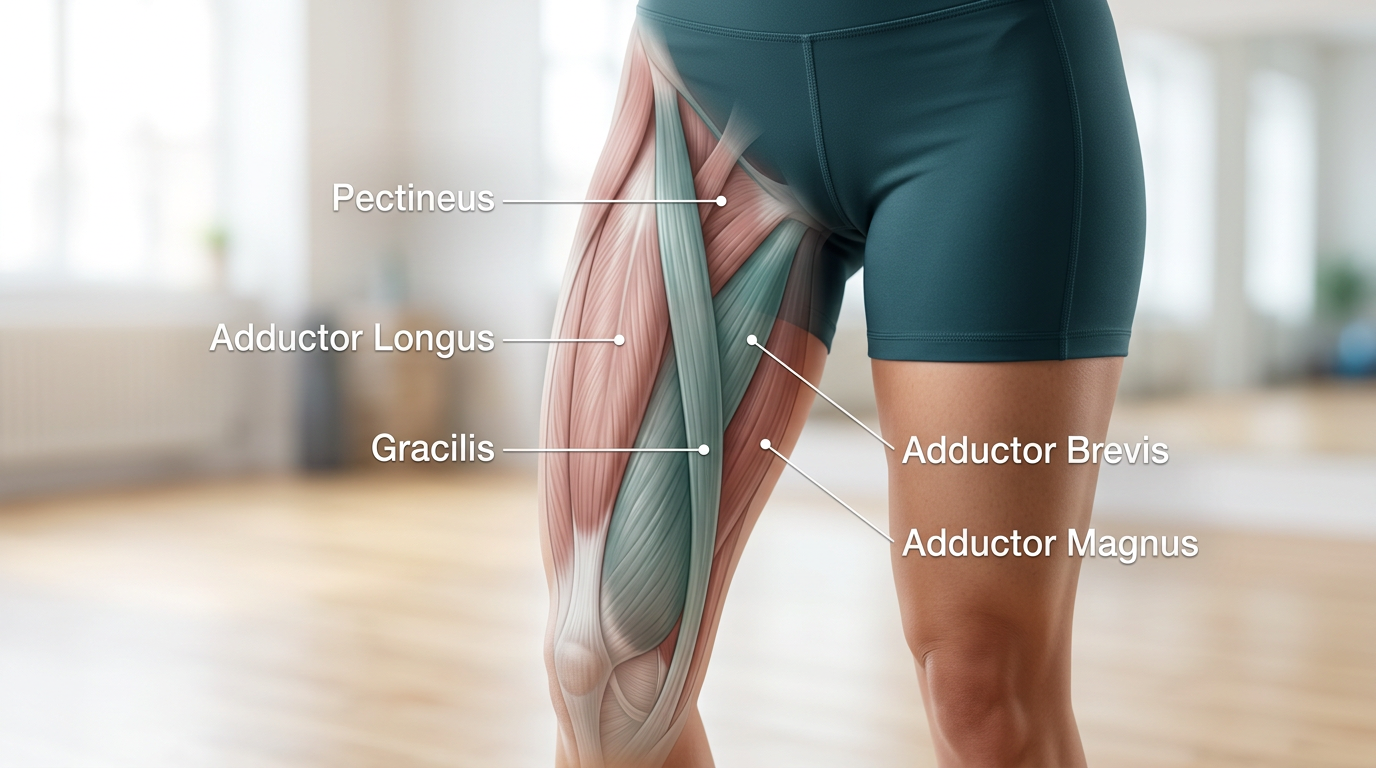
Anatomical illustration showing the inner thigh adductor muscle group including adductor longus, adductor brevis, adductor magnus, gracilis, and pectineus with labels
Understanding Your Inner Thigh Muscles
Before jumping into exercises, it's important to understand what you're actually working. Your inner thighs consist of five adductor muscles: the adductor longus, adductor brevis, adductor magnus, gracilis, and pectineus. Together, these muscles work to bring your legs toward your body's midline (a movement called adduction), stabilize your pelvis during walking and running, and assist with hip flexion and rotation.
Why Inner Thighs Are Hard to Tone
The adductors are often undertrained because standard exercises like squats and lunges primarily target the quads, hamstrings, and glutes. Without specific adduction movements, your inner thighs won't receive adequate stimulus for growth and strengthening. Additionally, many women store body fat in the inner thigh area due to hormonal factors, which means building muscle alone won't create visible definition without addressing overall body composition through nutrition.
The Role of Progressive Overload
To see real changes in your inner thighs, you need to apply progressive overload—gradually increasing the challenge over time. This means adding weight, increasing repetitions, slowing down tempo, or reducing rest periods. Your muscles adapt to stress, so continually challenging them is essential for development. Based on feedback from thousands of Strong Curves app users, those who track their progress and systematically increase difficulty see results significantly faster than those who repeat the same routine indefinitely.
Realistic Expectations for Results
While you might see advertisements promising toned thighs in days, realistic timelines are more like 4-8 weeks for noticeable strength improvements and 8-12 weeks for visible changes. Genetics, starting fitness level, nutrition, and consistency all play roles. Focus on performance gains first—like adding weight to your sumo squats or holding a Copenhagen plank longer—and aesthetic changes will follow.
Exercise Comparison Table
Exercise
Difficulty Level
Equipment Needed
Best For
Sumo Squats
Beginner
Optional weights
Overall inner thigh strength
Copenhagen Planks
Advanced
Bench or chair
Maximum adductor activation
Lateral Lunges
Beginner-Intermediate
Optional weights
Functional movement patterns
Cable Hip Adduction
Intermediate
Cable machine
Isolation and progressive overload
Cossack Squats
Intermediate
Optional weights
Mobility and strength combined
Side-Lying Leg Lifts
Beginner
None
Activation and endurance
Slider Side Lunges
Intermediate
Sliders or towel
Eccentric strength
Banded Adductor Squeezes
Beginner
Resistance band or ball
Isometric strength
Curtsy Lunges
Beginner-Intermediate
Optional weights
Glutes and inner thighs
Skater Squats
Advanced
None
Balance and unilateral strength
1. Sumo Squats
Sumo squats are one of the most effective compound movements for targeting your inner thighs while also engaging your glutes, quads, and core. The wide stance and outward toe angle place significantly more emphasis on the adductors compared to traditional squats. This exercise is perfect for beginners and can be progressively loaded with dumbbells, kettlebells, or a barbell as you get stronger.
To perform a sumo squat, stand with your feet wider than shoulder-width apart and toes pointed out at roughly 45 degrees. Keep your chest up and core engaged as you lower down by bending your knees and pushing your hips back. Descend until your thighs are parallel to the ground or slightly below, then drive through your heels to return to standing. Focus on keeping your knees tracking over your toes throughout the movement.
Start with bodyweight for 3 sets of 12-15 repetitions to master the form. Once comfortable, add weight incrementally—begin with a single dumbbell held at chest height (goblet style) or a kettlebell. Women 35+ focused on strength training and body recomposition particularly benefit from this exercise because it builds functional lower body strength while targeting common problem areas.
Pros
- Highly effective for inner thigh activation while building overall leg strength
- Easy to learn and scale from beginner to advanced
- Can be performed anywhere with minimal equipment
- Improves hip mobility and ankle flexibility over time
Cons
- Requires good hip and ankle mobility for proper depth
- May feel awkward initially if you're used to traditional squats
- Loading limitations with heavy weights compared to barbell back squats
2. Copenhagen Planks
The Copenhagen plank is an advanced inner thigh exercise that research shows produces the highest adductor muscle activation of any movement. Originally developed for soccer players to prevent groin injuries, this challenging exercise involves holding a side plank position with your top leg elevated on a bench or sturdy chair. Studies have found Copenhagen planks activate the adductors up to 95% of their maximum voluntary contraction, making them incredibly effective for building strength.
To perform this exercise, position yourself perpendicular to a bench with your forearm on the ground. Place your top foot on the bench and either let your bottom leg hang free (harder) or rest it on the ground (easier modification). Lift your hips to create a straight line from head to feet, engaging your core and squeezing your inner thigh to maintain the position. Hold for 15-30 seconds per side.
Because of the intensity, start with the modified version where your bottom leg provides support. Progress to the full version only when you can hold the modified position for 30 seconds with perfect form. This exercise is particularly valuable for those who want maximum results from minimal time investment, as even short holds produce significant training stimulus.
Pros
- Highest adductor activation of any exercise (backed by research)
- Builds exceptional hip stability and core strength simultaneously
- Helps prevent groin strains and improves athletic performance
- Requires minimal equipment—just an elevated surface
Cons
- Very challenging—not suitable for beginners
- Requires significant core and shoulder strength
- Easy to perform incorrectly without proper coaching
- May cause discomfort in the supporting shoulder initially
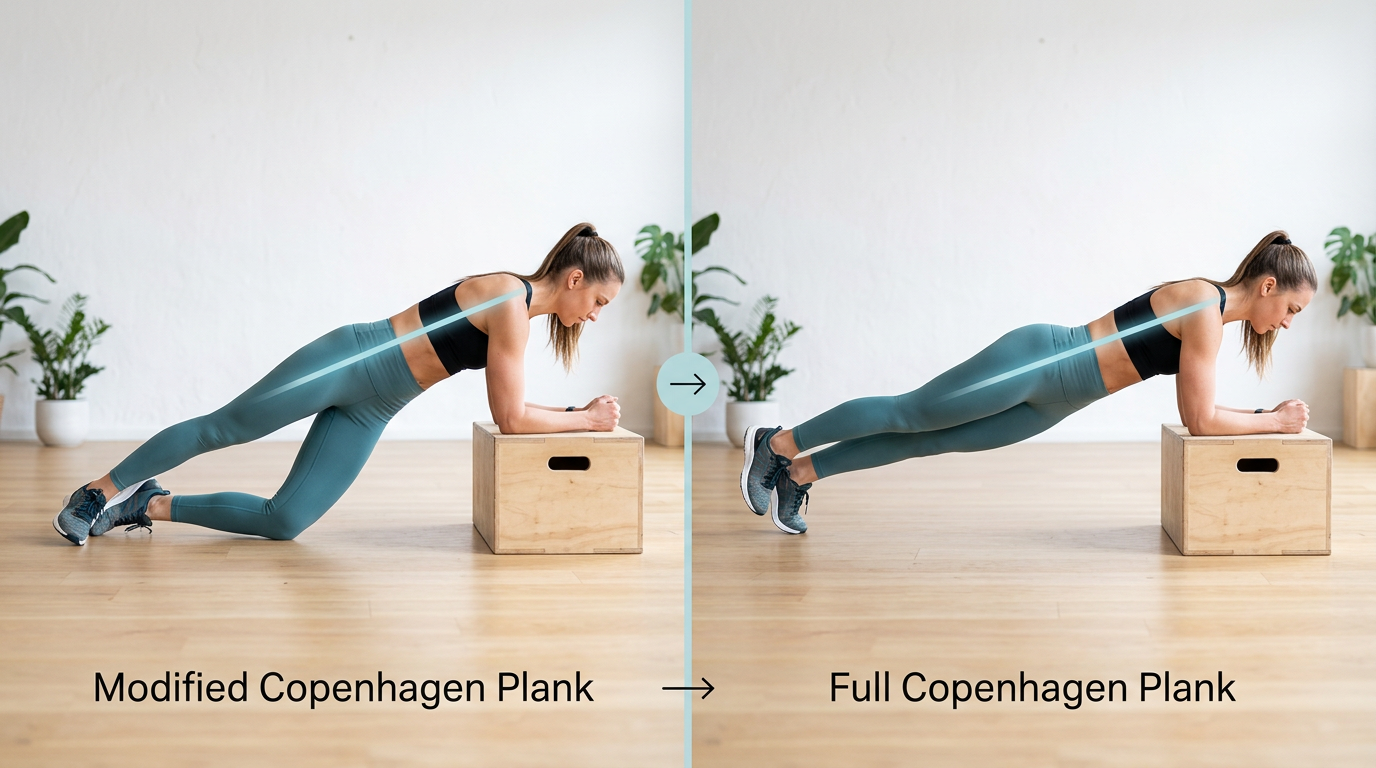
Step-by-step demonstration of Copenhagen plank progression from modified version with bottom leg on ground to full version with bottom leg elevated, showing proper body alignment
3. Lateral Lunges
Lateral lunges are a functional movement pattern that trains your inner thighs through a full range of motion while improving lateral stability and mobility. Unlike forward lunges that primarily work in the sagittal plane, lateral lunges challenge your body in the frontal plane—a movement pattern often neglected but essential for real-world activities and injury prevention.
Start by standing with feet hip-width apart. Take a wide step to your right, keeping your left leg straight as you bend your right knee and push your hips back. Your right foot should point forward with your knee tracking over your toes. Push off your right foot to return to the starting position, then repeat on the left side. Keep your chest up and core engaged throughout the movement.
This exercise can be performed with just bodyweight or loaded with dumbbells held at your sides or a single weight at chest height. Aim for 3 sets of 10-12 repetitions per side. The eccentric (lowering) phase is particularly important for inner thigh development, so control your descent rather than dropping quickly into the lunge position. Many practitioners of progressive strength training programs find lateral lunges improve their performance in other exercises by addressing mobility limitations.
Pros
- Trains inner thighs through functional movement patterns
- Improves hip and ankle mobility simultaneously
- Easy to modify for different fitness levels
- Enhances balance and coordination
Cons
- Requires good hip mobility to perform correctly
- Can be challenging to maintain balance initially
- May cause knee discomfort if form is poor
4. Cable Hip Adduction
Cable hip adduction is an isolation exercise that allows you to target your inner thighs with precise, controlled resistance. Using a cable machine provides constant tension throughout the entire range of motion, which is superior to free weights for adductor isolation. This exercise is excellent for progressive overload because you can easily adjust the weight in small increments and track your strength gains over time.
Attach an ankle cuff to the low pulley of a cable machine and secure it around your ankle closest to the machine. Stand perpendicular to the machine with feet hip-width apart, holding onto the machine for balance. Keeping your working leg straight, pull it across your body past your midline, squeezing your inner thigh at the peak contraction. Slowly return to the starting position with control.
Perform 3-4 sets of 12-15 repetitions per leg. Focus on quality over quantity—controlled movements with appropriate weight will yield better results than swinging heavy weight with momentum. This exercise pairs well with compound movements like sumo squats in a comprehensive leg workout. The Strong Curves glute-focused approach to functional fitness often incorporates isolation work like this after compound movements to fully fatigue the target muscles.
Pros
- True isolation of the adductor muscles
- Constant tension throughout the range of motion
- Easy to progressively overload with precise weight adjustments
- Low injury risk when performed correctly
Cons
- Requires access to a cable machine
- Less functional than compound movements
- Can feel awkward to set up initially
5. Cossack Squats
Cossack squats are a dynamic movement that combines deep squatting with lateral shifting, creating an excellent stimulus for inner thigh strength and hip mobility. Named after traditional Russian folk dances, this exercise challenges your adductors through a large range of motion while also improving ankle and hip flexibility. It's particularly effective for those who sit for long periods and need to restore natural movement patterns.
Start with feet wider than shoulder-width apart and toes pointing forward. Shift your weight to your right side, bending your right knee deeply while keeping your left leg straight. Your right foot stays flat on the ground while your left foot pivots onto the heel with toes pointing up. Lower as far as comfortable while maintaining an upright torso, then push back to center and repeat on the other side.
Begin with bodyweight only for 3 sets of 8-10 repetitions per side, focusing on depth and control. As you improve, hold a light dumbbell or kettlebell at chest height. Many people find their mobility improves significantly within just 2-3 weeks of consistent practice. This exercise complements other inner thigh work by addressing both strength and flexibility simultaneously, making it a valuable addition to any lower body training routine.
Pros
- Develops both strength and mobility in one movement
- Addresses common hip and ankle restrictions
- Highly functional for everyday movement patterns
- Can be regressed or progressed easily
Cons
- Requires significant mobility to perform full range of motion
- Can be intimidating for beginners
- May cause knee or hip discomfort if mobility is limited
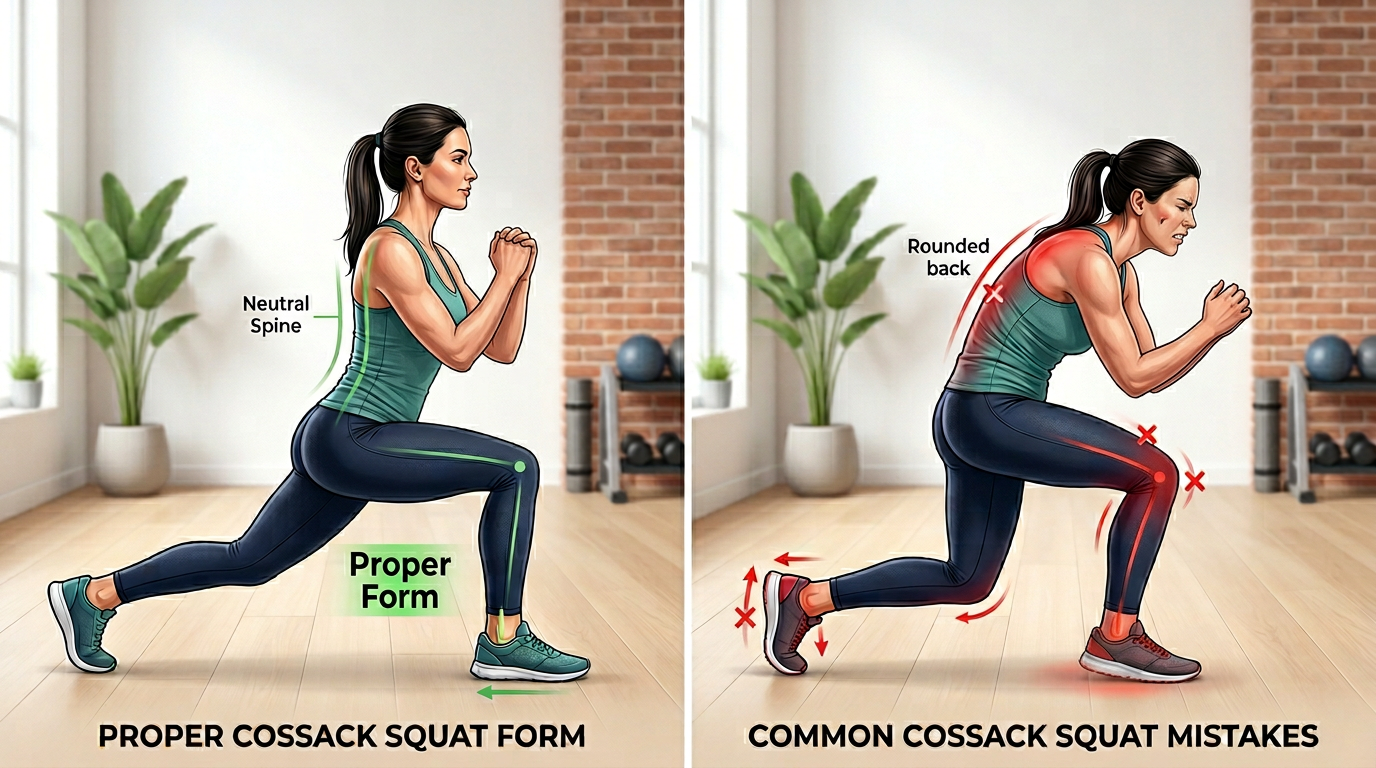
Side-by-side comparison showing proper Cossack squat form with common mistakes like rounded back, lifted heel, and knee caving inward highlighted
6. Side-Lying Leg Lifts
Side-lying leg lifts are a beginner-friendly bodyweight exercise that isolates the inner thighs without requiring equipment or advanced strength. While they may look simple, when performed with proper form and tempo, they effectively activate the adductors and build muscular endurance. This exercise is perfect for activation work before heavier lifts or as a finisher to fully fatigue the muscles at the end of your workout.
Lie on your right side with your body in a straight line, supporting your head with your right hand. Bend your left (top) leg and place that foot flat on the floor in front of your bottom leg. Keeping your bottom leg straight, lift it as high as comfortable while maintaining alignment. Lower with control without letting it rest on the ground between repetitions.
Perform 3-4 sets of 15-20 repetitions per side. To increase difficulty, add an ankle weight, slow down the tempo (3 seconds up, 3 seconds down), or hold the top position for 2-3 seconds. Despite being a bodyweight movement, this exercise can be surprisingly challenging when performed with proper muscle engagement rather than momentum. Focus on feeling your inner thigh working throughout each repetition.
Pros
- Requires no equipment and can be done anywhere
- Perfect for beginners or those recovering from injury
- Low impact on joints
- Excellent for muscle activation and endurance
Cons
- Limited progressive overload potential without equipment
- May feel too easy for advanced exercisers
- Requires high repetitions to challenge stronger individuals
7. Slider Side Lunges
Slider side lunges use a simple piece of equipment—furniture sliders, paper plates, or even a towel on smooth flooring—to create an intense eccentric challenge for your inner thighs. The sliding motion forces your adductors to work hard to control the movement, building strength through a full range of motion. This exercise is particularly effective for developing the eccentric strength that helps prevent groin strains.
Place a slider under your right foot and stand with feet hip-width apart. Keeping your left leg straight and strong, slowly slide your right foot out to the side as you bend your left knee and lower into a single-leg squat position. Your sliding leg should remain relatively straight. Use your inner thigh to pull your sliding leg back to the starting position.
Start with 3 sets of 8-10 repetitions per side, focusing on controlled movement in both directions. The eccentric (sliding out) phase should take 3-4 seconds, and the concentric (pulling back) phase should be powerful and deliberate. You can hold dumbbells for added resistance once you've mastered the bodyweight version. In our experience with thousands of women who train at home, slider exercises provide gym-quality resistance with minimal investment.
Pros
- Inexpensive equipment that's easy to store
- Excellent eccentric training for injury prevention
- Challenges stability and coordination
- Can be performed in small spaces
Cons
- Requires smooth flooring surface
- Can be very challenging initially
- May cause muscle soreness due to eccentric emphasis
8. Banded Adductor Squeezes
Banded adductor squeezes are an isometric exercise that builds strength through sustained muscle contraction rather than movement. Using a resistance band, small ball, or even a pillow between your knees, you squeeze inward to engage your adductors. This exercise is excellent for building mind-muscle connection and can be performed almost anywhere, making it perfect for those with limited time or space.
Lie on your back with knees bent and feet flat on the floor. Place a resistance band loop around your thighs just above your knees (or a small ball/pillow between your knees). Squeeze your knees together against the resistance, holding maximum contraction for 5-10 seconds. Release slightly but maintain tension, then repeat.
Perform 3-4 sets of 10-12 squeezes with 5-10 second holds. You can also perform this exercise seated or standing, making it versatile for different situations. While this won't build the same strength as loaded movements, it's valuable for activation, endurance, and maintaining muscle engagement during rehabilitation. Many physical therapists recommend adductor squeezes as part of comprehensive hip strengthening programs.
Pros
- Can be done anywhere with minimal equipment
- Low impact and suitable for all fitness levels
- Great for rehabilitation and activation work
- Builds mind-muscle connection effectively
Cons
- Limited strength-building potential compared to dynamic exercises
- Can become boring due to static nature
- Requires consistent effort to maintain proper intensity
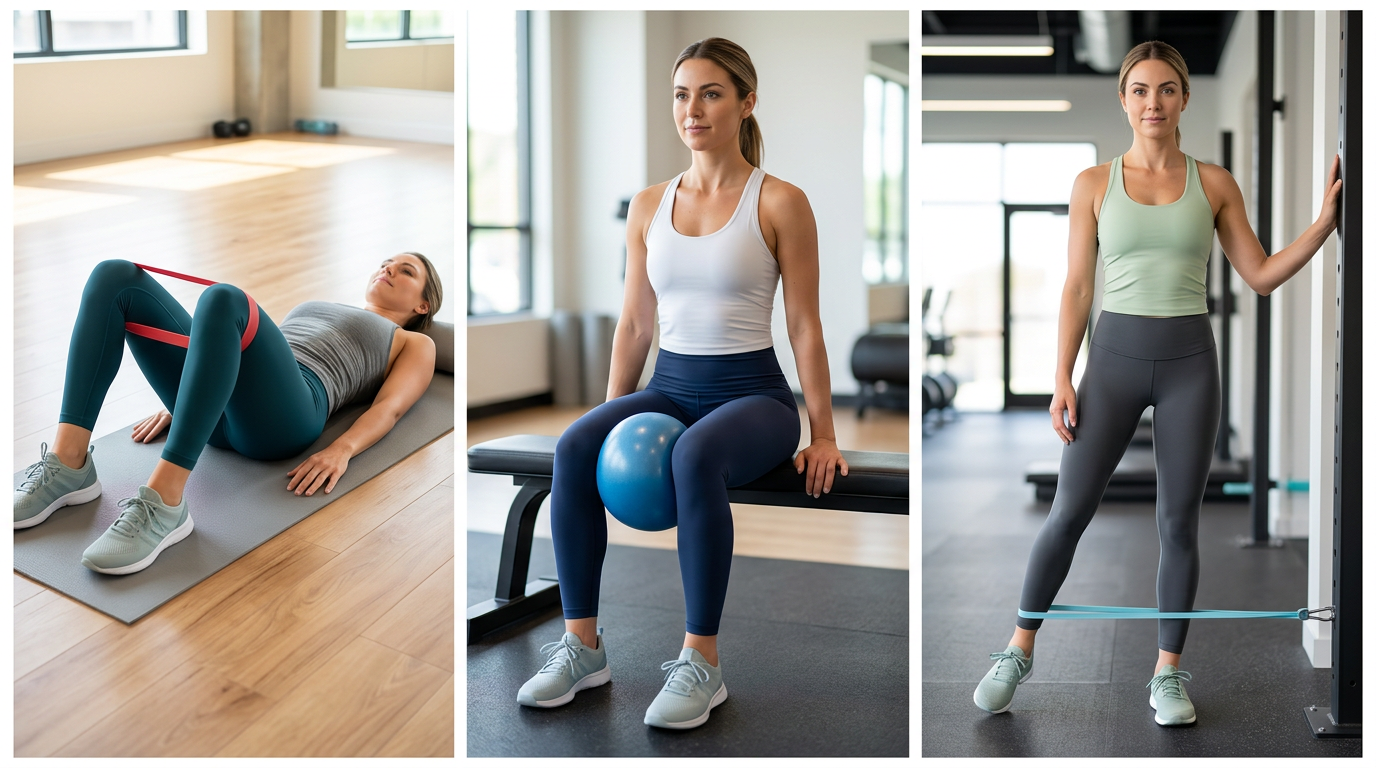
Collage showing three variations of banded adductor squeezes: lying down with resistance band, seated with ball, and standing with band, demonstrating versatility
9. Curtsy Lunges
Curtsy lunges add a rotational component to traditional lunges, creating unique activation patterns in your inner thighs while also targeting your glutes. The crossing motion behind your body emphasizes the adductors of your front leg while challenging your balance and coordination. This exercise is particularly effective for developing functional strength that translates to everyday movements like climbing stairs or getting up from the floor.
Stand with feet hip-width apart and hands on hips or holding dumbbells at your sides. Step your right leg back and across your body, as if performing a curtsy, landing on the ball of your right foot. Lower down by bending both knees until your front thigh is parallel to the ground. Push through your left heel to return to standing, then repeat on the other side.
Perform 3 sets of 10-12 repetitions per leg. Keep your chest up and core engaged throughout the movement to maintain balance. Start with bodyweight to master the coordination, then progress to holding dumbbells. Many women find curtsy lunges challenging initially due to the balance requirement, but they become more natural with practice. The combination of inner thigh and glute activation makes this an efficient exercise for comprehensive lower body development.
Pros
- Targets both inner thighs and glutes effectively
- Improves balance and coordination
- Functional movement pattern with real-world applications
- Easy to perform at home with minimal space
Cons
- Requires good balance and coordination
- Can stress knees if performed incorrectly
- May feel awkward until movement pattern is learned
10. Skater Squats
Skater squats are an advanced unilateral exercise that challenges your inner thighs, quads, and glutes while demanding exceptional balance and control. This movement mimics the motion of a speed skater, requiring you to lower down on one leg while the other leg extends behind you. The single-leg nature of this exercise creates significant adductor demand for hip stabilization, making it one of the most challenging bodyweight movements for inner thigh development.
Stand on your left leg with your right leg hovering slightly behind you. Lower down by bending your left knee and pushing your hips back while simultaneously reaching your right leg further behind you and lowering it toward the ground. Your right knee should nearly touch the ground behind your left heel. Push through your left heel to return to standing.
Start with 2-3 sets of 5-8 repetitions per leg, using a wall or chair for balance support if needed. This exercise requires significant single-leg strength, so don't be discouraged if you can only perform a few repetitions initially. Progress by increasing depth, adding repetitions, or eventually holding a light weight. The unilateral nature makes this excellent for identifying and correcting strength imbalances between legs.
Pros
- Highly effective for building unilateral leg strength
- Requires no equipment for challenging workout
- Develops exceptional balance and coordination
- Identifies and corrects strength imbalances
Cons
- Very advanced—not suitable for beginners
- Requires significant mobility and strength
- Can be frustrating initially due to difficulty
- Higher injury risk if attempted before ready
Creating Your Inner Thigh Workout Routine
Now that you understand the best inner thigh exercises, let's discuss how to structure them into an effective workout routine. The key is balancing frequency, volume, and intensity while allowing adequate recovery. Training your inner thighs 2-3 times per week with at least 48 hours between sessions allows for optimal recovery and growth.
Sample Beginner Routine
If you're new to targeted inner thigh training, start with this routine performed twice per week:
- Sumo Squats: 3 sets of 12-15 reps
- Lateral Lunges: 3 sets of 10 reps per side
- Side-Lying Leg Lifts: 3 sets of 15-20 reps per side
- Banded Adductor Squeezes: 3 sets of 12 reps (5-second holds)
This routine takes approximately 20-25 minutes and provides a solid foundation for inner thigh development. Focus on mastering form before adding weight or increasing volume.
Sample Intermediate Routine
Once you've built a base of strength and can perform the beginner routine with good form, progress to this intermediate routine performed 2-3 times per week:
- Sumo Squats with Weight: 4 sets of 10-12 reps
- Cossack Squats: 3 sets of 8-10 reps per side
- Slider Side Lunges: 3 sets of 10 reps per side
- Curtsy Lunges with Dumbbells: 3 sets of 10-12 reps per side
- Cable Hip Adduction: 3 sets of 12-15 reps per side
Sample Advanced Routine
For those with established strength seeking maximum challenge, try this advanced routine 2-3 times per week:
- Copenhagen Planks: 3 sets of 20-30 second holds per side
- Weighted Sumo Squats: 4 sets of 8-10 reps (heavy)
- Skater Squats: 3 sets of 6-8 reps per side
- Slider Side Lunges with Dumbbells: 3 sets of 8-10 reps per side
- Cable Hip Adduction: 4 sets of 12-15 reps per side
Progressive Overload Strategies
To continue seeing results, you must progressively challenge your muscles. Here are effective strategies:
- Add weight: Increase resistance by 5-10% when you can complete all sets with good form
- Increase volume: Add an extra set or 2-3 more repetitions per set
- Slow the tempo: Take 3-4 seconds for the eccentric phase to increase time under tension
- Reduce rest periods: Decrease rest between sets from 90 seconds to 60 seconds
- Increase frequency: Add a third weekly session if recovering well
Common Mistakes to Avoid
Even with the best exercise selection, poor execution can limit results and increase injury risk. Here are the most common mistakes to avoid when training your inner thighs.
Neglecting Progressive Overload
Many people perform the same routine with the same weight for months and wonder why they're not seeing results. Your body adapts to stress, so you must continually increase the challenge. Track your workouts in a journal or app, noting weights, reps, and sets. Aim to improve at least one variable every 1-2 weeks.
Using Momentum Instead of Muscle
Swinging weights or using momentum to complete repetitions reduces the effectiveness of inner thigh exercises. Controlled, deliberate movements with a 2-3 second eccentric phase and 1-2 second concentric phase maximize muscle activation and minimize injury risk. If you can't control the weight throughout the entire range of motion, reduce the load.
Training Too Frequently Without Recovery
More is not always better. Your muscles grow during recovery, not during the workout itself. Training your inner thighs every day can lead to overuse injuries and diminished results. Stick to 2-3 sessions per week with at least 48 hours between sessions targeting the same muscle group.
Ignoring Nutrition
You cannot out-exercise poor nutrition. If your goal includes visible muscle definition, you need to address body composition through proper nutrition. Consume adequate protein (0.7-1 gram per pound of body weight), maintain a slight caloric deficit if fat loss is needed, and prioritize whole foods. Exercise builds the muscle, but nutrition reveals it.
Expecting Spot Reduction
It's important to understand that you cannot spot-reduce fat from your inner thighs through exercise alone. Fat loss occurs systemically throughout your body based on genetics and hormones. Inner thigh exercises build and strengthen the underlying muscles, which improves appearance and function, but overall body composition determines definition visibility.
Which Inner Thigh Exercise Is Best For You?
The best exercise depends on your current fitness level, available equipment, and specific goals. Here's a guide to help you choose:
Best for Complete Beginners
Start with sumo squats and side-lying leg lifts. These movements are easy to learn, require minimal equipment, and provide a solid foundation for inner thigh strength. They allow you to develop proper movement patterns before progressing to more complex exercises.
Best for Home Workouts
If you train at home with limited equipment, focus on lateral lunges, curtsy lunges, and slider side lunges. These exercises require minimal space and equipment but deliver excellent results. Add resistance bands for additional challenge.
Best for Maximum Strength
For building serious inner thigh strength, prioritize Copenhagen planks and cable hip adduction. Research shows these exercises produce the highest muscle activation and allow for precise progressive overload. Combine them with heavy sumo squats for comprehensive development.
Best for Functional Fitness
If your goal is improving real-world movement and athletic performance, emphasize lateral lunges, Cossack squats, and skater squats. These exercises train movement patterns you use in daily life and sports while building strength in multiple planes of motion.
Best for Injury Prevention
To prevent groin strains and hip injuries, include Copenhagen planks, slider side lunges, and banded adductor squeezes. These exercises build both concentric and eccentric strength while improving hip stability—key factors in injury prevention.
Best for Muscle Definition
Visible muscle definition requires building muscle through progressive resistance training combined with reducing body fat through nutrition. Use weighted sumo squats, cable hip adduction, and Copenhagen planks for muscle development, while maintaining a slight caloric deficit and adequate protein intake for fat loss.
Frequently Asked Questions
How do I tone my inner thighs fast?
Combine targeted inner thigh exercises like sumo squats and Copenhagen planks 2-3 times weekly with progressive overload. Pair this with proper nutrition at a slight caloric deficit and adequate protein intake. Visible results typically appear in 4-8 weeks with consistent effort.
How do you strengthen weak inner thighs?
Start with bodyweight exercises like side-lying leg lifts and banded adductor squeezes to build foundational strength. Progress to weighted movements like sumo squats and lateral lunges, gradually increasing resistance. Train 2-3 times weekly, allowing 48 hours between sessions for recovery.
How to fix saggy inner thighs?
Build inner thigh muscle through progressive resistance training using exercises like weighted sumo squats and cable hip adduction. Simultaneously reduce body fat through a moderate caloric deficit and high protein intake. Significant improvements typically require 8-12 weeks of consistent effort.
Why is it so hard to tone inner thighs?
Inner thighs are challenging because standard exercises don't adequately target the adductor muscles, and many women genetically store fat in this area. Success requires specific adduction exercises with progressive overload combined with overall body fat reduction through nutrition.
How often should I train my inner thighs?
Train inner thighs 2-3 times per week with at least 48 hours between sessions. This frequency provides sufficient stimulus for muscle growth while allowing adequate recovery. Overtraining can lead to diminished results and increased injury risk.
Can I do inner thigh exercises every day?
Daily training is not recommended as muscles need recovery time to grow stronger. Stick to 2-3 sessions weekly with rest days between. Light activation work like banded squeezes can be done daily, but avoid heavy resistance training without recovery.
What equipment do I need for inner thigh exercises?
You can start with no equipment using bodyweight exercises like sumo squats and side-lying leg lifts. For progression, add dumbbells, resistance bands, sliders, and access to a cable machine. Even minimal equipment produces excellent results with proper programming.
Conclusion
Building strong, toned inner thighs requires more than wishful thinking—it demands strategic exercise selection, progressive overload, and consistency. The inner thigh exercises outlined in this guide provide you with a comprehensive toolkit for developing your adductor muscles, whether you're a complete beginner or an advanced exerciser seeking new challenges.
Remember these key principles for success:
- Specificity matters: Standard leg exercises won't adequately target your inner thighs—you need dedicated adduction movements
- Progressive overload is essential: Continually challenge your muscles by increasing weight, reps, or difficulty
- Consistency beats intensity: Training 2-3 times weekly for months produces better results than sporadic intense efforts
- Nutrition supports your efforts: Visible definition requires building muscle through exercise and reducing body fat through proper nutrition
- Patience pays off: Realistic timelines are 4-8 weeks for strength improvements and 8-12 weeks for visible changes
Whether you choose to focus on Copenhagen planks for maximum activation, sumo squats for compound strength, or lateral lunges for functional fitness, the most important factor is taking action. Start with exercises appropriate for your current fitness level, track your progress, and gradually increase the challenge over time. Your inner thighs will respond to consistent, progressive training combined with proper recovery and nutrition.
Ready to transform your inner thighs with a structured program designed specifically for women? The Strong Curves app provides comprehensive workout plans, exercise demonstrations, progress tracking, and nutritional guidance to help you achieve your fitness goals. Trusted by over 50,000 women worldwide, our science-backed approach delivers real results. Start your journey today and experience the confidence that comes from building genuine strength.