Best upper glute exercises are movements that specifically target the gluteus medius and upper gluteus maximus fibers. The most effective include hip thrusts with elevated shoulders, curtsy lunges, cable pull-throughs, single-leg Romanian deadlifts, and deficit reverse lunges, performed with progressive overload for sculpted, lifted glutes.
Introduction
Are you tired of feeling like your glute training isn't hitting the right spot? You're not alone. Many women focus on overall glute development but struggle to build that coveted upper glute shelf that creates a lifted, rounded appearance. The upper glutes—specifically the gluteus medius and the upper fibers of the gluteus maximus—require targeted exercises that differ from traditional squats and lunges.
Understanding the best upper glute exercises is crucial for achieving balanced, functional strength and the aesthetic results you're working toward. Created by certified trainer Shelley Darlington with 15+ years experience, this comprehensive guide will walk you through the most effective movements for sculpting your upper glutes. Whether you're training at home or in the gym, these exercises will help you build strength, improve hip stability, and create that rounded, lifted look.
In this guide, you'll discover ten proven exercises specifically designed to target your upper glutes, complete with detailed instructions, pros and cons, and expert tips for maximizing your results. We'll also answer common questions about upper glute training and help you choose the best exercises for your fitness level and goals.
Key Takeaways
- Upper glute development requires specific exercises that target the gluteus medius and upper gluteus maximus fibers
- Progressive overload with proper form is essential for building the upper glute shelf
- Combining compound movements with isolation exercises yields the best results
- Consistency and adequate recovery are crucial for upper glute growth
- Women 35+ can achieve significant upper glute development with targeted training
Understanding Upper Glute Anatomy
Before diving into the exercises, it's important to understand what we're actually targeting. Your upper glutes consist primarily of the gluteus medius and the upper portion of the gluteus maximus. These muscles are responsible for hip abduction (moving your leg away from your body), external rotation, and stabilizing your pelvis during movement.
Why Upper Glutes Matter
The upper glutes aren't just about aesthetics. These muscles play a critical role in functional movement patterns, athletic performance, and injury prevention. Strong upper glutes help stabilize your hips during walking, running, and single-leg movements. They also contribute to proper knee alignment and can reduce lower back pain.
For women 35+ focused on strength training and body recomposition, developing the upper glutes becomes even more important. As we age, maintaining hip stability and preventing muscle imbalances helps preserve mobility and quality of life.
The Upper Glute Shelf Explained
The "shelf" appearance comes from well-developed upper gluteus maximus fibers that create a distinct curve at the top of your glutes. This requires targeting the muscle from multiple angles with exercises that emphasize hip extension combined with abduction or external rotation. Traditional exercises like basic squats primarily target the lower and middle glutes, which is why specific upper glute work is necessary.
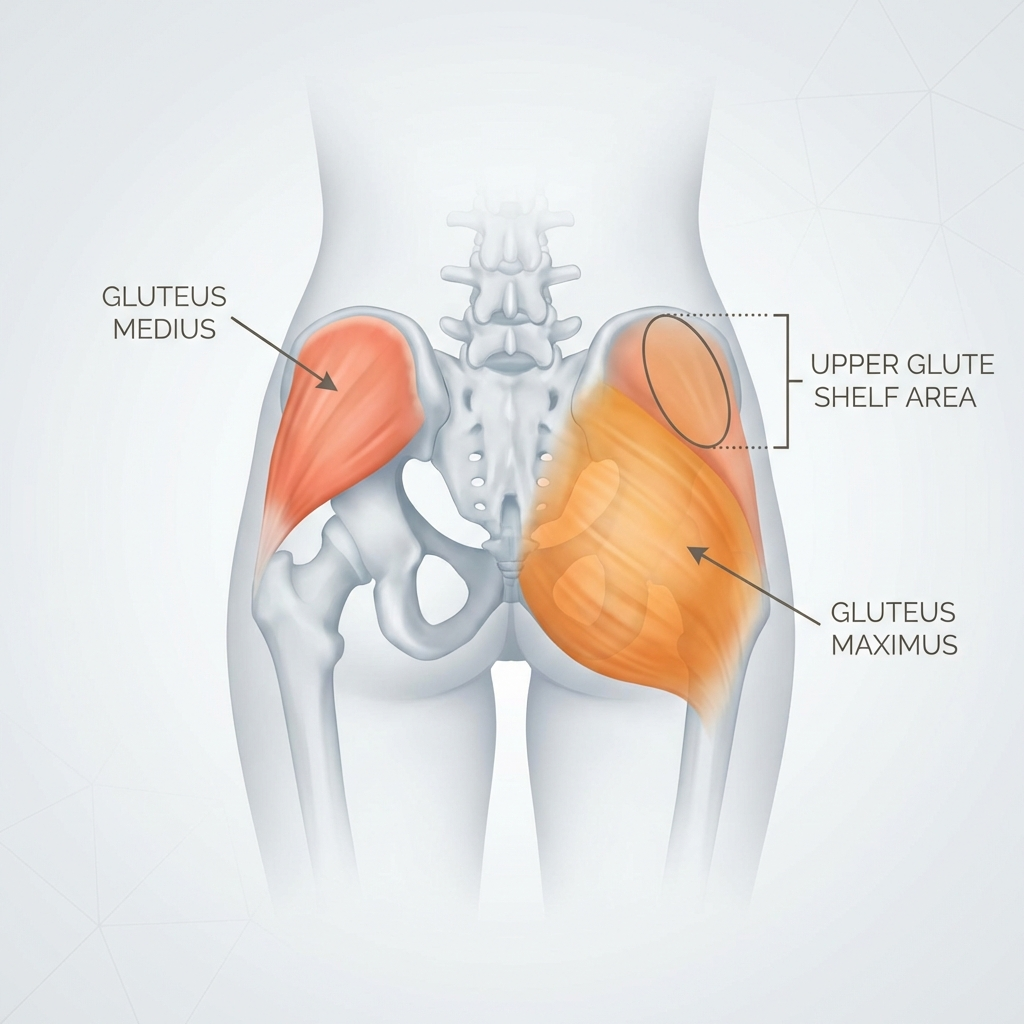
Anatomical diagram showing the gluteus medius and upper gluteus maximus highlighted, with labels indicating the upper glute shelf area
Comparison Table: Best Upper Glute Exercises
1. Hip Thrusts with Elevated Shoulders
Hip thrusts are the gold standard for glute development, and when performed with your shoulders elevated on a bench, they become even more effective for targeting the upper glutes. This exercise allows you to load heavy weight safely while maintaining constant tension on the glutes throughout the movement.
The elevated shoulder position creates a greater range of motion and emphasizes the top portion of the movement where upper glute activation peaks. As you drive through your heels and extend your hips, focus on squeezing your glutes at the top and holding for a second before lowering with control.
How to Perform
- Position your upper back against a bench with your shoulder blades at the edge
- Place a barbell or weight across your hips (use padding for comfort)
- Position feet hip-width apart, knees bent at 90 degrees at the top
- Drive through your heels, extending hips until your body forms a straight line
- Squeeze glutes hard at the top, pause, then lower with control
- Perform 3-4 sets of 8-12 reps with progressive weight increases
Pro Tips
Keep your chin tucked and core engaged throughout the movement. Avoid hyperextending your lower back at the top—the movement should come from your hips, not your spine. Based on feedback from thousands of Strong Curves app users, placing a resistance band around your knees and maintaining tension outward further activates the gluteus medius.
Pros
- Allows for heavy loading and progressive overload
- Directly targets upper glute fibers with peak contraction
- Lower injury risk compared to squats and deadlifts
- Can be performed at home or gym with various equipment
Cons
- Requires proper setup and equipment for comfort
- May cause discomfort on hip bones without adequate padding
- Learning proper form takes practice for beginners
2. Curtsy Lunges
Curtsy lunges are a game-changer for upper glute development because they combine hip extension with abduction and external rotation—the perfect recipe for targeting the gluteus medius and upper gluteus maximus. This movement creates that coveted shelf appearance by hitting the glutes from a unique angle.
The crossing motion of the back leg forces your working glute to stabilize while also contracting through a full range of motion. This exercise is particularly effective for building the rounded, lifted appearance in the upper glute region.
How to Perform
- Stand with feet hip-width apart, holding dumbbells at your sides
- Step your right leg back and across your body, as if curtsying
- Lower down until your front thigh is parallel to the ground
- Drive through your front heel, squeezing your glute to return to standing
- Complete all reps on one side before switching
- Perform 3 sets of 10-15 reps per leg
Pro Tips
Keep your front knee tracking over your toes and your chest upright throughout the movement. The deeper you can go while maintaining form, the greater the stretch and activation in your upper glutes. Start with bodyweight to master the pattern before adding resistance.
Pros
- Specifically targets gluteus medius and upper glute fibers
- Improves hip mobility and stability
- Can be performed anywhere with minimal equipment
- Addresses muscle imbalances through unilateral training
Cons
- Requires good balance and coordination
- May feel awkward initially for beginners
- Can stress knees if form is incorrect
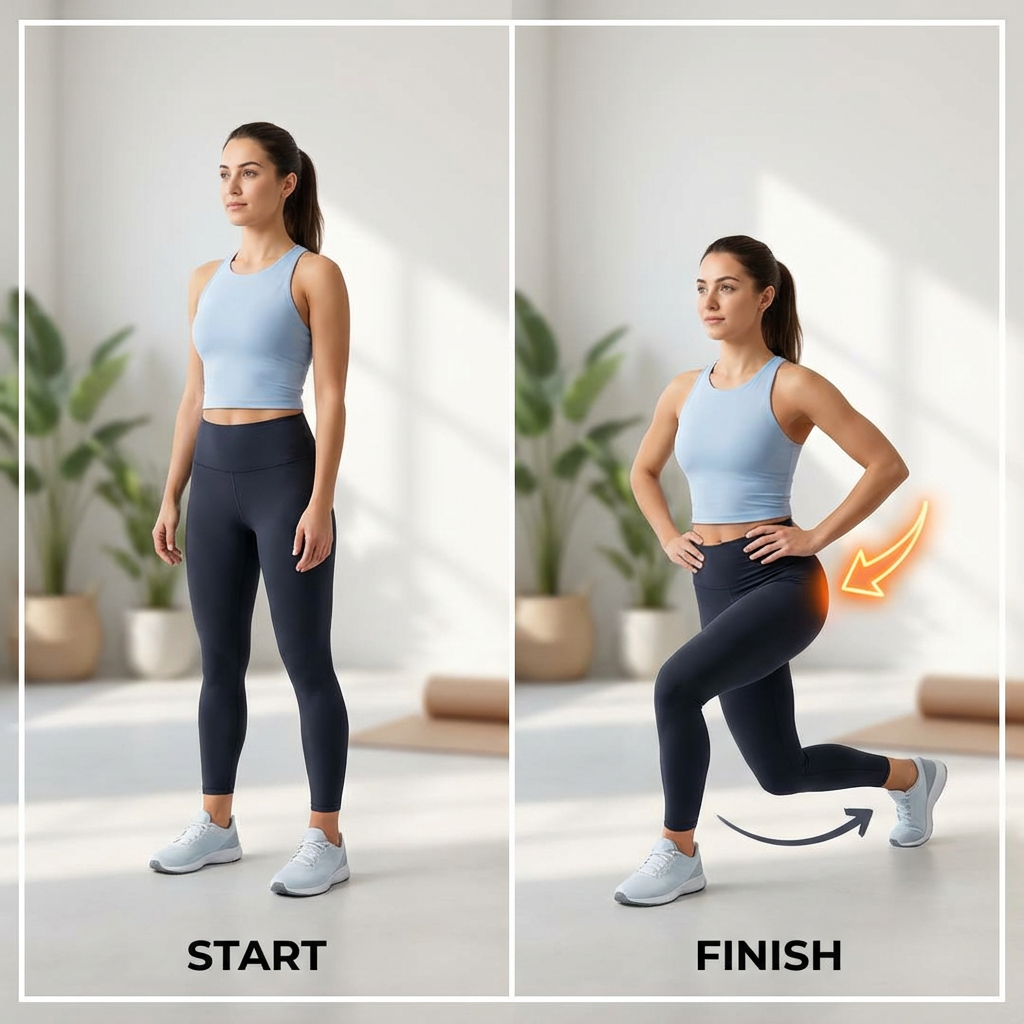
Side-by-side comparison showing proper curtsy lunge form with arrows indicating the crossing leg movement and upper glute engagement
3. Cable Pull-Throughs
Cable pull-throughs are an excellent hip hinge exercise that emphasizes the stretch and contraction of the upper glutes. The constant tension from the cable creates a unique stimulus that dumbbells and barbells can't replicate, making this one of the best upper glute exercises for developing that shelf.
The forward lean and hip hinge pattern place maximum tension on the glutes at the bottom of the movement, while the explosive hip extension targets the upper fibers. This exercise also teaches proper hip hinge mechanics, which translates to better performance in deadlifts and other compound movements.
How to Perform
- Set a cable pulley to the lowest position with a rope attachment
- Face away from the machine, holding the rope between your legs
- Walk forward to create tension, feet shoulder-width apart
- Hinge at your hips, pushing them back while keeping your back straight
- Feel the stretch in your glutes, then explosively drive hips forward
- Squeeze glutes hard at the top, then control the descent
- Perform 3-4 sets of 12-15 reps
Pros
- Constant tension throughout the entire range of motion
- Teaches proper hip hinge pattern with lower injury risk
- Excellent for upper glute stretch and activation
- Easy to adjust weight for different fitness levels
Cons
- Requires cable machine access
- May feel awkward for first-timers
- Limited by cable weight stack in some gyms
4. Single-Leg Romanian Deadlifts
Single-leg Romanian deadlifts (RDLs) are phenomenal for upper glute development because they combine hip extension with the stability demands of unilateral training. The working leg's glute must fire intensely to control the movement and maintain balance, creating exceptional upper glute activation.
This exercise addresses the common issue of strength imbalances between legs while building functional strength that translates to everyday movements. The single-leg variation forces each glute to work independently, preventing your stronger side from compensating.
How to Perform
- Stand on your right leg holding a dumbbell in your left hand
- Keep a slight bend in your standing knee
- Hinge at your hips, extending your left leg behind you for balance
- Lower the weight toward the ground while maintaining a neutral spine
- Feel the stretch in your right glute and hamstring
- Drive through your heel to return to standing, squeezing your glute
- Complete 3 sets of 8-12 reps per leg
Pro Tips
Focus on keeping your hips square to the ground rather than letting them rotate open. Your back leg is just a counterbalance—all the work should come from your standing leg's glute and hamstring. If balance is challenging, perform these near a wall or use a light touch on a stable surface.
Pros
- Exceptional upper glute and hamstring activation
- Improves balance, stability, and coordination
- Corrects strength imbalances between legs
- Functional movement pattern for daily activities
Cons
- Requires good balance and body awareness
- Challenging for beginners to master proper form
- Limited by the amount of weight you can control on one leg
5. Deficit Reverse Lunges
Deficit reverse lunges take the traditional reverse lunge and amplify upper glute activation by increasing the range of motion. Standing on a platform or step allows your working leg to drop lower, creating a deeper stretch in the upper glutes and maximizing muscle fiber recruitment.
The increased range of motion combined with the backward stepping motion places significant emphasis on the glutes over the quads, making this ideal for upper glute development. The Strong Curves glute-focused approach to functional fitness emphasizes exercises like this that prioritize posterior chain development.
How to Perform
- Stand on a 4-6 inch platform or step holding dumbbells
- Step back with your right leg, lowering until your knee nearly touches the ground
- Your front thigh should be parallel or slightly below parallel
- Drive through your front heel, focusing on glute contraction
- Return to the starting position with control
- Complete all reps on one side before switching
- Perform 3 sets of 10-12 reps per leg
Pros
- Increased range of motion for greater glute activation
- Emphasizes glutes over quads compared to forward lunges
- Safer for knees than forward lunges
- Builds unilateral strength and stability
Cons
- Requires platform or step for proper setup
- More challenging than standard reverse lunges
- May cause balance issues for beginners
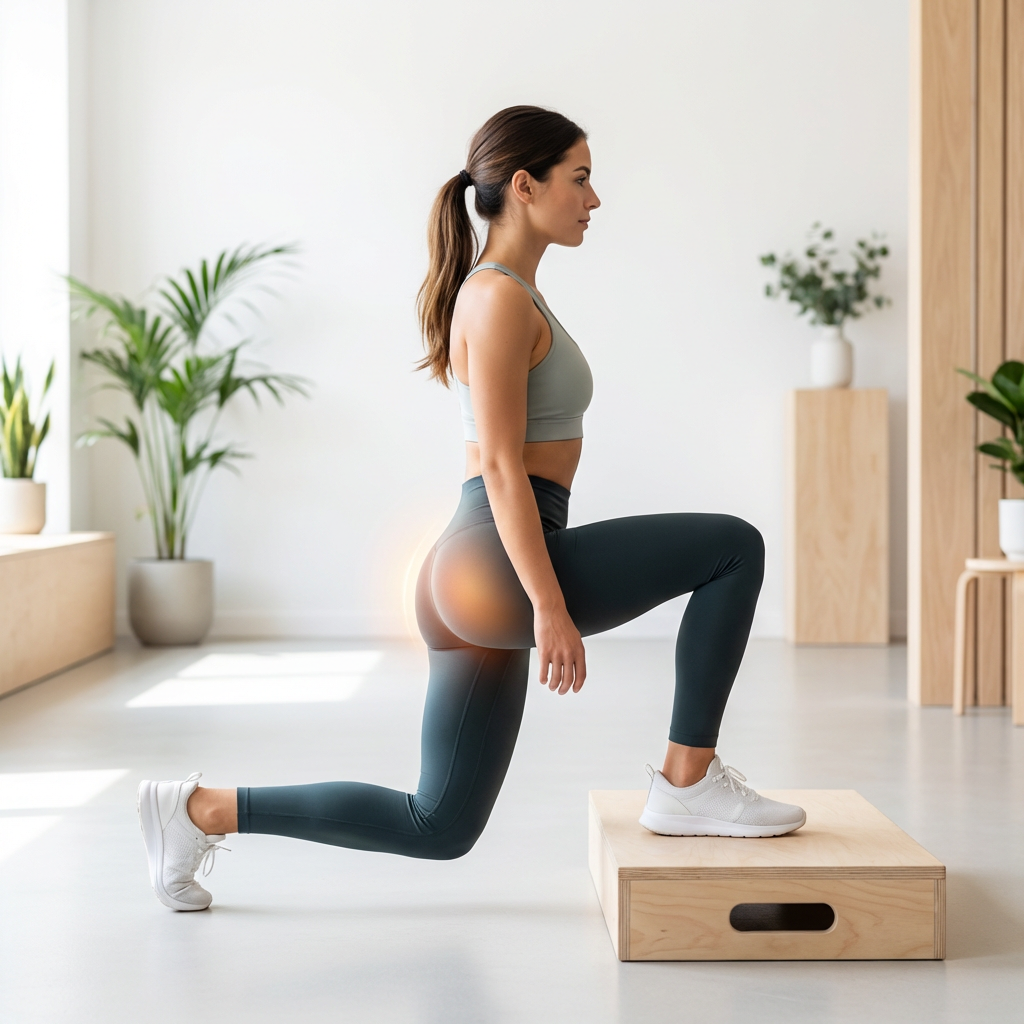
Demonstration of deficit reverse lunge showing the elevated platform position and the increased range of motion with upper glute engagement highlighted
6. Banded Lateral Walks
Don't let the simplicity of banded lateral walks fool you—this exercise is a gluteus medius powerhouse. The constant tension from the resistance band creates intense activation in the upper glutes, particularly the gluteus medius, which is crucial for creating width and that shelf appearance.
This exercise is perfect for warm-ups, burnout sets, or as part of your main workout. Banded lateral walks improve hip stability and strengthen the muscles responsible for hip abduction, directly targeting the upper glute region.
How to Perform
- Place a resistance band around your legs (above knees or around ankles)
- Stand with feet hip-width apart, creating tension in the band
- Lower into a quarter squat position
- Step laterally with your right foot, maintaining tension
- Follow with your left foot, keeping constant band tension
- Take 10-15 steps in one direction, then reverse
- Complete 3 sets of 10-15 steps each direction
Pro Tips
Keep your toes pointing forward and avoid letting your knees cave inward. The burn you feel in your upper glutes is exactly what you're looking for. For increased difficulty, use a heavier band or place it around your ankles instead of your knees.
Pros
- Directly targets gluteus medius for upper glute width
- Minimal equipment needed—just a resistance band
- Perfect for warm-ups or activation work
- Can be performed anywhere, including at home
Cons
- Limited progressive overload potential
- May feel too easy for advanced lifters as main exercise
- Requires adequate space for lateral movement
7. Bulgarian Split Squats
Bulgarian split squats are one of the most effective unilateral exercises for upper glute development. The elevated rear foot position forces your front leg's glute to work overtime, creating exceptional muscle activation and growth stimulus. This exercise builds both strength and muscle while improving balance and stability.
The forward lean and deep range of motion place maximum stretch and tension on the upper glutes, making this exercise invaluable for building that shelf. Trusted by over 50,000 women worldwide, this movement consistently delivers results when performed with proper form and progressive overload.
How to Perform
- Stand facing away from a bench with your rear foot elevated on it
- Position your front foot far enough forward for a deep lunge
- Hold dumbbells at your sides or a barbell across your back
- Lower down by bending your front knee until your thigh is parallel
- Lean slightly forward from your hips to emphasize glutes
- Drive through your front heel to return to starting position
- Complete 3-4 sets of 8-12 reps per leg
Pros
- Exceptional upper glute and quad activation
- Addresses strength imbalances between legs
- Allows for significant progressive overload
- Improves balance, stability, and coordination
Cons
- Challenging exercise that requires practice to master
- Can cause knee discomfort if form is incorrect
- Requires bench or elevated surface for rear foot
8. Frog Pumps
Frog pumps are a hidden gem for upper glute activation. This floor-based exercise might look simple, but the combination of hip abduction (knees out) and hip extension creates intense upper glute contraction. The shortened range of motion allows for high repetitions and a powerful muscle-building burn.
Frog pumps are perfect for burnout sets after heavy compound movements or as a standalone exercise for building the upper glute shelf through high-volume training. The constant tension keeps your glutes engaged throughout the entire set.
How to Perform
- Lie on your back with your feet together and knees out (frog position)
- Place your heels close to your glutes
- Optional: place a weight plate or dumbbell on your hips
- Drive through your heels, lifting your hips toward the ceiling
- Squeeze your glutes hard at the top
- Lower with control and repeat for high reps
- Perform 3-4 sets of 20-30 reps
Pro Tips
Focus on the squeeze at the top rather than range of motion. The frog position naturally emphasizes the upper glutes, so maintain that knee-out position throughout. This exercise works exceptionally well as a finisher to completely fatigue your glutes.
Pros
- Intense upper glute activation with minimal equipment
- Perfect for high-rep burnout sets
- Easy to learn with low injury risk
- Can be performed at home on a mat
Cons
- Limited progressive overload potential
- May feel awkward initially
- Not ideal as a primary strength-building exercise
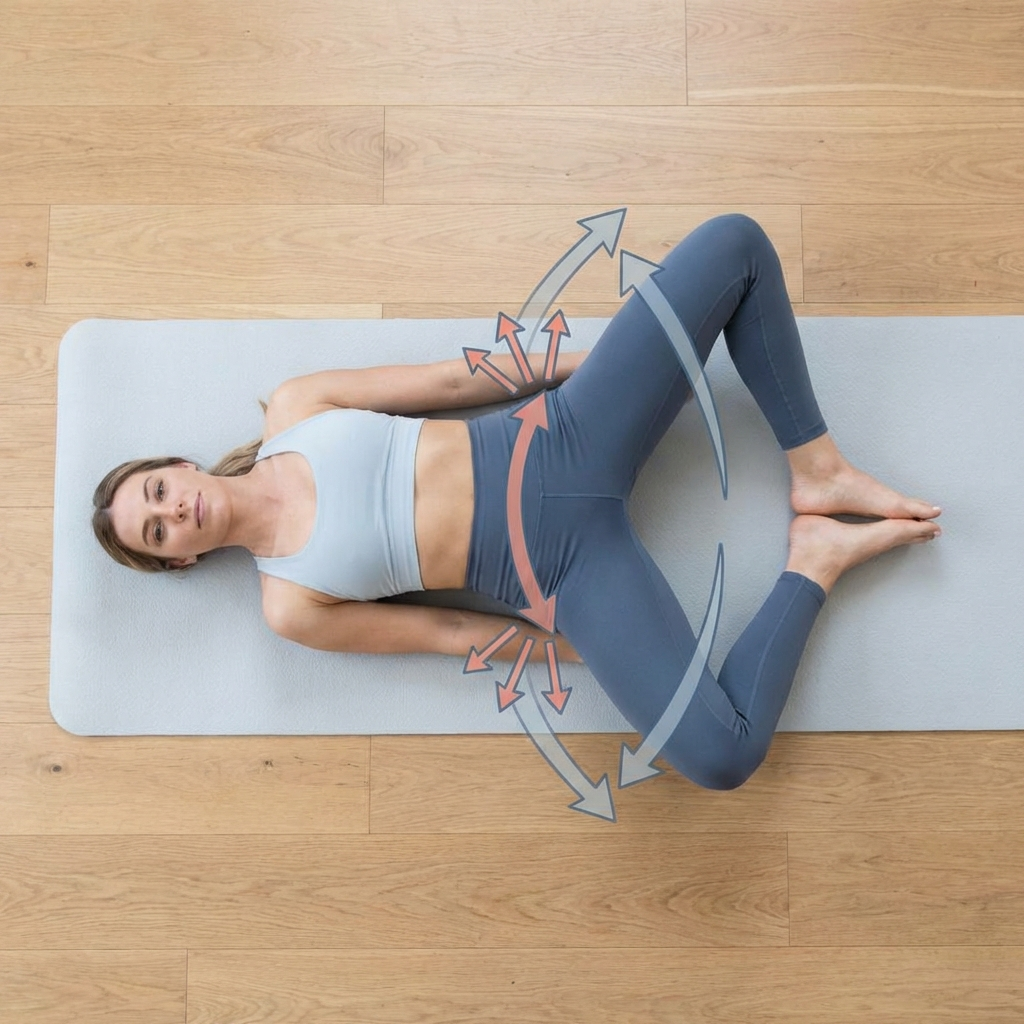
Overhead view of frog pump starting position showing the frog-leg position with arrows indicating hip thrust movement and upper glute contraction
9. Step-Ups
Step-ups are a functional, unilateral exercise that builds real-world strength while targeting the upper glutes. The stepping motion requires your glute to fire intensely to lift your body weight, and the higher the step, the greater the upper glute activation. This exercise translates directly to activities like climbing stairs and hiking.
Step-ups allow you to work each leg independently while building strength, power, and muscle in the upper glutes. The key is using a box height that creates a 90-degree angle at your hip and knee when your foot is on the platform.
How to Perform
- Stand facing a box or bench 16-24 inches high
- Place your right foot completely on the box
- Hold dumbbells at your sides for added resistance
- Drive through your right heel, lifting yourself up
- Avoid pushing off with your bottom foot—let your glute do the work
- Step down with control and repeat
- Complete 3 sets of 10-15 reps per leg
Pros
- Functional movement with real-world applications
- Excellent upper glute and quad activation
- Easy to adjust difficulty by changing box height
- Builds unilateral strength and power
Cons
- Requires sturdy box or platform
- Easy to cheat by pushing off bottom leg
- Can stress knees if box is too high initially
10. Sumo Deadlifts
Sumo deadlifts round out our list of best upper glute exercises with their unique wide stance that emphasizes the glutes and inner thighs. The wider foot position and more upright torso angle shift emphasis away from the lower back and onto the glutes, particularly the upper fibers.
This compound movement allows for heavy loading while targeting the upper glutes through hip extension and abduction, making it ideal for building overall glute mass and strength. The sumo stance also improves hip mobility and strengthens the adductors.
How to Perform
- Stand with feet wider than shoulder-width, toes pointed out 30-45 degrees
- Position a barbell over the middle of your feet
- Hinge at your hips, gripping the bar with hands inside your legs
- Keep your chest up, back straight, and core engaged
- Drive through your heels, extending hips and knees simultaneously
- Squeeze glutes hard at the top
- Lower with control and repeat for 3-4 sets of 6-10 reps
Pro Tips
Focus on pushing the floor away rather than pulling the bar up. Keep your knees tracking over your toes throughout the movement. If you don't have access to a barbell, you can perform sumo deadlifts with dumbbells or kettlebells for similar benefits.
Pros
- Allows for heavy loading and progressive overload
- Targets upper glutes, inner thighs, and posterior chain
- Less stress on lower back compared to conventional deadlifts
- Builds overall strength and power
Cons
- Requires proper form instruction to perform safely
- Needs barbell or heavy dumbbells for optimal results
- May require mobility work to achieve proper position
Creating Your Upper Glute Training Program
Now that you understand the best upper glute exercises, let's discuss how to incorporate them into an effective training program. Consistency and progressive overload are the keys to building the upper glute shelf you're working toward.
Training Frequency and Volume
For optimal upper glute development, train your glutes 2-4 times per week with at least 48 hours between sessions targeting the same muscles. Research shows that higher training frequencies lead to better muscle growth when volume is appropriately distributed.
A sample weekly split might include:
- Monday: Lower body focus with hip thrusts, Bulgarian split squats, and banded lateral walks
- Wednesday: Upper body with glute activation work (frog pumps, banded walks)
- Friday: Lower body with sumo deadlifts, curtsy lunges, and cable pull-throughs
- Sunday: Optional glute-focused session with step-ups and single-leg RDLs
Progressive Overload Strategies
To continue building your upper glutes, you must progressively challenge them. This doesn't always mean adding weight. You can progress through:
- Increasing weight lifted (most common method)
- Adding repetitions or sets
- Improving range of motion
- Slowing down the tempo (especially the eccentric phase)
- Decreasing rest periods between sets
- Using more challenging variations
Exercise Selection and Order
Structure your workouts by starting with compound movements that allow heavy loading (hip thrusts, sumo deadlifts, Bulgarian split squats), then progress to isolation exercises (curtsy lunges, banded walks), and finish with high-rep burnout movements (frog pumps). This ensures you're fresh for the most demanding exercises while still achieving complete muscle fatigue.
Common Mistakes to Avoid
Even with the best upper glute exercises, poor execution can limit your results. Avoid these common pitfalls to maximize your upper glute development.
Neglecting the Mind-Muscle Connection
Actively focusing on feeling your glutes work during each repetition dramatically improves muscle activation and growth. Don't just go through the motions—visualize your upper glutes contracting and concentrate on squeezing them throughout each movement. This intentional focus makes a significant difference in your results.
Using Too Much Weight Too Soon
Progressive overload is important, but not at the expense of proper form. Using weight that's too heavy often shifts tension away from the glutes and onto other muscles. Master the movement pattern with lighter weights first, then gradually increase resistance while maintaining perfect form.
Skipping Warm-Up and Activation
Cold, inactive glutes won't perform optimally. Spend 5-10 minutes before your workout performing glute activation exercises like banded walks, glute bridges, or clamshells. This primes your nervous system and ensures your glutes are firing properly during your working sets.
Inconsistent Training
Building the upper glute shelf requires consistent effort over months, not weeks. Training sporadically or constantly switching programs prevents you from making progress. Commit to a structured program for at least 8-12 weeks before evaluating results.
Nutrition for Glute Growth
Exercise provides the stimulus, but nutrition provides the building blocks for muscle growth. Your upper glute development depends on proper fueling.
Protein Requirements
Aim for 0.7-1 gram of protein per pound of body weight daily to support muscle recovery and growth. Distribute this protein across 3-4 meals for optimal muscle protein synthesis. Quality sources include chicken, fish, eggs, Greek yogurt, lean beef, and plant-based options like tofu and legumes.
Caloric Considerations
Building muscle requires adequate calories. If you're in a significant caloric deficit, your body won't have the resources to build new muscle tissue. For optimal glute growth, maintain a slight caloric surplus (200-300 calories above maintenance) or eat at maintenance while training hard. Learn more about nutrition for muscle building to optimize your results.
Timing and Recovery
Consume protein and carbohydrates within 2 hours post-workout to support recovery. Adequate sleep (7-9 hours nightly) is equally important—this is when your body repairs and builds muscle tissue. Chronic sleep deprivation significantly impairs muscle growth and recovery.
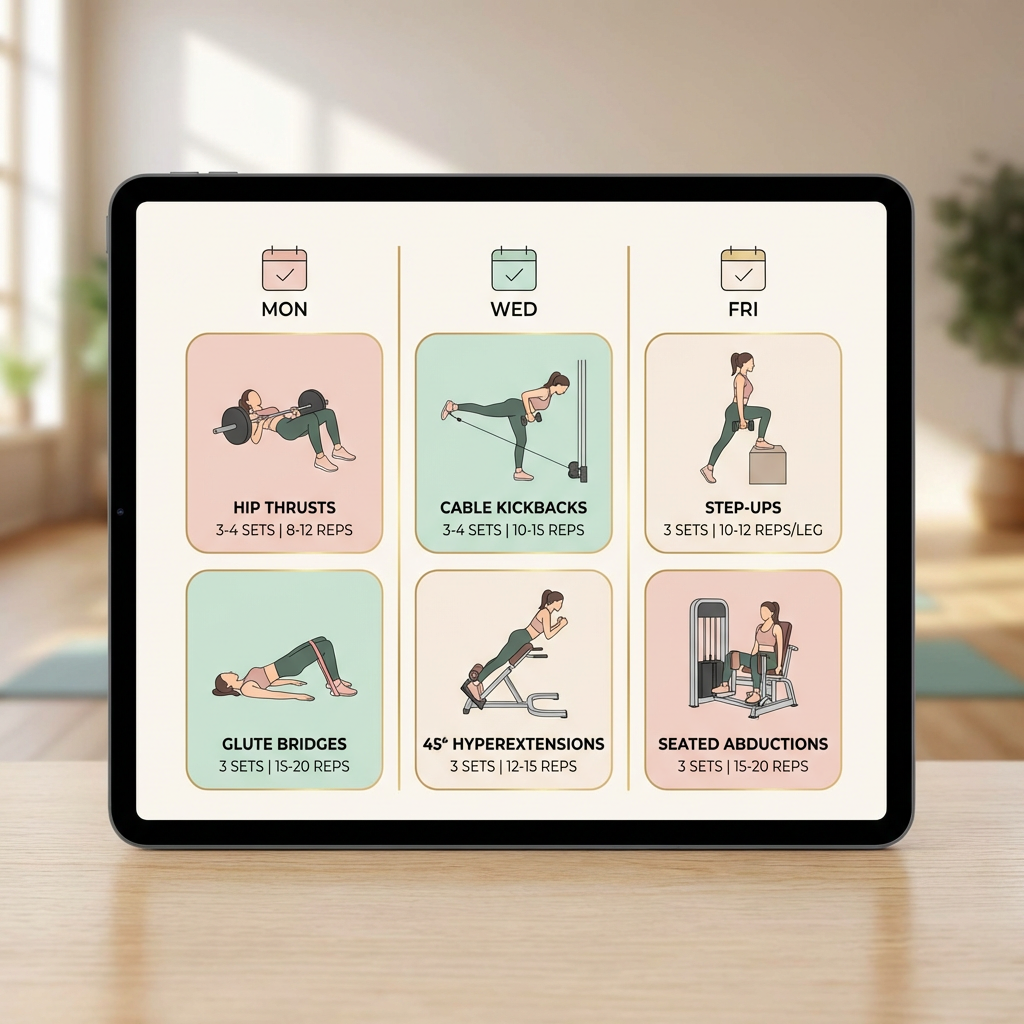
Infographic showing weekly upper glute training split with exercise examples and recommended sets and reps for each day
Which Upper Glute Exercise Is Best For You?
The best upper glute exercises for you depend on your fitness level, available equipment, and specific goals. Here's how to choose:
For Beginners
Start with exercises that are easier to learn and require minimal equipment. Focus on banded lateral walks, frog pumps, and step-ups to build foundational strength and learn proper glute activation. These movements teach you to feel your glutes working before progressing to more complex exercises.
For Intermediate Lifters
Incorporate hip thrusts, curtsy lunges, cable pull-throughs, and deficit reverse lunges into your routine. These exercises allow for progressive overload while targeting the upper glutes from multiple angles. You should be able to perform these with proper form and moderate to heavy resistance.
For Advanced Lifters
Challenge yourself with single-leg RDLs, Bulgarian split squats, and heavy sumo deadlifts. These exercises require excellent balance, coordination, and strength. Advanced lifters benefit from combining heavy compound movements with high-rep isolation work for complete upper glute development.
For Home Training
If you're training at home with limited equipment, prioritize exercises like frog pumps, banded lateral walks, curtsy lunges, step-ups, and single-leg RDLs with dumbbells. These movements deliver excellent results without requiring extensive equipment.
For Gym Training
Take advantage of gym equipment by incorporating hip thrusts with a barbell, cable pull-throughs, Bulgarian split squats, and sumo deadlifts. The variety of equipment allows for greater progressive overload and exercise variation.
For Building the Upper Glute Shelf
Focus on exercises that combine hip extension with abduction: curtsy lunges, hip thrusts with a band around your knees, banded lateral walks, and Bulgarian split squats with a forward lean. These movements specifically target the area responsible for that shelf appearance.
Frequently Asked Questions
How do you target your upper glutes?
Target your upper glutes by performing exercises that emphasize hip extension combined with abduction or external rotation. Hip thrusts, curtsy lunges, Bulgarian split squats, and banded lateral walks effectively activate the gluteus medius and upper gluteus maximus fibers. Focus on proper form with progressive overload for best results.
How to get a shelf on the upper glutes?
Build the upper glute shelf by consistently training with exercises that target the upper gluteus maximus and gluteus medius 2-4 times weekly. Prioritize hip thrusts, curtsy lunges, and deficit reverse lunges with progressive overload. Combine this with adequate protein intake and a slight caloric surplus for muscle growth over 12-16 weeks.
What are the top 3 glute exercises?
The top three glute exercises are hip thrusts for maximum glute activation and loading potential, Bulgarian split squats for unilateral strength and upper glute emphasis, and sumo deadlifts for overall posterior chain development. These compound movements allow progressive overload while targeting all glute regions effectively when performed with proper form.
What is the 888 rule for glutes?
The 888 rule for glutes involves performing 8 reps, 8 sets, with 8 seconds of tension per rep for maximum muscle growth. This high-volume approach emphasizes time under tension and metabolic stress. While effective for some lifters, most women achieve better results with varied rep ranges and traditional progressive overload methods.
How long does it take to build upper glutes?
Building noticeable upper glute development typically takes 8-16 weeks of consistent training with proper nutrition. Beginners may see results faster, while advanced lifters require more time. Training frequency, exercise selection, progressive overload, adequate protein intake, and recovery all influence the timeline for visible upper glute growth.
Can you train upper glutes every day?
Training upper glutes every day isn't recommended as muscles need 48-72 hours for recovery and growth. However, you can alternate between heavy training days and light activation work. Perform intense glute workouts 2-4 times weekly, with optional activation exercises on rest days to maintain blood flow without hindering recovery.
Do squats build upper glutes?
Traditional squats primarily target the lower and middle glutes rather than the upper glutes. While squats contribute to overall glute development, exercises like hip thrusts, curtsy lunges, and Bulgarian split squats more effectively target the upper glute region. Combine squats with upper glute-specific exercises for balanced development.
Conclusion
Building strong, sculpted upper glutes requires targeted training with the right exercises, consistent effort, and proper nutrition. The best upper glute exercises we've covered—from hip thrusts and curtsy lunges to Bulgarian split squats and cable pull-throughs—provide you with a comprehensive toolkit for developing that coveted upper glute shelf.
Remember these key takeaways as you embark on your upper glute training journey:
- Focus on exercises that combine hip extension with abduction or external rotation for maximum upper glute activation
- Train your glutes 2-4 times per week with progressive overload to stimulate continuous growth
- Prioritize proper form and mind-muscle connection over lifting heavy weight
- Support your training with adequate protein intake and proper recovery
- Be patient—building the upper glute shelf takes 8-16 weeks of consistent effort
Your journey to stronger, more sculpted upper glutes starts with taking action today. Whether you're training at home or in the gym, these exercises will help you build the strength, stability, and confidence you deserve. Ready to transform your glute training? Download the Strong Curves app for personalized workout programs designed specifically for women, complete with video demonstrations, progressive training plans, and a supportive community of over 50,000 women achieving their fitness goals. Start your journey toward stronger, more sculpted glutes today!