Best lower glute exercises target the gluteus maximus lower fibers for a lifted, sculpted appearance. The most effective include step-ups, Bulgarian split squats, deficit reverse lunges, single-leg glute bridges, and cable kickbacks. These movements emphasize hip extension and posterior pelvic tilt, activating lower glute fibers more effectively than traditional squats alone.
Best Lower Glute Exercises: Complete Guide
Are you struggling to develop that coveted lower glute definition, even though you're already doing squats and lunges? You're not alone. Many women find that while their upper glutes respond well to traditional exercises, the lower portion remains frustratingly underdeveloped. The lower glutes—the area where your glutes meet your hamstrings—require specific exercise selection and execution to truly transform.
Understanding the best lower glute exercises is essential for creating that rounded, lifted appearance that comes from balanced glute development. This comprehensive guide will walk you through the most effective movements, proper form cues, and programming strategies to finally build that lower glute shelf you've been working toward. Whether you're a beginner or advanced lifter, these exercises will help you target this often-neglected area with precision.
Created by certified trainer Shelley Darlington with 15+ years experience, this guide draws from proven training principles that have helped transform countless physiques. We'll explore why certain exercises activate the lower glutes more effectively, how to perform them correctly, and how to integrate them into your existing routine for maximum results.
Key Takeaways
- Lower glute development requires exercises that emphasize hip extension from a stretched position with posterior pelvic tilt
- Single-leg exercises and deficit movements create greater range of motion for enhanced lower glute activation
- Progressive overload with proper form is more important than exercise variety for building lower glute mass
- Combining compound movements with isolation exercises yields the best results for complete lower glute development
- Consistency with 2-3 targeted sessions weekly produces visible changes within 8-12 weeks
Understanding Lower Glute Anatomy and Function
Before diving into the best lower glute exercises, it's crucial to understand what we're actually targeting. The gluteus maximus is the largest muscle in your body, and while it functions as one unit, different fiber orientations mean certain areas can be emphasized through strategic exercise selection.
What Makes Lower Glutes Different
The lower glute fibers originate from the lower portion of the sacrum and insert into the gluteal tuberosity of the femur, creating a more horizontal fiber orientation compared to upper glute fibers. This anatomical difference means these fibers are maximally activated during hip extension when the hip starts in a flexed position, especially when combined with posterior pelvic tilt.
The lower glutes work hardest when you're driving your leg backward from a stretched position—think stepping up onto a high platform or extending your leg behind you against resistance. This is why exercises that emphasize this movement pattern are so effective for lower glute development.
Why Traditional Exercises Miss the Lower Glutes
Standard squats and deadlifts certainly work your glutes, but they don't maximally challenge the lower fibers. These exercises often emphasize the upper and mid-glute regions more because of the hip and knee angles involved. To truly target the lower shelf, you need exercises that create a deeper hip flexion starting position and emphasize hip extension through a full range of motion.
Women 35 and older focused on body recomposition often notice this imbalance first—upper glutes develop while lower glutes lag behind, creating an incomplete shape. Addressing this requires intentional exercise selection that specifically targets these lower fibers.
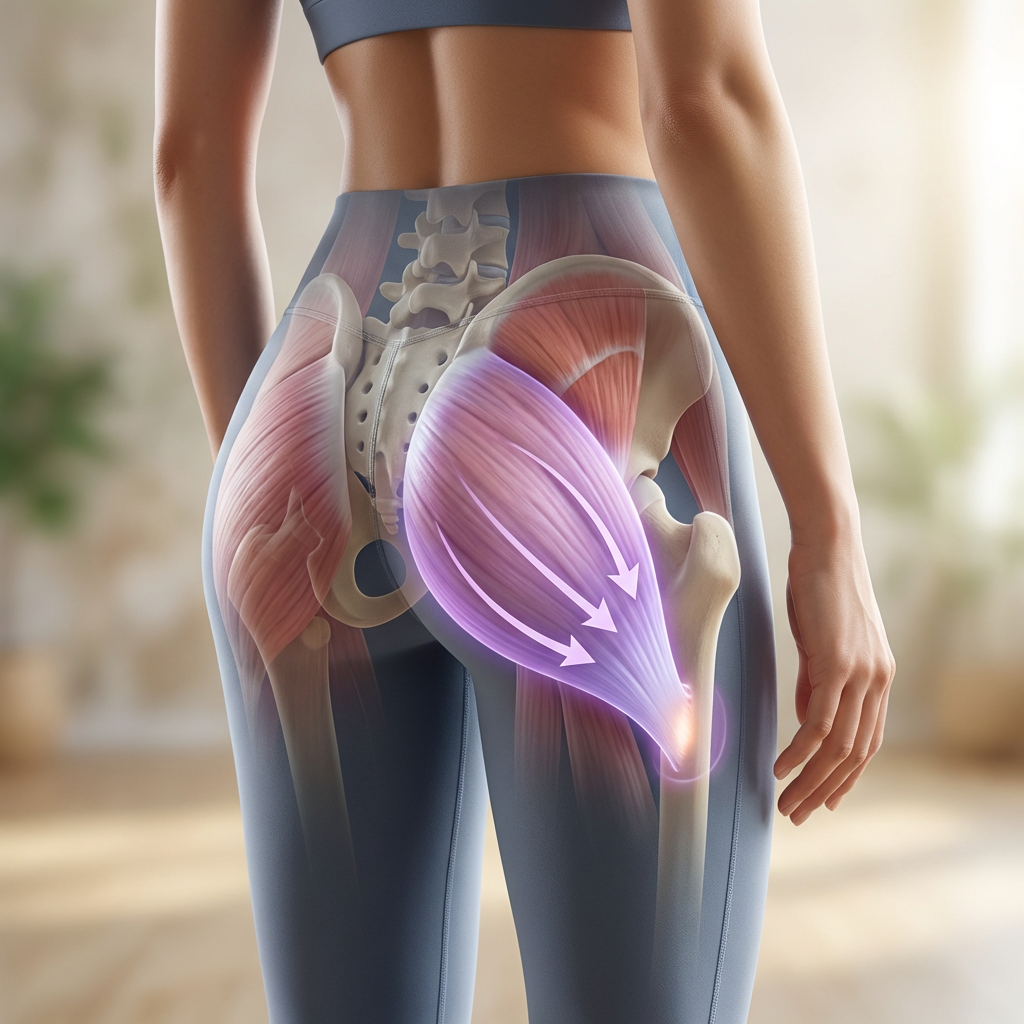
Anatomical diagram showing gluteus maximus muscle with lower fibers highlighted, indicating fiber direction and attachment points on the femur
1. Step-Ups
Step-ups are arguably the most effective lower glute builder available. This unilateral movement forces your working glute to handle your entire body weight while moving through a significant range of motion. The key is using a box height that creates at least 90 degrees of hip flexion at the bottom position.
To perform step-ups correctly, place your entire foot on the box, drive through your heel, and focus on using only your front leg to lift your body—avoid pushing off with your back foot. The eccentric lowering phase is equally important; control your descent to maximize time under tension for the lower glute fibers.
Start with bodyweight to master the movement pattern, then progress by holding dumbbells at your sides or a barbell across your back. Box heights between 16-24 inches work well for most women, but taller individuals may benefit from higher platforms. The higher the step, the greater the hip flexion and lower glute emphasis.
For optimal results, perform 3-4 sets of 8-12 reps per leg twice weekly. Focus on controlled tempo—2 seconds up, 1 second pause at the top, 3 seconds down. This tempo maximizes muscle tension and metabolic stress, both critical for hypertrophy.
Pros
- Highly functional movement that transfers to daily activities
- Unilateral training addresses strength imbalances between sides
- Minimal equipment required—just a sturdy box or bench
- Easy to progressively overload by increasing height or adding weight
Cons
- Requires good balance and coordination, challenging for beginners
- Can aggravate knee issues if form breaks down
- Takes longer to complete due to single-leg nature
2. Bulgarian Split Squats
Bulgarian split squats are a powerhouse exercise for lower glute development. By elevating your rear foot, you increase the range of motion at the front hip, creating deeper hip flexion and greater stretch on the lower glutes. This exercise also allows for significant loading while maintaining balance more easily than traditional step-ups.
Position your rear foot on a bench 12-18 inches high, with your front foot far enough forward that your knee stays behind your toes at the bottom. Descend until your front thigh is parallel to the ground or slightly below. The magic happens in that bottom position where your hip is maximally flexed—this is where lower glute fibers are stretched and then forcefully contracted during the ascent.
Many women make the mistake of keeping their torso too upright, which shifts emphasis to the quads. Instead, allow a slight forward lean from the hips to maintain tension on the glutes throughout the movement. Your shin angle and torso angle should be roughly parallel.
Based on feedback from thousands of Strong Curves app users, Bulgarian split squats consistently rank as one of the most effective exercises for building lower glute definition. Start with 3 sets of 10-15 reps per leg, progressing to 4 sets of 8-12 reps with heavier loads as you advance.
Pros
- Excellent for building strength and muscle simultaneously
- Easier to balance than step-ups due to rear foot support
- Creates significant mechanical tension on lower glutes
- Can be loaded heavily with dumbbells or barbell
Cons
- Can cause hip flexor discomfort in the rear leg
- Requires flexibility and mobility to perform correctly
- Learning curve for proper positioning and form
3. Deficit Reverse Lunges
Deficit reverse lunges take the traditional reverse lunge and amplify its lower glute activation by starting from an elevated platform. Standing on a 4-6 inch platform allows your rear leg to descend lower than ground level, increasing the range of motion and stretch on the front leg's glutes.
Step backward off the platform into a lunge position, lowering your rear knee toward the ground. The front leg stays planted on the platform throughout the movement. Focus on driving through your front heel to return to standing—this heel drive is essential for maximizing lower glute activation rather than relying on your quads.
The deficit variation is particularly valuable because it challenges your balance and stability while creating a deeper stretch position. This combination stimulates both mechanical tension and metabolic stress, two key drivers of muscle growth. The Strong Curves glute-focused approach to functional fitness emphasizes these compound movements that build strength while sculpting.
Perform 3 sets of 12-15 reps per leg with moderate weight, focusing on control rather than speed. As you become more proficient, you can increase the deficit height up to 8 inches or add more resistance through dumbbells or a barbell.
Pros
- Greater range of motion than standard lunges
- Less knee stress than forward lunges
- Improves balance and coordination
- Allows for progressive overload through deficit height or weight
Cons
- Requires a stable platform or step
- More technically demanding than basic lunges
- Can be challenging for those with balance issues
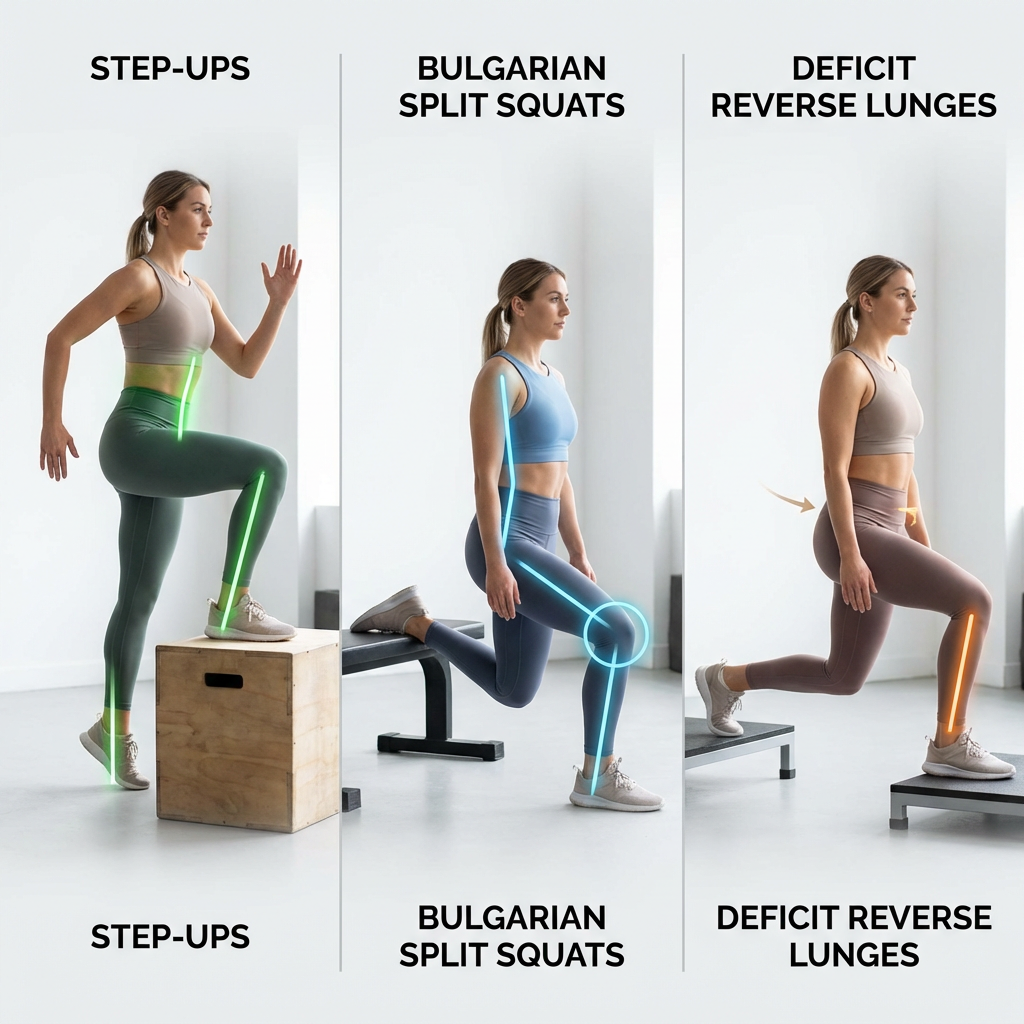
Side-by-side comparison images showing proper form for step-ups, Bulgarian split squats, and deficit reverse lunges with form cues highlighted
4. Single-Leg Glute Bridges
Single-leg glute bridges isolate each glute individually while emphasizing the lower fibers through the hip extension pattern. Unlike bilateral bridges, the single-leg variation prevents your stronger side from compensating, ensuring balanced development and addressing any asymmetries.
Lie on your back with one foot planted firmly on the ground, knee bent at 90 degrees. Extend your other leg straight out or bend it and hold it toward your chest. Drive through your planted heel to lift your hips until your body forms a straight line from shoulders to knee. At the top position, squeeze your glute hard and tilt your pelvis posteriorly—this posterior tilt is crucial for maximizing lower glute fiber activation.
The beauty of this exercise is its scalability. Beginners can start with bodyweight, focusing on mastering the mind-muscle connection. As you progress, place a dumbbell or barbell across your hips for added resistance. You can also elevate your shoulders on a bench to increase the range of motion, creating an even greater stretch and contraction.
For hypertrophy, perform 3-4 sets of 12-20 reps per leg. Use a controlled tempo with a 2-3 second hold at the top of each rep to maximize time under tension. This higher rep range works exceptionally well for glute development because of the muscle's fiber type composition.
Pros
- Excellent mind-muscle connection for glute activation
- Low impact and safe for those with back issues
- Easy to perform at home with minimal equipment
- Highly effective for correcting strength imbalances
Cons
- Limited loading potential compared to bilateral exercises
- Can cause hamstring cramping if form is incorrect
- May feel awkward initially for beginners
5. Cable Kickbacks
Cable kickbacks provide constant tension throughout the entire range of motion, making them ideal for isolating the lower glutes. Unlike free weight exercises where tension varies based on leverage, cables maintain consistent resistance, creating a powerful stimulus for muscle growth.
Attach an ankle strap to a low cable pulley and secure it around your ankle. Face the machine and hold onto it for support. With a slight forward lean from your hips, extend your leg straight behind you, focusing on driving your heel backward and upward. The key is to maintain a posterior pelvic tilt throughout the movement—imagine tucking your tailbone under as you kick back—to maximize lower glute activation.
Many women make the mistake of arching their lower back during this exercise, which shifts tension away from the glutes. Keep your core engaged and your spine neutral. The movement should come purely from hip extension, not spinal extension.
Perform 3 sets of 15-20 reps per leg as a finishing exercise after your compound movements. The higher rep range works well here because cables allow for a strong contraction without excessive joint stress. You can also experiment with different foot positions—toes pointed down emphasizes lower glutes more than toes pointed forward.
Pros
- Constant tension throughout entire range of motion
- Excellent for developing mind-muscle connection
- Easy to adjust resistance incrementally
- Great finishing exercise for metabolic stress
Cons
- Requires cable machine access
- Limited loading compared to compound exercises
- Easy to compensate with lower back if form breaks down
6. Curtsy Lunges
Curtsy lunges add a unique diagonal movement pattern that targets the lower glutes from a different angle than traditional exercises. The crossing motion creates additional glute medius activation while still emphasizing the lower gluteus maximus fibers through hip extension.
From a standing position, step one leg diagonally behind you, crossing behind your front leg as if performing a curtsy. Lower your hips until your front thigh is parallel to the ground. The front leg does most of the work, with the glute extending the hip to return to standing. Focus on sitting back into your front hip and driving through your front heel to stand—this ensures your glutes, not your quads, are doing the work.
The crossing angle creates a slight abduction component that hits the lower outer glute fibers particularly well. This area is crucial for creating that rounded, lifted appearance from all angles. Keep your chest upright and core engaged to prevent twisting through your spine.
Start with bodyweight for 3 sets of 12-15 reps per leg, then progress to holding dumbbells at your sides. This exercise pairs exceptionally well with traditional lunges or squats in a superset format, allowing you to target glutes from multiple angles within the same workout.
Pros
- Targets glutes from a unique angle for complete development
- Improves hip mobility and stability
- Engages glute medius in addition to lower glute fibers
- Functional movement that enhances lateral stability
Cons
- Requires good hip mobility and balance
- Can stress the knee if alignment is poor
- Awkward movement pattern for some individuals
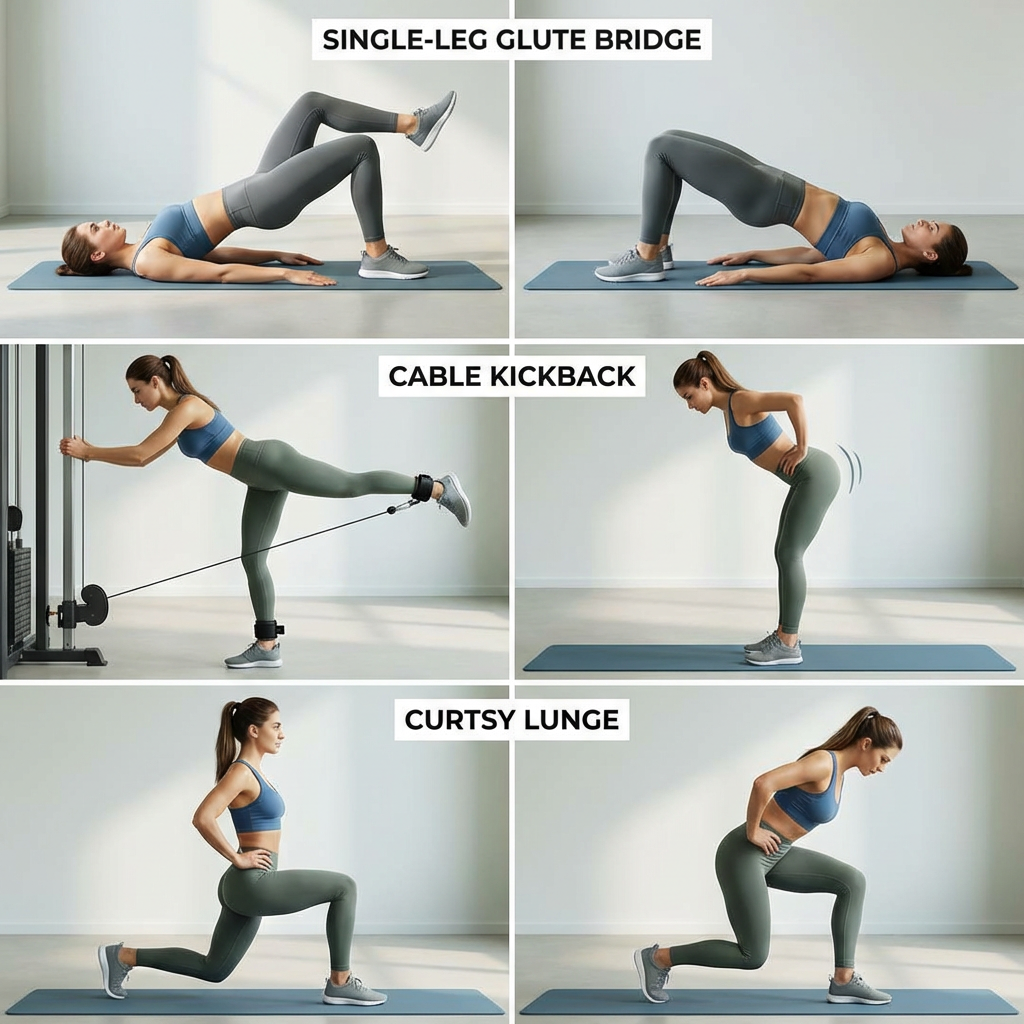
Demonstration images showing single-leg glute bridge, cable kickback, and curtsy lunge with proper form and common mistakes to avoid
7. Barbell Hip Thrusts (Elevated Feet Variation)
While standard barbell hip thrusts are excellent for overall glute development, the elevated feet variation shifts emphasis toward the lower glutes. By placing your feet on a small platform or weight plates (4-6 inches high), you increase the range of motion and create a deeper stretch position at the bottom.
Set up with your upper back against a bench and your feet elevated on platforms, hip-width apart. Place a barbell across your hips (use a pad for comfort). Drive through your heels to lift your hips until your thighs are parallel to the ground. At the top, squeeze your glutes maximally and ensure your ribs stay down—avoid hyperextending your lower back, as this reduces glute activation.
The elevated foot position forces your glutes to work through a greater range of motion, particularly emphasizing the stretch and contraction of the lower fibers. This variation also reduces quad involvement compared to standard hip thrusts, making it more glute-dominant.
Trusted by over 50,000 women worldwide, this exercise variation consistently delivers results when performed with proper form and progressive overload. Work up to 3-4 sets of 8-12 reps with challenging weight, resting 2-3 minutes between sets to allow for full recovery.
Pros
- Allows for very heavy loading safely
- Greater range of motion than standard hip thrusts
- Highly effective for building lower glute mass
- Easy to track progressive overload
Cons
- Requires specific setup with bench and platforms
- Can be intimidating in busy gym settings
- May cause discomfort across hips despite padding
8. Stiff-Legged Deadlifts (Deficit)
Deficit stiff-legged deadlifts emphasize the stretched position of the glutes and hamstrings, creating significant tension on the lower glute fibers. Standing on a 2-4 inch platform allows the weight to descend below your feet, increasing the range of motion and stretch.
Stand on a platform with feet hip-width apart, holding a barbell or dumbbells. With a slight bend in your knees (not locked), hinge at your hips and lower the weight along your legs until you feel a strong stretch in your hamstrings and glutes. The stretch position is where lower glutes are maximally loaded—control the descent and feel the tension build before driving your hips forward to return to standing.
This exercise differs from Romanian deadlifts in that the knees remain more extended throughout, shifting emphasis from hamstrings to the glute-hamstring junction—exactly where your lower glutes are. Maintain a neutral spine and avoid rounding your lower back by only descending as far as your flexibility allows.
Perform 3-4 sets of 8-12 reps with moderate to heavy weight. This exercise responds well to progressive overload, so gradually increase the weight as your strength improves. Include this movement early in your workout when you're fresh, as it requires significant concentration to maintain proper form.
Pros
- Excellent for building strength in the stretched position
- Targets glute-hamstring tie-in effectively
- Allows for significant loading
- Improves posterior chain flexibility
Cons
- Requires good hamstring flexibility
- High risk of lower back strain with poor form
- Not suitable for those with lower back issues
9. Walking Lunges
Walking lunges combine the benefits of traditional lunges with continuous movement, creating sustained tension on the glutes throughout the entire set. The forward momentum and alternating leg pattern challenge your balance while ensuring both glutes work equally.
Take a large step forward and lower your back knee toward the ground until your front thigh is parallel to the floor. Push through your front heel to bring your back leg forward into the next lunge. The key for lower glute activation is to take longer steps—this increases hip flexion in the front leg and creates a greater stretch on the glutes at the bottom position.
Walking lunges are particularly effective because they eliminate the rest period between reps that occurs with stationary lunges. This continuous tension creates significant metabolic stress, a key factor in muscle hypertrophy. The dynamic nature also improves functional strength and coordination.
Perform 3 sets of 20-30 total steps (10-15 per leg) with bodyweight or light dumbbells. Focus on controlled movement rather than speed. You can perform these in a straight line down a hallway or outdoor space, or in a circular pattern if space is limited. As you advance, increase the weight or add a deficit by stepping onto low platforms.
Pros
- Highly functional movement pattern
- Continuous tension maximizes metabolic stress
- Improves balance and coordination
- Can be performed anywhere with minimal equipment
Cons
- Requires significant space
- Can be fatiguing, limiting load capacity
- Challenging for those with balance issues
10. Reverse Hyperextensions
Reverse hyperextensions isolate the glutes and hamstrings while minimizing lower back involvement, making them ideal for targeting lower glutes without spinal stress. This exercise emphasizes hip extension from a stretched position, perfectly aligned with lower glute fiber function.
Lie face down on a reverse hyperextension machine, bench, or stability ball with your hips at the edge and legs hanging down. Keeping your legs relatively straight, lift them upward by contracting your glutes until your body forms a straight line. At the top of the movement, squeeze your glutes hard and focus on posterior pelvic tilt—this ensures maximum lower glute activation rather than lower back extension.
If you don't have access to a reverse hyperextension machine, you can perform this exercise on a regular bench or even lying face down on a stability ball. The key is achieving that full range of motion from a stretched position to full hip extension with glute contraction.
Perform 3 sets of 15-20 reps, focusing on controlled tempo and peak contraction. You can add resistance by holding a dumbbell between your feet or wearing ankle weights. This exercise works exceptionally well as a finisher after your main compound movements, creating a powerful pump and metabolic stress.
Pros
- Minimal lower back stress compared to other extensions
- Excellent isolation of glutes and hamstrings
- Can be performed with various equipment options
- Great for developing mind-muscle connection
Cons
- Requires specific equipment or creative setup
- Limited loading potential
- Can cause hamstring cramping if form is incorrect
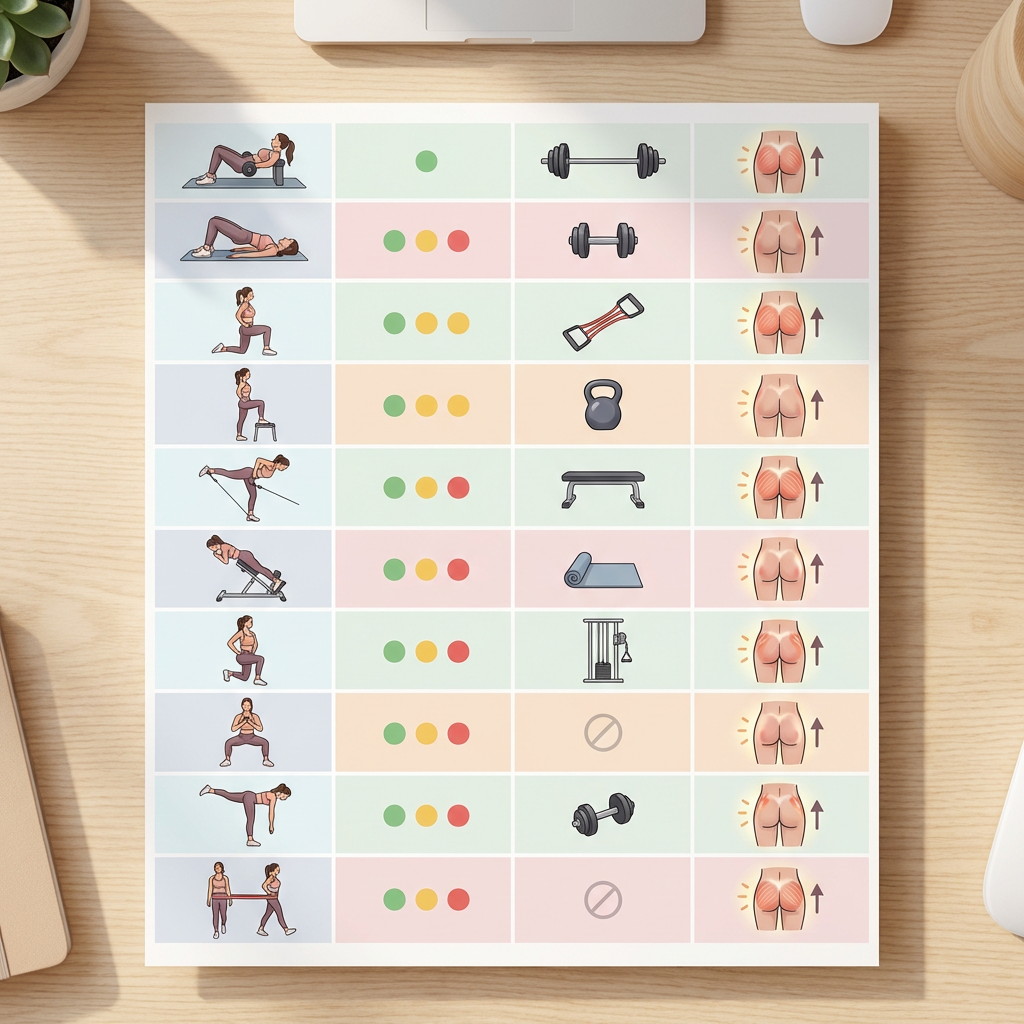
Comparison table infographic showing all 10 exercises with difficulty level, equipment needed, and primary benefits for lower glute development
How to Program the Best Lower Glute Exercises
Knowing the best lower glute exercises is only half the equation—programming them effectively is what delivers results. Your training frequency, volume, and exercise selection need to be strategically planned to maximize lower glute development while allowing for adequate recovery.
Training Frequency and Volume
For optimal lower glute development, train glutes 2-3 times per week with at least 48 hours between sessions targeting the same muscle group. This frequency allows for sufficient stimulus while providing recovery time for growth. Each session should include 12-20 total sets for glutes, with 6-12 sets specifically targeting lower glute emphasis exercises.
Structure your weekly training with one heavy day (6-10 reps), one moderate day (10-15 reps), and optionally one high-rep day (15-25 reps). This varied rep scheme targets different muscle fiber types and creates multiple growth stimuli. Learn more about progressive overload strategies for glute development to ensure continuous improvement.
Exercise Selection and Order
Begin each session with compound movements when you're fresh and can lift heaviest. Step-ups, Bulgarian split squats, or deficit stiff-legged deadlifts should come first. Follow with moderate-load exercises like walking lunges or barbell hip thrusts, then finish with isolation movements like cable kickbacks or single-leg glute bridges.
Don't try to do all ten exercises in one workout. Select 3-4 exercises per session, ensuring you're hitting different movement patterns. For example, pair a step-up (vertical loading) with a hip thrust variation (horizontal loading) and finish with cable kickbacks (isolation). This combination provides comprehensive lower glute stimulation from multiple angles.
Progressive Overload Strategies
Progressive overload is non-negotiable for building muscle. Track your workouts and aim to increase either weight, reps, or sets every 1-2 weeks. For compound movements, focus on adding weight. For isolation exercises, increasing reps or time under tension often works better than adding resistance.
- Week 1-2: Master form with moderate weight, establish baseline performance
- Week 3-4: Increase weight by 5-10% while maintaining rep range
- Week 5-6: Add 1-2 reps per set at the new weight
- Week 7-8: Increase weight again or add an additional set
- Week 9-12: Continue progression, consider deload if fatigue accumulates
For more guidance on building a complete workout routine, explore comprehensive glute training programs for women that integrate these principles systematically.
Common Mistakes That Limit Lower Glute Development
Even with the best lower glute exercises in your program, certain mistakes can sabotage your progress. Understanding and avoiding these pitfalls will accelerate your results significantly.
Using Too Much Weight Too Soon
The most common mistake is prioritizing weight over form, which shifts tension away from the target muscle and increases injury risk. Your glutes can't grow if you're compensating with your quads, lower back, or momentum. Start lighter than you think necessary and focus on feeling the work in your lower glutes before adding resistance.
A properly executed Bulgarian split squat with 20-pound dumbbells will build more glute muscle than a sloppy version with 40-pound dumbbells where your quads do all the work. Master the movement pattern first, develop your mind-muscle connection, then progressively add load.
Neglecting the Eccentric Phase
The lowering portion of each exercise is just as important as the lifting phase for muscle growth. Rushing through the eccentric phase reduces time under tension and eliminates a significant growth stimulus. Control your descent for 2-3 seconds on every rep, feeling the stretch in your glutes at the bottom position.
This is particularly important for exercises like step-ups and lunges where many women simply drop down quickly. That controlled eccentric creates significant muscle damage—a key trigger for hypertrophy—while also improving your strength in the stretched position where lower glutes work hardest.
Insufficient Recovery Between Sessions
Your muscles don't grow during workouts—they grow during recovery. Training glutes intensely every day doesn't allow time for repair and adaptation. If you're constantly sore and your performance isn't improving, you're likely not recovering adequately. Ensure you're getting 7-9 hours of quality sleep and consuming adequate protein (0.8-1 gram per pound of body weight).
Additionally, consider incorporating recovery strategies and nutrition for muscle growth to optimize your results between training sessions.
The 8-8-8 Rule for Glutes Explained
You may have heard about the 8-8-8 rule for glutes and wondered how it applies to your training. This principle refers to performing 8 reps, for 8 sets, with 8 exercises targeting the glutes. While this creates a high-volume approach that can be effective, it's not necessarily optimal for everyone, especially beginners.
The 8-8-8 rule works best for advanced lifters who have built a solid foundation and can recover from high training volumes. For most women focused on lower glute development, a more targeted approach with 3-4 exercises, 3-4 sets each, and varied rep ranges (6-20 reps depending on the exercise) produces better results without excessive fatigue.
If you do want to try a high-volume approach, ensure you're alternating between compound and isolation movements, varying angles and movement patterns, and allowing adequate recovery. The key is not just volume, but quality volume with proper form and progressive overload.
Building Bottom Shelf Glutes: Your Complete Strategy
Building that coveted lower glute shelf—the visible definition where your glutes meet your hamstrings—requires a comprehensive approach combining exercise selection, nutrition, and consistency. This distinctive feature comes from well-developed lower glute fibers with low enough body fat to show definition.
Training Strategy
Prioritize exercises that create maximum stretch in the bottom position followed by full hip extension with posterior pelvic tilt. The exercises listed in this guide—particularly step-ups, Bulgarian split squats, and deficit variations—should form the foundation of your program. Perform these 2-3 times weekly with progressive overload.
Combine these with adequate volume (12-20 sets per week for glutes), varied rep ranges, and sufficient recovery. Track your workouts meticulously and ensure you're getting stronger over time. Strength gains in these movements directly correlate with muscle growth in your lower glutes.
Nutrition for Glute Growth
You can't build muscle in a significant caloric deficit. To maximize lower glute development, ensure you're eating at maintenance calories or a slight surplus (200-300 calories above maintenance). Prioritize protein intake at 0.8-1 gram per pound of body weight, distributed across 3-4 meals daily.
If you're carrying excess body fat that obscures muscle definition, consider a structured approach of building phases (slight surplus to maximize muscle growth) alternated with cutting phases (moderate deficit to reduce body fat while preserving muscle). This approach yields better long-term results than trying to do both simultaneously.
Patience and Consistency
Building noticeable lower glute development takes time—typically 8-12 weeks of consistent training before you see significant changes, and 6-12 months for dramatic transformation. Progress photos every 4 weeks provide better feedback than daily mirror checks. Trust the process, stay consistent with your training and nutrition, and the results will come.
Which Lower Glute Exercise Is Best For You?
With ten excellent exercises to choose from, how do you decide which ones to prioritize? Your selection should be based on your training experience, available equipment, any physical limitations, and your specific goals.
For Beginners
Start with bodyweight step-ups, reverse lunges (without deficit initially), and single-leg glute bridges. These movements teach proper hip extension mechanics and allow you to develop a mind-muscle connection without overwhelming complexity. Focus on mastering form for 4-6 weeks before adding significant resistance.
For Intermediate Lifters
Progress to Bulgarian split squats, deficit reverse lunges, and barbell hip thrust variations as your primary movements. Add cable kickbacks and walking lunges as accessory exercises. You should be comfortable handling moderate loads and ready to push progressive overload more aggressively.
For Advanced Lifters
Incorporate all variations with heavy loading, deficit positions, and advanced techniques like tempo training or pause reps. Focus on deficit stiff-legged deadlifts, elevated foot hip thrusts, and heavily loaded Bulgarian split squats. Use isolation exercises like cable kickbacks and reverse hyperextensions for high-rep finishing work.
For Home Training
If you're training at home with limited equipment, prioritize step-ups (using stairs or a sturdy box), single-leg glute bridges, walking lunges, and curtsy lunges. These exercises require minimal equipment but deliver excellent results. Invest in a set of resistance bands to add variety and progressive overload options.
For Those With Knee Issues
Focus on hip-dominant exercises that minimize knee flexion: single-leg glute bridges, hip thrust variations, reverse hyperextensions, and cable kickbacks. Avoid deep lunging patterns initially, and work with a physical therapist to address any underlying mobility or stability issues.
Frequently Asked Questions
How do I target my lower glutes?
Target lower glutes by emphasizing hip extension from a deeply flexed position with posterior pelvic tilt. Step-ups, Bulgarian split squats, and deficit lunges create maximum stretch at the bottom, then forcefully contract lower fibers during the ascent. Focus on driving through your heels and squeezing glutes at the top of each movement.
Which exercises for lower glutes?
The most effective lower glute exercises include step-ups, Bulgarian split squats, deficit reverse lunges, single-leg glute bridges, and cable kickbacks. These movements emphasize hip extension from stretched positions while maintaining posterior pelvic tilt. Perform 3-4 sets of 8-15 reps twice weekly with progressive overload for optimal results.
What is the 8 8 8 rule for glutes?
The 8-8-8 rule involves performing 8 reps, for 8 sets, of 8 different glute exercises in one session. This high-volume approach works best for advanced lifters with strong recovery capacity. Most women achieve better results with 3-4 exercises, 3-4 sets each, using varied rep ranges and adequate recovery between sessions.
How to build bottom shelf glutes?
Build bottom shelf glutes by prioritizing exercises with deep hip flexion and full extension: step-ups, Bulgarian split squats, and deficit stiff-legged deadlifts. Train glutes 2-3 times weekly with 12-20 total sets, progressive overload, and adequate protein intake. Visible results typically appear within 8-12 weeks of consistent training.
How long does it take to see lower glute development?
Noticeable lower glute development typically requires 8-12 weeks of consistent training with proper programming and nutrition. Beginners may see changes sooner due to newbie gains, while advanced lifters need longer. Take progress photos every 4 weeks to track changes, as daily observation makes progress harder to notice.
Can I train lower glutes every day?
Training lower glutes every day is not recommended as muscles grow during recovery, not during workouts. Train glutes 2-3 times weekly with at least 48 hours between intense sessions. This frequency provides sufficient stimulus while allowing adequate recovery for muscle repair and growth, yielding better long-term results.
Do squats work lower glutes effectively?
Traditional squats work glutes but don't maximally target lower fibers due to hip and knee angles involved. Step-ups, lunges, and hip thrusts with proper form emphasize lower glutes more effectively. Include squats for overall lower body development, but prioritize hip-dominant exercises for specific lower glute development.
Conclusion
Developing your lower glutes requires strategic exercise selection, proper form, and consistent progressive overload. The best lower glute exercises—step-ups, Bulgarian split squats, deficit reverse lunges, single-leg glute bridges, and cable kickbacks—all emphasize hip extension from a stretched position, targeting those lower fibers with precision.
Remember these key principles for maximum lower glute development:
- Prioritize exercises that create deep hip flexion at the start and full hip extension with posterior pelvic tilt at the finish
- Train glutes 2-3 times weekly with 12-20 total sets, allowing adequate recovery between sessions
- Focus on progressive overload—gradually increasing weight, reps, or sets over time
- Master form before adding significant resistance; quality always trumps quantity
- Support your training with adequate nutrition, especially protein intake of 0.8-1 gram per pound of body weight
Building that lower glute shelf takes time—typically 8-12 weeks for noticeable changes and 6-12 months for dramatic transformation. Stay consistent, trust the process, and track your progress with photos and performance metrics rather than relying solely on the mirror.
Ready to transform your glutes with a structured, science-backed program? The Strong Curves app provides complete workout plans specifically designed for women focused on glute development and body recomposition. Access progressive training programs, exercise demonstrations, and a supportive community of women on the same journey. Download the Strong Curves app today and start building the strong, sculpted glutes you've been working toward.
What lower glute exercises have worked best for you? Share your experience in the comments below and let's build a stronger community together!